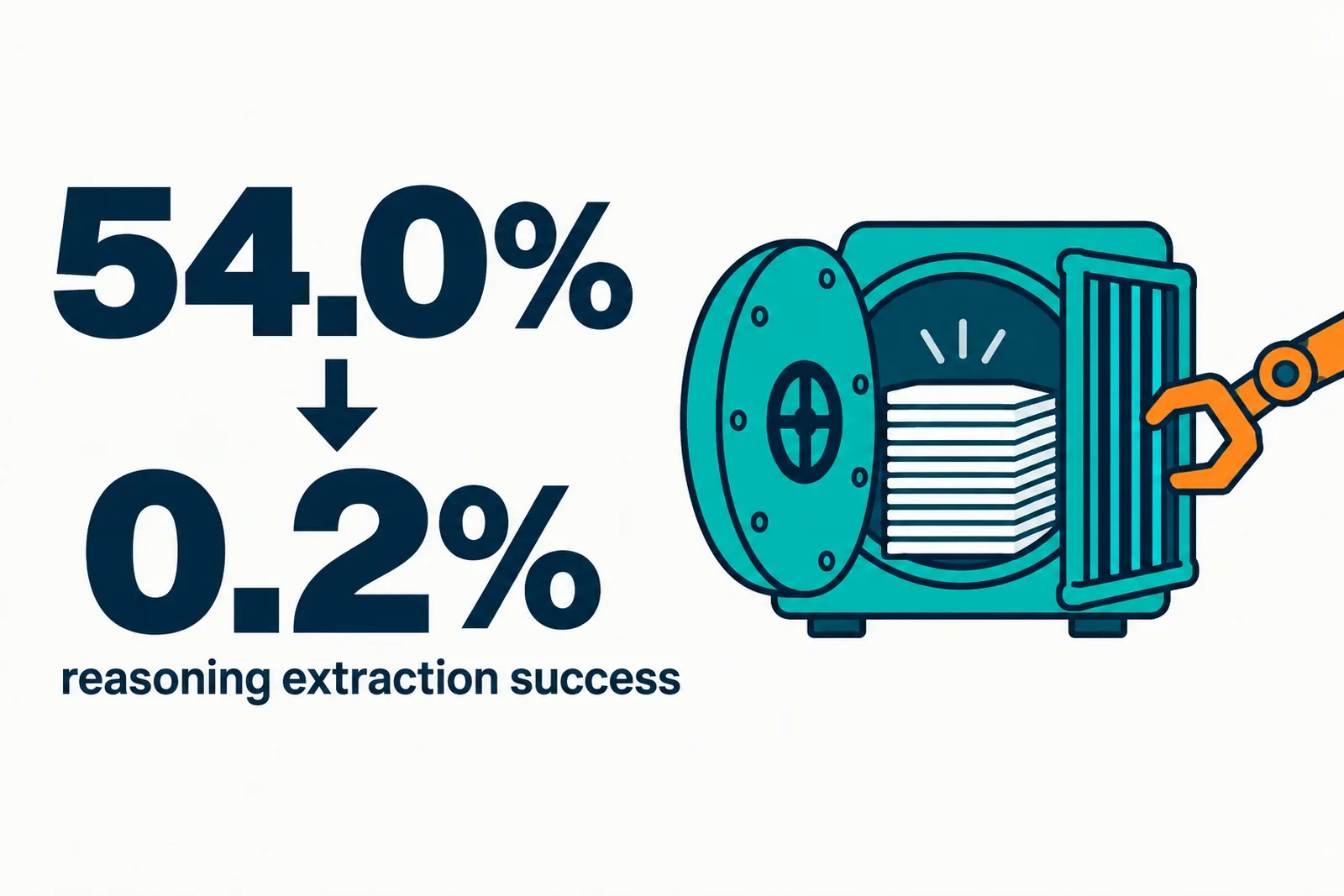
OpenAI says it has nearly closed the door on attacks that copy its models’ hidden reasoning. In research announced on X at 19:33 UTC on November 20, 2026, the company said: “Distillation can reproduce powerful AI capabilities without the safeguards built around them.” Its post reports that adaptive attacks extracting protected reasoning from an earlier request now succeed 0.2% of the time on GPT-6.2 Astra, against 54.0% on GPT-6 Astra with its original safeguards.
We did not open openai.com for this record. The figures below come from OpenAI’s X post and two named reports of the post, by Unite.ai and MLQ.ai, which agree on every number we use.
 OpenAI said on November 20, 2026 that adaptive attacks extracting protected reasoning from an earlier request succeed 0.2% of the time on GPT-6.2 Astra, down from 54.0% on GPT-6 Astra.
 For the current request, the same test fell from 22.9% to 0.9%. Both figures come from OpenAI’s own red-teaming across six attacker models.
 In an internal study, a student model trained on exact reasoning traces generally beat one trained on summaries on cyber tasks, which is why OpenAI guards the traces.
 In the API, GPT-6.2 Astra and Sol tie protected reasoning to the conversation that produced it, and older model families cannot read it.
 OpenAI says weekly enforcement reaches thousands to tens of thousands of accounts, and names DeepSeek and individuals associated with Moonshot AI in earlier findings.
§ 01The numbers OpenAI reports
| Attack | GPT-6 Astra, original safeguards | GPT-6.2 Astra, updated safeguards |
|---|---|---|
| Extract reasoning from an earlier request | 54.0% | 0.2% |
| Extract reasoning from the current request | 22.9% | 0.9% |
The red-teamers were automated and adaptive: they changed approach as the system responded and saw only what an outside user would see, according to both reports.

§ 02Why the traces matter
OpenAI trained the same pretrained student model two ways on Astra-level teacher trajectories from coding and defensive security tasks: once on exact reasoning traces, once on what users see (final answers, reasoning summaries and tool interactions). After supervised fine-tuning, the exact-trace student generally did better. After a light round of reinforcement learning, it still scored higher at the largest inference budget on ExploitBench and SEC-bench Pro, while the summary-trained student did better at lower budgets.
That is the case for hiding the traces: they carry skills the final answer does not, and those skills can transfer.
§ 03What changed
| Level | Defense |
|---|---|
| Model | Trained to recognize extraction attempts and refuse to reveal protected reasoning |
| Request | Input classifiers for extraction attempts; output classifiers on messages and tool-call arguments |
| API | Reasoning tied to its conversation; rewriting an earlier message drops what followed |
| API | Older model families cannot read GPT-6.2 reasoning; a path to another user’s encrypted reasoning was closed |
| Campaign | Account-network investigations, enforcement, and indicators shared with other providers |
OpenAI says weekly enforcement against distillation campaigns has ranged from thousands to tens of thousands of accounts this year, rising sharply over the summer. It names DeepSeek, which it briefed Congress about in February, and individuals associated with Moonshot AI, the subject of its earlier report. It says it will share more about recent campaigns soon.
§ 04What the numbers leave out
- Self-reported. Every figure comes from OpenAI’s internal testing. No outside group has reproduced it yet.
- Benchmark scores. The reports give the direction of the study results, not the scores themselves.
- Older models. GPT-6 Astra gets only selected improvements, so its exposure is not described by the 0.2% figure.
Anthropic published its own version in October, saying its changes cut what reasoning distillers extract by 10 to 100 times (our record). Two labs have now put numbers on the same fight; both sets are their own.
§ 05Sources
- OpenAI on X, 19:33 UTC, November 20, 2026
- OpenAI, Combatting adversarial distillation, November 20, 2026 (linked, not read by us)
- Unite.ai, OpenAI Strengthens GPT-6.2 Astra Against Reasoning Extraction, November 20, 2026
- MLQ.ai, OpenAI says it has cut attacks that extract its models’ hidden reasoning to under 1%, November 20, 2026
Q1What is adversarial distillation?
Using a frontier model’s outputs without permission to train another model. OpenAI’s concern is that the copy can inherit capabilities without the safeguards of the original.
Q2Why does hidden reasoning matter so much?
OpenAI’s study found that exact reasoning traces taught a student model more than the summaries users see, on coding and defensive security tasks. The traces carry steps the final answer leaves out.
Q3Does this change anything for developers?
On GPT-6.2 Astra and Sol, rewriting an earlier message drops the protected reasoning that followed it, and that reasoning cannot be passed to older model families.
Q4Does this affect CellCog?
Not directly. CellCog’s Core lanes run on Anthropic’s Claude Opus 5.5 and its Max lanes on Fable 5.2; none route to OpenAI models.