Anthropic published a long engineering post on November 6, 2026, on how it gives Claude memory that lasts between sessions. The centrepiece is a process Anthropic calls dreaming: offline time in which Claude rereads its own logs, corrects notes that turned out to be wrong, builds linked wiki pages, and decides which few notes get loaded into every future session.
The most useful line in it is a design rule, not a benchmark: “We’ve found that it helps to tell Claude what memory is for, but not how to use it.” Strong models did worse when Anthropic told them exactly what to write down.
On this page · 10 sectionsOpen
 Anthropic published The components of agent memory on November 6, 2026, describing how Claude keeps knowledge between sessions as files.
 Dreaming is offline time in which Claude rereads its logs to fix wrong notes, write new ones, build wikis and choose what loads next time.
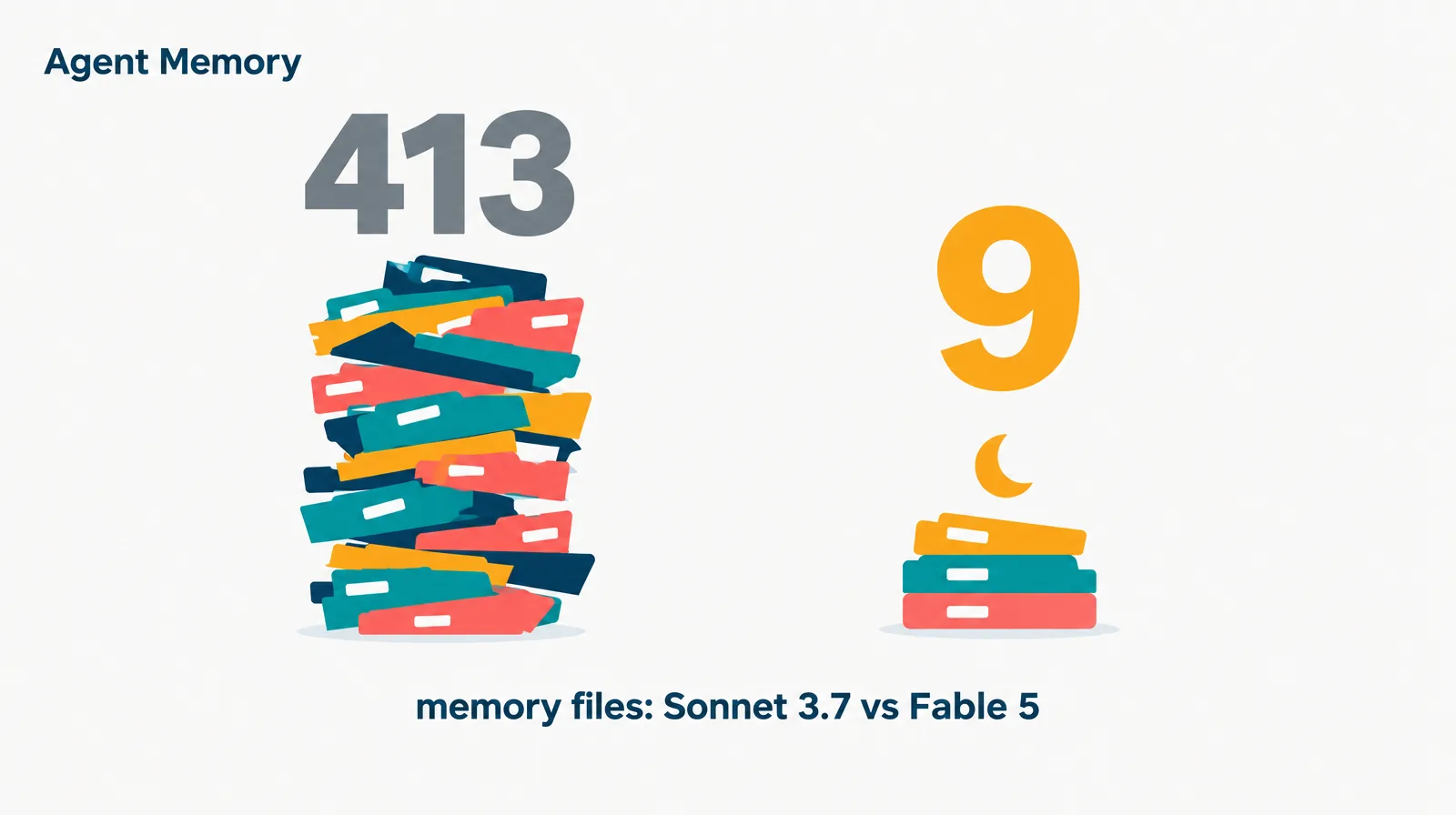
 At about 10,000 steps of Pokemon Red, Sonnet 3.7 kept 413 memory files and won one badge; Fable 5 kept nine files plus one dashboard and won four.
 A wiki built over 128 dreaming sessions raised scores on 25 company questions from 13% to 48%; search plus wiki reached 61% vs 53% for search alone.
 Telling strong models to record only failures weakened them; Anthropic’s rule is to say what memory is for, not how to use it.
 The always-loaded memory layer must stay small; Claude Code loads only the first 200 lines or 25 KB of MEMORY.md as an index.
§ 01What Anthropic means by memory
Anthropic separates memory, knowledge Claude keeps between sessions as files it can read later, from weight changes, in-context learning and compaction. The post frames each note as a bet on the future: “Memory is, occasionally, a prediction. By writing down a rule, an agent predicts that the pattern it’s describing will be relevant again.”
It then splits the work in two, borrowing from how human sleep consolidates memory:
- Writing in the moment. During a session, Claude tags salient events and writes notes to a memory folder.
- Dreaming afterwards. Between sessions, Claude reflects on its logs to fix mistakes, write new notes, build representations such as wikis, and shape what is loaded next time. Anthropic credits the idea of sleep-time compute to researchers at Letta and UC Berkeley.
§ 02Newer models write less, and better
Two tests show the change across model generations.
On the CL-Bench 1.0 database task, each question started in a fresh session with only a persistent memory folder. Sonnet 4.6 left scattered, untested guesses. Opus 4.7 consolidated one reference file. “Claude Opus 5 was the first of these models to close the loop”, writing rules with how it knew they were true, plus warnings about traps. Opus 5.5 and Sonnet 5.5 closed the loop too.
In Pokémon Red, the gap was about judgment. At about 10,000 steps, “Sonnet 3.7 wrote 413 memory files across 225 folders and earned one badge.” Fable 5 “wrote nine files in two folders, plus a single top-level file called global.md, and earned four badges.” Sonnet 3.7 kept recording things the screen already showed, like money and map position, and spent turns maintaining notes instead of playing. Opus 5.5 kept a small folder of goals and next steps “and beat the game.”
§ 03What dreaming changed in the tests
| Test | Setup | Result |
|---|---|---|
| Company corpus, 25 questions | Wiki built over 2 vs 128 dreaming sessions, wiki only | 13% to 48% of graded criteria |
| Company corpus, 25 questions | Search plus wiki, as the wiki grew | 54% to 61% |
| Company corpus, 25 questions | Search tool alone | 53% |
| Company corpus | Search plus wiki vs search alone | About 20,000 fewer tokens per question |
| Merger questions needing several documents | Wiki vs search alone | 87% vs 73% |
| CL-Bench, Sonnet 4.6 | Prompted to read memory and test its theories | Score nearly doubled |
| CL-Bench, Opus 5 and Opus 4.7 | Told to record only failures | Lost much of the memory gain |
| Shared contract-terms page | Several agents writing at once | 41 of 57 facts survived |
The company corpus was about 350,000 internal files, roughly 420M tokens, from Stainless, which Anthropic acquired in May. Over 128 sessions, Opus 5 agents explored the files, wrote and corrected linked wiki pages, merged duplicates and checked claims against the sources, coordinating through a shared log.
The wiki did not always help. On a legal brief task where most criteria could be found in a single document, it showed no clear gain over search. On another, the wiki grew larger than the documents themselves, which Anthropic compares to Borges’s map as large as the empire.
§ 04Dreaming fixes wrong notes
The clearest example is a mistake. In Pokémon, Claude wrote down that a landmark was on the east side of a mountain when it was on the west. Trusting the note, it walked off a one-way ledge three times, then wrote “I’m going to stop rather than keep looping.” Anthropic then ran dreaming on that memory folder: “Dreaming gives Claude a way to test its notes against the original transcripts.” Claude caught the error, rewrote the note, went back into the cave and reached the next city.
That is the case for dreaming in one run. A note written in the moment can be wrong, and a later session will trust it. The transcript is the record that lets an offline pass check it.

§ 05Keep the always-loaded layer small
Dreaming can also promote notes to the top of the memory hierarchy, the layer loaded into every session. Anthropic warns this has to be done carefully, since injected notes cost tokens and a wrong one travels into every session: “So the top layer of the memory hierarchy has to stay relatively small.” Claude Code’s own auto memory follows that rule: “It loads only the first 200 lines or 25 KB of MEMORY.md.” That header works as an index pointing to the rest.
§ 06What it means for anyone running agents
Four lessons carry over to any agent that works across many sessions:
- Give the purpose, not a checklist. Fixed rules about what to save weakened the strongest models.
- Keep the record. Dreaming only works because the transcript exists to check memory against.
- Small top layer, links below. What loads every time should be an index, not an archive.
- Several writers need structure. Many agents editing one shared page lost facts; giving each agent its own page did better, per the post.
§ 07Where CellCog fits
Our conflict, declared: we build CellCog, an AI employee platform, and our agents run on Claude Opus 5.5. The pattern Anthropic describes is close to how our AI employees already work: each one keeps memory in its own workspace, writes a handover at the end of a working session, reviews what it learned before it stops, and starts the next session from a small set of notes that point to the full records. Anthropic’s results are a useful outside check on that design, and its warning about a bloated top layer applies to us as much as anyone.
§ 08What is not established yet
- Product availability. The post describes research setups on Managed Agents and Claude Code’s auto memory; it does not announce dreaming as a general product feature.
- Cost. No figures on how much offline compute dreaming uses per session.
- Other labs. All comparisons are between Claude models.
§ 09Where to watch
- Whether dreaming ships as a feature in Claude Code or Managed Agents.
- A public release of CL-Bench and the wiki evaluations.
- How Claude Duet uses memory organized around the person it helps, which the post mentions as a goal.
§ 10Sources
- Anthropic, The components of agent memory, Engineering blog, November 6, 2026.
- @AnthropicAI on X, November 6, 2026.
- Lance Martin, post on X, November 6, 2026.
Q1When did Anthropic publish the agent memory post?
November 6, 2026, on its engineering blog, under the title The components of agent memory.
Q2Which Claude models closed the memory learning loop?
On the CL-Bench 1.0 database task, Opus 5 was the first, followed by Opus 5.5 and Sonnet 5.5. Earlier models left untested guesses or partial notes.
Q3How much did a wiki help?
On 25 questions about a 350,000-file company corpus, search plus a Claude-built wiki scored 61% vs 53% for search alone and used about 20,000 fewer tokens per question. On some legal tasks the wiki showed no clear gain.
Q4Is dreaming available as a product feature?
The post describes research setups on Managed Agents and Claude Code’s auto memory. It does not announce dreaming as a general feature.
Q5How does CellCog handle AI employee memory?
Each CellCog AI employee keeps memory and records in its own workspace, writes a handover at the end of a working session, and starts the next one from a small set of notes that point to the full records.