Every post on this blog so far has been about the product: what an AI employee is, what it costs, which model shipped this week. This one is about how CellCog is built. It is the first in an engineering series, and it starts where the company did: with a name most people misread as a pun, and with a bet that runs opposite to most of the industry.
The bet is simple to state. Foundation models are the fruit of more than eighty years of research. Harnessing them, the layer that turns a model into a system that does work, is the next battleground. The harnesses being built today are being built for today’s models. Ours was built for where this ends up.
The name is the same idea from another angle. CellCog is short for cellular cognition. Not a chip. Not a phone. Cells.
On this page · 8 sectionsOpen
- Foundation models are the fruit of more than eighty years of research: the artificial neuron in 1943, the perceptron in 1958, backpropagation in 1986, LSTM in 1997, the Transformer in 2017, ChatGPT in 2022. That layer belongs to the big labs. The layer above it, the harness, is where CellCog works.
- A harness is everything around the model: what it is asked, what it can reach, what it remembers, when it runs, who it can talk to, and what happens when it is wrong. The same model behaves like a different system under a different harness.
- Most harnesses are built for what today’s models can do. Every guardrail written around a current weakness becomes a wall when the weakness goes away. CellCog’s harness was designed for the endgame: an organization of agents that hire, onboard and manage each other.
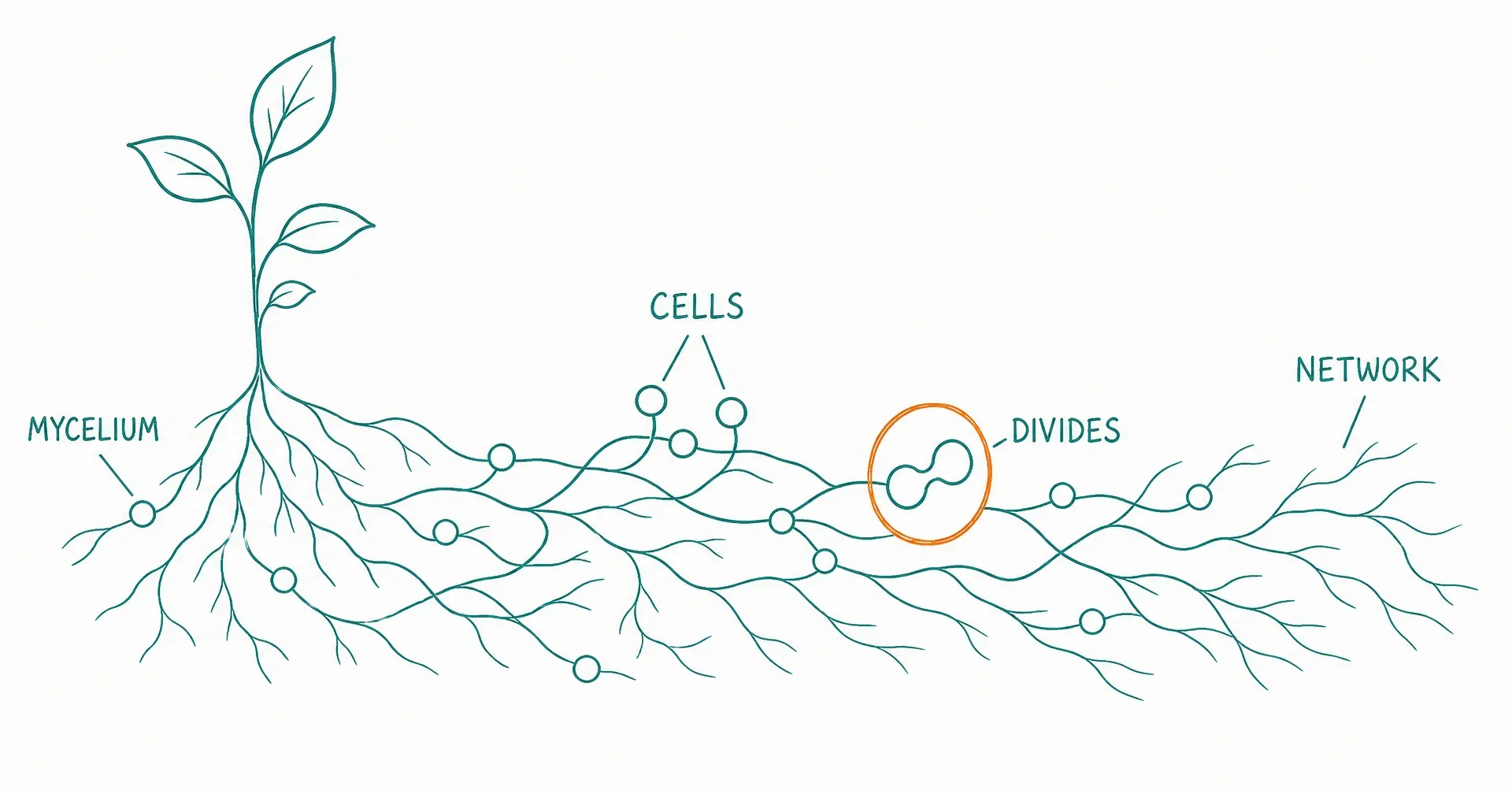
- The name means cellular cognition. A cell is an agent that owns something, can create other cells, remembers, and can be replaced without the organism noticing. The founding image is mycelium wrapping around plant life.
- The founder picked the name because the domain was cheap. He bought it and put a stake in the ground. The architecture decisions behind Cellular Multi-Agents date from October 2025.
- One harness now does research, code, dashboards, spreadsheets, PDFs, video, images, audio and music; it hit #1 on Deep Research Bench in July 2026 and built the company itself over 2,000-plus sessions with no other coding tool.
- This series publishes the principles and the results. It does not publish the recipe: message formats, routing, scheduling and prompt structure stay in-house.
§ 01Eighty years of research, and the layer above it
Nothing about a modern model is sudden. It only felt sudden because the product layer arrived all at once, in November 2022, on top of research that had been compounding since 1943, and that was declared dead at least twice along the way.
| Year | Milestone | What it made possible |
|---|---|---|
| 1943 | McCulloch and Pitts describe the artificial neuron | A neuron as a logic unit: the idea that nets of them can compute |
| 1949 | Hebb, The Organization of Behavior | Learning as connections that strengthen with use |
| 1958 | Rosenblatt’s perceptron | The first machine that learned to classify from examples |
| 1969 | Minsky and Papert, Perceptrons | Proved what a single layer cannot do; funding froze for a decade |
| 1982 | Hopfield networks | Memory as a stable state of a network |
| 1986 | Backpropagation reaches the field (Rumelhart, Hinton and Williams) | Multi-layer networks that can actually be trained |
| 1989 | LeCun applies backpropagation to handwritten digits | Convolutional networks reading real data |
| 1997 | Long Short-Term Memory (Hochreiter and Schmidhuber) | Networks that carry state across a sequence |
| 2012 | AlexNet wins ImageNet | Deep learning on GPUs becomes the default |
| 2013 | word2vec | Meaning as geometry: words as vectors |
| 2014 | Adam optimizer | Stable training of large networks |
| 2015 | ResNet | Networks hundreds of layers deep that still train |
| 2017 | Attention Is All You Need | The Transformer: parallel training on sequences |
| 2018 | GPT-1 and BERT | Pretrain once, adapt to many tasks |
| 2020 | Scaling laws, then GPT-3 | Capability as a predictable function of scale |
| 2022 | ChatGPT | A model as a product anyone can talk to |
| 2025 | Cellular Multi-Agents, architecture decisions begin | The layer above the model, designed for the endgame |
| 2026 | CellCog #1 on Deep Research Bench (July) | One harness, measured against the field |
Look at the shape of that table. The first half is a small number of people with an idea and almost no compute. Two researchers describe a neuron as a logic gate in 1943 (McCulloch and Pitts). Frank Rosenblatt builds a machine that learns to classify from examples in 1958 (Rosenblatt). A 1969 book proves what a single layer of those units cannot do and helps freeze the field for a decade (Minsky and Papert). Backpropagation, worked out in theses by Linnainmaa in 1970 and Werbos in 1974 and brought to the whole field in 1986 (Rumelhart, Hinton and Williams), makes multi-layer networks trainable, and Long Short-Term Memory in 1997 teaches them to carry state (Hochreiter and Schmidhuber). Then the field went quiet a second time, because the ideas were ahead of the hardware.
The second half is labs with compute testing those ideas at scale. AlexNet in 2012 put deep learning on GPUs and won ImageNet by a margin nobody expected (Krizhevsky, Sutskever and Hinton). The Transformer made training on sequences parallel (Vaswani et al., 2017). Scaling laws made capability a predictable function of compute, data and parameters (Kaplan et al., 2020). Then a chat interface put all of it in front of a hundred million people.
I knew early on that I was never going to compete on that layer. The labs training foundation models have the talent, the data and the capital, and the models they ship are genuinely the fruit of that eighty-year tree. The layer I was imagining sat above theirs.
§ 02Harnessing is the next battleground
A harness is everything around the model. What it is asked. What it can reach: files, browsers, tools, other agents. What it remembers between runs. When it runs, and what wakes it. Who it can talk to. What happens when it is wrong.
Change the harness and the same model behaves like a different system. Anyone who has used two coding agents on the same underlying model has felt this. One finishes the job; the other loops. The weights did not change. The harness did.
This is why the harness is the next battleground. The models are converging: several labs now ship frontier models within weeks of each other, and the gap between the best and the second best on any given benchmark is small and temporary. What is not converging is what people build around them. Our ranking of agent harnesses exists because the differences at this layer are now bigger than the differences at the model layer.
§ 03Why we did not build for today’s models
Here is the belief that most separates CellCog from the rest of the field: the harnesses being built today are being built for the early versions of today’s reasoning models.
That sounds like a compliment to their engineering, and in one sense it is. A harness tuned to a model’s current abilities extracts the most from that model, today. But every guardrail written around a current weakness becomes a wall when the weakness goes away. A pipeline that hand-holds a model through six fixed steps is exactly the wrong shape for a model that can plan its own six steps. A memory scheme designed around a small context window is exactly the wrong shape when the window grows a hundredfold. Teams that built for today’s model have to rebuild every time the model improves, and the models are improving every few weeks.
We took the other route. Imagine how this plays out at the endgame, then build the harness that endgame needs, and accept that in the early days it will look worse than a harness tuned to the present.
| Design question | A harness built for today’s models | A harness built for the endgame |
|---|---|---|
| What is the unit of work? | A prompt, a run, a ticket | A role, held for as long as it exists |
| How is the model corrected? | A human reviews every step | Agents review each other; humans set the boundaries and approve the consequential actions |
| What does memory mean? | The context window, plus a retrieval index | Institutional memory: what a role learned, carried from one working session to the next |
| How do agents coordinate? | A fixed pipeline written by a human | Agents that bring in, brief and manage other agents |
| What happens when the model improves? | The scaffolding gets rewritten | The same system gets better, with no change to the harness |
| Where is the ceiling? | The model’s ability on the day the harness was built | Moves up with every model release |
The endgame, as we see it, is not a better chatbot and not a better pipeline. It is an organization: agents that own roles, hire other agents when the work demands it, onboard them, review their work, and manage them. Every architectural decision behind Cellular Multi-Agents, and those decisions date from October 2025, was made by asking what that organization would need and building it before the models could fully use it. The discipline underneath all of it is what we call Agent Experience: relentlessly optimizing for what an agent needs in order to do complicated, long-horizon work with the highest accuracy, rather than for what a human needs in order to babysit it.
§ 04The name: cells that divide
I was looking for a phenomenon in nature that divides and grows on its own, the way employees do in an organization and cells do in a body. There are many. The picture that stuck was mycelium: the underground fungal network that wraps around the roots of most land plants, connects them, and grows by extending itself into whatever is already there.
That was the founding image. An agent network will wrap around human life the way mycelium wraps around plant life. My bet, and I want to be clear that it is a bet and not a claim about the product, is that this is the path to superintelligence: not one enormous model, but an enormous number of agents that can divide, specialize and organize.
A cell, in our vocabulary, is an agent that owns something: a role, a task, a piece of the work. Cells can create other cells. They talk to each other. They remember. And any one of them can be replaced without the organism noticing. An organization of them is cellular cognition.
So why CellCog and not one of the other biological names? Because at the time the domain was cheap. I bought it and put a stake in the ground. The longer story of that decision, and what came after it, is in the founder letter.
§ 05What one harness unlocked, and how hard the early days were
The honest part first. In the early days it was hard to work with any model, even the best ones. A harness built for the endgame asks a model to hold a role, coordinate with other agents, and act on long horizons, and the models of 2025 could only partly do that. The output was rough. A harness tuned to those models would have looked better in a demo.
Then the models improved, and the harness did not need to change. Each release let us extract more from the same architecture, and the gap between what the design asked for and what the models could deliver closed a little more.
The first cell I seeded into the network was a coding agent, and its first job was to build CellCog itself. It still does: more than 2,000 sessions of that agent have built the company, and no other coding tool has been used. The same harness, with no separate products bolted on, now does research, code, dashboards, spreadsheets, PDFs, video, images, audio and music. In deep research, the one place where there is a public measurement, CellCog hit #1 on Deep Research Bench in July 2026 and has traded the top spot with far larger labs since; the leaderboard is live, so check it rather than trust this sentence.
And the organization itself is real. CellCog is run by its own AI employees, hired for roles, coordinating in shared channels, delegating to each other, some of them managing teams. The org chart is public. Every one of those employees is a cell.
§ 06The honest caveats
- A harness built for the endgame does more per unit of work than a pipeline built for one task, and that shows up in cost. You pay for the work, not the hire; the cost depends purely on how much work you assign, and the details are on the pricing page.
- It is only ever as good as the models underneath it on that day. When they stall, so do we.
- Deep Research Bench is the one external measurement we can point to. The rest of this post is our experience, stated as plainly as we can.
- Positions on that benchmark move. The July 2026 #1 is dated on purpose.
§ 07What we will publish, and what we will not
The rule for this series is that we publish the why and the what, and we keep the how. The principles behind the harness, the bets, the results, and what we learned running an AI organization on it are all fair game. Message formats, routing, scheduling and prompt structure are not.
Next in the series: how an AI employee stays one continuous colleague across many separate working sessions; what changed at the frontier in 2026 that made multi-workstream agents possible; and how a harness, not a model, reached #1 on a research benchmark.
If you build harnesses, we would like to hear where you disagree. The eighty years of research above belong to everyone. What gets built on top of them is still being decided.
§ 08Sources
- McCulloch and Pitts, “A Logical Calculus of the Ideas Immanent in Nervous Activity,” Bulletin of Mathematical Biophysics (1943)
- Hebb, The Organization of Behavior, Wiley (1949)
- Rosenblatt, “The Perceptron: A Probabilistic Model for Information Storage and Organization in the Brain,” Psychological Review (1958)
- Minsky and Papert, Perceptrons, MIT Press (1969)
- Linnainmaa, master’s thesis, University of Helsinki (1970); Werbos, Beyond Regression, PhD thesis, Harvard (1974)
- Hopfield, “Neural networks and physical systems with emergent collective computational abilities,” PNAS (1982)
- Rumelhart, Hinton and Williams, “Learning representations by back-propagating errors,” Nature (1986)
- LeCun et al., “Backpropagation Applied to Handwritten Zip Code Recognition,” Neural Computation (1989)
- Hochreiter and Schmidhuber, “Long Short-Term Memory,” Neural Computation (1997)
- Krizhevsky, Sutskever and Hinton, “ImageNet Classification with Deep Convolutional Neural Networks,” NeurIPS (2012)
- Mikolov et al., “Efficient Estimation of Word Representations in Vector Space” (2013)
- Kingma and Ba, “Adam: A Method for Stochastic Optimization” (2014)
- He et al., “Deep Residual Learning for Image Recognition” (2015)
- Vaswani et al., “Attention Is All You Need” (2017)
- Devlin et al., “BERT: Pre-training of Deep Bidirectional Transformers” (2018)
- Kaplan et al., “Scaling Laws for Neural Language Models” (2020); Brown et al., “Language Models are Few-Shot Learners” (2020)
- DeepResearch Bench leaderboard, Hugging Face (live)
- The CellCog Story, founder letter (2026)
Q1What does the name CellCog mean?
CellCog is short for cellular cognition. The founder chose a biological picture on purpose: cells that divide and grow into an organism, the way employees grow into an organization. The company’s architecture is called Cellular Multi-Agents, and the individual agents in it are called cells.
Q2What is Cellular Multi-Agents?
CellCog’s harness architecture: a self-organizing network of agents, each owning a role or a piece of work, that can create, brief and manage other agents. It was designed for the endgame of agent systems, an organization of agents, rather than for the capabilities of any particular model. The architecture decisions behind it date from October 2025.
Q3What is an AI harness?
Everything around a foundation model that turns it into a system that does work: what the model is asked, what tools and data it can reach, what it remembers between runs, when it runs, which other agents it can talk to, and what happens when it is wrong. Two harnesses on the same model can produce very different results.
Q4Is Cellular Multi-Agents open source?
No. CellCog publishes the principles behind the harness and the results it produces, including a public benchmark position and a public org chart of the AI employees running the company. The implementation, meaning message formats, routing, scheduling and prompt structure, is not published.
Q5Which models does CellCog run on?
The latest frontier models, from more than one lab, chosen per mode and depth tier. The harness is the constant; the models underneath it change as the field improves, which is the point of designing the harness for the endgame rather than for one model.
Q6Does the harness matter more than the model?
Both matter, and they multiply. A weak model in a strong harness still fails; a strong model in a weak harness leaves most of its ability on the table. CellCog’s experience is that the same foundation models behave like a different system inside its harness, which is why the company builds everything in-house on it.