
Anthropic’s IPO roadshow video carries two lines that spread on X this week: that Mythos got Claude running on AMD chips in three days, and that cancer and Alzheimer’s will be relics of the past in under a decade. Both lines are in the video. We read its full captions file and the slides behind them. The three-day line comes with small print on screen that narrows it a good deal. The disease line is Dario Amodei’s own estimate, and the prospectus does not repeat it.
The video runs 42 minutes and 43 seconds and sits on Anthropic’s investor site. Three posts about it on X had about 573,000, 382,000 and 117,000 views when we read them at 13:05 UTC on November 11, 2026. The largest one opens with: “The Nvidia CUDA moat is gone”.
The video does not say that. Here is what it does say.
On this page · 8 sectionsOpen
 Anthropic’s IPO roadshow video runs 42 minutes and 43 seconds on its investor site. Its captions file holds 6,468 words by our count, and we read all of it.
 Chief Compute Officer Tom Brown says Mythos got Claude running on AMD chips in three days, with basically no human intervention.
 A footnote on the slide narrows that: about 3 days to bring up prompt processing for one Anthropic model on AMD MI355X GPUs.
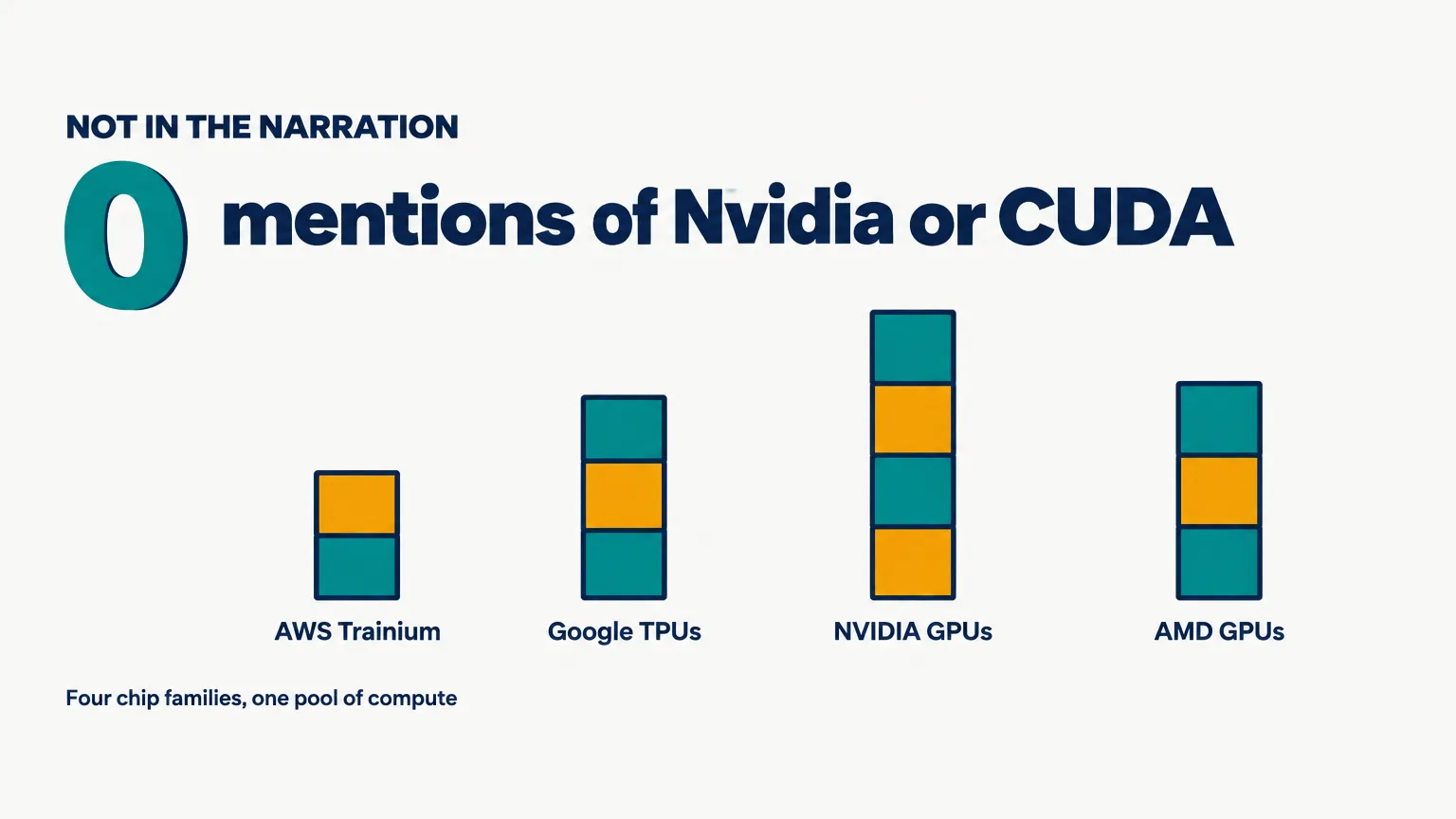
 The narration never mentions Nvidia or CUDA. Anthropic says it runs Claude on four chip families, Nvidia GPUs included, as one pool.
 Dario Amodei says cancer, Alzheimer’s, heart disease and mental illness will be relics of the past in, he thinks, less than a decade. The prospectus has no such line.
§ 01The two lines, and where they are
| Claim | Where it is | Who says it | What qualifies it |
|---|---|---|---|
| Four diseases gone in under a decade | Video, 40:38 | Dario Amodei, CEO | His own estimate. Not in the prospectus |
| Claude running on AMD in three days | Video, 20:42 | Tom Brown, Chief Compute Officer | A footnote: one model, prompt processing, MI355X chips |
| Nvidia’s CUDA moat is gone | A post on X | Not Anthropic | The narration never says Nvidia or CUDA |
The captions file names no speakers. We matched each line to the name shown on screen: Dario Amodei at 0:37 and Tom Brown at 18:51.
§ 02Three days on AMD: the line and its footnote
Tom Brown describes how Anthropic runs Claude on several kinds of chips. He says: “We train and serve Claude now across all four major chip families”.
A slide at 19:41 lists them: AWS Trainium, Google TPUs, NVIDIA GPUs and AMD GPUs.
Then comes the line that travelled. Brown says bringing up a new chip used to be slow: “In the past, bringing on a new chip platform took dozens of engineers months of work”.
He goes on: “This time we had Mythos try it out”.
And then: “It got Claude running on AMD in just three days with basically no human intervention”.
He adds one more sentence: “Claude ported or wrote almost 100% of the kernels”.
While he speaks, a chart compares about 3 days with Mythos to about 6 to 12 months with the traditional approach. Small print under the chart defines the three days: “The ~3 day timeline reflects the approximate time for Claude Mythos Preview to bring up prompt processing for one Anthropic model on AMD MI355X GPUs at a useful level of performance”.
A second sentence explains the comparison: “The ~6-12-month estimate is based on the Company’s historical experience bringing up new accelerators using traditional engineering approaches”.
| Spoken in the video | In the footnote |
|---|---|
| Mythos | Claude Mythos Preview |
| Claude running on AMD | Prompt processing for one Anthropic model |
| AMD | AMD MI355X GPUs |
| Three days | About 3 days, approximate |
| No speed is given | A useful level of performance |
| Dozens of engineers, months of work | About 6 to 12 months, from past experience |

So the claim is narrower than the clip. It covers one model, not all of them. It covers prompt processing, and the footnote does not mention training. It gives no speed, no cost and no comparison with any other chip.
Mythos is not a public model. Earlier in the video Anthropic says it deployed models like Mythos only to cyber defenders.
§ 03Does this end Nvidia’s lead? The video does not say so
The narration never says Nvidia and never says CUDA. We counted zero uses of each in the captions. What Brown describes is using every chip family at once: “Our multi-silicon chip strategy means we can treat all of our chips across providers, architectures and locations as one fungible pool of compute”.
- Nvidia is still one of the four. The slide at 19:41 lists NVIDIA GPUs beside the other three.
- Nvidia is also buying Anthropic stock. The prospectus names NVIDIA Corporation and Advanced Micro Devices among seven companies buying $26.0 billion of stock in a private placement. Our IPO page has the amounts.
- The prospectus gives no number of days. It says: “Historically, bringing a new chip platform into production required intense engineering effort over many months”.
- Its claim about Claude is general. It says: “By leveraging Claude, our engineering teams can now bring new chip platforms into production more quickly”.
- The chips differ. The footnote names the MI355X. The prospectus, describing Anthropic’s AMD supply, names the MI450 series.
The words three days, MI355X and kernels do not appear in the prospectus we read, Amendment No. 2.
§ 04Diseases as relics: what Amodei said
Near the end, at 40:38, Amodei says: “You know, if today we look at things like cancer, Alzheimer’s, heart disease, mental illness, these will be relics of the past in, I think, less than a decade”.
Two sentences later he adds: “I think if we do this right, we can create an age of miracles where humanity is able to solve problems that have eluded us for millennia”.
Four things to know about the line.
- It is his estimate. He says I think. He cites no study, trial or date.
- It is not new. In his October 2024 essay Machines of Loving Grace, Amodei predicted that AI would “compress the progress that human biologists would have achieved over the next 50-100 years into 5-10 years”.
- The essay’s clock started later. Those 5 to 10 years were counted from the arrival of what he called powerful AI, which he wrote “could come as early as 2026”.
- The prospectus does not repeat it. The phrases relics of the past and less than a decade are not in the filing. The founders’ letter on the investor site uses different words. It says AI could “bring cures for major diseases within reach”.
The same video also carries a much smaller estimate. At 13:25 another speaker, whose name we did not check, says: “We think that AI will help us reduce the time to do a clinical trial by 20 to 30%”.
The four panels below sum up both claims.



§ 05What else the video tells investors
The video ends its financial chapter with a target. It says Anthropic believes it can reach adjusted operating margins of more than 35%.
| Period | Adjusted operating margin (%) |
|---|---|
| Year to date, per the video | 12 |
| Third quarter of 2026, per the site | 15 |
| Long-term target, more than | 35 |
- Where the costs should land. The video says compute and infrastructure should trend toward approximately 45 to 50% of revenue, and sales, marketing and partnerships toward 7 to 10%.
- Opus 5.5 got cheaper. The video says the model delivered 40% lower customer costs in September and is significantly cheaper for Anthropic to serve. It is the model CellCog runs on most tiers.
- None of it is final. The investor site’s legal notice says: “The registration statement has not yet become effective”.
§ 06What is not known
- Which model was brought up, and how fast it runs on the MI355X.
- Whether Mythos has done the same for training.
- What basically no human intervention means in engineer hours.
- What evidence sits behind less than a decade. The video gives none.
§ 07Our conflict, declared
CellCog runs on Anthropic’s Claude models (Claude Opus 5.5 on most tiers; Claude Fable 5.2 on Agent Max and Creative Max since November 11, 2026). We are an Anthropic customer, so we gain if its models get cheaper to run. CellCog does not route to Mythos, and we tested none of these claims ourselves. Everything here comes from the video, its captions, the investor site and the prospectus, read on November 11, 2026.
§ 08Sources
- Anthropic, IPO investor site with the roadshow video, read November 11, 2026
- Anthropic, roadshow video captions file
- Anthropic, Anthropic launches roadshow for proposed initial public offering, November 10, 2026
- Anthropic, amended registration statement on EDGAR
- Dario Amodei, Machines of Loving Grace, October 2024
- Marcelo Lima, post on X, November 10, 2026
- Fireside Alpha, post on X, November 10, 2026
- Andrew Curran, post on X, November 11, 2026
Q1Where can I watch the Anthropic roadshow video?
On Anthropic’s investor site, ipo.anthropic.com/us, in the section called Roadshow video. It runs 42 minutes and 43 seconds, has 11 chapters, and comes with a captions file.
Q2Did Mythos port Claude to AMD in three days?
Anthropic’s Chief Compute Officer Tom Brown says so in the video, at 20:42. A footnote on the slide defines the three days as the approximate time for Claude Mythos Preview to bring up prompt processing for one Anthropic model on AMD MI355X GPUs at a useful level of performance.
Q3Is Nvidia's CUDA moat gone?
The video does not say that. Its narration never mentions Nvidia or CUDA. A slide lists NVIDIA GPUs as one of four chip families Anthropic uses, and the prospectus names Nvidia among seven companies buying Anthropic stock in a private placement.
Q4Did Dario Amodei say cancer will be cured within 10 years?
At 40:38 he says cancer, Alzheimer’s, heart disease and mental illness will be relics of the past in, he thinks, less than a decade. It is his own estimate and he cites no evidence for it in the video. The prospectus does not contain the line.
Q5Has Amodei made the disease forecast before?
Yes. His October 2024 essay Machines of Loving Grace predicted AI would compress 50 to 100 years of progress in biology into 5 to 10 years, counted from the arrival of what he called powerful AI.