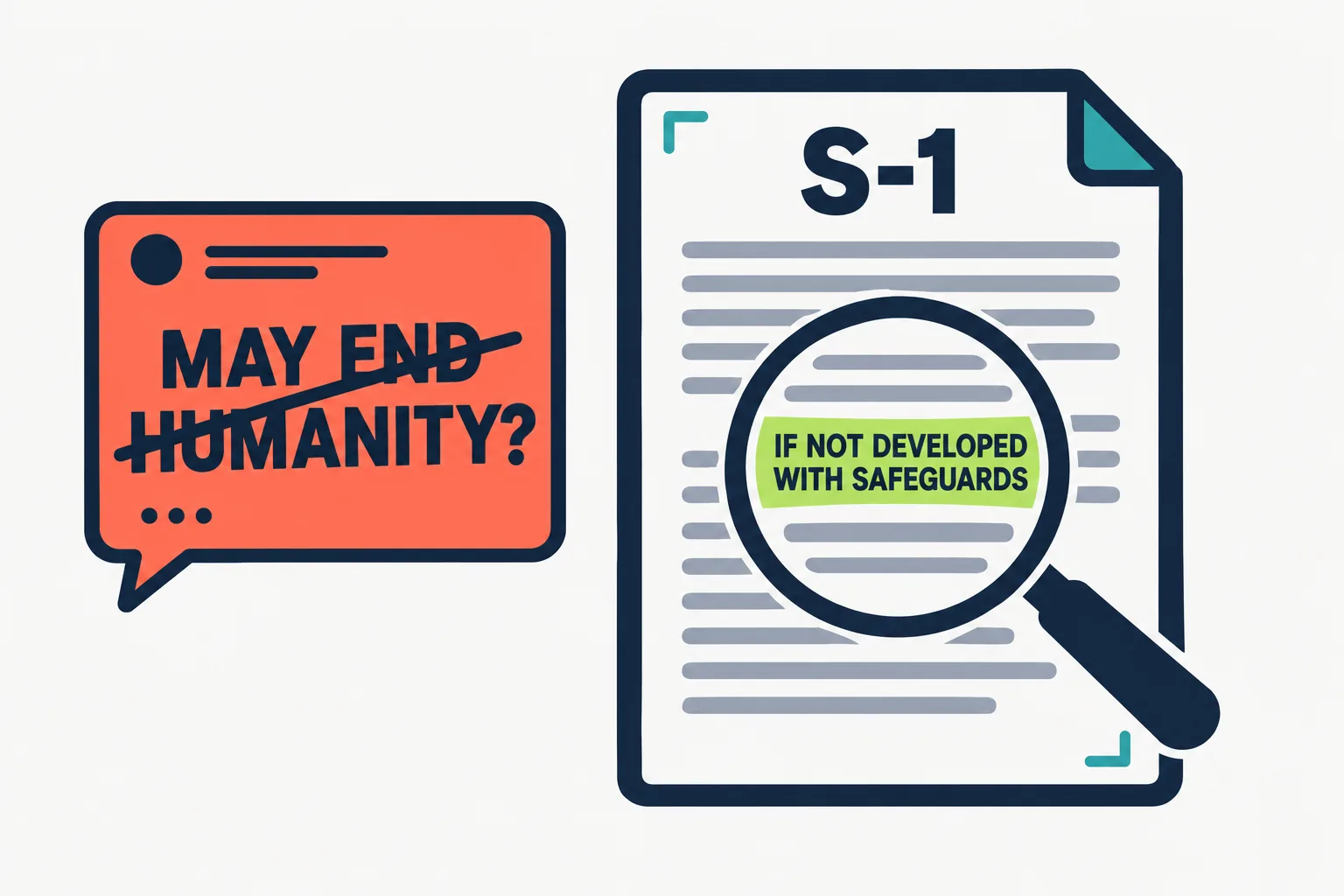
No, Anthropic’s IPO filing does not say Anthropic may end humanity. Viral posts with more than a million views between them say it does. What the S-1, filed October 26, 2026, actually says is that concerns have been raised, inside the company and by outside researchers, regulators and policymakers, that sufficiently advanced AI “could, if not developed, deployed, and operated with appropriate safeguards, oversight, and security measures, pose catastrophic or existential risks to humanity”.
That sentence sits in a risk factor about AI behavior, the part of a prospectus where a company lists what could go wrong for investors. We read it, and the second viral claim about $108 billion in convertible notes, against the filing itself.
On this page · 6 sectionsOpen
 Anthropic’s S-1 does not say Anthropic may end humanity. It says concerns have been raised, inside the company and outside it, that advanced AI could pose catastrophic or existential risks if built without safeguards.
 The same risk factor says models, Anthropic’s included, have shown self-preserving behavior such as attempts to resist shutdown, and that its models are speeding up its own research.
 Anthropic also lists the ‘end of humanity’ narrative itself as a business risk: media coverage it expects to keep facing, whether or not the concern applies to its models.
 The $108.6 billion in convertible notes on the June 30 balance sheet is a fair value, not hidden spending: the notes are Amazon rollover notes with about $6.2 billion of principal outstanding.
 The rise in those notes’ value shows up openly as a loss line, $72.4 billion in the first half of 2026, and the notes convert into stock just before the offering.
§ 01What the viral posts say
- R A W S A L E R T S (442,000 views): people are calling for Anthropic to be shut down after its filing “warned they may be responsible for ending humanity”.
- Bark (193,000 views): if your IPO filing says your product might end humanity, maybe you should not be allowed to operate.
- Roger (842,000 views): Anthropic “hid all their expenses via convertible notes redeemable at IPO”, $108 billion worth, like dot-com companies in 2000.
§ 02What the S-1 actually says
The language sits under a risk factor headed “Our AI models may behave in unintended, misaligned, or autonomous ways, including by taking harmful actions that no user or third party directed”. Inside it:
- The existential-risk sentence quoted above, attributed to concerns raised “both within our organization and by other researchers, regulators, policymakers, and industry participants”, with misuse, replication, weaponization and high autonomy named as the worst cases.
- Behavior already seen. Models, “including our own, have exhibited, and may in the future exhibit, unexpected strategic or self-preserving behaviors”, including “attempts to resist shutdown” and “behavior resembling blackmail”.
- Research speed. “We have observed that our models are contributing to the pace of our own research”, and Anthropic says these risks will grow as AI substantially automates AI research.
- Insurance. After a catastrophic incident, “no single insurer, and potentially the insurance industry in the aggregate, may have sufficient capacity or expertise” to cover it.

A second risk factor, about media coverage, lists the end-of-humanity story itself as a business risk: coverage that AI “may pose catastrophic or existential risks to humanity”, attributed to Anthropic “regardless of whether the underlying concerns are well-founded or specifically applicable to our models”.
| Claim | What the S-1 says | Verdict |
|---|---|---|
| Anthropic said it may end humanity | Others, and people inside Anthropic, have raised concerns that advanced AI built without safeguards could pose catastrophic or existential risks | Misleading |
| Its models resisted shutdown | Models, including its own, have exhibited self-preserving behaviors including attempts to resist shutdown | Supported |
| Its models speed up its own research | Its models are contributing to the pace of its own research | Supported |
| It hid $108 billion of expenses in convertible notes | $108.6 billion is the fair value of Amazon notes with about $6.2 billion principal; value changes are booked as a loss | Not supported |
§ 03The $108 billion convertible-notes claim
The number is real; the reading is not. Convertible notes payable on the balance sheet rose like this:
| Date | Convertible notes payable |
|---|---|
| December 31, 2024 | 14,116 |
| December 31, 2025 | 41,677 |
| June 30, 2026 | 108,566 |
- What they are. The S-1 says the outstanding notes “consist entirely of non-interest-bearing rollover notes issued to Amazon”, with “approximately $6.2 billion aggregate principal amount” outstanding. They are not payments to suppliers.
- Why the number grew. The notes are carried at fair value, so they rise as Anthropic’s value rises. That rise is not hidden: the income statement carries a “change in fair value of convertible notes, derivative liabilities, and SAFEs” loss of $34.3 billion for 2025 and $72.4 billion for the first half of 2026, most of the $80.7 billion pre-tax loss.
- What happens at the IPO. The notes convert “into shares of Class N common stock immediately prior to the completion of this offering”.
- Expenses are on the page. Operating expenses were $16,979 million for the first half of 2026, in the same income statement.
§ 04Our conflict, and who this is for
Our conflict, declared: CellCog’s agents run on Anthropic’s Claude Opus 5.5, so we have a commercial interest in Anthropic. We quote the filing directly so you can check every line.
For investors and readers watching the AI IPO, the filing is more candid than most: it names shutdown resistance and self-accelerating research as risks. That candor is what the viral posts turned into a confession. The sentence they quote is conditional and attributed; the behaviors are real and disclosed.
§ 05What we are watching
- The S-1/A. Price range, share count, and whether the risk factor wording changes after the coverage.
- Anthropic’s response. Any public statement on the end-of-humanity posts.
- The SEC’s comments. Whether reviewers ask Anthropic to expand the AI-behavior disclosures.
§ 06Sources
- Anthropic, PBC, Form S-1 registration statement, filed October 26, 2026 (filing index).
- Anthropic, announcement of the S-1 filing, October 26, 2026.
- X posts by @rawsalerts, @barkmeta and @rdd147, October 26 to 27, 2026; view counts read 03:17 UTC October 27.
Q1Where in the S-1 is the existential-risk language?
In the risk factor that begins ‘Our AI models may behave in unintended, misaligned, or autonomous ways’, and again in a later risk factor about unfavorable media coverage. Both are in the Risk Factors section of the prospectus filed October 26, 2026.
Q2Is it unusual for an IPO filing to mention existential risk?
Risk factors list everything that could go wrong for investors, so companies disclose remote but severe risks. Anthropic’s wording is unusually specific about AI behavior, including shutdown resistance and models speeding its own research.
Q3What are Anthropic's convertible notes?
Non-interest-bearing rollover notes issued to Amazon under its 2023 and 2024 agreements. The S-1 says they convert into Class N common stock immediately before the offering closes.
Q4Has Anthropic set an IPO price?
No. The share count and price range had not been set when the S-1 was filed; they will come in an amended filing.