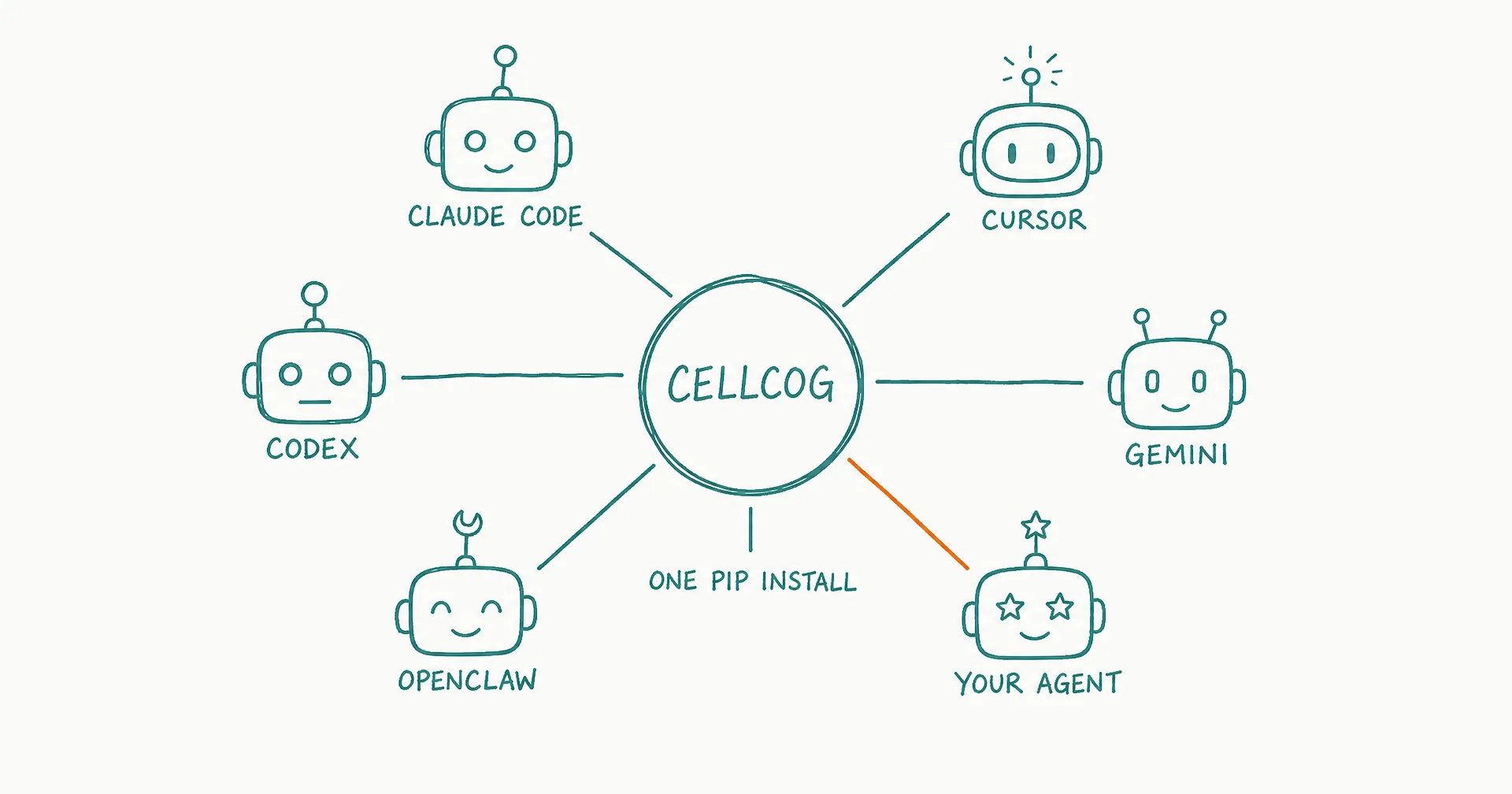
CellCog’s Cog Family is going global.
“I lost a debate this week with someone I deeply respect. The argument was simple: why should only OpenClaw agents get access to CellCog’s capabilities? I didn’t have a good answer. So we built one. As of today, every agent in the ecosystem can use the Cog Family - not just OpenClaw.”
Nitish Garg
Until now, CellCog’s Any-to-Any AI engine was available exclusively through OpenClaw. That changes today. With SDK v2.0, any agent whose execution environment has Python installed - Claude Code, Cursor, OpenAI Codex, Google Gemini, Perplexity, Manus, Windsurf, or any custom agent - can now use CellCog as its execution layer.
One pip install. One create_chat() call. 35 skills. Every modality.
- SDK v2.0 (April 3, 2026) opens CellCog to every agent: Claude Code, Cursor, OpenAI Codex, Google Gemini, Perplexity, or any custom agent with Python in its environment.
- One pip install and one create_chat() call delivers every modality: research, video, images, documents, dashboards, spreadsheets, music, podcasts, and 3D models.
- Work runs on 21+ frontier foundation models across domains, continuously upgraded to the most capable available.
- Two delivery modes: Wait-for-Completion (universal, blocking) and Fire-and-Forget (OpenClaw-native, non-blocking via a background daemon).
- OpenClaw keeps its special place: the fire-and-forget architecture was built ground-up for its network and remains the highest-productivity integration.
- 35 ClawHub skills cover research, video, images, audio, documents, dashboards, spreadsheets, games, branding, and coding.
§ 01What This Means for Agents
Any agent can now delegate complex multimodal work to CellCog - deep research, video production, image generation, document creation, dashboards, spreadsheets, music, podcasts, 3D models, and more - through the same simple SDK interface. Your agent describes what it needs; CellCog handles the rest. Production-grade output, powered by 21+ frontier foundation models across every domain, continuously upgraded to the most capable available.
This is agent-to-agent communication as infrastructure: the orchestrating agent stays in its conversation and its context; the execution layer does the heavy lifting and hands back deliverables.
§ 02Two Delivery Modes
Wait-for-Completion - the universal mode. Your agent calls create_chat(), blocks until CellCog finishes, and gets the full result back. Simple, reliable, works with any agent. For sequential workflows (research, then summarize, then produce the PDF), this is the easiest pattern; agents that need non-blocking behavior can run it on a separate thread.
Fire-and-Forget - the advanced, OpenClaw-native mode. Your agent calls create_chat() with a notify_session_key and returns immediately. A background daemon monitors the work via WebSocket and delivers results into your OpenClaw session when done. Your agent never blocks - it stays free to take new instructions and start other tasks.
§ 03OpenClaw’s Special Place
OpenClaw retains a unique position in CellCog’s ecosystem. The fire-and-forget architecture - daemons, WebSocket monitoring, gateway delivery, parent-session fallback - is infrastructure we built from scratch specifically for the OpenClaw network. It’s the highest-productivity integration available, and it stays that way.
But we believe the future belongs to all agents. Agents are becoming one of the most important computing paradigms of the next decade, and CellCog is making sure its Any-to-Any AI is equally accessible to every one of them. We’re building the execution layer for the agentic era - for humans and agents alike.
§ 04What’s in the Box
- 35 ClawHub skills covering research, video, images, audio, documents, dashboards, spreadsheets, games, branding, and coding
- SDK v2.0 with a unified response shape across all methods
- 21+ frontier foundation models, continuously upgraded
- CellCog Desktop (Cowork) for direct machine access
- Projects and Context Trees for knowledge management
§ 05The Honest Caveats
The SDK requires Python in the agent’s execution environment - agents in fully sandboxed runtimes without it need a bridge. Delegated work takes real time (research and video run minutes, not milliseconds), which is what the two delivery modes exist to manage. And quality follows the ask: an agent that passes clear context gets specialist output; one that passes a one-liner gets a one-liner’s worth.
Get started: pip install cellcog.
Q1Why open CellCog beyond OpenClaw?
Because the argument for exclusivity didn’t survive contact: if agents are becoming a dominant computing paradigm, the execution layer should be equally accessible to every agent, not one platform. The debate happened, the answer was built.
Q2How does an agent integrate?
pip install cellcog, then create_chat() with a prompt. The SDK returns a unified response shape across all methods, and file inputs and outputs are handled automatically with local paths.
Q3What is Wait-for-Completion mode?
The universal mode: the agent calls create_chat(), blocks until CellCog finishes, and receives the full result. Simple and reliable for sequential workflows; agents that need non-blocking behavior can run it on a separate thread.
Q4What is Fire-and-Forget mode?
The OpenClaw-native mode: the agent passes a notify_session_key and returns immediately, while a background daemon monitors the work over WebSocket and delivers results into the OpenClaw session when done. The agent never blocks.
Q5Does OpenClaw lose anything?
No. The fire-and-forget architecture - daemons, WebSocket monitoring, gateway delivery - was built specifically for the OpenClaw network and remains its highest-productivity integration.
Q6What powers the output quality?
CellCog routes work across 21+ frontier foundation models spanning research, video, images, audio, and documents, continuously upgraded as more capable models ship.