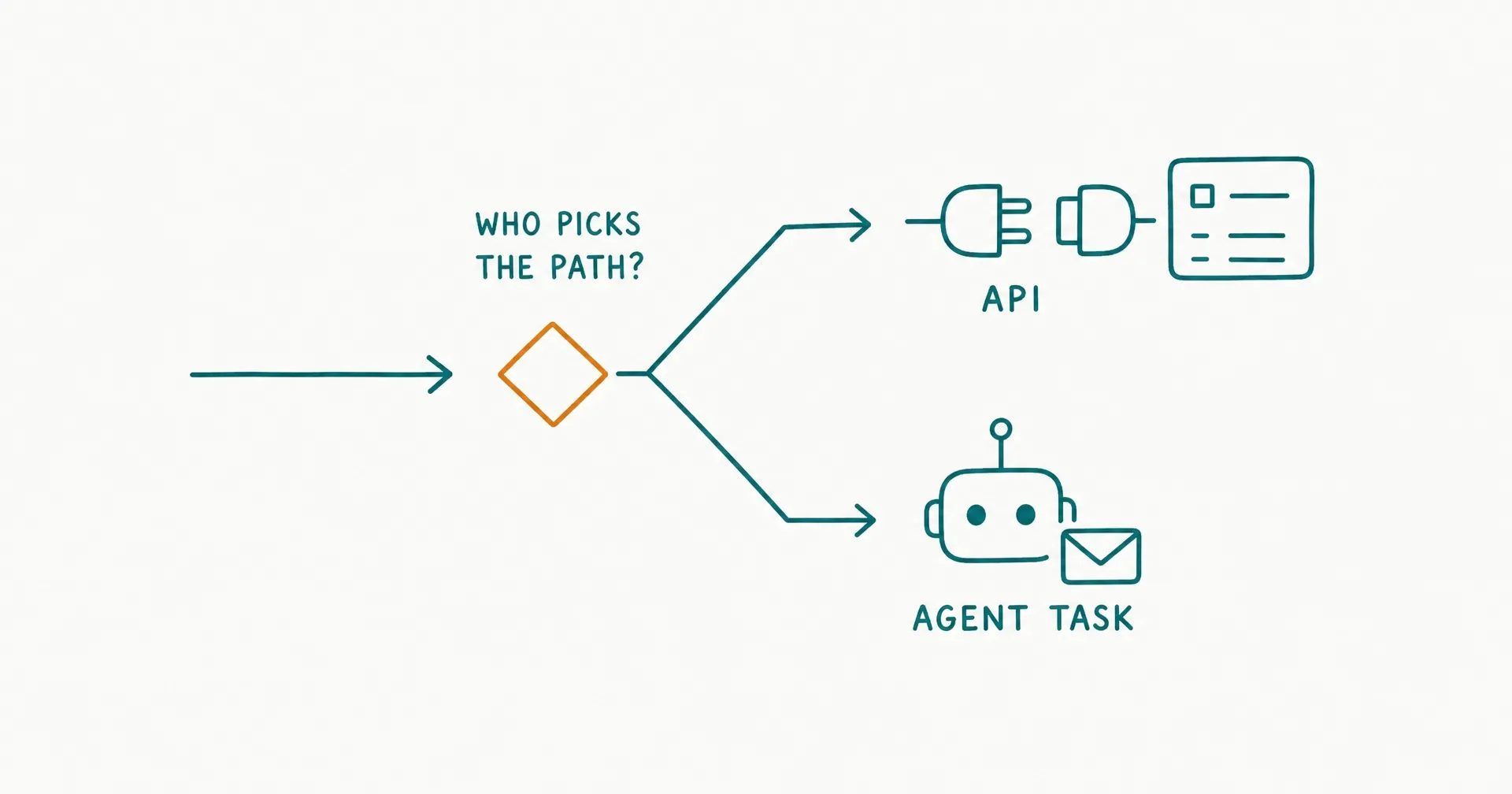
Use API automation when the caller knows the operation, can validate the inputs, and should control the workflow. Use agent-to-agent communication when the caller knows the desired outcome but a remote agent must interpret the request, choose a path, request clarification, manage task state, and return an independently reviewable result.
The comparison is about operating semantics, not network transport. An agent-to-agent system can expose HTTP endpoints, use JSON request bodies, return status codes, and publish an OpenAPI description. The formal A2A Protocol itself supports HTTP+JSON/REST, JSON-RPC, and gRPC bindings. Calling an endpoint does not tell you whether the remote system behaves like a bounded function or an independent worker.
The neutral agent-to-agent communication model defines discovery, identity, relationship, task, authority, message, state, and artifact boundaries. Those additional semantics are justified only when they create more value than the extra latency, cost, evaluation, and recovery work they introduce.
On this page · 15 sectionsOpen
- What Is the Difference Between Agent-to-Agent and API Automation?
- Why Is “A2A vs API” Not a Transport Choice?
- When Is API Automation the Better Choice?
- When Is Agent-to-Agent Communication the Better Choice?
- Which 10 Factors Decide Between A2A and an API?
- How Do A2A and APIs Compare on Latency, Cost, and Reliability?
- How Do Failure Modes Differ?
- How Do Security and Authority Change?
- Why Is a Hybrid Architecture Usually Better?
- Which Interface Fits Common Workloads?
- How Should Teams Compare the 2 Architectures?
- How Do You Implement the Decision Safely?
- How Does CellCog Fit the A2A and API Decision?
- What Is the A2A vs API Checklist?
- Use the Narrowest Interface That Preserves Required Flexibility
- Choose API automation for known operations with typed inputs, bounded outputs, predictable failure modes, and a caller that retains control of every step.
- Choose agent-to-agent communication when the receiver must interpret an outcome, select its own execution path, ask for missing information, maintain a task lifecycle, and return a durable artifact.
- A2A and APIs are not mutually exclusive. A2A 1.0 defines agent and task semantics over standard bindings that include HTTP+JSON/REST.
- Do not replace a reliable API with an agent merely because natural-language input is convenient. Keep stable policy, calculations, permissions, and consequential writes deterministic.
- Compare complete accepted outcomes, not raw calls. Include routing, model and tool use, queue time, clarification, artifact validation, retries, review, and failure recovery.
- A hybrid architecture is the normal production answer: agents handle ambiguity and coordination; APIs enforce stable transactions and systems of record.
- Use the narrowest interface that preserves the flexibility the task actually requires.
§ 01What Is the Difference Between Agent-to-Agent and API Automation?
API automation invokes a declared operation through a defined interface. Agent-to-agent communication delegates a task to a separately operated participant that may determine how to complete it.
| Decision dimension | API automation | Agent-to-agent communication |
|---|---|---|
| Caller knows | Operation and arguments | Desired outcome and constraints |
| Receiver represents | Service, resource, or function | Agent or agentic system |
| Path ownership | Caller or encoded workflow | Receiver for its accepted scope |
| Discovery | Endpoint and operation catalog | Identity, capabilities, skills, modes, security |
| Input | Typed parameters or resource representation | Task request, context, references, acceptance rule |
| Clarification | Usually a validation error | Can be a normal interrupted task state |
| State | Request/response or application-specific job state | Standardized task lifecycle |
| Output | Response or resource representation | Message for direct response or artifact for task result |
| Variability | Usually constrained by the operation | Expected inside the agreed outcome boundary |
| Latency | Often optimized for short transactions | May be long-running and asynchronous |
| Evaluation | Schema, business rule, integration test | Schema plus semantic quality, evidence, and task acceptance |
| Best fit | Stable operation | Variable path or delegated expertise |
The decisive question is who chooses the path. If the caller specifies GET customer, calculate tax, create invoice, and send notification, it owns the sequence even if an agent selected those tools. If the caller asks another system to “investigate this account and return a source-backed risk report,” the receiver owns a meaningful part of task execution.
API automation is an interaction pattern, not one specification
“API automation” can describe REST, RPC, GraphQL, webhooks, event APIs, job APIs, or private service calls. These interfaces can be synchronous or asynchronous, stateless or backed by durable application state, simple or computationally complex.
Do not make any of these assumptions from surface behavior:
- every API returns instantly;
- every API is stateless at the application layer;
- every API output is identical across runs;
- every agent uses natural language;
- or every A2A task is long-running.
The useful distinction is contract scope. API automation usually exposes an operation the caller can name. Agent-to-agent communication exposes a participant that can accept and manage a goal-shaped task.
A2A adds standardized agent semantics
The current A2A Protocol specification defines an AgentCard, Task, Message, Part, Artifact, and Extension. It also defines operations for sending messages, streaming, retrieving and listing tasks, subscribing to updates, canceling work, and retrieving agent cards.
Those objects standardize answers to questions that a generic business API usually leaves to each application:
- Which remote agent claims the capability?
- Which interaction modes does it support?
- Which task is active?
- Is it working, blocked on input, awaiting authorization, or terminal?
- Which messages changed the task?
- Which durable artifacts contain the result?
- Can the caller reconnect, retrieve, or cancel the task?
An ordinary API can implement every one of those behaviors. A2A’s value is a shared agent-oriented contract across implementations rather than the mere ability to send HTTP requests.
§ 02Why Is “A2A vs API” Not a Transport Choice?
A2A can run through APIs. The protocol separates its canonical data model and operations from the binding that carries them.
| Layer | A2A concern | Example |
|---|---|---|
| Data model | Shared objects and meanings | Task, Message, AgentCard, Artifact |
| Operations | Required interaction behavior | Send message, get task, cancel task |
| Binding | How operations travel | HTTP+JSON/REST, JSON-RPC, gRPC |
| Application | What the remote agent actually does | Research, coding, document production |
The table prevents an architectural category error. A REST endpoint can expose either a narrow operation or an A2A task interface. The wire format does not decide how much execution authority the receiver has.
OpenAPI can describe an agent-facing HTTP service
The OpenAPI Specification 3.2.0 defines a language-agnostic interface description for HTTP APIs. It can describe paths, operations, parameters, request bodies, responses, callbacks, security schemes, and webhooks.
An agent service can publish an OpenAPI description for its HTTP surface. That description helps a client construct requests and understand responses. It does not automatically provide the complete semantics of capability discovery, task ownership, clarification, agent identity, result artifacts, or formal A2A compatibility.
OpenAPI and A2A can therefore coexist:
- OpenAPI describes the HTTP interface;
- A2A defines the agent interaction objects and behavior;
- application policy defines which tasks and actions are allowed;
- and evaluation determines whether the returned work is acceptable.
HTTP statelessness does not prevent long-running tasks
RFC 9110 defines HTTP as a stateless request/response protocol: each request’s semantics can be understood in isolation. An application behind HTTP can still create durable jobs, store state, publish events, accept webhooks, and make results retrievable by task ID.
A conventional API can implement:
- POST /jobs to create work;
- GET /jobs/{id} to retrieve state;
- a webhook for completion;
- POST /jobs/{id}/cancel to request cancellation;
- and GET /jobs/{id}/result to fetch output.
That design may be sufficient when the job type, schema, and lifecycle are known. A2A becomes useful when multiple agent providers need common discovery, task, message, artifact, version, and error semantics instead of a custom job contract for every provider.
§ 03When Is API Automation the Better Choice?
API automation is the default when you can state the operation more precisely than the outcome.
| Work characteristic | Why an API fits | Example |
|---|---|---|
| Stable operation | The function is known before execution | Retrieve customer balance |
| Typed input | Required fields can be validated at the boundary | Calculate shipping quote |
| Bounded output | Response schema is predictable | Return tax jurisdiction code |
| Fixed policy | Rules should not be interpreted differently per run | Block payment above policy limit |
| High transaction volume | Low overhead and horizontal scaling matter | Enrich 100,000 records |
| Tight latency | Result is needed in milliseconds or seconds | Check inventory at checkout |
| Consequential write | Exact action and authorization must be inspectable | Issue approved refund |
| Exhaustive path testing | State space is enumerable | Validate required form fields |
| Strong idempotency need | Repeated request must not duplicate action | Create order once |
| System-of-record update | Destination semantics already exist | Update CRM opportunity stage |
The strongest API cases are not necessarily simple. A payment network, tax engine, or logistics service can be complex internally while exposing a narrow, stable contract. The caller benefits from that complexity without delegating an open-ended goal.
Deterministic refers to the contract, not identical bytes
Weather, search, fraud, and recommendation APIs may return different values as underlying data changes. They can still have deterministic interface behavior:
- the operation is named;
- required parameters are known;
- the response shape is bounded;
- error classes are documented;
- authorization is tied to the operation;
- and the caller decides what happens next.
Do not classify an interface as agent-to-agent merely because its result is probabilistic or produced by a model. A text-generation endpoint can remain a bounded API operation if the caller owns the surrounding workflow.
Stable policy belongs outside model discretion
If a rule says “refunds above $500 need a finance approval,” encode the threshold in policy. If a customer is in a restricted jurisdiction, enforce that condition in an authoritative service. If a duplicate payment request arrives, prevent the second effect at the transaction boundary.
Agents can collect evidence and recommend an action. They should not be the only place where stable constraints are remembered and applied.
APIs make retries easier to reason about
Retries are safe only when the operation’s semantics support them. The Stripe idempotency documentation shows a practical pattern. A client supplies an idempotency key so a repeated create or update request can return the original result rather than produce a duplicate effect.
An agent task needs similar protection at two distinct layers:
- task-level deduplication so a retried request does not create a second task;
- action-level idempotency so a retried task does not repeat a payment, message, or record update.
A2A does not remove the need for destination API controls. The remote agent’s “completed” state cannot prove that an external write happened exactly once.
§ 04When Is Agent-to-Agent Communication the Better Choice?
Agent-to-agent communication earns its overhead when the remote participant must manage meaningful uncertainty inside a bounded task.
| Work characteristic | Why an agent boundary fits | Example |
|---|---|---|
| Outcome known, path unknown | Receiver must select steps from context | Investigate a market change |
| Unstructured inputs | Documents, messages, images, and data need interpretation | Build a source-backed diligence packet |
| Dynamic capability selection | Suitable receiver may vary by task | Route legal, technical, or media work |
| Clarification expected | Missing information cannot be reduced to field validation | Resolve ambiguous product requirements |
| Long-running work | Task needs progress, interruption, and recovery | Produce a multi-source research report |
| Several artifact types | Receiver coordinates document, data, and media output | Deliver report, spreadsheet, and presentation |
| Delegated expertise | Receiver chooses its own methods and tools | Specialist code review |
| Cross-provider interoperability | Independently operated agents need a common contract | Company agent delegates to vendor agent |
| Independent review | A second agent produces a separate assessment | Validate evidence against acceptance rules |
| Changing task decomposition | Required subtasks depend on what is discovered | Diagnose an unfamiliar system defect |
The receiver still needs a bounded outcome, limited authority, and an acceptance rule. “Use an agent” is not permission to replace a precise operation with an unrestricted request.
Flexibility must be material to the result
Anthropic’s guidance on effective agents recommends starting with the simplest workable design. It distinguishes predefined workflows from agents that dynamically direct their own process and notes that agentic systems often trade latency and cost for task performance.
That trade is justified when the path cannot be encoded economically or when dynamic selection materially improves the accepted result. It is not justified when an agent reconstructs the same 4 API calls on every run.
Clarification is a normal state, not an error
An API often rejects a missing required field. An agent may discover later that the task cannot continue without a choice the caller did not know to provide.
For example, a research agent may need:
- the target geography;
- the evidence cutoff date;
- the allowed source classes;
- the comparison cohort;
- or the required output audience.
An A2A-style task can enter an input-required state, preserve completed work, receive the missing information, and continue. This is more useful than returning a generic validation error when the missing requirement emerges during execution.
Results need artifact semantics
Open-ended work rarely fits one scalar response. A remote agent may produce a report, source ledger, dataset, image, code patch, or presentation.
The artifact record should identify:
- task and artifact IDs;
- type and schema version;
- producer and creation time;
- retrieval reference or content;
- evidence and provenance;
- integrity value where useful;
- sensitivity and retention class;
- validation results;
- and supersession history.
The AI agent task delegation framework adds the parent/child ownership, authority, acceptance, and closure rules needed when the caller retains the wider outcome.
§ 05Which 10 Factors Decide Between A2A and an API?
Score the task before selecting the interface. A single variable rarely decides the architecture.
| Factor | API signal | A2A signal | Hard question |
|---|---|---|---|
| 1. Operation clarity | Exact operation is known | Only desired outcome is known | Can you name the function before reading the case? |
| 2. Path variability | Same steps apply | Steps depend on discoveries | How often does the sequence change? |
| 3. Input structure | Typed fields dominate | Unstructured context dominates | Can schema validation find most defects? |
| 4. Clarification | Missing fields are predictable | New questions emerge during work | Does the receiver need multi-turn input? |
| 5. Duration | Short transaction | Long or interrupted task | Must the caller reconnect later? |
| 6. Output shape | One bounded response | Several variable artifacts | Can downstream code validate the result directly? |
| 7. Receiver independence | Caller selects every operation | Receiver selects methods and tools | Who controls execution inside the boundary? |
| 8. Consequence | Exact write matters | Analysis or production precedes the write | Can variability cause irreversible effects? |
| 9. Evaluation | Contract tests cover quality | Semantic and domain review are required | What evidence proves acceptance? |
| 10. Provider diversity | One known service | Several independent agent providers | Is a common task protocol worth maintaining? |
Use API automation when most signals land on the left. Use agent-to-agent communication when several right-side signals are essential rather than merely convenient.
Apply 4 hard API gates
Even when an agent handles the wider task, keep a step behind a deterministic API if it:
- moves money or creates a legal commitment;
- changes identity, permission, or security policy;
- updates an authoritative business record;
- enforces a stable regulatory or contractual rule.
The agent can prepare parameters and evidence. An independent policy and approval layer should decide whether the operation is allowed.
Apply 4 hard A2A questions
Before adding an agent boundary, answer:
- What execution freedom does the receiver actually need?
- Which task state cannot the existing API represent?
- Which artifact or quality gain justifies the extra boundary?
- How will the caller recover when the receiver stalls, disconnects, or returns unacceptable work?
If the team cannot answer those questions, the label is driving the architecture instead of a demonstrated need.
§ 06How Do A2A and APIs Compare on Latency, Cost, and Reliability?
An API call is usually one component of an agent task. Comparing one API request with one complete delegated outcome understates A2A cost and overstates equivalence.
| Cost or time component | API automation | Agent-to-agent task |
|---|---|---|
| Discovery and routing | Usually static configuration | Card/registry lookup plus eligibility decision |
| Request construction | Typed parameters | Task contract plus context selection |
| Execution | Service operation | Model, tools, APIs, retrieval, and substeps |
| Waiting | Network and service latency | Queue, processing, clarification, and artifact production |
| Validation | Schema and business rules | Schema, evidence, semantic quality, authority, and artifact checks |
| Retry | Operation-level | Task, message, artifact, and operation levels |
| Review | Often exception-based | Often required until quality is established |
| Recovery | Error code and replay | Retrieve state, resume, repair, reroute, or cancel |
| Cost unit | Request, event, compute, or subscription | Model, tool, platform, artifact, review, and failure cost |
The correct denominator is accepted work. Cheap calls that produce rejected outputs are not cheaper at the business level.
Use accepted-outcome cost
Calculate:
cost per accepted outcome = (interface cost + execution cost + review cost + retry cost + allocated failure cost) / accepted outcomes
Measure elapsed time separately:
time to accepted outcome = queue time + execution time + clarification time + review time + repair time
An API architecture may require more engineering before launch but less variable review per run. An agent architecture may launch a flexible task sooner but require ongoing evaluation, review, and exception handling.
Compare the same business outcome
Consider an illustrative batch of 1,000 supplier records that must end with an accepted risk classification and evidence packet.
| Illustrative design | Run behavior | Direct run cost | Human review | Accepted outcomes | Cost per accepted outcome |
|---|---|---|---|---|---|
| API pipeline | 4 data APIs + encoded rules | $240 | $600 | 920 | $0.91 |
| Remote agent | Researches variable evidence and classifies | $900 | $900 | 960 | $1.88 |
| Hybrid | APIs resolve known fields; agent handles exceptions | $410 | $420 | 955 | $0.87 |
The figures are illustrative assumptions, not benchmarks. They show why the winner can change with exception rate. If API coverage resolves most records, the hybrid avoids paying agent cost for routine cases. If evidence is highly unstructured, the API-only pipeline may push too many records into manual review.
Latency budgets should follow user need
Do not stream minute-by-minute progress for a background report unless someone will act on it. Do not route a checkout validation through a remote agent that may ask for clarification.
Set separate service objectives for:
- acknowledgement;
- first useful progress;
- input request;
- artifact delivery;
- accepted completion;
- and recovery after interruption.
This separates protocol responsiveness from business completion.
§ 07How Do Failure Modes Differ?
API failures are often easier to type. Agent failures are often easier to misclassify as success.
| Failure class | API example | A2A example | Required control |
|---|---|---|---|
| Contract | Invalid parameter | Unsupported task or output mode | Schema and capability validation |
| Authentication | Expired token | Caller or remote agent cannot prove identity | Approved credential flow |
| Authorization | Forbidden resource | Receiver exceeds task authority | Per-operation policy check |
| Availability | Timeout or 503 | Receiver unavailable or queue stalled | Retry budget and alternate route |
| Version | Deprecated field | Card, protocol, or artifact mismatch | Explicit version compatibility |
| Duplicate | Repeated create call | Duplicate task and repeated downstream action | Task and action idempotency |
| Partial work | Multi-step transaction stops | Some artifacts exist before failure | Checkpoint and partial-result policy |
| Quality | Valid response contains wrong business data | Polished artifact is unsupported or incomplete | Domain validation and evidence |
| False completion | Success code before durable write | Completed state without acceptable artifact | Independent state verification |
| Cancellation | Request arrives after action | Remote agent stops after side effect | Side-effect record and compensation |
The most dangerous difference is false completion. A syntactically valid artifact may still cite weak evidence, violate scope, omit a required section, or reflect an unauthorized action.
Do not let agent status replace destination evidence
If an agent says it updated the CRM, verify the target record and version. If it says it sent a message, store the provider’s message ID and delivery state. If it says it created a refund, retrieve the transaction from the payment service.
An agent task’s terminal state describes the agent boundary. The system of record describes the external effect.
Separate transport retry from task retry
A dropped HTTP connection may justify repeating a safe retrieval. It does not prove the remote task failed.
Before creating another task:
- use the original idempotency key;
- retrieve the known task ID;
- inspect current state and artifacts;
- determine whether the first request began execution;
- and create a new attempt only when policy permits.
This prevents one uncertain network result from causing duplicate work by two agents.
Treat external results as untrusted
The official A2A samples repository warns that external Agent Cards, messages, artifacts, and task states should be handled as untrusted inputs. A capability description or result can become an injection path when copied directly into another model’s instruction context.
Validate identity, schema, media type, size, references, content, provenance, task correlation, and authority before using the result. Keep unaccepted output out of durable memory and automated downstream writes.
§ 08How Do Security and Authority Change?
An API exposes permissions around resources and operations. An agent interface adds authority around interpretation, tool selection, task continuation, and possible downstream delegation.
| Control boundary | API automation | Agent-to-agent communication |
|---|---|---|
| Principal | User, service account, workload identity | Initiating principal plus sender and receiver identities |
| Permission target | Resource and operation | Task, data, tools, actions, artifacts, delegation |
| Credential | Token, key, mTLS, signed request | Same transport credentials plus task-scoped authority |
| Scope | Endpoint/resource permissions | Purpose, data, action, time, spend, and chain limits |
| Content trust | Request and response validation | Card, message, status, artifact, and source validation |
| Review | Operation-specific | Outcome, evidence, authority, and external effects |
| Audit | Request ID and resource change | Full task chain, versions, messages, artifacts, and actions |
The receiver should never inherit the sender’s complete authority. Its effective permission should be the intersection of the initiating principal’s purpose, the sender’s right to delegate, the receiver’s role, the task grant, destination policy, approvals, and current limits.
Natural language is not authorization
A task can request “email the customer” or “publish the report.” That sentence does not grant the required permission.
Enforce consequential operations through:
- destination API scopes;
- recipient or resource restrictions;
- amount and frequency limits;
- approval bound to exact parameters;
- one-time or expiring grants;
- and post-action verification.
The agent may propose an action. A deterministic control should decide whether the action can occur.
Capability discovery is not a trust decision
An Agent Card or registry entry helps the caller find a candidate. It does not establish that the candidate is suitable for a sensitive task.
Add:
- verified provider and endpoint identity;
- allowlist or procurement status;
- current capability version;
- data-classification eligibility;
- evaluation history;
- incident status;
- and owner contact.
Discovery produces options. Policy produces eligible options.
§ 09Why Is a Hybrid Architecture Usually Better?
Hybrid systems place variability where it creates value and determinism where it protects control.
| Hybrid layer | Best responsibility | Example |
|---|---|---|
| Trigger and intake API | Receive event and validate required fields | New vendor review request |
| Deterministic policy | Apply hard eligibility and data rules | Remove prohibited fields |
| Agent layer | Interpret ambiguous objective and plan work | Identify evidence needed by vendor type |
| Tool/API layer | Retrieve and change external systems | Query registry and sanctions APIs |
| Agent review layer | Reconcile conflicting evidence | Explain mismatch and recommend next state |
| Approval service | Gate consequential decision | Human approves high-risk rejection |
| Write API | Perform exact authorized update | Set vendor status |
| Audit and metrics | Preserve task, action, and outcome | Link task ID to record version |
The agent is not replacing the API. It is deciding which bounded operations are needed and synthesizing what they mean.
Keep the stable skeleton deterministic
The broader AI employee versus workflow automation guide uses path predictability as the central test: stable paths and rules favor encoded workflows; stable outcomes with variable paths favor agentic execution.
A hybrid workflow can encode:
- intake;
- eligibility;
- authorization;
- tool schemas;
- timeout and retry limits;
- required approvals;
- write operations;
- and closure evidence.
The agent works inside that skeleton on classification, decomposition, search, synthesis, and exception analysis.
Use APIs as the action boundary
Agents should usually act through the same governed APIs used by other applications. That provides:
- named operations;
- input validation;
- access scopes;
- idempotency;
- rate limits;
- request IDs;
- versioning;
- and destination evidence.
Computer use may cover systems without supported APIs, but that is a separate reliability decision. Do not use interface absence to widen authority silently.
Use A2A for remote expertise, not every internal subtask
A central agent can invoke a local specialist as a tool and keep control. A2A is more useful when the remote participant is independently deployed, owned, versioned, or discovered and must manage its own task.
The general-purpose versus specialized agent framework helps decide whether the receiver’s specialization creates enough quality, permission separation, capacity, or failure isolation to justify another boundary.
§ 10Which Interface Fits Common Workloads?
The same company may use APIs, A2A, and hybrid designs across different tasks.
| Workload | Preferred interface | Why | Guardrail |
|---|---|---|---|
| Retrieve exchange rate | API | Named data operation | Validate timestamp and source |
| Calculate approved tax rule | API | Stable inputs and policy | Version rule and jurisdiction |
| Update CRM field | API | Exact system-of-record write | Scope, idempotency, version check |
| Research unfamiliar market | A2A | Variable sources and path | Source policy and artifact review |
| Produce report plus slides | A2A | Several coordinated artifacts | Acceptance per artifact |
| Diagnose novel code defect | A2A or hybrid | Subtasks depend on findings | Repository scope and test gate |
| Qualify inbound lead | Hybrid | Interpretation plus exact CRM actions | Policy before write |
| Resolve support exception | Hybrid | Contextual analysis plus governed refund API | Human gate above threshold |
| Reconcile known invoice fields | API workflow | Enumerable checks | Exception queue |
| Review ambiguous contract set | Hybrid | Agent extracts and compares; policy service gates action | Legal reviewer owns decision |
| Send approved notification | API | Recipient and template are fixed | Deduplication and delivery ID |
| Create source-backed media package | A2A | Research and production path varies | Rights, source, and artifact checks |
The table is not a product ranking. It routes work according to operation clarity, path variability, consequence, and acceptance burden.
Example: account research should usually be hybrid
An agent can interpret the research question, select relevant sources, reconcile conflicts, and produce a structured evidence packet. Deterministic services should still:
- verify account identity;
- enforce approved source and data policy;
- validate the output schema;
- deduplicate the task;
- require approval before outreach;
- and perform the CRM write.
The agent owns synthesis. The APIs own controlled retrieval and action.
Example: payment action should remain an API operation
An agent may classify a request, gather supporting documents, calculate a recommendation, and ask for approval. The final payment should use a named API operation with exact amount, currency, recipient, purpose, approval reference, and idempotency key.
Delegating the whole payment outcome to a remote agent creates flexibility where exactness matters more.
Example: multi-artifact production can justify A2A
A coding or operations agent may need a remote participant to research a topic, create a document, generate supporting media, and return a packaged result. The task is outcome-shaped, the path is variable, and the output includes several artifacts.
That is a stronger A2A fit than exposing separate low-level operations and forcing the caller to coordinate services it cannot inspect or maintain.
§ 11How Should Teams Compare the 2 Architectures?
Run the same representative outcomes through API-only, A2A, and hybrid designs where all 3 are technically plausible.
| Evaluation dimension | What to measure | Why it matters |
|---|---|---|
| Acceptance | Accepted outcomes / attempted outcomes | Measures usable work |
| Correctness | Domain defects by severity | Separates format from truth |
| Evidence | Claims or decisions supported by required proof | Tests auditability |
| Latency | Median, p95, and time to accepted outcome | Exposes tail delay |
| Cost | Total cost per accepted outcome | Includes review and failure |
| Clarification | Tasks requiring additional input | Reveals contract quality |
| Reliability | Timeouts, retries, duplicates, false completion | Measures operational burden |
| Authority | Denied and successful out-of-scope attempts | Tests boundary enforcement |
| Recovery | Interrupted cases restored without loss or duplicate action | Tests resilience |
| Maintenance | Engineering and policy hours per change | Captures lifecycle cost |
An interface wins only if it improves the business outcome at an acceptable operational cost. Flexibility is not a benefit when it only moves work from code into review and incident response.
Build a 30-case comparison pack
An illustrative pack can include:
- 10 routine cases with complete inputs;
- 5 valid cases with unusual but allowed inputs;
- 4 missing or conflicting input cases;
- 3 permission-boundary cases;
- 2 duplicate and replay cases;
- 2 timeout or disconnection cases;
- 2 unsupported operation or capability cases;
- and 2 deceptive or malformed content cases.
Run each case enough times to observe variable behavior. One successful demonstration cannot establish a stable accepted-outcome rate.
Keep semantic and transaction scores separate
Use one scorecard for interpretation:
- correct scope;
- source and evidence quality;
- contradiction handling;
- artifact completeness;
- uncertainty;
- and business recommendation.
Use another scorecard for execution:
- authorization;
- exact parameters;
- idempotency;
- destination state;
- latency;
- and recovery.
The agent may outperform at synthesis while the API remains the only acceptable action path.
Include the simpler baseline
OpenAI’s practical agent guide recommends using agents where complex decisions, difficult rule sets, or unstructured data make deterministic approaches insufficient; otherwise, a deterministic solution may be enough.
Compare:
- the current manual process;
- the current process plus better APIs and validation;
- one agent with governed tools;
- a remote agent task;
- and a hybrid.
This prevents a multi-agent design from “winning” only because the strongest simpler option was never tested.
§ 12How Do You Implement the Decision Safely?
Start with the smallest boundary that can prove the disputed capability.
| Phase | Interface | Scope | Exit evidence |
|---|---|---|---|
| 0. Baseline | Current process | Representative outcomes | Quality, time, cost, exception record |
| 1. API contract | Typed operation or job | Stable path | Contract and failure tests pass |
| 2. Agent shadow | Agent recommends without acting | Ambiguous cases | Incremental quality is measurable |
| 3. Hybrid assist | Agent prepares; APIs act after approval | Reversible low-risk work | Authority and acceptance remain bounded |
| 4. Remote task | Known agent receives bounded delegation | One task and artifact type | State, recovery, and result quality pass |
| 5. Wider routing | Several eligible receivers | Controlled capability set | Routing improves outcomes without new incidents |
Do not start with open discovery, recursive delegation, and external writes in the same release. Each changes a different failure surface.
Define the interface decision record
For each workload, record:
- business outcome;
- current owner;
- operation or task contract;
- path variability;
- data and sensitivity;
- required authority;
- latency budget;
- output and acceptance rule;
- expected volume;
- cost model;
- failure and recovery policy;
- and selected interface with review date.
Review the decision after workload, provider, model, API, policy, or risk changes.
Preserve escape paths
An A2A task should have:
- known receiver or allowlist fallback;
- retrieval after disconnection;
- deadline and expiry;
- cancellation request;
- partial-artifact policy;
- task and action deduplication;
- human escalation;
- and a way to revert to the API or manual path.
Flexibility without a safe exit becomes dependency rather than resilience.
Avoid premature protocol migration
Do not rebuild a working job API as A2A solely for vocabulary consistency. Add a protocol when interoperability, discovery, task semantics, or provider portability produces measurable value.
The build-versus-buy AI employee framework applies the same lifecycle lens to ownership: prototype effort is only one part of integration, evaluation, security, monitoring, incident response, and exit cost.
§ 13How Does CellCog Fit the A2A and API Decision?
CellCog’s current public product combines an agent-oriented task model with API-, SDK-, plugin-, integration-, and skills-based access.
The CellCog Agent-to-Agent platform says external agents can delegate work and receive finished artifacts. Its listed entry points include OpenClaw, Claude Code, Cursor, Codex, Hermes, Linear, and custom Open Plugins-compatible agents; the listed work covers research, media, documents, applications, dashboards, and coding.
The caller can therefore request outcome-shaped work through programmatic interfaces. “API” describes how the caller reaches the service; the requested task and returned artifact define the higher-level relationship.
What CellCog’s public page establishes
As of July 27, 2026, CellCog publicly describes:
- one API key across its listed capabilities;
- a Python SDK example;
- plugins, integrations, and skills for named agent environments;
- agent-initiated task submission;
- finished artifact return;
- and approximately 30% of CellCog chats starting from other agents.
The 30% figure is a first-party usage claim. It indicates agent-initiated traffic on CellCog, not formal A2A Protocol compatibility, task quality, security, latency, or accepted business outcomes.
What a buyer still needs to verify
For the exact workload, verify:
- supported request and artifact schemas;
- authentication and secret handling;
- task IDs and lifecycle states;
- polling, streaming, or notification behavior;
- clarification and authorization behavior;
- idempotency and duplicate handling;
- timeout, cancellation, and partial results;
- data retention and deletion;
- evidence and provenance;
- rate and cost limits;
- evaluation results;
- and support or incident ownership.
CellCog’s current page does not claim that the surface implements the formal A2A 1.0 standard. Treat product naming and protocol compliance as separate questions.
Where CellCog is a stronger fit
CellCog is more relevant when the calling agent needs a finished, multi-step artifact and does not want to integrate each underlying research or media capability separately.
A conventional API remains the better fit when the caller needs:
- one narrow data lookup;
- a fixed calculation;
- a high-volume typed transaction;
- a system-of-record update;
- or an operation whose exact semantics already exist elsewhere.
Test CellCog against the same accepted-outcome, authority, latency, cost, and recovery scorecard used for every remote provider.
§ 14What Is the A2A vs API Checklist?
Use this checklist before approving the interface.
Choose an API when
- The operation can be named before execution.
- Required inputs and outputs have stable schemas.
- The caller should own the complete workflow.
- Validation errors cover most missing information.
- Low latency or high transaction volume matters.
- The action changes money, identity, permission, policy, or a system of record.
- Contract and integration tests can cover the important state space.
- Exact idempotency and destination evidence are required.
Choose agent-to-agent communication when
- The outcome is clear but the path depends on discoveries.
- A remote specialist must select methods or tools.
- Clarification can emerge after work begins.
- The task may be long-running or interrupted.
- Results include one or more reviewable artifacts.
- The receiver operates under a distinct identity or ownership domain.
- Common discovery and task semantics reduce provider-specific integration.
- Semantic evaluation can prove the flexibility creates value.
Choose a hybrid when
- Interpretation is variable but actions are stable.
- Agents need governed APIs for data and tools.
- Consequential writes require independent policy or approval.
- Routine cases can bypass agent cost.
- Exceptions need agent analysis.
- The agent result can be validated before it enters the system of record.
- Task and action retries are controlled separately.
- A simpler fallback remains available.
If both sides of the checklist remain ambiguous, narrow the workload. Architecture is easier to select for one accepted outcome than for an entire department.
§ 15Use the Narrowest Interface That Preserves Required Flexibility
The right comparison is not between “modern agents” and “old APIs.” Conventional interfaces remain the action and data foundation of most agent systems. A2A adds value when another participant needs enough independence to manage a goal-shaped task across a real system boundary.
Use an API when you can define the operation more precisely than the outcome. Use agent-to-agent communication when the outcome is precise but the path must remain flexible. Use a hybrid when the system needs both interpretation and controlled execution.
That produces a practical order of preference:
- start with a direct API operation;
- add a deterministic workflow when several known operations must run together;
- add one agent when variable interpretation becomes the bottleneck;
- add a remote agent boundary only when specialization, ownership, interoperability, or capacity creates measurable value;
- keep consequential writes behind governed APIs throughout.
The best architecture is the one that reaches an accepted outcome with the least unnecessary uncertainty. Agent-to-agent communication should preserve flexibility you can prove you need - not replace control you already know how to enforce.
Q1Is A2A better than REST APIs?
No. A2A and REST address different layers. A2A defines agent discovery, task, message, state, artifact, and error semantics; HTTP+JSON/REST is one of its supported bindings. Use a conventional REST operation for bounded functions and an A2A-style task when a remote agent needs meaningful execution independence.
Q2Can an API call another AI agent?
Yes. An API can expose a remote agent. The important question is whether the interface behaves like a known operation or a delegated task. An agent-shaped API needs task identity, clarification, state, artifacts, authorization, recovery, and semantic evaluation in addition to request and response schemas.
Q3When should an agent call another agent instead of an API?
Call another agent when the receiver must interpret an outcome, choose a variable path, manage its own task, request additional input, and return an artifact that cannot be reduced economically to one known operation. Call an API when the action and contract are already clear.
Q4Does agent-to-agent communication replace MCP?
No. The Model Context Protocol architecture primarily exposes tools, resources, and prompts to an AI application. A2A primarily supports communication between independent agents. A remote agent can accept a task through A2A and use MCP or ordinary APIs for its own tools.
Q5Is an asynchronous job API the same as A2A?
Not necessarily. A job API can provide task IDs, state, webhooks, cancellation, and results. It may be sufficient for one known job type. A2A adds standardized agent discovery, skills, interaction modes, messages, artifacts, versions, and operations intended for interoperability across agent systems.
Q6Should high-risk actions ever be delegated to another agent?
An agent can prepare evidence and recommend a high-risk action, but the final write should normally pass through a named API operation, independent authorization, parameter-bound approval, idempotency, and destination verification. The remote task should not widen the initiating principal’s authority.