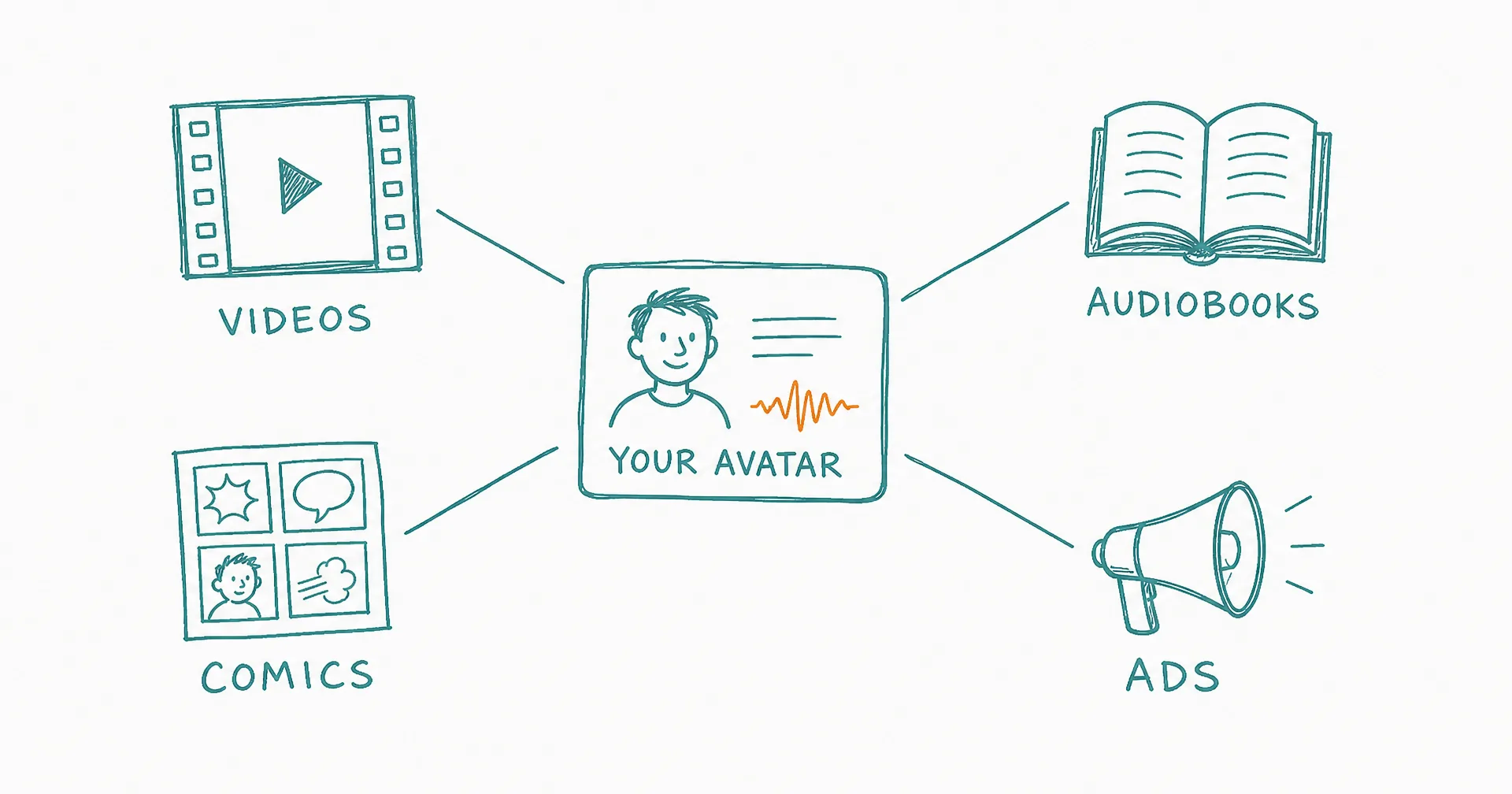
Create once, use everywhere. Avatars let you build consistent digital personas - with your face, your voice, and your style - that work across all your CellCog chats.
- Avatars launched December 23, 2025: persistent digital personas with your face, your voice, and your style, usable across all CellCog chats.
- Build one in the Avatars sidebar: upload reference images, record your voice, set personality traits.
- Invoke anywhere: say ‘using my [avatar name]’ in any chat and the AI handles the rest.
- Multi-character storytelling: build an avatar per character and they stay visually and vocally consistent across scenes and episodes.
- Use cases span product demos in your own voice, audiobooks narrated by you, character casts for series, and brand mascots.
- Project Voices were retired: existing voice clones converted automatically to personal Avatars.
§ 01What You Can Do
- Business owners - record product demos and announcements in your own voice. No voice actors, no sounding like everyone else.
- Authors and podcasters - turn your manuscript into an audiobook narrated by you, or create distinct character voices for each role.
- Content creators - build a cast of characters for comic strips, animated series, or social content. Same characters, consistent look, every time.
- Marketing teams - one brand mascot that looks and sounds identical across hundreds of posts, videos, and ads.
§ 02How It Works
- Go to Avatars in the sidebar
- Upload reference images, record your voice, set personality traits
- In any chat, say “using my [avatar name]” - and the AI handles the rest
Your avatars follow you everywhere: every project, every chat, every piece of content you create.
§ 03Multi-Character Storytelling
Creating a video series or comic with multiple characters? Build an avatar for each one. The AI keeps them visually consistent across scenes and episodes, and each speaks in its own distinct voice.
Consistency is the entire point. Generative tools are brilliant at making a character and historically terrible at making the same character twice - the frustration behind every abandoned AI comic. An avatar turns your character from a lucky roll into a standing definition that every multimodal generation can reference.
§ 04Migrating from Project Voices
We’ve retired Project Voices. If you had voice clones in your projects, they’ve been automatically converted to personal Avatars and are ready to use with all the new capabilities.
§ 05The Honest Caveats
Consistency quality tracks reference quality: clear images from a few angles and a clean voice recording make a dramatically better avatar than one blurry photo. Voice cloning is built for your voice and characters you have rights to - not for impersonating others. And stylized renditions (comics, animation) keep the character recognizable rather than pixel-identical; that’s the medium, not a defect.
Q1What makes an avatar different from just uploading a photo?
Persistence and consistency. An avatar is a standing definition - face references, cloned voice, personality - that every chat can invoke, so your character looks and sounds the same in content made months apart.
Q2How does the voice part work?
You record your voice once during setup; content that needs narration or dialogue can then be generated in it - your product demo speaks as you, your audiobook reads as you.
Q3Can I run multiple characters in one story?
Yes - build an avatar per character. The AI keeps each visually consistent across scenes and episodes, and each speaks in its own distinct voice.
Q4Who gets the most out of avatars?
Business owners recording demos in their own voice, authors turning manuscripts into audiobooks, creators running character-driven series, and marketing teams that need one mascot identical across hundreds of assets.
Q5I had Project Voices - where did they go?
They were converted automatically to personal Avatars, ready to use with all the new capabilities - nothing to migrate by hand.