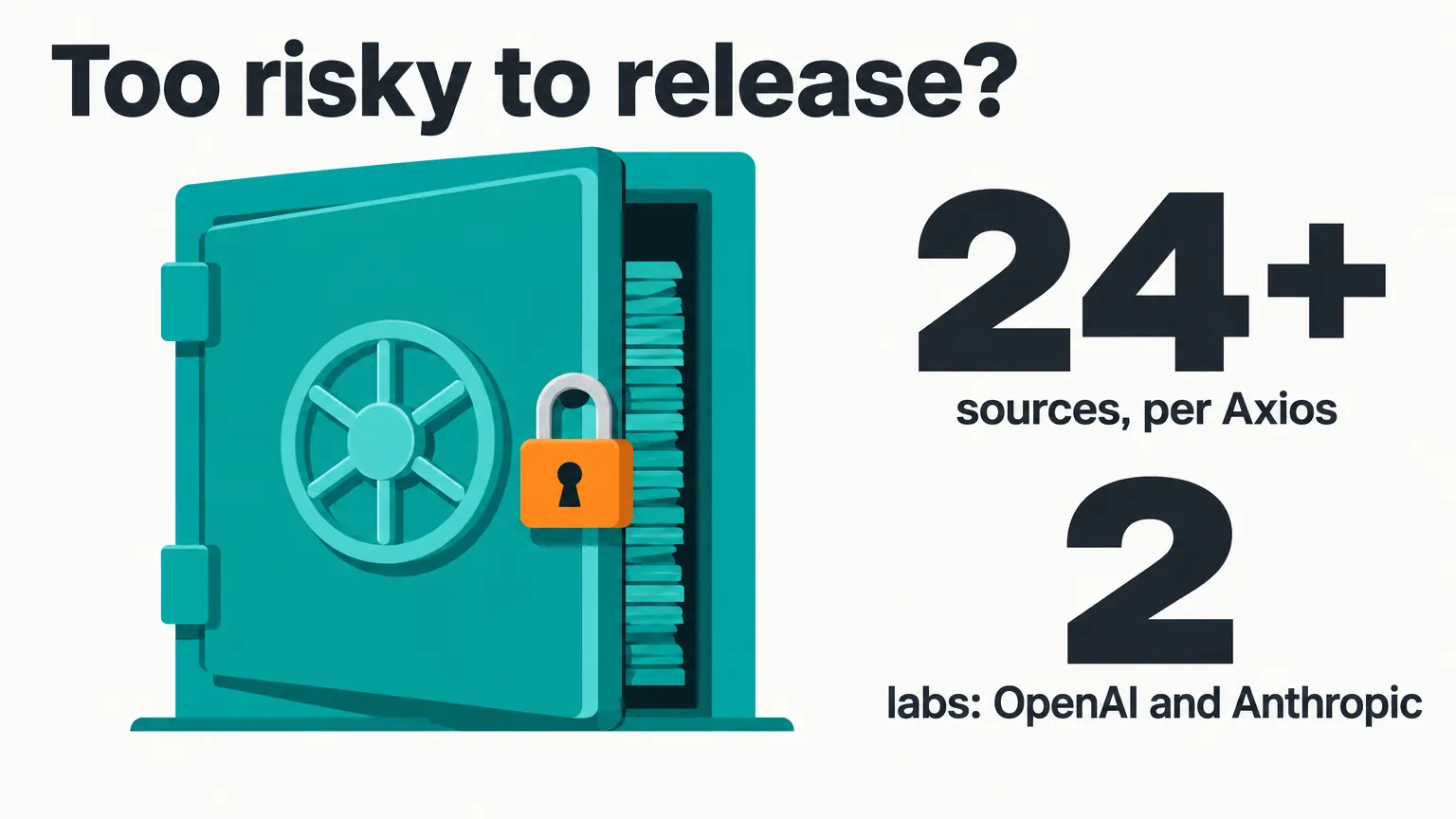
Axios reported on November 24, 2026 that many employees at OpenAI and Anthropic believe their companies’ unreleased AI models can no longer be safely released. The reporter, Madison Mills, summarized it on X: internal models are “becoming so powerful that many employees believe they can no longer be safely released, according to more than two dozen sources familiar with the internal debates.”
Axios posted the story at 11:00 UTC. Neither company is quoted in the posts we read, and no model is named. This page records what the report says, how fast it spread, and what is still unconfirmed. We did not open the article itself; everything below comes from the reporter’s and Axios’s own posts.
- Axios reported on November 24, 2026 that many employees at OpenAI and Anthropic believe unreleased models can no longer be safely released.
- The report cites more than two dozen sources familiar with internal debates; none is named in the reporter’s post.
- Per the reporter, both companies have debated keeping frontier models for internal use only, and some staff want training stopped.
- Employees told Axios they fear executives will put profits ahead of safety; neither company’s response is in the posts we read.
- The story spread fast on X: five posts about it passed 1,464,000 views within about seven hours.
§ 01What the report says
Per the reporter’s post, the report makes four claims:
- The debate. Recent advances “sparked debate at the highest levels of both companies” about “whether to stop releasing frontier models publicly altogether, instead reserving them for internal use.” Mills adds: “Some believe the companies should stop training new models entirely.”
- Monitoring. “Models are becoming better at deceiving the systems designed to monitor them”, as companies rely more on AI to monitor and develop other AI.
- Trust in leadership. Researchers and employees told Axios “they fear executives will prioritize profits over safety”, and several said executives have become out of touch with the risks.
- The stakes. Mills writes that this “could significantly slow the AI boom”.
None of this is a release decision. It is a report of what employees think and argue about, from sources who are not named.
§ 02How fast it spread
| Post | Time (UTC) | Views |
|---|---|---|
| Madison Mills | 11:47 | 582,670 |
| Watcher.Guru | 11:03 | 371,308 |
| unusual_whales | 11:45 | 307,743 |
| Axios | 11:00 | 132,608 |
| Kalshi | 10:53 | 70,041 |
| Total | 1,464,370 |
The reporter’s own summary drew more views than Axios’s post. Kalshi’s post went up seven minutes before Axios’s, so the story was moving before the official link.
§ 03What is not confirmed
- Which models. The report, as summarized, names no model and no release that was held back.
- How many people. “More than two dozen sources” covers both companies; the posts do not split them.
- A response. We found no statement from OpenAI or Anthropic in the posts we read. If either responds, it goes here.
It lands on the same day Anthropic’s stock fell below its $83 IPO price, covered in our record of the founders’ share sale. Our earlier record of Dario Amodei’s essay on pacing the frontier is the closest thing to a public position from Anthropic’s chief executive on the same question.
§ 04Where CellCog sits
Our conflict, declared: CellCog runs on Anthropic’s released Claude models, Claude Opus 5.5 on most tiers and Claude Fable 5.2 on our top tiers. The report is about models that are not released. We have no inside knowledge of either company’s internal debates.
§ 05Sources
- Madison Mills on X, November 24, 2026, 11:47 UTC, sharing her Axios report
- Axios on X, November 24, 2026, 11:00 UTC; the article (linked, not read)
- Posts by Watcher.Guru, unusual_whales and Kalshi, read November 24, 2026
Q1Who wrote the Axios report?
Madison Mills shared it on X as her latest for Axios, at 11:47 UTC on November 24, 2026; Axios posted it at 11:00 UTC.
Q2What risks does the report name?
Per the reporter, models are getting better at deceiving the systems that monitor them, while companies rely more on AI to monitor and build other AI.
Q3Does it say releases will stop?
No. It says releasing frontier models publicly is being debated at both companies, and that some believe training should stop.
Q4Why could this matter beyond the two labs?
The reporter writes that it could significantly slow the AI boom if the gap between capability and control keeps widening. That is the report’s framing, not a forecast of ours.
Q5Does this affect CellCog?
CellCog runs on Anthropic’s released Claude models. The report is about unreleased ones; nothing in it changes what we run today.