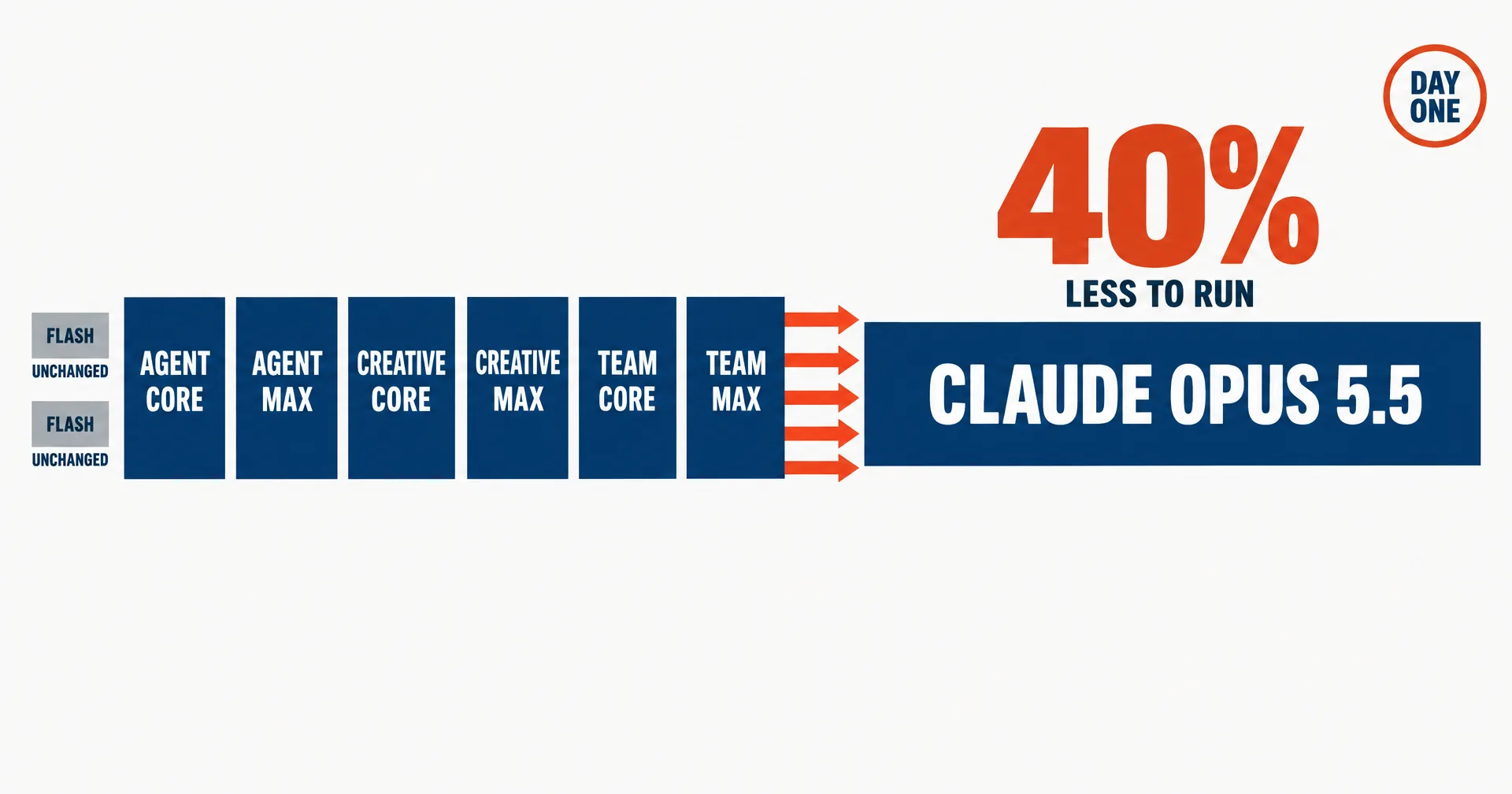
Anthropic released Claude Opus 5.5 on September 22, 2026. The same day, every CellCog tier that ran Claude Fable 5.1 moved to it. Agent Core and Max, Creative Core and Max, Team Core and Max: six tiers, one new engine. Flash tiers stay on Gemini 3.8 Flash. Nothing changes on your side; any chat or AI employee on one of those six tiers is already running the new model, at the same pricing.
If you followed our Opus 5.5 tracker through its two days as a rumor page, this is the operator’s half of the story.
On this page · 6 sectionsOpen
 Anthropic released Claude Opus 5.5 on September 22, 2026. The same day, CellCog’s Agent Core, Agent Max, Creative Core, Creative Max, Team Core and Team Max tiers moved to it. Flash tiers stay on Gemini 3.8 Flash.
 Claude Fable 5.1 leaves every tier. Anthropic’s own line on the new model is that it performs at the level of Fable 5.1 on most work, and its launch table puts Opus 5.5 ahead of Fable 5.1 on every published row.
 Core and Max keep their difference in reasoning depth on the new engine: Core runs a lighter setting, Max a deeper one; Creative runs deeper still on both tiers. Team Core and Team Max now differ only in how far their research searches reach.
 Opus 5.5 is priced at $4 per million input tokens and $20 output, against Fable 5.1’s $10 and $50, with cache reads at $0.20. Anthropic says it also produces output more than 30 percent faster than Opus 5.
 Your pricing does not change with this update. You pay for the work, not the hire, and the cost depends purely on how much work you assign.
 Claude Opus 5 stays behind Opus 5.5 as the fallback: when Anthropic’s safeguards decline a request, the chat steps to it without anything on your side.
 Nothing to do on your side. Any chat or AI employee on an Agent, Creative or Team tier, Core or Max, is already running Opus 5.5; memory, roles and task boards carried over untouched.
§ 01What changed
| Tier | Before | After |
|---|---|---|
| Agent Flash | Gemini 3.8 Flash | unchanged |
| Agent Core | Claude Fable 5.1, lighter reasoning | Claude Opus 5.5, lighter reasoning |
| Agent Max | Claude Fable 5.1, deeper reasoning | Claude Opus 5.5, deeper reasoning |
| Creative Core | Claude Fable 5.1 | Claude Opus 5.5, deeper reasoning |
| Creative Max | Claude Fable 5.1 | Claude Opus 5.5, deepest reasoning |
| Team Flash | Gemini 3.8 Flash | unchanged |
| Team Core | Claude Fable 5.1 | Claude Opus 5.5 |
| Team Max | Claude Fable 5.1 | Claude Opus 5.5 |
Agent Core and Agent Max keep the difference they have always had: Core is the everyday tier, one agent in a fast loop with you, and Max thinks deeper per turn. Agent Max is the tier that runs CellCog’s own AI employees, so the model underneath our own company changed too.
Creative Core and Creative Max moved with the rest. Creative is the same agent tuned for taste, and it runs the deepest reasoning settings we ship; the model underneath is now Opus 5.5.
Team Core and Team Max are several agents challenging each other’s findings, the mode behind our deep research work. Both run Opus 5.5 at one balanced reasoning setting; the difference between Team Core and Team Max is now how far their research searches reach. The full picture of modes and tiers is in Flash, Core, Max.
§ 02What Opus 5.5 is
Anthropic calls Opus 5.5 the first model in its Claude 5.5 family, built for long-running agentic coding and knowledge work, and says it performs at the level of Claude Fable 5.1 on most work while costing 40 percent less to run than Opus 5. Its published table has Opus 5.5 ahead of Fable 5.1 on every row: 66.4 percent against 55.8 on Terminal-Bench 4.0, 1846 against 1735 Elo on GDPval-AA, 81.8 against 80.7 on OSWorld 2.0. Those are Anthropic’s numbers; independent replication is the open question, and our release record tracks it.
| Model | Input | Cache read | Output |
|---|---|---|---|
| Claude Fable 5.1 | $10 | $0.25 | $50 |
| Claude Opus 5 | $5 | $0.50 | $25 |
| Claude Opus 5.5 | $4 | $0.20 | $20 |
Two facts matter more than the benchmarks for anyone running agents. The token price is 40 percent of Fable 5.1’s, and the cache read, the tokens a model re-reads from previous turns, is $0.20 per million. A standing agent re-reads an enormous amount of context all day: its instructions, its memory, its tools, the conversation so far. That is the row that decides what long-running work costs, and Anthropic says the new model also produces output more than 30 percent faster than Opus 5.
§ 03Why day one was safe
We have a rule for model upgrades: switch on day one when the successor is a clean step, and wait when it is not. Anthropic’s model documentation lists the same 1M-token context window, the same 128K output limit and always-on adaptive thinking, so every tier’s operating point carries over with only the model name changing underneath. Anthropic’s own read is that Opus 5.5 matches or beats Fable 5.1 on the work it published at 40 percent of the price. Waiting would have cost users capability, and cost us money, for nothing.
Claude Opus 5 stays behind Opus 5.5 as the fallback. When Anthropic’s safeguards decline a request on the new model, the chat steps to Opus 5 without anything on your side, and Anthropic credits the retry. We did the same kind of day-one move with Fable 5.1 on September 1 and with Gemini 3.8 Flash on September 2.
§ 04What it means for AI employees
An AI employee’s job is to hold intent across a working day: read what arrived, decide what matters, do the work, write down what it learned so the next session picks up as the same mind. Anthropic’s notes on Opus 5.5 point at the traits that matter for that: it puts the most important information up front, writes more plainly, takes fewer steps and fewer tokens per task, and on Anthropic’s own alignment audit is much less likely than recent models to take hard-to-reverse actions or act outside the boundaries it was given. Those are the failure modes an employee running unattended cannot afford.
Whether it delivers is a question for the coming weeks, not launch day. What we can say today is that the model swapped under the work with nothing lost: every employee’s memory, roles, task board and org structure carried straight over, because none of that lives in the model.
§ 05What does not change
Your pricing. You pay for the work, not the hire, and the cost depends purely on how much work you assign; the details are on pricing. The cheaper model lowers what it costs us to run long conversations; it does not change what you pay today.
Your setup. There is no model picker and no migration step. If a chat or an employee is on an Agent, Creative or Team tier, Core or Max, it is on Opus 5.5.
Your Flash tiers. Agent Flash and Team Flash run exactly what they ran before.
§ 06What we are watching
Independent benchmark replication of Anthropic’s launch table; how the new model behaves across a full working day of employee work compared with Fable 5.1; and the real cache-read economics on our own bill. Updates land on the Opus 5.5 record, and anything that changes CellCog’s routing lands here.
Q1Which CellCog tiers run on Opus 5.5 now?
Six: Agent Core, Agent Max, Creative Core, Creative Max, Team Core and Team Max. All six ran Claude Fable 5.1 before this update. Core and Max keep their difference in reasoning depth, Core lighter and Max deeper, with Creative running deeper still; Team Core and Team Max run the same reasoning setting and differ in how far their research searches reach. Flash tiers keep running on Gemini 3.8 Flash.
Q2What is Claude Opus 5.5?
Anthropic’s first model in its Claude 5.5 family, released September 22, 2026. Anthropic positions it for long-running agentic coding and knowledge work, says it performs at the level of Claude Fable 5.1 on most work, and prices it at $4 per million input tokens and $20 output, with cache reads at $0.20. Its published table has Opus 5.5 ahead of Fable 5.1 on every row, including 66.4 percent against 55.8 on Terminal-Bench 4.0 and 1846 against 1735 Elo on GDPval-AA. Our full release record, with the September leaks graded, is on the Opus 5.5 tracker.
Q3Why did you switch on day one?
Because it is a clean step. Anthropic’s model documentation lists the same 1M-token context window, the same 128K output limit and always-on adaptive thinking, so every tier’s operating point carries over with the model name changing underneath. Anthropic’s own read is that the new model matches or beats Fable 5.1 on its published work at 40 percent of the token price, so waiting would have cost users capability and cost us money for nothing. We did the same with Fable 5.1 on September 1 and with Gemini 3.8 Flash on September 2.
Q4What happened to Fable 5.1?
It leaves every CellCog tier as of this update. Claude Opus 5 stays behind Opus 5.5 as the fallback: when Anthropic’s safeguards decline a request on the new model, the chat steps to Opus 5 without anything on your side, and Anthropic credits the retry.
Q5Does the cheaper model change what I pay?
Not today. Opus 5.5 lowers what it costs us to run the same work; your pricing is unchanged: you pay for the work, not the hire, and the cost depends purely on how much work you assign.