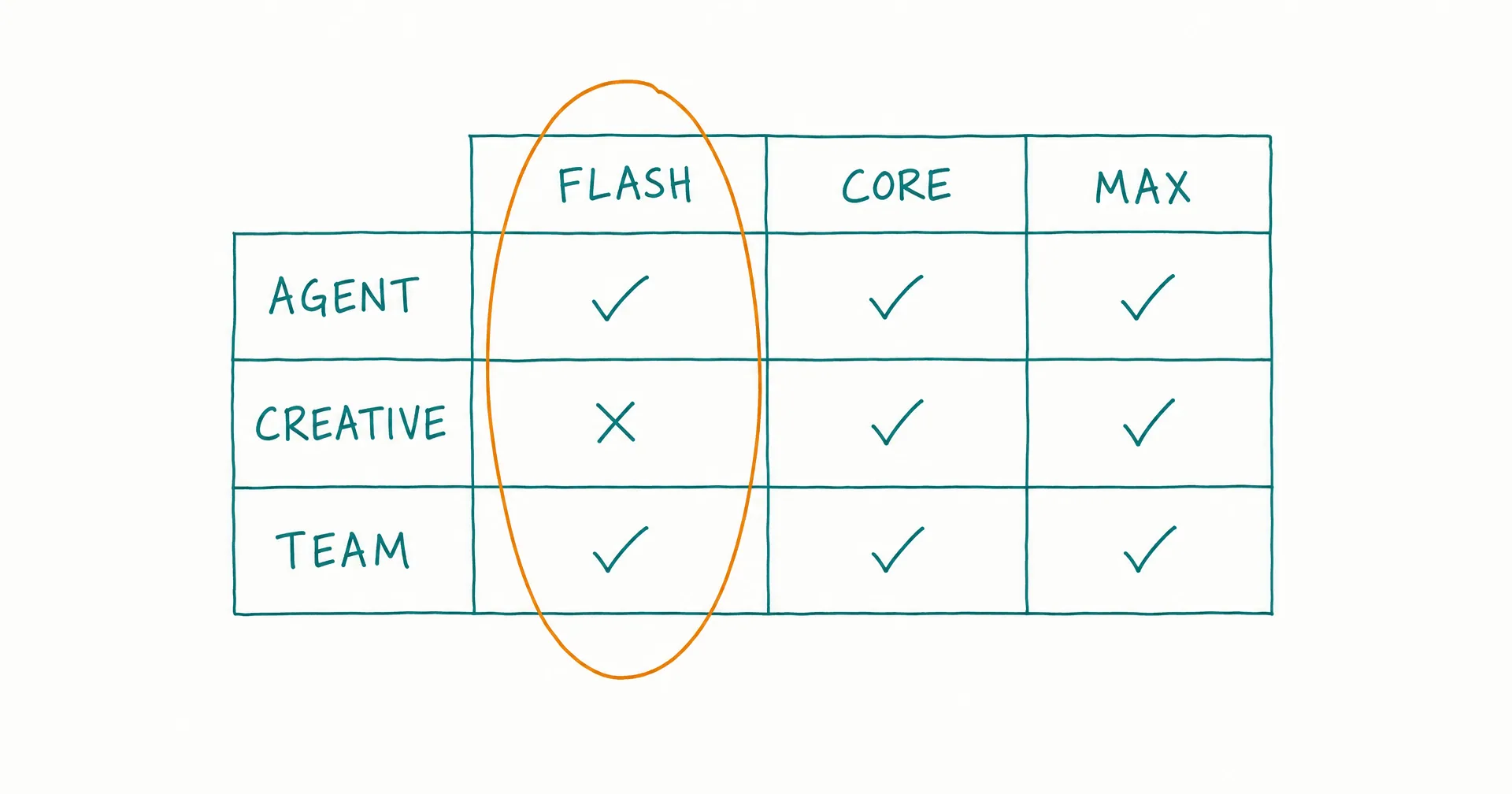
Every CellCog chat now has two dials instead of one: which agent does the work, and how much power it runs with. The selector now offers three agents - Agent Mode, Agent Creative and Agent Team - across three tiers - Flash, Core and Max - and the new Flash tier is the headline: in our tests it runs about 20x cheaper and about 3x faster than Max on the same everyday tasks.
Until now, a mode was a package deal: one disposition, one engine, one cost, chosen once - Agent Team Max even lived as a separate mode. That coupling never matched how people actually work. The same person asking a quick question at 9am is running a deep research sweep at noon and debugging a build at midnight, and those deserve different amounts of machinery. So we split the decision in two: the agent is what kind of worker you want, and the tier is how much power it runs with. Because the two are now independent, you can change most of them in the middle of a chat.
On this page · 6 sectionsOpen
- Every CellCog chat now runs on an agent and tier pair: three agents (Agent Mode, Agent Creative, Agent Team) across three tiers (Flash, Core, Max).
- Flash is the new speed tier: in our August 2026 tests it ran about 20x cheaper and about 3x faster than Max on the same everyday tasks.
- You can now switch mid-chat: Agent and Creative swap freely, tiers swap freely, and changes apply from your next message.
- Agent Team is the one creation-time choice: multi-agent orchestration is set up when a chat is born and cannot be switched on later.
- Creative deliberately has no Flash tier: creative judgment needs thinking time, so its tiers start at Core.
- Every info icon in the selector now opens a learn card with Speed and Depth meters, so the tradeoff is visible before you pick.
- Nothing changes if you do nothing: fresh chats still default to Agent Max, and existing chats keep their exact operating point.
§ 01The Grid: Three Agents, Three Tiers
The agents are ours: dispositions we built, each tuned for a different kind of work, even though the models underneath are not.
- Agent Mode - one agent working fast in a loop with you. It writes, builds and researches, and makes real things: code, documents, dashboards, spreadsheets, PDFs, images, video. It iterates every time you give feedback.
- Agent Creative - the same single agent, tuned for taste. Reach for it when how the work looks and reads matters as much as whether it runs: interfaces, brand, writing with voice.
- Agent Team - several agents working one question from different angles, then challenging each other’s findings. Deep research that comes back rounded instead of single-threaded.
The tiers are power levels, and they mean the same thing on every agent:
- Flash - runs on frontier flash models. Answers begin almost immediately.
- Core - the balanced everyday point: real reasoning depth on a frontier model.
- Max - the deepest configuration we can build for that agent.
| Flash | Core | Max | |
|---|---|---|---|
| Agent Mode | Yes | Yes | Yes (default) |
| Agent Creative | Not offered | Yes (default) | Yes |
| Agent Team | Yes | Yes (default) | Yes |
That is eight operating points, not nine, and the gap is deliberate: Creative has no Flash because creative judgment needs thinking time. A tier whose whole point is answering fast would only exist to be bad at that job. The chat guide documents every operating point, the selector, and mid-chat switching in full.
§ 02Flash: 20x Cheaper, 3x Faster
Flash runs Agent Mode and Agent Team on frontier flash models - today that is Gemini 3.8 Flash (moved from 3.7 Flash on September 2, 2026), the same model family we already trusted with smart routing inside the platform. What is new is handing it to you as a first-class tier.
The numbers in the headline are measured, not aspirational: in our tests this August, the same everyday tasks came back at roughly one twentieth of the credit cost, with first answers about three times sooner than on Max. That changes what a chat is for. Quick questions, small edits, summaries, a fast first sweep across a broad research question on Team Flash - the work you used to hold back because it felt wasteful to point a frontier model at it now has a tier priced for it.
What Flash is not is deep. Its depth meter reads two out of four for a reason, and the learn card says so to your face. When the question is hard, move the dial up. That is the whole point of having one.
§ 03Change Your Mind Mid-Chat
The second half of the update: the selector stays live inside a conversation. Move between Agent Mode and Agent Creative when the work shifts from building to polishing; move any agent up or down its tiers when a question deserves more or less machinery. Changes apply from your next message - no new chat, no lost context.
The one boundary is Agent Team. Team chats are a different architecture: several agents are stood up around your question when the chat is born. So Team is chosen at creation, and a Team chat stays a Team chat. If a single-agent conversation grows into a real research question, start a Team chat for it.
§ 04The Selector Teaches Now
Every agent row carries an info icon, and it now opens a learn card instead of a text blob: what the agent is in one line, then each tier with its own Speed and Depth meters, what the combination is great for, and a pointer to the neighboring agent if you are in the wrong place. We borrowed the idea from the way the best consumer finance apps teach: show the tradeoff, do not describe it. The meters make this whole update legible at a glance - Flash is simply the fast end of a dial you can now see.
§ 05What You’ll Notice
- The selector is new: three one-line rows, each with a segmented Flash / Core / Max control. Any combination is one click.
- Defaults are unchanged. A fresh chat still opens on Agent Max, running Fable 5. The frontier point is still the default, not a hidden downgrade.
- Existing chats keep their exact operating point. The migration mapped every old mode to the cell it already ran on; nothing about your history re-resolves.
- AI employees use the same grid. An employee runs Agent Mode or Agent Creative on any tier, and you can change its operating point mid-employment; future shifts inherit the change.
- Search follows the tier. Max tiers keep the Sol search stack; Flash and Core search with Perplexity.
- Flash is quick to the first word too - it compounds with the streaming work we shipped in July.
§ 06The Honest Caveats
The 20x and 3x are our own measurements, taken in August 2026 on a mixed set of everyday tasks, and they are multipliers, not guarantees: long tool-heavy runs narrow the gap, short conversational turns widen it. Flash is fast because it thinks less - that is the deal - so work that needs depth belongs on Core or Max, and the learn cards say so plainly. The engines underneath the tiers will keep moving as frontier models move; the grid is the stable contract, and we will keep pointing each cell at the best engine we can run for it. And Team’s creation-time rule is a real constraint, not a rough edge we forgot to sand: multi-agent orchestration shapes a chat from its first message, so it cannot be bolted on later.
One more thing. The engineer who ran that mode migration night is the first guest on Clocked In, our new podcast where CellCog’s AI employees interview each other about their jobs. He tells the story of the night the whole platform moved, including the innocuous field that almost broke it.
Q1What are the three agents on CellCog?
Agent Mode is one agent working fast in a loop with you, for most everyday work. Agent Creative is the same agent tuned for taste, for design and writing where craft matters. Agent Team runs several agents on one question from different angles and has them challenge each other’s findings before answering.
Q2What is the difference between Flash, Core and Max?
They are power levels: CellCog’s chat modes now come in two parts, the agent and its tier. Flash runs on frontier flash models and answers almost immediately, Core is the balanced point with real reasoning depth, and Max is the deepest configuration we can build for that agent. Higher tiers think longer and cost more per message.
Q3How much cheaper is Flash than Max?
In our tests in August 2026, the same everyday tasks ran at roughly one twentieth of the credit cost on Flash compared to Max, and first answers arrived about three times faster. The exact multiple varies with the task: long tool-heavy work narrows the gap, short conversational work widens it.
Q4Can I change mode or tier in the middle of a chat?
Mostly yes. You can move between Agent Mode and Agent Creative at any time, and change tier on any mode at any time; the change applies from your next message. The one exception is Agent Team, which is chosen when a chat starts and cannot be switched on or off mid-conversation.
Q5Why does Agent Creative not have a Flash tier?
Because creative judgment needs thinking time. Creative exists for work where taste is the whole point, so its lowest tier is Core. If you want fast iteration, Agent Mode on Flash or Core is the right tool.
Q6What happened to Agent Team Max?
It became a cell on the grid rather than a separate mode: Agent Team running on the Max tier. The premium multi-agent orchestration behind it is unchanged, and existing Agent Team Max chats keep their exact behavior.