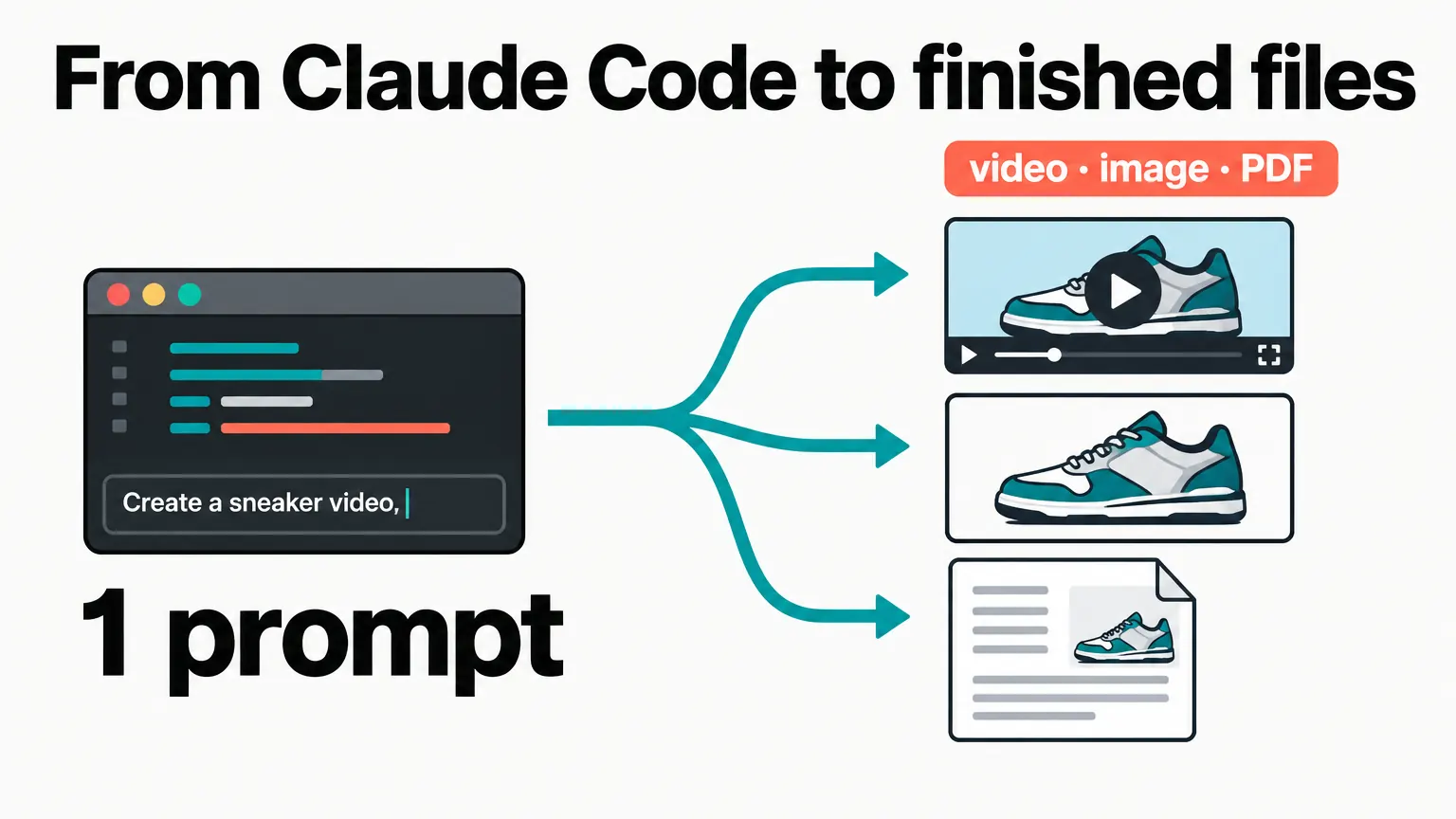
If you sell a product and already work in Claude Code, you can get launch videos, product images and one-page PDFs from the same session. The CellCog plugin adds skills that send media and document tasks to CellCog and bring the finished files back into your project. This page shows the setup, the requests that work best for product teams, and the point where a repeating request should become an AI employee instead.
Everything below comes from our Plugin Guide and the plugin repository. We make the plugin, so read this as a vendor’s setup guide.
 The CellCog plugin adds a set of skills to Claude Code, so you can ask for a product video, product images or a PDF in plain words and get the files back in your project.
 Two commands install it: add the CellCog marketplace, then install the plugin; the Python SDK and an API key from your CellCog profile finish the setup.
 Beyond video it covers images, PDFs, slide decks, spreadsheets, research with citations, music, voiceover, diagrams and 3D models, each with its own skill.
 Run /cellcog:cellcog-setup inside Claude Code to check the SDK, install it if needed and walk through the API key.
 When the same request comes back every week, such as a video for each new product, that is a role, not a prompt.
 Hire an AI employee for that role: it keeps its own memory, schedule and files, and delivers the weekly assets without you typing the request again.
§ 01Set it up in two minutes
Add the CellCog marketplace, install the plugin, then install the Python SDK and set your API key:
bash
claude plugin marketplace add CellCog/cellcog-plugin
claude plugin install cellcog@cellcog
pip install -U cellcog
export CELLCOG_API_KEY="sk_..."
The key comes from your CellCog profile under API keys. If anything is missing, run /cellcog:cellcog-setup inside Claude Code: it checks the SDK, installs it if needed and walks through the key. The SDK is on PyPI, and the plugin follows the Open Plugins standard, so other plugin hosts can load the same repository.
§ 02What to ask for
You write the request the way you would brief a designer. The plugin picks the skill and Claude Code sends the task. A request like “Create a 30-second marketing video for our new fitness app” returns a video file; “Design logo concepts and a one-pager PDF for my coffee shop” returns images and a PDF.
| You need | Ask for | Skill the plugin loads |
|---|---|---|
| A launch video | A 30-second video for the new product, with captions | video-generation-cellcog |
| Product shots | Three lifestyle images of the product on a clean background | image-generation-cellcog |
| A one-pager | A one-page PDF with the product, price and three benefits | pdf-document-generation-cellcog |
| A pitch or sales deck | A ten-slide deck for retail buyers | presentation-slides-cellcog |
| A price sheet | A spreadsheet of SKUs and margins with a chart | excel-spreadsheet-cellcog |
| Market research | A cited report on competitors in the category | deep-research-cellcog |
| A voiceover | A narration track for the launch video | audio-generation-cellcog |
Files land in ~/.cellcog/chats/ under the chat’s id, or at the path you name in a GENERATE_FILE tag, so they can go straight into your repository or your store’s asset folder. The agent picks a mode for you: Agent for most tasks, Agent Creative for design and brand work, Agent Team for deep research, each at Flash, Core or Max.
§ 03When the request repeats, hire for it
A plugin request is one job. Product businesses rarely need one video: they need a video, a product shot and a listing sheet for every new product, every week. Once you type the same request on a schedule, it has become a role.
| The plugin in Claude Code | An AI employee on CellCog | |
|---|---|---|
| Starts when | You type a request | Its schedule, a new task or an email |
| Remembers | The session you are in | Your brand, products and past work, in written memory |
| Works on | Your machine and project | Its own secure computer, file system, inbox and task board |
| Best for | One-off assets while you build | Weekly launch assets, listings and reports |
| Cost | Credits per task | You pay for the work, plus a monthly fee for each AI employee |
The two work together: keep the plugin for the one-offs you need mid-build, and hire an AI content creator for the weekly launch kit. It holds your brand rules, makes the video, images and listing sheet for each product, and asks before anything is posted or sent. Our guide to hiring an AI employee covers the first conversation.
§ 04Sources
- CellCog, Plugin Guide, read November 26, 2026
- CellCog plugin repository on GitHub
- cellcog on PyPI
- Open Plugins standard
- CellCog, Introducing the CellCog Plugin and the Linear Agent, April 29, 2026
Q1Is the CellCog plugin free?
The plugin is free and open source under the MIT license. Tasks it sends to CellCog use credits from your CellCog account.
Q2What can I ask for besides video?
Images, PDFs, slide decks, spreadsheets, research reports with citations, music, voiceover, diagrams, UI prototypes and 3D models. Each has a skill the plugin loads automatically.
Q3Where do the files go?
They download to ~/.cellcog/chats/ under the chat’s id, or to the path you name with a GENERATE_FILE tag in the request.
Q4Does it work in Cursor?
The plugin is not in Cursor’s marketplace yet. Cursor connects over MCP from MCP / API in the CellCog sidebar, or through the CellCog skill.
Q5What is the difference between the plugin and an AI employee?
The plugin answers the request you type, inside your coding session. An AI employee holds a role: it remembers your brand and products, works on a schedule and sends you the results.
Q6How much does CellCog cost?
Plans start at $8 a month. You pay for the work, plus a monthly fee for each AI employee. Try it free, no credit card needed.