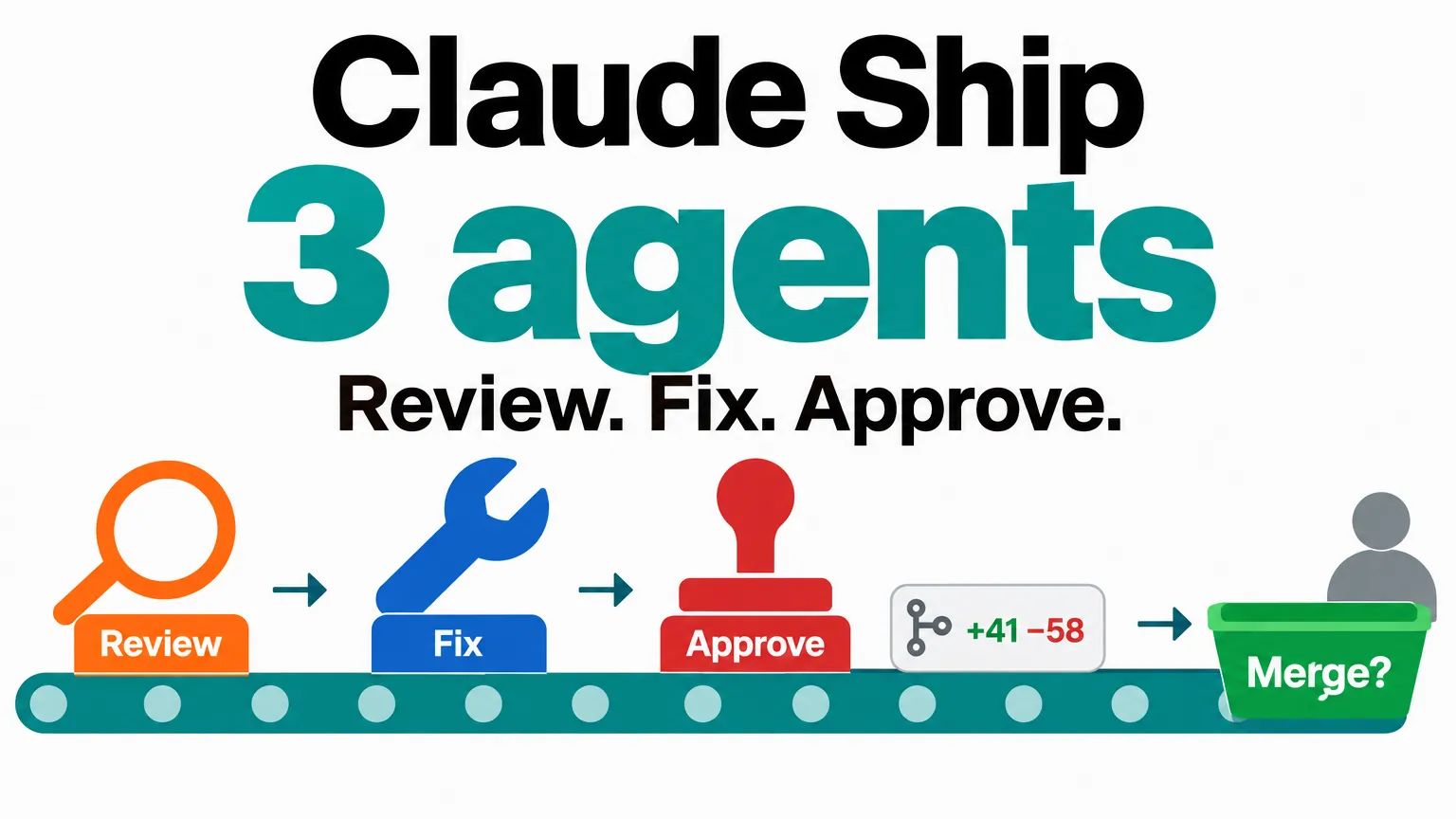
Anthropic has launched Claude Ship, three agents that take a GitHub pull request from review to an approval decision. Its launch post on X, at 20:13 UTC on November 23, 2026, put it in one line: “Claude can review your pull requests, work on fixes, and approve the ones your team’s policy allows.” Code Review was already on sale; PR Steward and Claude Approvals are new and in beta.
Claude Ship is Anthropic’s product, not CellCog’s; we have no part in it and have not tested it. This page sets out what Anthropic’s announcement, product page and documentation say, what it costs, and the one setting Anthropic itself warns about.
On this page · 10 sectionsOpen
- Anthropic launched Claude Ship on November 23, 2026: three agents that take a GitHub pull request through review, fixes and an approval decision.
- Code Review is generally available; PR Steward and Claude Approvals are in beta.
- PR Steward pushes fixes for failing checks, conflicts and review comments, and is designed not to approve or merge.
- Claude Approvals applies a policy file in the repo and can approve routine changes on its own where the policy allows.
- It is for Team and Enterprise plans on GitHub, billed on tokens, and not offered with Zero Data Retention, the HIPAA configuration or customer-managed keys.
- Eligible Enterprise organizations can claim at least $10,000 in Claude Ship credits by January 15, 2027.
§ 01The three agents
| Agent | Status | What it does | What it is designed not to do |
|---|---|---|---|
| Code Review | Generally available | Reviews a pull request at Quick, Standard or Deep level and posts findings ranked Important, Nit or Pre-existing | Merge anything |
| PR Steward | Beta | Pushes fixes for failing checks, merge conflicts and review comments, and says after each push what it changed and how to undo it | Approve or merge a pull request |
| Claude Approvals | Beta | Checks the pull request against a policy file the team writes, and can approve routine changes where the policy allows | Block a merge unless the team makes it a required check |
Addy Osmani, on the Claude Code team, described Approvals as “a smarter CODEOWNERS”. The policy lives in .claude/approvals.yml and can name how many people must approve changes to a path, use classifiers a team writes in plain language, and say whether Claude’s approval counts. Developers steer PR Steward by commenting @claude with an instruction, or @claude stop to make it step back.
There are two ways in. A developer can run /ship in Claude Code on a finished change: Claude pushes it, opens the pull request, reviews it and works on feedback. An admin can instead turn the agents on repository by repository, so they run on every pull request without anyone typing a command. Anthropic says /ship is rolling out in Claude Code and the desktop app starting today.

§ 02Who can use it, and what it costs
- Plans. Claude Team and Enterprise, for repositories on GitHub only.
- Excluded. Organizations with Zero Data Retention, the HIPAA configuration or customer-managed encryption keys cannot use the agents.
- Billing. No flat price. Each agent is billed on tokens through the organization’s usage credits, separately from the plan’s included usage. Admins can set spend limits for Code Review and PR Steward; PR Steward has none until one is set.
- Approvals. No base charge, but classifiers in a policy are billed, and a policy that uses Claude’s review starts a billed Code Review, even in observe mode.
- /ship. Counts as regular Claude Code usage.
- Promotion. Eligible Enterprise organizations can claim at least $10,000 in Claude Ship credits, to use within 30 days of claiming. The claim window closes January 15, 2027.
§ 03How Anthropic says to roll it out
- Turn on Code Review in one repository and set a monthly spend limit. Read the average cost per review before adding more repositories.
- Add PR Steward in Manual mode, where a developer comments
@claude stewardto start it. - Add an approval policy in observe mode, where the check reports what the policy would decide and approves nothing. Enforce it only once it matches your reviewers.
To switch it off, Anthropic says to remove Approvals before Code Review, because a policy can start billed reviews where Code Review is off.
§ 04The merge no person touches
The documentation carries one warning worth reading twice. If a team uses GitHub auto-merge or a merge queue with a policy that does not require a person’s approval, “a change can merge without anyone acting.” That is the setting where Claude Ship stops being a reviewer and becomes the last step before production. Anthropic’s own FAQ adds: “Claude Ship uses AI and may miss bugs, security vulnerabilities, or other issues.”
§ 05Anthropic’s own numbers
Anthropic says the Claude Code team runs Claude Ship on many of its own pull requests. On that team, where Claude’s review is one layer of a broader process, merged pull requests more than doubled from June to September while the share reverted fell by more than 40%. Those are Anthropic’s internal figures; it has not published the underlying counts.
Two customers are quoted. Vatsal Bhatt of TELUS Digital: “We keep a human in the loop, and the human’s time now goes to the changes that need it.” Alex Devkar of Carvana says PR Steward is helping teams in its pilot spend less time on review feedback. The stated goal, in the announcement: “ship code as fast as teams write it.”
§ 06Opus 4.5, a year on
Boris Cherny, who leads Claude Code, tied the launch to a model: “A year ago we launched Opus 4.5, the first model to write 100% of my code.” The same day, Anthropic’s release notes announced the deprecation of Claude Opus 4.5, with retirement on the Claude API on January 22, 2027, and recommended moving to Claude Opus 5.5.
§ 07How far it spread
| Post | Time (UTC) | Views |
|---|---|---|
| Claude Devs | 20:13 | 185,138 |
| Boris Cherny | 20:21 | 36,511 |
| Addy Osmani | 20:16 | 15,907 |
§ 08What we did not check
- Real costs. Anthropic publishes no per-review price; the cost depends on review level, change size and how often reviews run.
- The promotion terms. We did not read the credit terms page, so eligibility beyond “eligible Enterprise organizations” is Anthropic’s to state.
- Quality. We have not run Claude Ship on a repository; nothing on this page is a test of its reviews.
§ 09Where CellCog sits
Our conflict, declared: CellCog builds AI employees, including an AI software engineer that writes code and opens pull requests. Claude Ship works on the other side of that pull request, after it opens. CellCog has no part in Claude Ship.
§ 10Sources
- Introducing Claude Ship, Anthropic, November 23, 2026
- Claude Ship product page, Anthropic
- Claude Ship documentation, Anthropic
- Claude Platform release notes, Anthropic
- Claude Devs on X, 20:13 UTC, November 23, 2026
- Boris Cherny on X, 20:21 UTC, November 23, 2026
- Addy Osmani on X, 20:16 UTC, November 23, 2026
Q1What is Claude Ship?
A set of three Anthropic agents launched in beta on November 23, 2026. Code Review finds problems in a pull request, PR Steward pushes fixes, and Claude Approvals checks the pull request against an approval policy the team writes.
Q2How much does Claude Ship cost?
There is no flat price. Each agent is billed on tokens through the organization’s usage credits, separately from the plan’s included usage. Admins can set spend limits for Code Review and PR Steward. Running /ship counts as regular Claude Code usage.
Q3Can Claude Ship approve and merge pull requests by itself?
PR Steward is designed not to approve or merge. Claude Approvals can post an approving review where the policy file allows it. With GitHub auto-merge or a merge queue and a policy that does not require a person, Anthropic says a change can merge without anyone acting.
Q4Who cannot use Claude Ship?
Individual Pro and Max plans, repositories outside GitHub, and organizations with Zero Data Retention, the HIPAA configuration or customer-managed encryption keys.
Q5Is Claude Ship a CellCog product?
No. Claude Ship is Anthropic’s product. CellCog has no part in it and has not tested it.