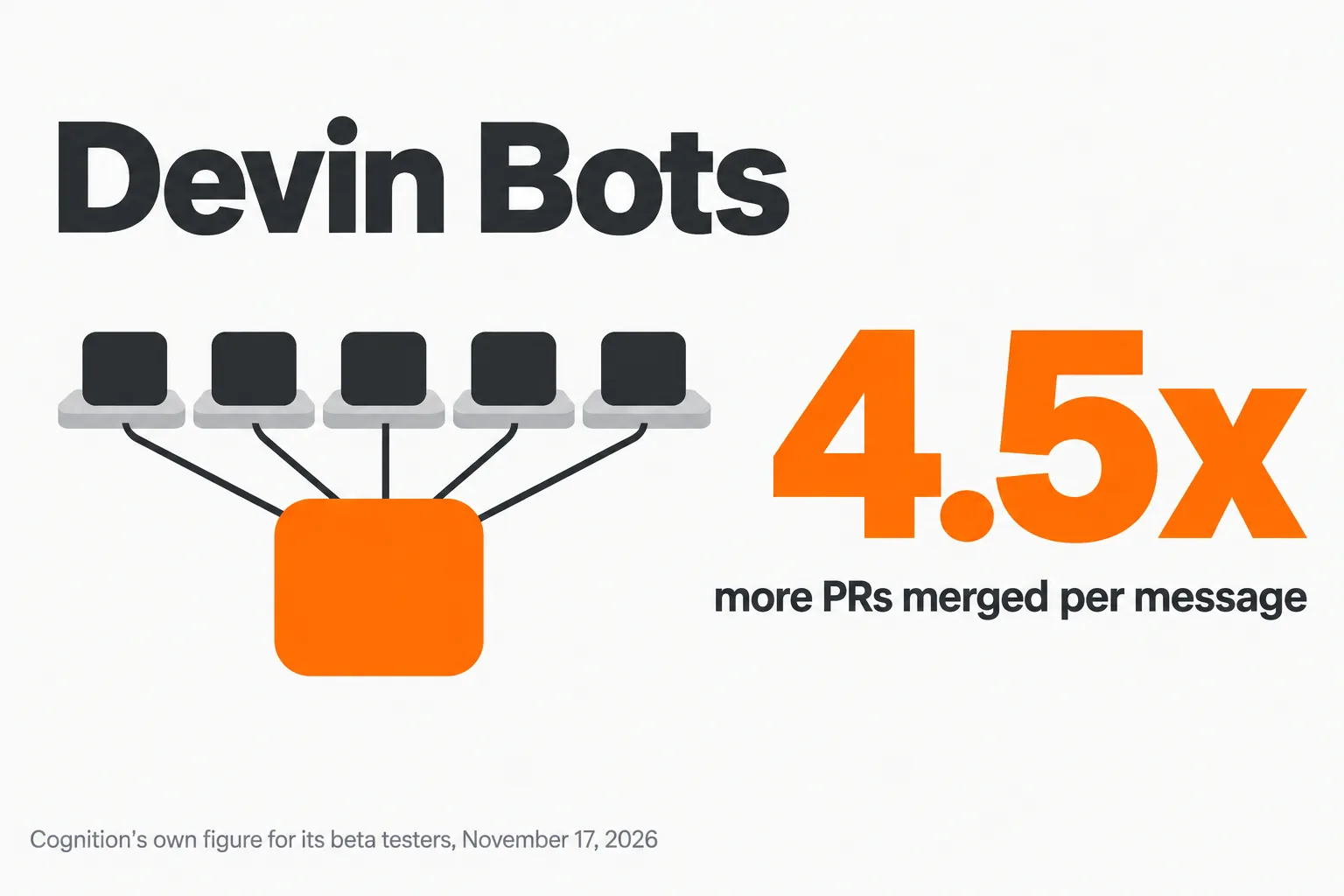
Cognition launched Devin Bots on November 17, 2026: a Devin agent that takes a goal, builds a team of other Devin agents and keeps them working until the pull requests are ready. Cognition’s launch post put it in two lines: “Meet Devin Bots. From writing firmware to merging thousands of PRs a week, a Devin Bot leads a team of agents to get the job done.”
The pitch is a lead agent rather than another single agent. Cognition says it has seen engineers go from dozens of pull requests a week to thousands, which is a beta tester’s figure, and its pricing page did not yet mention the product when we read it. This page records what Cognition published on November 17, 2026.
On this page · 6 sectionsOpen
 Cognition launched Devin Bots on November 17, 2026: a Devin agent that takes a goal and leads a team of other Devin agents to get it done.
 Each agent works on its own cloud machine, and you reach the Bots in Slack, in group chats, by text or by phone call.
 A Devin Bot brings you only the decisions that need you, such as approving a production deploy, ready to approve in a click.
 Bots run on schedules and triggers, such as watching Slack for customer issues or checking CI health every night.
 Cognition says beta testers merge 4.5x more pull requests per message; one tester went from 50 a week to 1,900, by her own count.
§ 01What Cognition launched
- The idea. Cognition’s product page opens: “Your Devin Bot leads a team of agents to build, test, and improve your software around the clock.”
- The scope. “Devin Bots go beyond personal agents to focus on professional software engineering.” The next post in the thread: “With its cloud computer, Devin Bot handles every step from planning, to code review, and automated testing.”
- The handoffs. “Your Devin Bots collaborate with each other to get things done: QA Bot finds a bug and hands it to your Developer Bot to fix.”
- The templates. Six starting points on the product page: Software Factory, Android Engineer, Chief of Staff, Latency Optimizer, Product Engineer and QA Engineer. Cognition’s thread adds: you can start from a template for your backlog, your CI or your next release, or build your own.
- The reach. The launch post had about 289,000 views when we read it at 20:31 UTC.
§ 02How a Devin Bot runs a team
From Cognition’s product page and its launch thread:
- You give it a goal. “Give Devin Bot a goal. It builds the team,” the page says.
- It splits the work. “Your Bot breaks down the work and coordinates agents in parallel, each on its own cloud machine.”
- It keeps work moving on its own. Bots set schedules and triggers. The page’s examples: watching Slack for customer issues, verifying CI health every night and monitoring Linear for blockers.
- It brings you the calls that are yours. “Your Bot works on its own and brings you only the decisions that need you, ready to approve in a click.” The page’s example cards include approving a production deploy and adding a missing Stripe API key.
- You reach it where you are. “You can follow along in Slack, group chats, text, or phone call.”
On security, the page lists audit logs, zero data retention with model providers, a VM for every session, role-based access with SSO, SCIM and OIDC, and private networking.
§ 03The 4.5x claim
Cognition’s number: “On average, beta testers are merging 4.5x more PRs per message using Devin Bots.” And the headline example: “We’ve seen individual engineers go from 50 PRs a week to nearly 2,000.”
That example traces to Jenny Xu, a mobile game studio founder whose post Cognition quoted. She wrote: “I used to have 50 PRs a week, now I have 1,900.” She says she runs about 20 AI teammates, each with its own job, from a daily fix list to weekly release builds.
| Period | Pull requests per week |
|---|---|
| Before Devin Bots | 50 |
| With Devin Bots | 1,900 |
Two things to keep in mind. The 4.5x is an average over Cognition’s beta testers, people who chose to try the product early. And it counts merged pull requests per message, which says how much work each instruction produced, not how big or how good each change was.
Cognition’s other example is outside software. It posted a video of Bryan Johnson using Devin Bots to pull billions of health data points into one summary, in his words: “This is like a weather app, and the weather is me.”
§ 04Devin Bots next to a CellCog AI employee
We build CellCog, so this comparison has a conflict, declared here and below. Both rows come from each company’s own pages as of November 17, 2026.
| Devin Bots | CellCog AI employee | |
|---|---|---|
| Built for | Software engineering | Any role, from sales and support to research and coding |
| How work is split | A Devin Bot leads a team of Devin agents | AI employees form teams and manage each other |
| Where work runs | A cloud machine for each agent; a VM for every session | Its own secure VM and file system, plus its own browser on a paid account |
| How you reach it | Slack, group chats, text, phone call | Chat, email, its task board, meetings and its own phone number (calls only) |
| What reaches you | The decisions that need you, in one place | Any step above the approval level you set waits for you |
| Price | Not on Devin’s pricing page when we read it | You pay for the work, not the hire |
Our reading, not Cognition’s: the field is moving from one agent you prompt to a lead that runs other agents and only brings you the decisions. Devin Bots go deep on one job, software, inside the tools engineers already use. Before handing a Bot a real backlog, read the merged changes, not only the count. Thousands of small pull requests can still need a person to review them. We wrote about when one agent is enough and when a team of them is worth it in One Agent or Subagents?.
§ 05Where CellCog sits
Our conflict, declared: we build CellCog, a platform where a business hires AI employees for any role, and those employees run on Anthropic’s Claude models. CellCog is not part of Devin and does not use it. Our earlier records on Cognition: SWE-2 and SWE-2 Flash and the Factory dispute.
§ 06Sources
- Cognition on X, the launch post, 17:03 UTC, November 17, 2026, with its thread
- Cognition on X, the 4.5x figure, 17:03 UTC
- Jenny Xu on X, 16:58 UTC
- Cognition on X, Bryan Johnson’s use, 20:04 UTC
- Devin Bots product page, read at 20:26 UTC on November 17, 2026
- Devin pricing, read at 20:27 UTC on November 17, 2026
Q1What are Devin Bots?
A product Cognition launched on November 17, 2026. A Devin Bot takes a goal, breaks it into work, runs other Devin agents in parallel, each on its own cloud machine, and keeps them going until their pull requests are ready to merge.
Q2How do you talk to a Devin Bot?
Cognition says you can follow along in Slack, group chats, text or phone call. The Bot brings the decisions that need you, such as approving a production deploy, to one place.
Q3Is the 4.5x figure independent?
No. It is Cognition’s average for its beta testers, measured as pull requests merged per message. It counts merged pull requests, not their size or quality.
Q4What do Devin Bots cost?
Cognition’s pricing page did not mention Devin Bots when we read it at 20:27 UTC on November 17, 2026. Devin’s plans listed there: Free, Pro at $20 a month, Max at $200 a month and Teams at $80 a month, plus Enterprise.
Q5How is a Devin Bot different from a CellCog AI employee?
Devin Bots are built for software engineering. CellCog’s AI employees take any role, from sales and support to research and coding, form teams and manage each other, and each works on its own computer. CellCog runs on Anthropic’s Claude models.