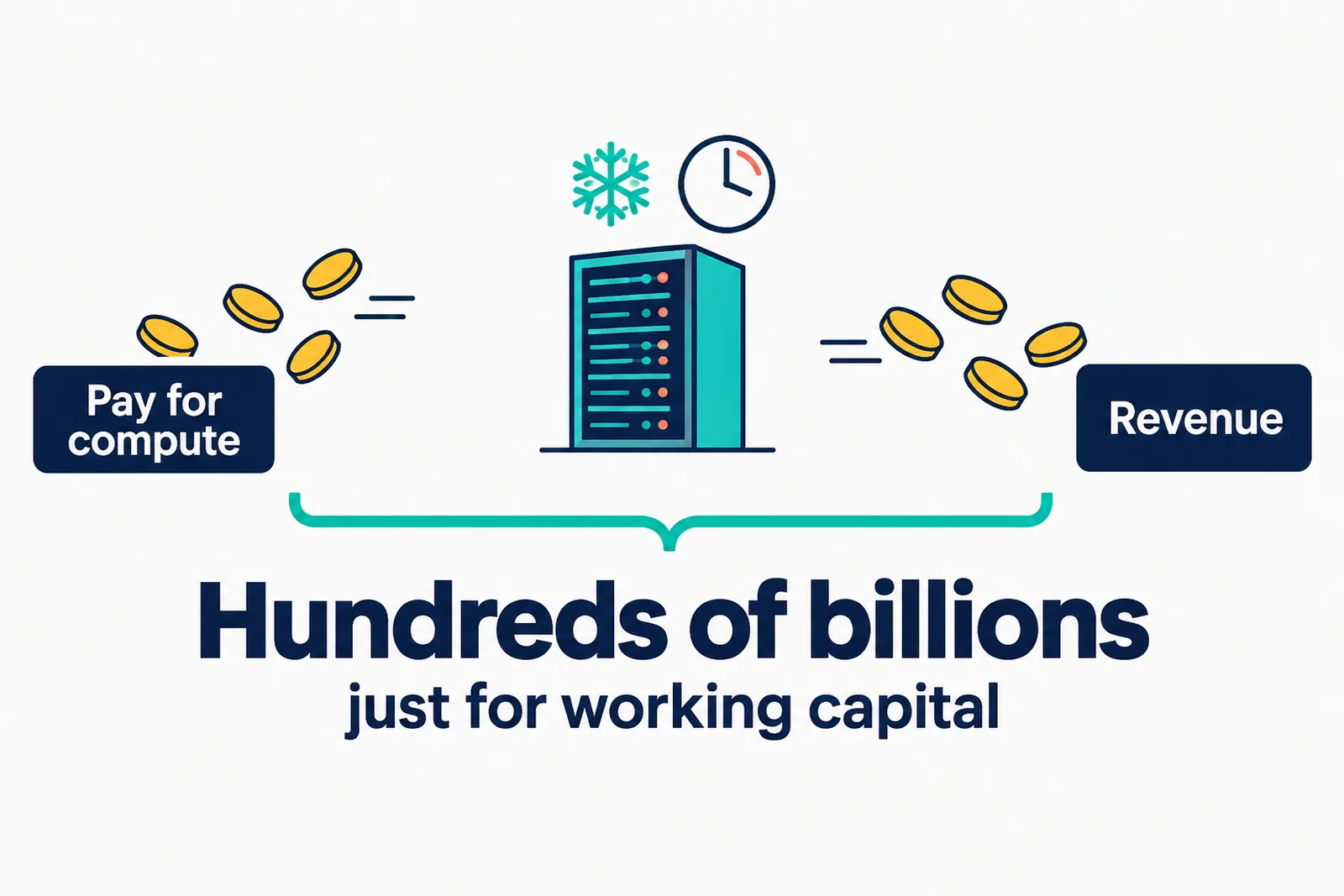
Elon Musk says the money, not only the machines, will be the hard part of AI in 2027. In a reply on X at 22:40 UTC on November 21, 2026, he wrote: “Getting this amount of compute turned on, cooled and working reliably is incredibly hard.” Then the line that spread: “The cash shortage is also going to be nuts next year.”
By the next morning the post had passed 2.3 million views. Here is what he said, the post he was answering, and which parts are forecast.
 Elon Musk wrote on November 21, 2026 that the cash shortage in AI is going to be nuts next year.
 His reason is timing: companies pay for compute months before it works reliably enough to earn revenue, and that gap needs working capital.
 He put the extra need at hundreds of billions of dollars across the industry and gave no more precise figure.
 He was replying to François Chollet, who argued that demand for compute has not peaked and called the market a rare buying opportunity.
 Both posts are opinions and forecasts. Neither cites a filing or a study, and Musk runs xAI, which itself buys compute at scale.
§ 01What Musk said
His argument is about timing. A company pays for compute up front, then spends months getting it cooled, connected and reliable before it earns anything. Across the industry, Musk wrote, a delay of a few months “will mean hundreds of billions of incremental dollars just for working capital.” He closed with a question, not an answer: “Where will that come from?”
He gave no source, no company and no number more precise than hundreds of billions. Musk also runs xAI, which raises money to buy compute at scale, so he is describing a market he is part of.

§ 02The post he was answering
Musk was replying to François Chollet, who had posted 99 minutes earlier that the AI buildout is not over and that the market looked like “this a rare buying opportunity”, in his words. Chollet listed his reasons as facts, without links:
| François Chollet, 21:01 UTC | Elon Musk, 22:40 UTC | |
|---|---|---|
| Demand | Compute need has not peaked; “frontier training compute is doubling every ~5 months” | Takes the demand as given |
| Supply | “HBM and DRAM production is effectively sold out through 2029” | Turning compute on reliably is “incredibly hard” |
| Money | “Inference is profitable with 70-85% margins” | Months of delay cost hundreds of billions in working capital |
| Conclusion | A buying opportunity | “Where will that come from?” |
The two do not disagree on demand. Chollet argues the spending is justified by what compute earns; Musk points at the gap between paying for it and earning from it.
| Post | Views |
|---|---|
| Elon Musk’s reply | 2,323,428 |
| François Chollet’s post | 870,239 |
| Polymarket’s summary | 320,544 |
Polymarket summed it up as a warning that the industry could need hundreds of billions in extra financing, which is a fair reading of Musk’s own words.
§ 03Fact, forecast and question
- Fact. Musk wrote these words; the posts and their times are on X.
- Forecast. That the shortage comes next year, and that it reaches hundreds of billions. Neither is backed by a figure he published.
- Question. Where the money comes from. This week’s answers were public markets: Anthropic’s record IPO, and Oracle’s stock and bond sale while it backs OpenAI’s buildout, which we covered in Oracle’s funding post.
§ 04What we are watching
- Filings. Capital spending and cash guidance in the next quarter’s results from the largest buyers of compute.
- New raises. Debt and equity deals tied to data centers, and their terms.
- Musk’s own numbers. Whether xAI or Musk puts a figure on the gap.
§ 05Sources
- Elon Musk on X, 22:40 UTC, November 21, 2026
- François Chollet on X, 21:01 UTC, November 21, 2026
- Polymarket on X, 23:40 UTC, November 21, 2026
Q1When did Musk post this?
At 22:40 UTC on November 21, 2026, as a reply on X. It passed 2.3 million views by the next morning.
Q2Who was he replying to?
François Chollet, who posted at 21:01 UTC that GPU spot prices keep rising, memory is sold out through 2029 and inference margins are 70 to 85 percent.
Q3What is working capital here?
The cash a company needs to cover the time between paying for data centers and chips and getting paid by customers who use them.
Q4Did Musk say who will run short?
No. He spoke of cumulative industry delays and did not name a company.
Q5Does this change how CellCog runs?
No. CellCog buys model access from providers rather than building data centers; we report this as AI business news.