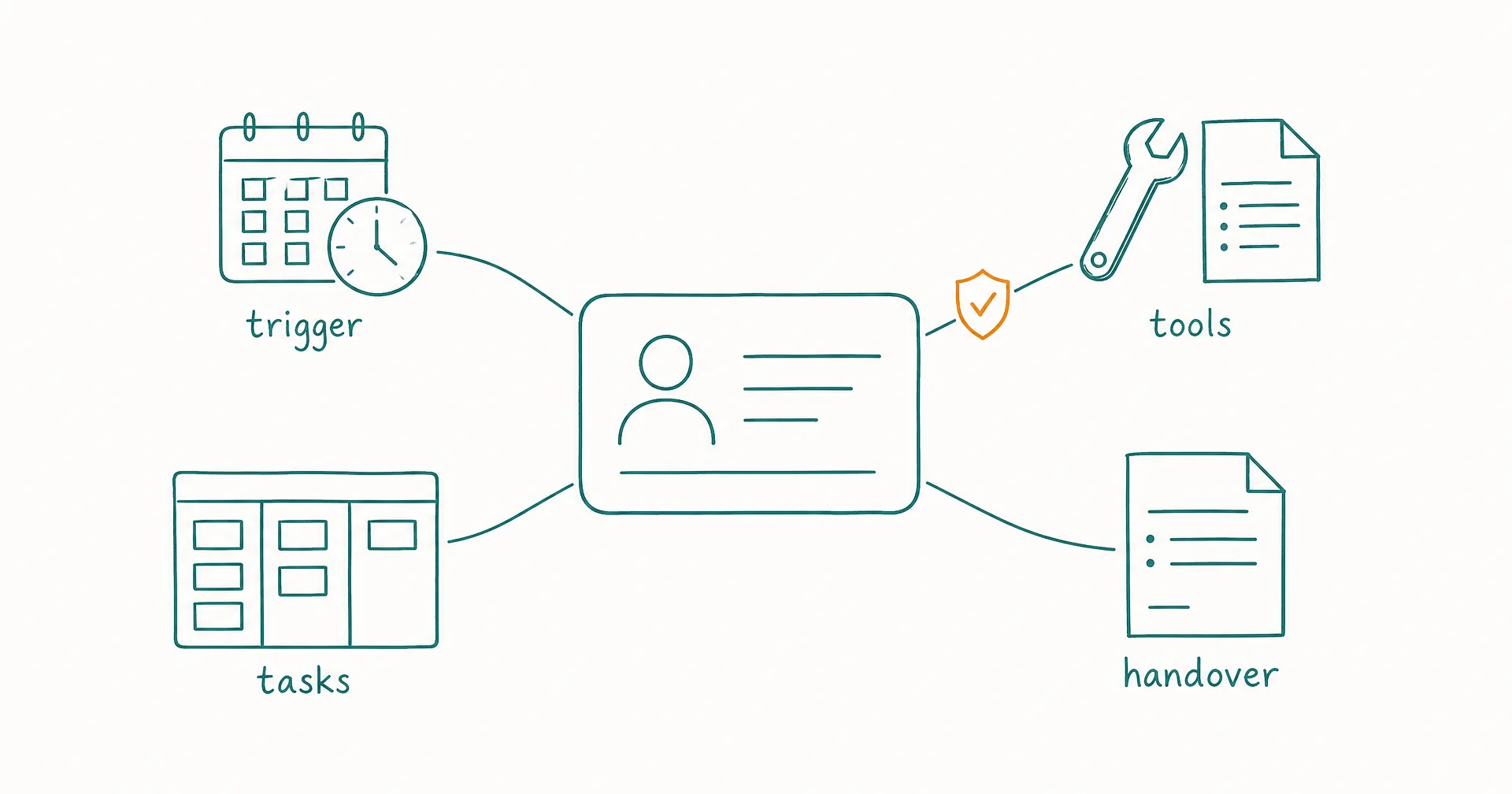
An AI employee is an agentic software system assigned an ongoing business role. It can begin work from a schedule or event, preserve approved context and open-task state across runs, act through permitted tools, and report through tasks, metrics, approvals, escalations, or handovers.
The important distinction is operational: an AI agent supplies the ability to pursue a goal, while an AI employee adds a continuing role and accountability system. “AI employee” is an emerging product category, not a legal employment classification, and vendors do not use one uniform definition.
A practical 5-part test - role, continuity, initiative, agency, and accountability - reveals the behavior behind the label. A useful system may fail part of the test and still solve a real problem. Buy the capability you can verify, not the job title on the landing page.
On this page · 15 sectionsOpen
- What Is an AI Employee?
- What 5 Traits Turn an AI Agent Into an AI Employee?
- How Is an AI Employee Different From a Chatbot, Assistant, Agent, and Workflow?
- How Does an AI Employee Work From Trigger to Handover?
- Which Tasks Are Good Fits for an AI Employee?
- Does an AI Employee Work Without Human Oversight?
- What Permissions and Approval Gates Should an AI Employee Have?
- Why Do Memory, Task State, and Handovers Matter?
- Can AI Employees Work Together or Manage Other AI Employees?
- The Category Test: What Changed in August 2026
- How Much Does an AI Employee Cost?
- How Do You Choose, Hire, and Onboard an AI Employee?
- How Does CellCog Implement the AI Employee Model?
- Is an AI Employee Right for Your Team?
- How to Take the Next Step
- An AI employee is software assigned a recurring business responsibility - not a human employee, legal person, or new foundation-model category.
- Use 5 tests: a defined role, continuity across runs, triggers that start work, permitted action in real tools, and accountability through evidence, metrics, approvals, escalation, or handover.
- A chatbot is conversation-first, an assistant helps on request, an agent pursues a task or goal, and a workflow follows a designed path. An AI employee can combine all 4 inside one ongoing operating role.
- Start with 1 recurring, digital, observable task that is safe to assign. Keep deterministic automation for stable rules and keep consequential judgment with a qualified human.
- Human oversight moves rather than disappears: from every step to policy, permissions, approvals, exception handling, sampling, and performance review.
- CellCog AI Employees are one implementation of this model, adding a role, inbox, shifts, triggers, memory, tasks, KPIs, approvals, and handovers around a general-purpose agent.
§ 01What Is an AI Employee?
An AI employee is an operating assignment around one or more AI agents. The assignment says what outcome the system owns, when it should work, which context it may use, which actions it may take, how success is measured, and when control returns to a person.
That definition is deliberately stricter than “an AI with a job title.” A system prompt saying “you are our marketing manager” does not create a manager. Without a work queue, current context, tools, permissions, completion criteria, and a review path, it remains a conversational role-play.
OpenAI’s practical guide to agents defines agents as systems that independently accomplish tasks on a user’s behalf, built from 3 basic components: a model, tools, and instructions. An AI employee uses those agent primitives, then adds the organizational machinery needed for work that recurs across days, tasks, and changing conditions.
An AI employee is an operating model, not a new foundation model
You do not need a special “employee model.” The underlying intelligence may be an existing large language model operating through an agent harness - CellCog, for example, runs its employees on Anthropic’s Fable line, on Fable 5.1 since September 1, 2026.
The employee layer answers 8 questions that a raw model does not:
- Which recurring outcome belongs to this role?
- What can start a new work run?
- Which business context may persist?
- Which systems can the agent read?
- Which systems can it change?
- Which actions require human approval?
- What counts as an accepted result?
- Who owns the exception when the agent is uncertain or wrong?
This is why the category is useful when defined carefully. It moves the conversation from model intelligence to operating responsibility. For a founder, owner-operator, operations lead, or AI lead, that changes the buying question from “Which model is smartest?” to “Which recurring outcome can this system own, under which controls?”
Autonomy is neither necessary nor sufficient
A fully autonomous system is not automatically an AI employee. It may be an unsupervised task agent with no stable role, no review standard, and no durable organizational context.
Conversely, an AI employee does not need unlimited autonomy. A research worker that runs every Monday, gathers sources, drafts a briefing, and stops for editor approval can own a real recurring responsibility while remaining tightly controlled.
The practical question is not “How autonomous is it?” It is: does the system own a bounded outcome inside explicit controls, and can a person inspect what happened?
§ 02What 5 Traits Turn an AI Agent Into an AI Employee?
The 5-part functional test is a practical framework for evaluating the product behavior behind the term “AI employee.” It is not an industry standard, certification, or legal test.
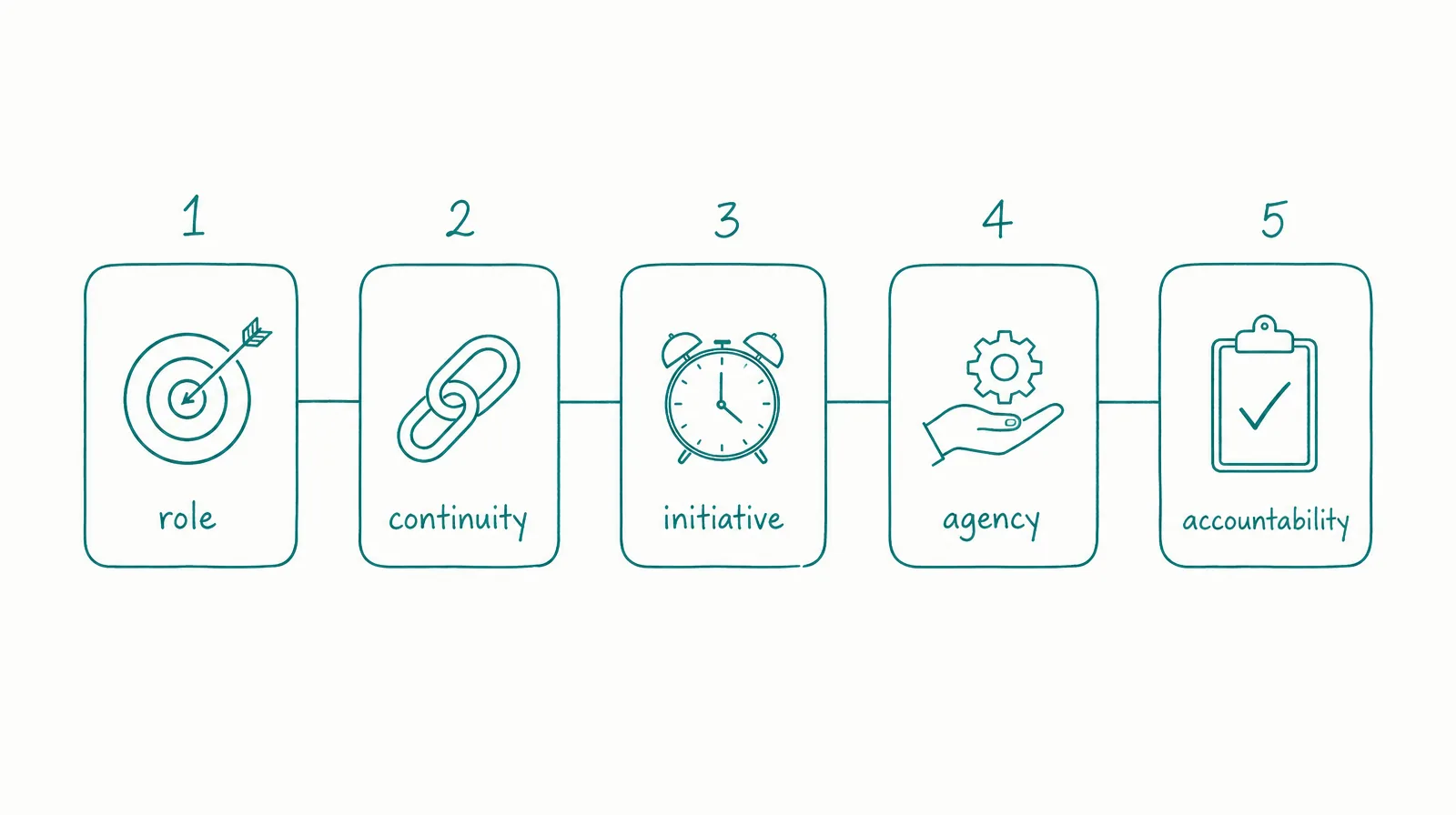
| Dimension | Minimum test | Evidence a buyer should request |
|---|---|---|
| 1. Role and responsibility | Owns a recurring outcome rather than waiting for isolated prompts | Role scope, goals, instructions, non-goals, success definition |
| 2. Continuity | Preserves approved context and open-task state across work sessions | Memory controls, task history, source provenance, correction and deletion behavior |
| 3. Initiative | A schedule, message, event, queue, or monitored condition can start work | Trigger configuration, run history, suppression rules, stop conditions |
| 4. Agency | Gathers context and takes permitted action in real tools | Connected tools, read/write scope, authentication, action logs |
| 5. Accountability | People can inspect, measure, approve, correct, pause, or escalate the work | KPIs, approvals, audit trail, exception path, handover |
A product does not need to score equally across all 5 dimensions. A tightly scoped support agent may have strong initiative and accountability but limited agency. That can be the right design.
1. Role and responsibility
A role is a continuing area of responsibility, not a bucket of unrelated prompts. “Help with marketing” is too vague. “Produce a source-backed competitive briefing every Friday and flag material pricing changes within 24 hours” is closer to an operating role.
A usable role definition includes one recurring outcome, an accountable human owner, approved inputs and systems, explicit non-goals, completion criteria, quality thresholds, time or event triggers, approval and escalation conditions, and a review cadence.
The narrower the first role, the easier it is to evaluate. A broad title may sound more employee-like, but it usually creates weaker measurement.
2. Continuity
Continuity means more than a long chat transcript. The system needs the right context at the right time: business definitions, approved policies, customer or account facts, open tasks, prior decisions, and current blockers.
Useful continuity is scoped to the role and account, tied to a source, dated or freshness-checked, visible to an authorized reviewer, correctable when wrong, deletable when no longer needed, and separated from instructions that should never be overwritten.
Memory can improve consistency, but it can also preserve a mistake. Microsoft’s guidance on agentic memory safety treats memory as candidate context rather than authoritative truth and recommends provenance, freshness checks, lifecycle logging, and view, edit, and delete controls.
3. Initiative
Initiative means work can begin without a person composing a fresh prompt for every run. The trigger may be a Monday 8:00 a.m. schedule, a new support ticket, an email to the worker’s inbox, a CRM status change, a missed KPI threshold, a task entering a queue, a person assigning work, or another agent delegating a task.
Initiative needs brakes. A production trigger should have a frequency limit, duplicate suppression, concurrency rule, quiet period, and stop condition. Otherwise, “proactive” becomes noisy, expensive, or dangerous.
4. Agency
Agency is the ability to gather context, choose a next step, use a tool, observe the result, and continue or stop. The ReAct research pattern showed how reasoning and task-specific action can be interleaved so a model updates its plan from what it observes.
In a business role, agency may include reading an approved inbox, searching a knowledge base, analyzing a spreadsheet, updating a low-risk CRM field, preparing a dashboard, creating a document, drafting an email, handing a task to a specialist, or requesting a human decision.
Tool access does not mean unrestricted tool access. The system should receive the smallest authority needed for the task.
5. Accountability
Accountability is what separates “the model produced something” from “the role completed work.” A responsible system leaves enough evidence for a person to answer: What started the run? Which instructions and sources shaped it? Which tools did it use? What changed? Which approvals occurred? What was accepted or rejected? What remains open? When did it escalate? Who owns the next decision?
Activity is not performance. Prompt count, tokens used, or tasks started may explain cost, but they do not prove value. Better role metrics include accepted-output rate, correction minutes, cycle time, escalation precision, source completeness, error severity, and cost per accepted outcome.
If a vendor cannot show evidence for these 5 dimensions, evaluate the narrower capability it does provide. Do not buy the job title.
§ 03How Is an AI Employee Different From a Chatbot, Assistant, Agent, and Workflow?
The categories overlap. An AI employee may use a chatbot interface, one or more agents, and several deterministic workflows. The distinction is the primary operating unit and accountability model.
| Category | Primary unit | Typical initiator | Work path | Continuity | Real-tool action | Accountability model | Best fit |
|---|---|---|---|---|---|---|---|
| Chatbot | Conversation | User or customer | Dialogue | Often session-based, but not always | Product-dependent | Conversation history, moderation, and escalation | Questions, routing, conversational service |
| AI assistant | User request | User | Collaborative | May preserve preferences and context | May use tools | User reviews most outputs | Drafting, analysis, on-demand help |
| AI agent | Task or goal | User or system | Model-directed loop | Product-dependent | Core capability | Run logs, guardrails, and handoff | Ambiguous multi-step tasks |
| Workflow automation | Defined process | Trigger | Predetermined rules and branches | State in workflow or data systems | Core capability | Logs, error handling, owner alerts | Stable repeatable processes |
| AI employee | Ongoing role or outcome | User, schedule, event, queue, or another agent | Agentic work plus organizational controls | Expected across runs | Expected within scoped permissions | Tasks, KPIs, approvals, escalation, and handovers | Recurring digital responsibility |
Use the simplest pattern that can reliably finish the work
Anthropic’s guidance on building effective agents distinguishes workflows, where models and tools follow predefined code paths, from agents, where models dynamically direct their own process and tool use. It also recommends increasing complexity only when the task requires it.
That creates a practical routing rule: use a chatbot when the unit of value is a conversation; an AI assistant when a person remains the active operator; an agent when the unit of value is an ambiguous task or goal; deterministic workflow automation when rules and branches are stable; and an AI employee when a recurring responsibility needs continuity, triggers, tool action, and organizational accountability.
If a 6-step rule can handle the process, an agent may add latency, cost, and failure variance without adding value. If the input changes every time and exceptions dominate, a rigid workflow may become expensive to maintain.
The strongest design is often hybrid
An AI employee does not replace every workflow. It can reason about the changing parts while deterministic controls handle the stable parts.
For example, a customer-support AI employee could interpret an unstructured message, retrieve the relevant policy, classify the request, use a deterministic refund-limit check, draft or send the response within permission, escalate exceptions, and update the ticket with evidence.
The agent handles ambiguity. The workflow enforces stable policy. The human handles the consequential exception.
§ 04How Does an AI Employee Work From Trigger to Handover?
An AI employee operates as a loop, not a single prompt. The loop begins with an owned outcome and ends with evidence, escalation, or a durable handover.
| Stage | Required input | AI action | Human control | Failure evidence |
|---|---|---|---|---|
| 1. Define | Role, outcome, constraints | Receives the operating assignment | Human owns the role definition | Vague goal or conflicting instruction |
| 2. Context | Approved sources and task state | Retrieves relevant context | Human controls access and source ownership | Missing, stale, or conflicting source |
| 3. Trigger | Schedule, event, message, queue, or assignment | Starts a run | Human sets frequency and stop rules | Duplicate, noisy, or unauthorized run |
| 4. Plan | Current goal and available tools | Creates or updates a plan | Human may approve high-impact plans | Unsupported assumption or scope drift |
| 5. Act | Scoped credentials and permissions | Uses tools and changes state | Permissions limit read/write behavior | Tool error, unintended action, denied access |
| 6. Observe | Tool result and environment state | Checks the result and decides whether to continue | Retry and spend limits prevent loops | Repeated retry, inconsistent state, missing evidence |
| 7. Report | Result, evidence, uncertainty, exceptions | Updates task, metric, or reviewer | Human accepts, rejects, or intervenes | No source, low confidence, failed threshold |
| 8. Handover | Completed work and open state | Records next action or transfers ownership | Receiver accepts the handover | Lost context, unclear owner, duplicated work |
The loop needs explicit exit conditions
An agent should not keep trying because it can. Every recurring role needs limits such as maximum tool calls or retries, maximum spend per run, maximum number of external messages, a deadline or timeout, required evidence before completion, a confidence or uncertainty threshold, mandatory approval for consequential action, and escalation after conflicting instructions.
An exit condition can be success, blocked status, human escalation, policy refusal, or safe rollback. “Continue until done” is not enough for a production worker.
A handover is an operational artifact
A useful handover contains the original goal, current status, work completed, sources and artifacts, decisions made, open questions, permissions used, risks or exceptions, the next recommended action, and the accountable recipient.
Without a handover, persistent work becomes persistent ambiguity.
§ 05Which Tasks Are Good Fits for an AI Employee?
The best starting task is recurring, digital, observable, bounded, supplied with accessible context, reversible or approval-gated, and measurable through an accepted output or business-state change.
| Task pattern | Fit | Why | First control |
|---|---|---|---|
| Weekly research briefing | Strong | Recurring, evidence-based, and reviewable | Require citations and source review |
| Inbox triage and draft replies | Strong with approval | Clear queue and measurable response time | Keep external sending in approval mode |
| CRM enrichment | Strong with validation | Structured destination and repeatable checks | Validate fields and log changes |
| KPI reporting | Strong | Recurring inputs and observable output | Reconcile every number to its source |
| High-volume outbound sending | Conditional | Scalable but reputational and deliverability risk | Add volume caps, exclusions, and approval rules |
| Contract or legal decision | Weak for final authority | High-impact professional judgment | Require qualified human review |
| Hiring rejection decision | Weak for unsupervised use | Material consequences and potential bias | Keep a human decision owner |
| Payment, deletion, or account change | Conditional and high risk | Financial or irreversible effect | Require explicit approval |
| Physical or relationship-critical work | Poor fit | Requires presence, empathy, negotiation, or licensed expertise | Keep human-led; automate only support tasks |
Start with the task, not the title
“AI operations manager” may contain 20 workflows with different risk and evidence profiles. Break the role into task units: reconcile weekly KPI inputs, draft an exception report, update low-risk project status, summarize blocked work, prepare a vendor comparison, schedule an approved meeting, and escalate an overdue owner.
CellCog’s public role pages, linked from the AI Employees hub, show how that decomposition changes by function - an AI research assistant, an AI data analyst, and an AI operations manager decompose into very different task units. The role title does not mean that every task should receive the same autonomy.
Do not begin with the most consequential task
Teams often choose a painful process because it consumes the most human time. That criterion is incomplete.
The first task should also have a reliable source of truth, a clear accepted-output definition, low-cost correction, visible failure, limited authority, a fast review cycle, and enough repetitions to learn from the pilot.
A weekly report with source reconciliation may be a better first AI employee task than an external sales campaign, even if outbound work consumes more hours.
§ 06Does an AI Employee Work Without Human Oversight?
No responsible definition should make zero human involvement the universal test. The amount and timing of oversight should depend on consequence, reversibility, permissions, evidence quality, system maturity, and the organization’s risk tolerance.
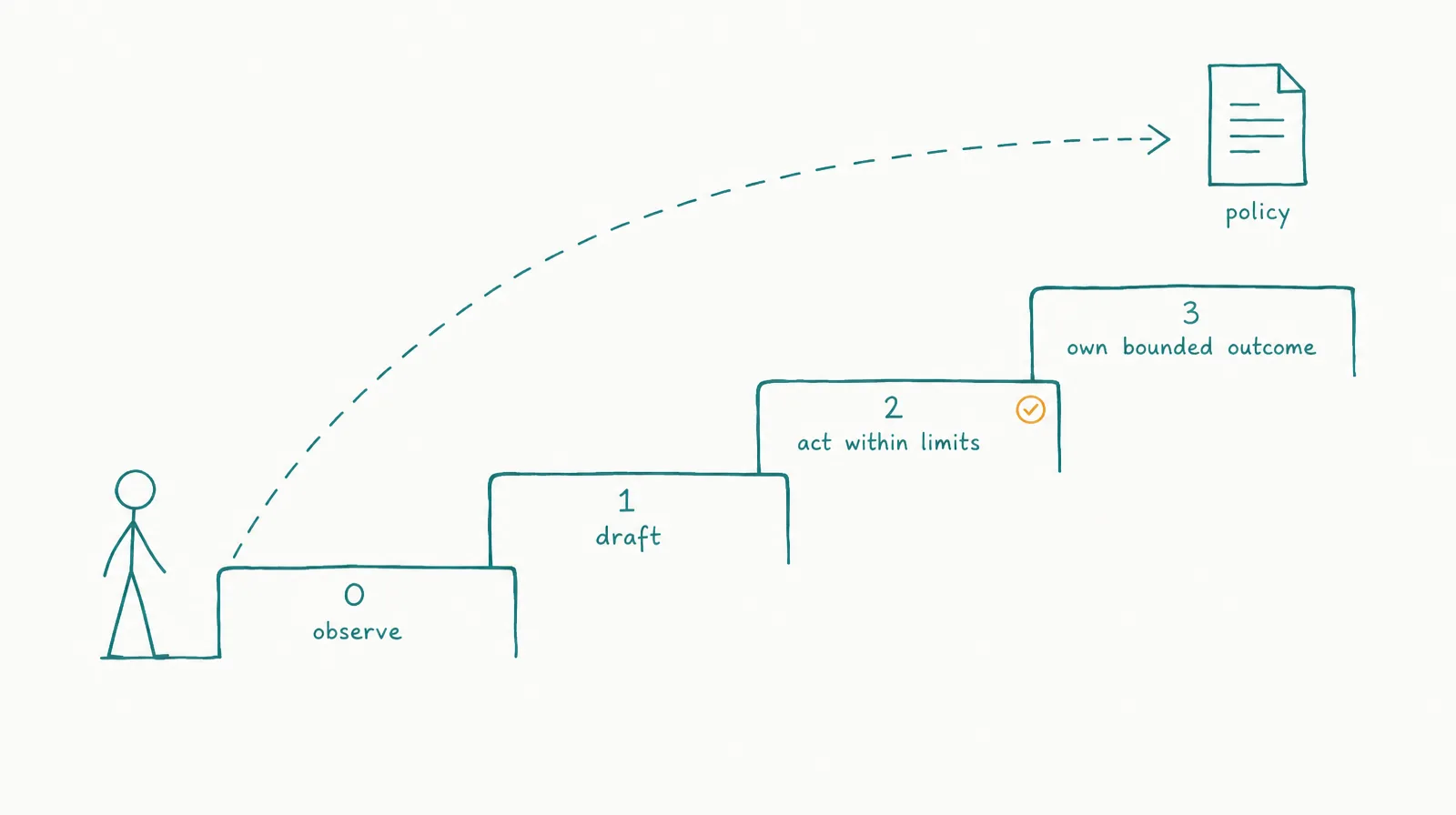
| Level | AI behavior | Human role | Suitable starting work |
|---|---|---|---|
| 0. Observe | Reads and summarizes without changing state | Verifies context and evaluates baseline quality | Process mapping, backlog review, source synthesis |
| 1. Draft | Prepares a proposed output or action | Approves every external or state-changing action | Emails, reports, tickets, CRM updates |
| 2. Act within limits | Executes low-risk, reversible actions | Reviews exceptions and samples completed work | Tagging, routing, scheduling within rules |
| 3. Own bounded outcome | Runs recurring work inside measured limits | Sets policy, reviews KPIs, handles escalation | Mature workflows with strong evidence and rollback |
This is a graduated-autonomy ladder, not a maturity standard. A high-impact role may remain at Level 1 permanently. That is a control decision, not a failed deployment.
Oversight moves from steps to policy
Automation can move human work from executing every step to defining role scope, approving sources and tools, setting permission tiers, reviewing a plan, handling high-risk actions, sampling completed work, monitoring exceptions, correcting memory, reviewing KPIs, and changing or decommissioning the role.
NIST’s AI Risk Management Framework treats risk management as continuous across the AI lifecycle and calls for clearly differentiated human-AI roles and oversight responsibilities. It is a voluntary framework, not a rule that every company must implement identically.
High-risk actions need a human decision boundary
OpenAI’s agent guidance identifies failure thresholds and high-risk actions as common triggers for human intervention - repeated inability to complete the task, and actions that are sensitive, irreversible, or high stakes.
That means a draft email can be autonomous while sending requires approval; a refund recommendation can be autonomous while payment requires approval; a candidate summary can be autonomous while rejection remains human-owned; a variance alert can be autonomous while changing a forecast remains reviewed; and a contract summary can be autonomous while legal judgment remains qualified-human work.
The operating goal is not the fewest approvals. It is the smallest review burden that still keeps consequence inside the organization’s tolerance.
§ 07What Permissions and Approval Gates Should an AI Employee Have?
Permission should be action-specific. A single “autonomous” toggle ignores the differences between reading a public page, updating a reversible internal field, sending an external message, deleting a record, and moving money.
The governing principle is least privilege: give the role only the data, tools, actions, accounts, duration, and downstream delegation rights required for its assigned outcome.
| Action | Default starting permission | Why | Escalation trigger |
|---|---|---|---|
| Read an approved knowledge base | Allow | Low action risk within a scoped source | Restricted, sensitive, or cross-account content |
| Draft an email | Allow | No external effect until sent | Legal, financial, confidential, or uncertain content |
| Send an external email | Approval during pilot | Reputational and privacy effect | New recipient, complaint, exclusion match, low confidence |
| Update a low-risk CRM field | Limited allow | Reversible and logged | Conflicting source or high-value account |
| Publish public content | Approval | Brand and factual consequences | New claim, regulated topic, or missing source |
| Delete records | Block or explicit approval | Irreversible | Always |
| Move money or accept a contract | Qualified-human approval | High financial or legal impact | Always |
Use 3 permission states
A practical starting model is: allow for low-risk actions inside a narrow scope, approval required for consequential, novel, or external actions, and block where the system has no legitimate role need.
Anthropic’s discussion of trustworthy agents describes a similar per-action control model - always allow, approval required, or block - inside Anthropic products. The 3-state framework is useful beyond one product, but buyers should verify the controls their own platform actually implements.
Permission is more than read versus write
Evaluate every proposed action across 7 dimensions: read or write; reversible or irreversible; internal or external; low or high financial impact; low or high reputational impact; public or sensitive data; and routine or novel context.
Then add operational limits: specific account, field, recipient class, amount, time window, volume, and expiration date.
CellCog’s AI Employee product page describes goals, permissions, approvals, and connected tool action. A buyer should still test the exact role and tool, because no platform can infer every organization’s definition of “sensitive” without configuration and evidence.
§ 08Why Do Memory, Task State, and Handovers Matter?
Employee-like continuity requires more than an indefinitely growing chat history. The system needs scoped business context, current task state, source-aware decisions, correction, and a clear handover.
| Continuity object | What it contains | Risk if unmanaged | Required control |
|---|---|---|---|
| Role memory | Goals, policies, terminology, examples | Stale or overbroad instructions | Named owner and review date |
| Relationship memory | Customer, account, or stakeholder context | Privacy or cross-account leakage | Account scope and access control |
| Task state | Open work, blockers, next action, deadline | Lost, duplicated, or abandoned work | Status, owner, and timestamps |
| Decision record | What was decided and why | Untraceable errors or repeated debate | Source and evidence links |
| Handover | Completed work, unresolved items, next step | Repeated setup or silent failure | Standard format and receiver acceptance |
Memory is not the same as learning
A system can remember a wrong fact. It can preserve a stale policy, copy a malicious instruction, or retrieve context that belongs to another account.
When an untrusted email, webpage, or document contains instructions designed to redirect the agent, the risk is known as prompt injection. Persistence raises the stakes because a poisoned instruction may influence a later run rather than fail visibly in the current one.
The practical memory lifecycle should therefore be treated as a governed write-and-read system: identify the source, decide whether the information may be stored, assign a scope and purpose, record provenance and time, validate relevance and freshness when retrieved, make the influence visible where possible, allow authorized correction, and delete or expire data that no longer belongs.
This is where employee-like continuity creates a different risk from a one-off chat. An error stored today may shape a tool action next week.
Task state should be separate from durable knowledge
“The company’s refund limit is $100” may belong in governed role context. “Ticket 482 is waiting for a receipt” belongs in task state. “The customer prefers email” may belong in relationship context with a defined scope.
Separating these objects improves freshness, access control, deletion behavior, source traceability, incident investigation, handover quality, and cross-agent isolation.
For exact product behavior, use the platform’s documentation rather than a generic memory claim. CellCog publishes a memory-system guide and a privacy policy; buyers should verify how memory is created, accessed, corrected, retained, and deleted for their own deployment.
§ 09Can AI Employees Work Together or Manage Other AI Employees?
Yes. Multiple AI workers can be coordinated through a manager pattern, a shared workflow, or direct handoffs. But each additional agent adds a new evaluation, context, permission, and failure surface.
| Pattern | Coordination model | Advantage | New risk | Use when |
|---|---|---|---|---|
| One employee, many tools | One agent owns the role | Simple accountability and shared context | Tool and instruction overload | One role has a coherent goal and manageable tool set |
| Manager plus specialists | Manager decomposes, delegates, and synthesizes | Specialized depth with one interface | Manager errors or authority can propagate | Work splits into clear specialties with independent checks |
| Peer handoffs | Agents transfer ownership | Flexible cross-functional flow | Lost context and unclear owner | Handoff rules and acceptance are explicit |
Anthropic’s orchestrator-worker pattern uses a central model to break down a task, delegate work, and synthesize results. Google’s A2A guidance separately describes how agents can discover and communicate with remote agents through capability descriptions and standardized messages.
Neither pattern removes the need for ownership. A multi-agent task still needs one final result owner, a typed delegation or handoff, a bounded authority envelope, evidence attached to results, timeouts and retry limits, an acceptance rule, independent checking for consequential work, and a human escalation path.
CellCog’s first-party AI organization example
As of August 29, 2026, CellCog’s public AI Organization page showed 1 human founder and 11 CellCog AI Employees, including a Chief of Staff, a Head of Growth, a Head of Marketing, a Principal Engineer, a Sales Lead, and 5 sales representatives - with real hire dates on the chart.
CellCog reports that its Sales Lead began as a solo outbound worker on June 27, became a manager on July 7, and onboarded the 5 representatives hired on July 7-8. After the team formed, CellCog reports 6x outbound throughput and a 1.5% bounce rate.
Those are dated, first-party operating claims. They are not customer results, an independent audit, or a promise that another team will produce the same outcome.
The more useful lesson is architectural: the founder talks to a manager; the manager assigns work to specialist task boards; the specialists report back; shared memory and handovers preserve state. The system resembles an organization because responsibility and information move through explicit roles - not because agents simulate office conversation.
§ 10The Category Test: What Changed in August 2026
A definition is only useful if the category it describes is real. One month after this page was first published, the external evidence hardened, and it is worth dating:
- The largest labs entered. xAI shipped Grok Bot on August 11, 2026: “always-on AI teammates” that run on a persistent cloud computer, now bundled across its consumer and developer plans. Our breakdown covers how it maps to the five-part test above.
- OpenAI is training for it. Per WIRED’s August 27 reporting, OpenAI has trained its forthcoming models, including Astra, to enable persistent agents - the standing-worker shape this page describes.
- Model licenses now name the category. The license Alibaba published with Qwen3.8-Flash-Next on August 26 explicitly calls out “AI Work Assistant” businesses as a licensing class. When a category appears in license text, it has stopped being a marketing term.
- Capital followed. Instinct, a personal-agent startup still in private beta, was reported on August 26 to be raising $250 million at a $2.5 billion valuation (The Information); as of September 1, 2026 the round had not been announced as closed.
None of this proves any single vendor’s claims, including ours. It proves the operating model - standing, persistent, role-shaped AI workers - is where the industry is converging, which makes the evaluation discipline on this page more useful, not less.
§ 11How Much Does an AI Employee Cost?
The monthly plan price is only one cost layer. A useful comparison measures total operating cost per accepted outcome: platform and model usage, plus setup and integration, plus human review, plus correction and rework, plus monitoring and governance, plus expected failure exposure.
| Cost layer | Buyer question | Evidence to collect |
|---|---|---|
| Subscription and credits | What access does the plan buy? | Current plan, included credits, expiry, and top-up rules |
| Run or task usage | How much does this role consume? | Representative pilot runs using the same inputs |
| Setup | Who prepares instructions, context, tools, and permissions? | Owner hours and implementation work |
| Review | How much work still needs checking or approval? | Review minutes per accepted output |
| Correction | How often must the output be repaired or rerun? | Acceptance rate and correction time |
| Monitoring | Who reviews logs, KPIs, memory, and exceptions? | Weekly operating cadence |
| Failure exposure | What is the downside of a wrong action? | Risk tier, maximum loss, and recovery time |
Suppose a weekly research brief consumes $12 of platform usage, 25 minutes of human review at an illustrative loaded cost of $60 per hour, and 10 minutes of correction. The illustrative weekly cost is $12 platform usage + $25 review + $10 correction = $47 per accepted brief.
That is not a CellCog price or an industry benchmark. It is an example showing why “$12 to run” and “$47 to accept” answer different questions.
CellCog’s live pricing page describes usage-based credits, with more complex work consuming more credits. Because plan details and task consumption can change, use the live page and a representative pilot before making annual cost claims.
Do not compare an AI subscription with a human salary as if both buy the same capacity. Compare a defined outcome, quality standard, review load, response time, authority boundary, and failure exposure.
§ 12How Do You Choose, Hire, and Onboard an AI Employee?
Start with the role contract, not the vendor demo. A good pilot can be described through 8 questions:
- What recurring outcome will the role own?
- What starts the work?
- Which context may it read and remember?
- Which tools may it use?
- Which actions require approval or remain blocked?
- What does an accepted output look like?
- Which metrics and failure thresholds will be reviewed?
- Who remains the accountable human owner?
Use a 6-step first pilot
- Hire the outcome before choosing the platform: choose 1 reversible recurring responsibility.
- Provide a small approved context pack.
- Onboard through observe, shadow, and draft stages before granting live authority.
- Record accepted outputs, corrections, cycle time, and escalation quality.
- Expand 1 permission or responsibility at a time.
- Stop or roll back when a failure threshold is exceeded.
The pilot should produce a purchase or deployment decision, not a polished demo. Use representative inputs, including messy cases and exceptions.
Define acceptance before the first run
For a weekly research briefing, acceptance could require every material claim linked to a source, at least 2 independent sources for a high-impact conclusion, contradictions surfaced rather than hidden, a clear “what changed” section, no confidential data outside the approved scope, delivery by Monday 8:00 a.m., and human approval before external distribution.
For CRM enrichment, acceptance might require source-backed field values, no overwrite of verified data, a change log, and escalation when sources conflict.
The role is ready to expand only when the organization can distinguish good work, bad work, and unsafe work.
Evaluate the platform through operating evidence
A serious evaluation should ask whether the platform supports persistent role context, schedules and event triggers, tool authentication and scoped permissions, action-specific approvals, task and run state, logs and source evidence, memory correction and deletion, human escalation, handovers and delegation, role-specific KPIs, predictable usage reporting, and export, pause, revocation, and decommissioning.
§ 13How Does CellCog Implement the AI Employee Model?
CellCog implements the category as 3 connected layers: an AI Employee operating layer, a general-purpose Super-Agent capability base, and an Agent-to-Agent interface for external agents. CellCog’s product overview documents all three layers in one place.
| Five-part test | CellCog’s public implementation | What a buyer should verify |
|---|---|---|
| Role and responsibility | User-defined role, goals, KPIs, and task board | Role boundary, accepted output, and human owner |
| Continuity | Persistent memory, attention loop, shifts, and handovers | Source scope, correction, retention, and open-task behavior |
| Initiative | Schedule, email, Slack message, event, or other wake condition | Frequency limits, duplicate suppression, and stop rules |
| Agency | Inbox, connected tools, local co-work, and browser action | Exact read/write scope and action evidence |
| Accountability | Tasks, KPI dashboards, permissions, approvals, and handovers | Approval coverage, log detail, escalation, and pause/revoke path |
Layer 1: the AI Employee operating system
The CellCog AI Employee layer gives the worker a role, name, goals, permissions, inbox, shifts, wake conditions, memory, task board, KPIs, approvals, and handovers.
That is the part that maps most directly to the 5-part definition. It makes continuing work visible as role state rather than a series of unrelated chats.
CellCog’s current product page also describes employees forming teams and managing each other. Treat that as a product capability to evaluate, not a reason to start with multiple workers. A single measured role is still the safer first deployment.
Layer 2: the general-purpose Super-Agent base
The CellCog Super-Agent is the capability layer under the employee. CellCog says it spans research, data analysis, code, documents, presentations, spreadsheets, images, video, audio, dashboards, apps, diagrams, and 3D outputs.
Breadth can reduce cross-tool handoffs when one role produces several artifact types. It can also make evaluation harder. Teams should test the exact work product - such as a source-backed PDF, reconciled spreadsheet, or production-ready dashboard - rather than treating modality count as proof of quality.
Layer 3: Agent-to-Agent access
CellCog’s Agent-to-Agent platform exposes capabilities to OpenClaw, Claude Code, Cursor, Codex, Hermes, Linear, and custom agents through supported interfaces.
This matters for teams that already have agents in their development or operating stack. The external agent can delegate a bounded capability and receive an artifact without moving the entire workflow into a new human-facing app.
It also creates new questions: which agent identity made the request, which authority traveled with the delegation, what context crossed the boundary, which system owns the final result, where logs are stored, and what happens after a timeout or partial result. The existence of an A2A interface does not answer those governance questions. The deployment design does.
Honest limits belong in the product section
CellCog is a broad platform, and broad platforms are not automatically best for every narrow, high-volume task. The public evidence is also uneven: the AI Organization is a first-party operating story, not a customer case study; anonymous or country-only testimonials are not named customer evidence; deep-research benchmark performance is evidence about deep research, not every employee role or modality; current pricing does not reveal cost per accepted outcome without a pilot; and connected tool and browser actions increase the need for scoped permissions and supervision.
That does not weaken the category case. It defines the evidence a serious buyer should request.
§ 14Is an AI Employee Right for Your Team?
Use a fit test before opening a vendor shortlist.
An AI employee is a strong fit when work recurs often enough to evaluate, inputs are digital and accessible, quality can be defined, outputs leave evidence, common actions are reversible, consequential actions can be approval-gated, exceptions can reach a named person, and the value of continuity exceeds the cost of setup and review. One reliable tell: a person on the team repeatedly restarts the same digital context every week.
Prefer another pattern when the rules and data are stable (a workflow may be cheaper and more predictable), when there is no measurable accepted output yet (define acceptance and metrics first), or when the task happens too rarely to evaluate (use on-demand assistance first).
Avoid deployment entirely - or solve the underlying problem first - when a high-impact action has no approval path, when sensitive data has unclear access controls, when the work is physical, licensed, or relationship-critical, or when the team cannot review failures and exceptions.
The best first role is not the grandest. It is 1 recurring outcome that is digital, reviewable, reversible, and worth measuring.
§ 15How to Take the Next Step
Use 3 paths:
- If the category is unclear: run your current tools through the 5-part test.
- If the role is unclear: choose 1 recurring, reversible outcome and define an accepted output.
- If the operating model fits: inspect CellCog AI Employees and begin with conservative permissions.
CellCog makes the employee scaffolding visible: inbox, shifts, triggers, memory, task state, KPIs, approvals, and handovers around a general-purpose agent.
Start with 1 role. Keep a person accountable. Expand only when accepted-output quality, correction burden, escalation behavior, and cost support the next permission.
Q1Is an AI employee a real employee?
No. An AI employee is software assigned an employee-like operating role. The product term does not make the system a human, legal person, or automatic party to an employment relationship.
Q2Is an AI employee the same as an AI agent?
An AI employee is usually built from one or more agents, but adds an ongoing role, continuity across runs, work triggers, and organizational accountability. The agent supplies execution capability; the employee layer supplies the operating assignment.
Q3Can an AI employee work without prompts?
It can begin from a schedule, message, event, queue, or monitored condition, but it still requires goals, permissions, evidence requirements, monitoring, and escalation rules. Proactivity is a trigger design, not independence from human policy.
Q4Can an AI employee make mistakes?
Yes. Agentic software can misread intent, use the wrong tool, act on stale context, preserve a bad memory, or propagate an error to another system. Consequence-based permissions, approval gates, logs, sampling, and incident response remain necessary.
Q5Should an AI employee replace workflow automation?
No. Keep deterministic automation for stable, rule-bound steps. Use agentic behavior when context and judgment change the path. Many strong systems combine an agent for ambiguity with workflows for policy and control.
Q6Can AI employees manage other AI employees?
Manager-agent patterns can delegate to specialists and synthesize results, but the human organization still needs clear ownership, authority limits, independent evaluation, and escalation. More agents increase coordination and failure surfaces as well as capability.