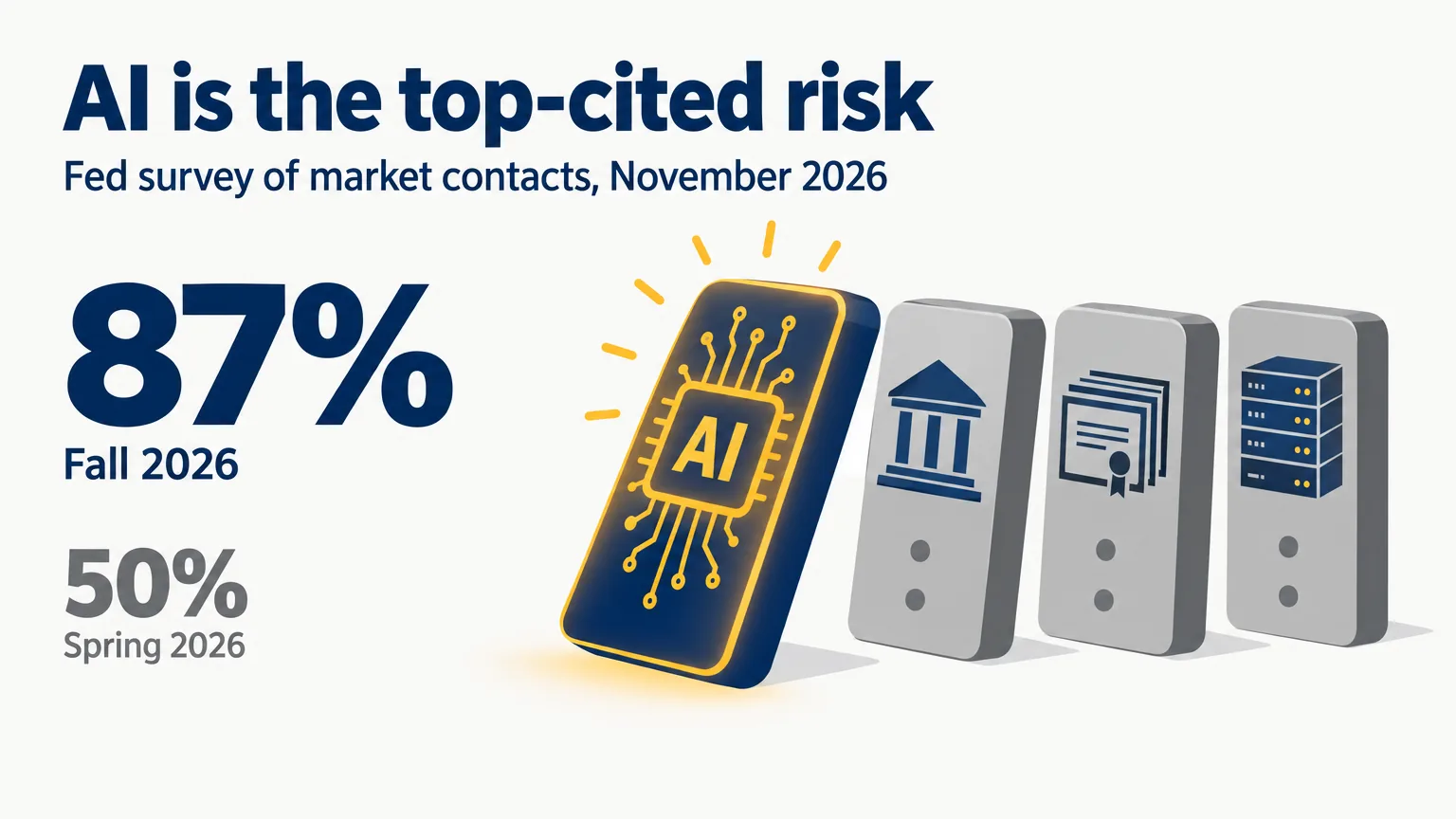
AI was the risk cited most often in the Federal Reserve’s survey of market contacts, according to the Financial Stability Report the Fed posted on November 13, 2026. 87% of the 23 contacts named it, up from 50% in the spring survey. The same report counts more than $680 billion of debt issued this year to build data centers, and warns about the links between the largest technology firms and smaller, riskier ones.
This page is written from the report itself, 69 pages, read at 14:03 UTC on November 14. A post on X that called AI “a major risk to the US financial system” reached about 874,000 views. The Fed’s own post about the report had about 33,000.
On this page · 7 sectionsOpen
 The Federal Reserve Board posted its Financial Stability Report on November 13, 2026. AI was the risk its survey of market contacts cited most.
 87% of the 23 contacts cited AI in the fall survey, against 50% in the spring. By our arithmetic that is about 20 of the 23.
 Their worries: high stock valuations, cyberattacks made easier by AI or caused by frontier models, and complex AI-related financing.
 A separate box counts more than $680 billion of debt issued for advanced computing by October 2026, about five times the $130 billion of 2023.
 The survey is the contacts’ view, not the Fed’s. The report says so in the box itself.
§ 01What the survey says
The survey sits in Box 5.1, Survey of Salient Risks to Financial Stability. New York Fed staff asked contacts at broker-dealers, banks, investment funds and advisory firms what they saw as risks; 23 answered in September and October.
- The headline line. “AI was the top-cited risk, with responses noting concerns around elevated equity valuations, AI-enabled cyberattacks, and complex forms of AI-related financing”
- Whose view it is. The box says it “should not be interpreted as representing the views of the Federal Reserve Board” or of the New York Fed.
- What moved. The report says “mentions of AI, higher long-term interest rates, and cyberattacks saw the greatest increase relative to the spring survey”
- Severity is a different ranking. Cyberattacks and fiscal debt sustainability were seen as having the most severe potential consequences, not AI.
| Risk | Fall 2026 | Spring 2026 | Change, points |
|---|---|---|---|
| Artificial intelligence | 87% | 50% | +37 |
| Risk asset correction | 52% | 35% | +17 |
| Higher long-term rates | 48% | 20% | +28 |
| Cyberattacks | 43% | 20% | +23 |
| Fiscal debt sustainability | 43% | 30% | +13 |
The percentages come from the report’s survey panel. The change column is our arithmetic.

§ 02The three AI worries
- Valuations. Elevated equity valuations, and the chance that lower-than-expected earnings bring a market correction. Respondents also cited a sharp correction in AI-related equities driven by uncertain returns on large capital spending.
- Cyberattacks. Risk from attacks by sophisticated state actors, or from “damage caused by frontier AI models themselves”. Many respondents said advances in AI are lowering the barrier to sophisticated attacks.
- Financing. Risks from complex forms of AI-related financing. Respondents named stretched valuations, circular financing arrangements and heavy reliance on debt to fund the buildout as things that could amplify losses.
§ 03The data center debt numbers
Box 2.2, Leverage in the Data Center Buildout, is the Fed staff’s own analysis, not the survey.
| Measure | Figure in the report |
|---|---|
| Advanced computing debt issued, 2023 | $130 billion |
| Advanced computing debt issued, by October 2026 | more than $680 billion |
| Share of investment-grade nonfinancial corporate debt issuance | under 6% in 2023, about 31% in 2026 |
| Public debt outstanding, October 2026 | more than $1.1 trillion |
| Leases signed but not yet started (undiscounted) | more than $1 trillion |
| Other obligations such as take-or-pay contracts and residual value guarantees (undiscounted) | more than $2 trillion |
- The comparison. The box compares five hyperscalers, Amazon, Alphabet, Meta Platforms, Microsoft and Oracle, with the telecom buildout that started in 1995. It says their capital spending may pass the pace of that cycle relatively soon.
- Off the balance sheet. It says long leases, contracts and guarantees let large firms with strong credit support projects by weaker firms without an immediate effect on their own balance sheets.
- GPU guarantees. It says GPU makers often guarantee a residual value on the GPUs used as collateral, and that equity stakes alongside these deals create what it calls a circular financing dynamic.
- The warning. In the report’s words, the links among these firms, credit markets, private lenders and special purpose vehicles “create vulnerabilities that necessitate close monitoring”
- Our page on one of those firms. We tracked Nvidia’s own commitments and guarantees in an earlier record.
§ 04How the story spread
- The Fed’s account posted the report at 21:18 UTC on November 13. It had about 33,000 views at 14:04 UTC on November 14.
- Five minutes later @WatcherGuru wrote that the “Federal Reserve report identifies artificial intelligence as a major risk to the US financial system”. It had about 874,000 views at the same time.
- That post does not say the finding comes from a survey of 23 contacts, or that the Fed says the survey is not its own view.
§ 05What we did not check
- We did not read the survey’s spring 2026 box or count how many contacts answered then. The spring figures here come from the fall report’s panel.
- We did not read the sources behind the debt figures (Bank of America Global Research, Bloomberg, company filings).
- We read the report’s text through a PDF extractor and its survey panel as a picture of page 11.
§ 06Where CellCog sits
CellCog is our product, an AI employee platform. Our AI employees run on Anthropic’s Claude models, and model labs are among the firms whose spending this report describes, so this page is written by a customer of the AI buildout. Nothing in the report names CellCog.
§ 07Sources
- Federal Reserve Board: Financial Stability Report, November 2026, posted November 13, 2026, Box 5.1 and Box 2.2.
- Federal Reserve Board: Financial Stability Report index.
- Federal Reserve: post on X, November 13, 2026, 21:18 UTC.
- @WatcherGuru: post on X, November 13, 2026, 21:23 UTC. Both posts were read through X’s API at 14:04 UTC on November 14.
Q1Did the Federal Reserve say AI threatens the financial system?
The report says AI was the risk most often cited by the market contacts the New York Fed surveyed in September and October. It also says the survey does not represent the views of the Board or the New York Fed. The posts that spread the story on X did not make that distinction.
Q2How many people were surveyed?
23 contacts at broker-dealers, banks, investment funds and advisory firms. 87% cited AI, which by our arithmetic is about 20 of them.
Q3What exactly worries them about AI?
Three things, in the report’s words: elevated equity valuations and a possible market correction, cybersecurity risk from state actors or from frontier AI models themselves, and risks from complex forms of AI-related financing.
Q4How much debt is going into data centers?
The report counts more than $680 billion of advanced computing debt issued by October 2026 and more than $1.1 trillion of related public debt outstanding. It says private deals make the full amount hard to measure.
Q5Which companies does the report name?
It names Amazon, Alphabet, Meta Platforms, Microsoft and Oracle as hyperscalers, and adds Broadcom and Nvidia in its count of debt and other obligations.