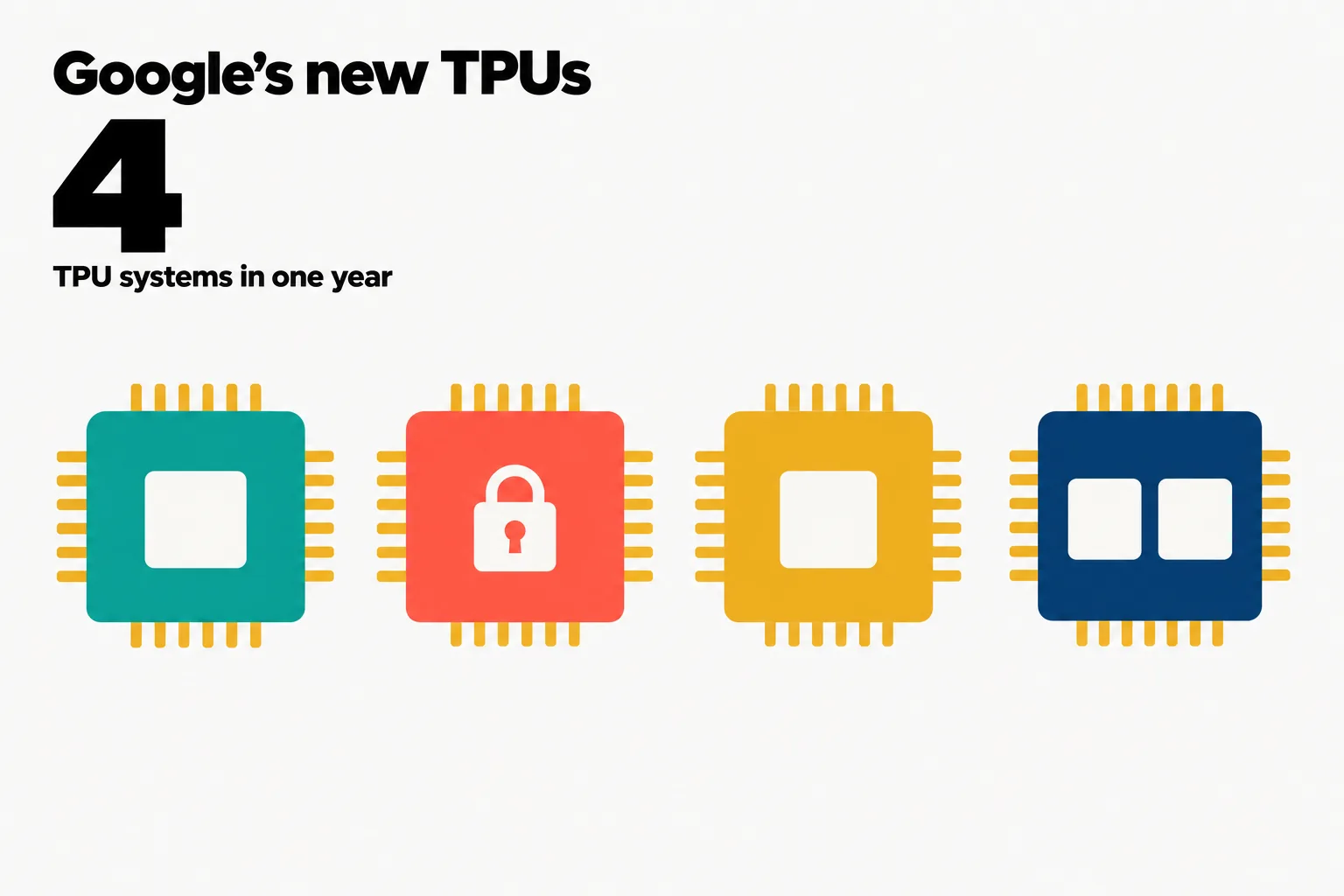
Google announced two new TPU systems on November 9, 2026: TPU 8tx, built to keep data protected while a model is working on it, and TPU 8i Max, which puts two chips in one package for very long contexts. Together with TPU 8t and TPU 8i from April, Google says this is “the first time we have introduced four TPU systems in a single year.”
The announcement, written by Amin Vahdat, Google’s SVP and Chief Technologist for AI and Infrastructure, landed the same morning Nvidia shares fell in premarket trading over its board’s investigation into Jensen Huang. Below: what each new system is for, the software that came with it, and what Google has not published.
On this page · 8 sectionsOpen
 Google announced TPU 8tx and TPU 8i Max on November 9, 2026, joining TPU 8t and 8i from April: four TPU systems in one year.
 TPU 8tx pairs TPU 8t silicon with 5th Generation AMD EPYC hosts and keeps data and model weights protected even while in use.
 TPU 8i Max puts two TPU 8i chips in one package: double the compute, SRAM and HBM bandwidth, and twice the silicon per rack footprint.
 Google also shipped software: an open-source TPU agent suite for coding tools, TPU Sync for KV caches, and Cloud Pathways on GKE.
 Bloomberg reports both arrive in 2027 and cites a forecast of TPU sales rising from about $12 billion in 2026 to over $135 billion by 2028.
§ 01Four TPU systems, four jobs
Vahdat writes that “TPUs are now a rapidly growing business with nearly 100 customers”, from frontier labs to trading firms, retailers and universities. The April pair split training from reasoning; the November pair split that again by security and by memory.

| System | Built for | What Google claims | Announced |
|---|---|---|---|
| TPU 8t | Large-scale training | Up to 2.7x training performance vs the previous generation | April 2026 |
| TPU 8i | Real-time reasoning | Up to 80% better inference price performance | April 2026 |
| TPU 8tx | Confidential inference, small-scale training | Up to 2x lower latency than TPU 8t | November 9, 2026 |
| TPU 8i Max | Long context, rack density | Double TPU 8i’s compute, SRAM and HBM bandwidth | November 9, 2026 |
§ 02TPU 8tx: data stays protected while in use
Data is normally encrypted when it is stored or sent, then decrypted in memory while a chip works on it. TPU 8tx is built on the same silicon as TPU 8t, paired with 5th Generation AMD EPYC host CPUs, and Google says it builds security into the hardware, “keeping sensitive data and model weights protected and isolated even while in active use.”
It also borrows the low-latency network Google built for reasoning, which Google says gives up to 2x lower latency than TPU 8t with a near-zero performance penalty. The pitch is regulated enterprises and governments: fine-tune on private data, distill large models into small ones and train agents with reinforcement learning on one system, without moving sensitive data between clusters.
§ 03TPU 8i Max: two chips in one package
TPU 8i Max is aimed at the memory wall: many agents reading a whole codebase or hours of video at once run out of memory bandwidth before they run out of compute. Google combined two TPU 8i chips onto a single package, “delivering double the compute, double the SRAM and double the HBM bandwidth of TPU 8i.” Because it fits twice the silicon in the same rack footprint, Google says data centers get more compute per square foot and per watt.
§ 04The software that shipped with it
The hardware is half the announcement. The other half is aimed at getting developers onto TPUs without rewriting code, and at the way agents actually run: in bursts, with long pauses.
| Release | What it does | Status |
|---|---|---|
| TPU agent suite | Plugs into Claude Code, Cursor and Google Antigravity to onboard and tune TPU code | Open source, preview |
| TorchTPU | Runs PyTorch code and Hugging Face models natively on TPUs | Open-sourced last month |
| Agent Compute Engine | Suspends idle agent sessions and moves their memory off the chip | New |
| TPU Sync | Tiers KV caches across chip, host memory and storage; Google claims over 90% lower KV transfer latency and time to first token | Open source |
| Cloud Pathways on GKE | Runs many TPU slices from one controller | Generally available |
| GKE dynamic slicing | Assembles TPU topologies on demand; Google claims up to 5x faster job startup | Generally available |
§ 05Availability, price and the Nvidia angle
Google’s post gives no price and no availability date. Bloomberg, which interviewed Vahdat, reports that both systems arrive in 2027. In the same story, carried in full by Yahoo Finance, Bloomberg Intelligence forecasts TPU sales, including related hardware and software but not use through Google Cloud, rising from about $12 billion in 2026 to more than $135 billion by 2028.
That is an analyst forecast, not a Google figure. Bloomberg also names Apple, Meta, Oracle and Anthropic among TPU customers, though not as buyers of these two systems. Anthropic’s Claude Opus 5.5 is the model behind CellCog’s agents, so its compute choices reach us too.
§ 06What this means if you build on AI
- Accelerators are specializing by job. Training, reasoning, confidential work and long context now get different systems, much as Nvidia’s partners are pairing different chips in one rack, as at Nvidia’s AI Day Seoul.
- Agents are the design target. Idle-session suspension and million-token memory tiering are built for agents that pause and resume, not for one-shot chat.
- Switching costs are falling. If PyTorch code runs natively and coding agents tune the kernels, trying TPUs gets cheaper for teams that never wrote JAX.
§ 07What we are watching
- Price and dates. A rate card or a firm 2027 date from Google.
- Benchmarks. Independent numbers for TPU 8tx’s confidential mode and TPU 8i Max.
- Customers. Who signs for the new systems first.
§ 08Sources
- Google, Our newest TPUs: 8tx and 8i Max, built for the agentic era, November 9, 2026
- Bloomberg, Google escalates Nvidia rivalry with new versions of its TPU systems
- Yahoo Finance, Bloomberg story reprint
Q1How is TPU 8i Max different from TPU 8i?
It combines two TPU 8i chips on one package, doubling the compute, the SRAM and the HBM bandwidth of a single TPU 8i.
Q2Does TPU 8tx use AMD chips?
Its host CPUs are 5th Generation AMD EPYC processors; the accelerator is built on the same silicon as TPU 8t.
Q3How many TPU customers does Google have?
Nearly 100, according to Google’s announcement, including frontier labs, trading firms, retailers and universities.
Q4Can I run PyTorch on TPUs?
Google says TorchTPU, open-sourced last month, runs PyTorch code and Hugging Face models natively on TPUs.
Q5Are these faster than Nvidia GPUs?
Google published no head-to-head numbers against Nvidia for these two systems.