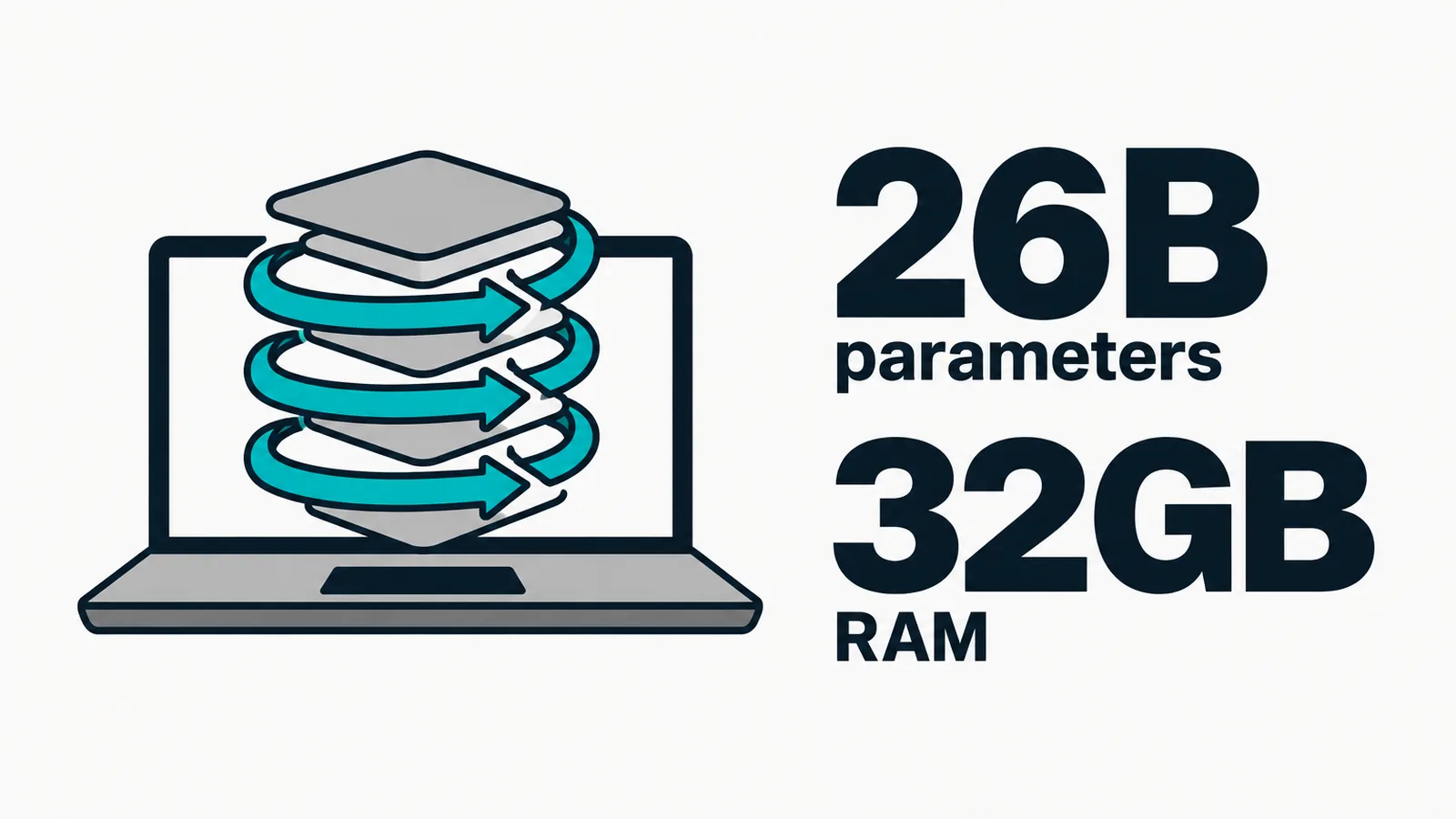
Thinking Machines has shrunk its open model to fit on a laptop. On November 20, 2026, the lab posted on X: “Some of you thought that Inkling 2 Small was too big at 594B parameters.” Its answer is Inkling 2 Mini, a 26.4 billion parameter open-weights model that runs on a Mac with 32GB of memory. The post passed 180,000 views within the hour.
The weights are on Hugging Face under the Apache 2.0 license. What makes the model unusual is not its size but its shape: part of it runs three times for every token.
On this page · 6 sectionsOpen
 Thinking Machines released Inkling 2 Mini on November 20, 2026: an open-weights model with 26.4 billion parameters, 3.4 billion of them active per token, under the Apache 2.0 license.
 It is a looped transformer: of its 24 layers, the middle 12 run three times for every token. That makes it 5.4 billion effective active parameters without more weights.
 On its own card it beats Qwen3.8-27B on coding and agent tests such as DeepSWE (48.2% vs 42.2%) and JobBench (49.6% vs 33.4%), and roughly ties it on hard reasoning.
 It runs on Macs with 32GB of memory through Ollama and on NVIDIA’s DGX Spark, with a context window of up to 1 million tokens.
 Artificial Analysis scored it 20 on its Intelligence Index at $0.59 per task, about 6 times cheaper than Qwen3.8 27B. Thinking Machines warns its reasoning can get stuck in loops.
§ 01What a looped transformer is
Inkling 2 Mini has 24 layers. The lab explained that the first six and last six run once, while the middle twelve loop three times. “Looping lets a model reason more while writing less, which has raised concerns about monitorability.”
| Item | Value |
|---|---|
| Total parameters | 26.4 billion |
| Active per token | 3.4 billion |
| Effective active, with three passes | 5.4 billion |
| Layers | 24, middle 12 run three times |
| Context window | up to 1 million tokens |
| License | Apache 2.0 |
| Runs on | Macs with 32GB, NVIDIA DGX Spark |
| Inputs | text and images |
Each extra pass adds about one billion effective active parameters, according to the card. The trade is more computation per token for the same set of weights, which is why a model this size can run locally and still do agent work.
Mira Murati added a caution: “At this scale, its thought process remains monitorable; this may not stay the case.” The lab is also releasing a variable-loop research model so others can study that question.

§ 02How it scores
The card compares it with four open models of similar size. Against Qwen3.8-27B, the closest rival, the coding and agent tests move most.
| Test | Inkling 2 Mini | Qwen3.8-27B |
|---|---|---|
| DeepSWE v1.1 | 48.2% | 42.2% |
| SWEBench Pro v2 (Hard) | 77.9% | 73.8% |
| BrowseComp | 79.0% | 61.6% |
| JobBench | 49.6% | 33.4% |
| LongBench v2 | 66.9% | 52.3% |
| HLE-Diamond | 15.2% | 15.3% |
| MMMU Pro | 74.9% | 76.3% |
On hard reasoning and image questions the two are close; Qwen edges it on MMMU Pro and HLE-Diamond. These are the lab’s own numbers, run on its own harnesses.
§ 03What it costs
Artificial Analysis, an outside benchmark firm, scored it 20 on its Intelligence Index and put it on the frontier for intelligence against active parameters. It also priced the runs using Thinking Machines’ own rates of $0.15, $0.50 and $0.015 per million input, output and cached tokens.
Inkling 2 Mini took 9.0 minutes per task against 38.2 minutes for Qwen3.8 27B. GPT-6 Luna at its max setting scored higher, 28, for less money per task, but it is a closed model that does not run on a laptop.
§ 04The limits it lists
- Reasoning loops. The card says the model sometimes gets stuck in long reasoning loops or re-checks its own work without progress, especially when debugging. It recommends limits on output tokens and agent turns.
- No true off switch. “Setting reasoning effort to its minimum does not fully disable reasoning.” The looped layers also mean more compute per token than the active count suggests.
- New in local tools. Support for looped models in local runtimes is new, so speed varies by runtime and hardware.
§ 05If you write code
A model that fits a 32GB laptop and scores close to much larger open models is useful for private, offline coding help. For work that has to keep going across days, the model is one piece; the memory, tools and review around it matter as much.
§ 06Sources
- Thinking Machines on X, 20:10 UTC, November 20, 2026, and its thread
- Mira Murati on X, 20:14 UTC, November 20, 2026
- Artificial Analysis on X, 20:35 UTC, November 20, 2026
- Inkling 2 Mini model card on Hugging Face, read November 20, 2026
Q1What is a looped transformer?
A model that sends each token through some of its layers more than once. Inkling 2 Mini runs its first six and last six layers once and its middle twelve three times, reusing the same weights each pass.
Q2How much does it cost to use hosted?
Artificial Analysis used Thinking Machines’ own prices of $0.15 per million input tokens, $0.50 per million output tokens and $0.015 per million cached tokens, which came to $0.59 per Intelligence Index task.
Q3Is it fully open?
The weights are on Hugging Face under Apache 2.0. Reports say a separate acceptable-use policy also applies to the weights, which we did not read.
Q4What are the known weak spots?
Its own card says the model sometimes gets stuck in long reasoning loops, especially when debugging code, and that setting reasoning to minimum does not turn reasoning off fully.
Q5Does CellCog use Inkling 2 Mini?
No. CellCog’s Core lanes run on Claude Opus 5.5 and its Agent Max and Creative Max lanes on Fable 5.2; none of its lanes routes to Inkling models.