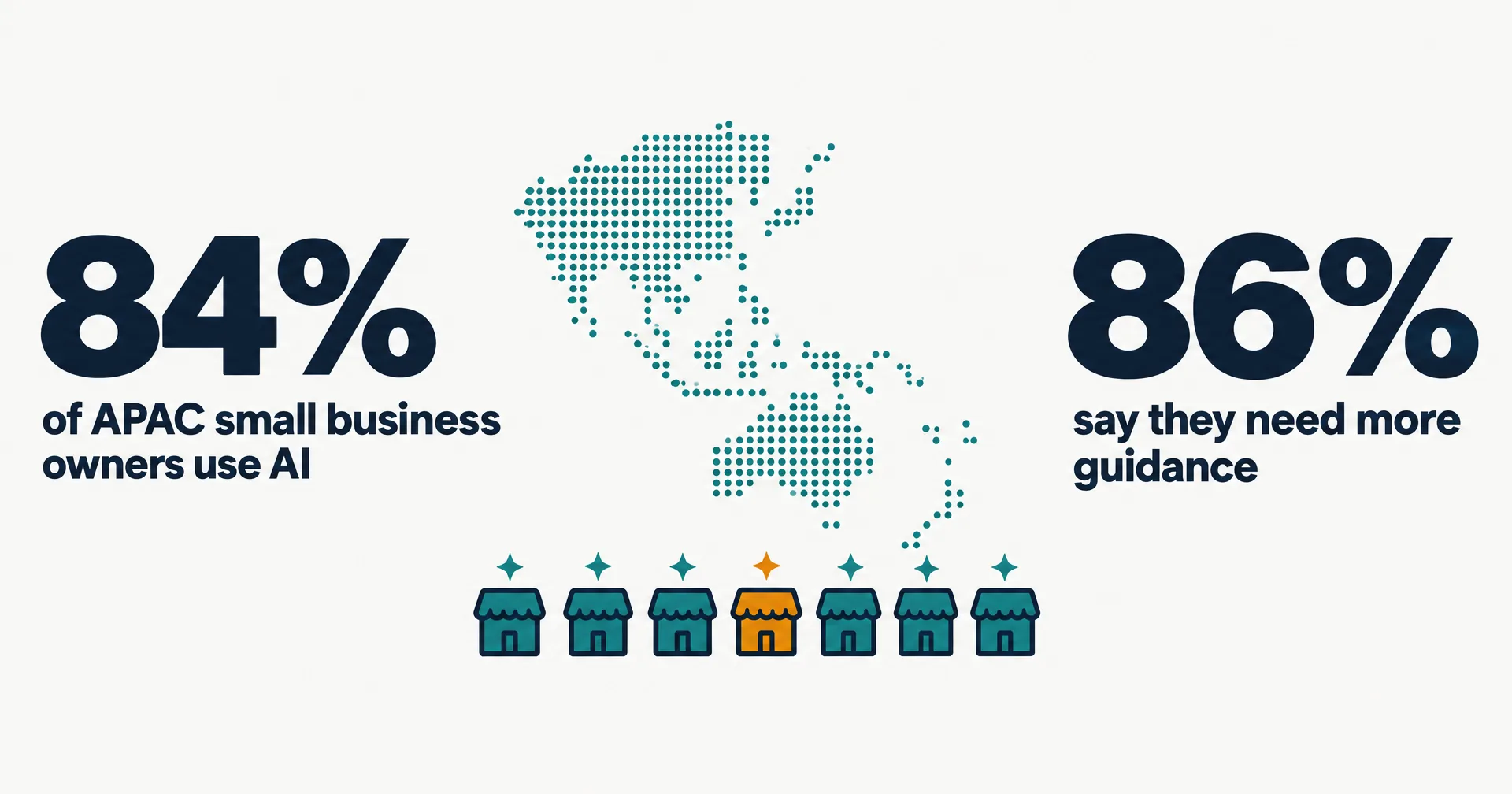
Meta says AI is already normal for small businesses in Asia-Pacific, and that what owners lack now is help using it well. In a newsroom post on October 15, 2026, Meta published a YouGov survey it commissioned of 3,983 small business owners in nine markets. 84% say they use AI, 76% report a productivity gain over the past year, and 86% say small businesses need more guidance to get the full benefit.
The numbers are useful as a read of how owners describe their own use. They are not a census, and Meta sells several of the AI tools the post promotes. Here is what the survey found and how far it travels.
 Meta commissioned YouGov to survey 3,983 small business owners in nine APAC markets between August 6 and September 2, 2026; 84% say they use AI.
 80% agree AI helps small businesses compete with larger companies, and 83% say it lets them do things that once took far more money.
 The everyday uses are content (51%), local advertising and marketing (43%), translation (38%) and customer support (37%).
 86% say small businesses need more guidance to get the full benefit of AI; cost is the top barrier to training, cited by 51%.
 The sample is an online panel with size quotas, not nationally representative, and Meta sells the AI ad tools the post promotes.
§ 01What the survey found
| Finding | Share of owners |
|---|---|
| Currently use AI | 84% |
| Need more guidance to get the full benefit | 86% |
| AI lets them do what once took far more money | 83% |
| AI helps them compete with larger companies | 80% |
| Positive impact on productivity, past 12 months | 76% |
| Positive impact on revenue or sales, past 12 months | 71% |
| Cost is the top barrier to AI training | 51% |
The highest number in the survey is the request for help, not the adoption figure. Owners asked for clearer information on cost and return on investment, and guidance on data privacy and security.
§ 02What owners use it for
Among owners whose business used AI in the past year, the uses are practical and close to the customer.
Where the saved time goes is a second clue. Among owners who reported a productivity gain, 58% put it into improving the quality of existing work, 50% into growth and business planning, and 46% into getting more done with the same team.
Meta’s own example is Zayya, an Indonesian modest-fashion brand whose founder used its training to expand into Malaysia. She said: “I used to think AI was mainly for writing captions and creating content, but I’ve learned that it can also help me understand new markets and reach the right customers.”
§ 03How far the numbers travel
| The survey shows | It does not show |
|---|---|
| How 3,983 owners in an online panel describe their AI use | AI adoption across all small businesses in these markets |
| Pooled results across nine markets | Results per country (Meta says they differ but gives none) |
| A balanced spread of 1-9, 10-19 and 20-49 employee firms | National representativeness (Meta says it is not) |
| What owners say they want | Which tools they use; the post promotes Meta’s own |
Meta flags the limits itself: the findings are “rather than being nationally representative”, and differences between markets “may partly reflect how owners in each market interpret the questions”. The 84% also sits far above national statistics. OpenAI’s EU report cites 20% of EU companies with 10 or more staff using AI in 2025, which we covered in our record of that report. The two measure different things: an owner saying they use any AI tool, against a statistical survey of firms.
§ 04Three vendors, one message
This is the third vendor report on small businesses and AI in about two weeks. OpenAI’s small business report said agentic tools made two-thirds of small-business output on its plans in August (our record), and its EU report put small-business agent growth at 8.1x since May. Meta now says nearly every APAC owner it surveyed uses AI and most want help. Each vendor measures its own users or its own panel, so none is a market figure. Read together, they say the same thing: adoption is not the gap any more; knowing what to hand the AI is.
§ 05Sources
- Meta: more than three quarters of small business owners say AI makes them more productive (October 15, 2026)
- OpenAI Economic Research: Europe’s Agentic Opportunity, PDF (October 2026)
- OpenAI: Helping small businesses put AI to work (September 30, 2026)
Q1Who ran the survey?
YouGov, commissioned by Meta, online, among 3,983 small business owners in Australia, Singapore, Vietnam, Indonesia, Taiwan, India, Thailand, Japan and Hong Kong, from August 6 to September 2, 2026.
Q2What counts as a small business here?
Firms with 1 to 49 employees. YouGov set quotas in each market for 1-9, 10-19 and 20-49 employees to get a balanced spread.
Q3Why is 84% so much higher than other adoption figures?
Different measures. This is owners in an online panel saying they use AI at all. OpenAI’s EU report cites 20% of EU companies with 10 or more staff using AI in 2025, a national statistic about firms.
Q4Does Meta publish results per country?
The post says adoption and impact differ across the nine markets but gives only the pooled figures; it adds that the gaps may partly reflect translation and local response norms.
Q5Does this cover CellCog?
No. The survey is Meta’s. CellCog builds AI employees for small businesses, and its AI employees run on Claude Opus 5.5.