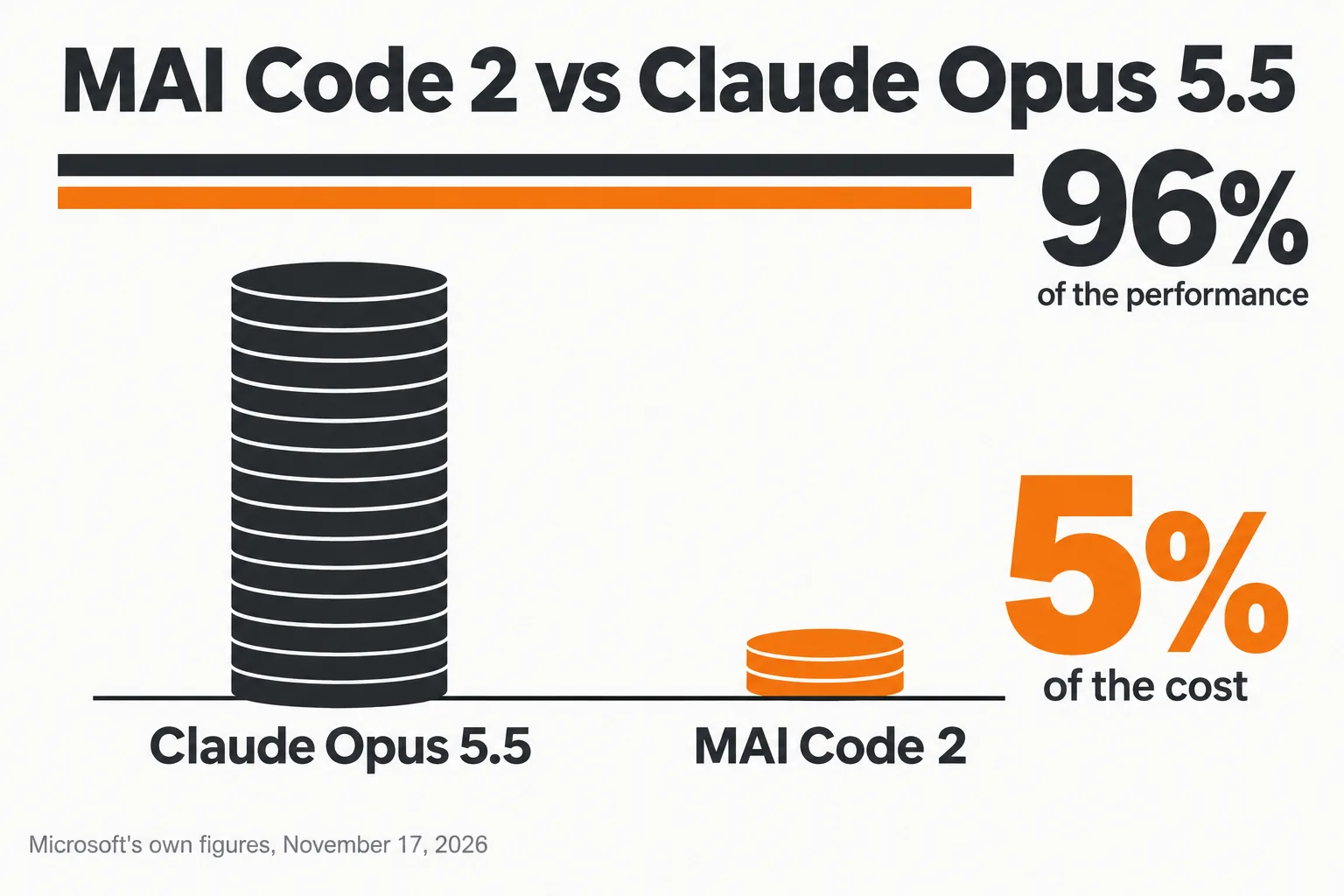
Microsoft AI launched seven new models at Ignite on November 17, 2026, and priced its pitch against Anthropic and OpenAI. The headline is MAI Code 2, which Microsoft says gives 96% of Claude Opus 5.5’s coding performance at 5% of the cost. The launch post on X read: “Frontier performance. A fraction of today’s prices. Built to run 24/7.”
Every figure on this page is Microsoft’s own, from its posts on launch day. Microsoft also says plainly what the models are not built for, and that line matters as much as the prices. This page records what Microsoft published on November 17, 2026.
On this page · 7 sectionsOpen
 Microsoft AI launched seven models at Ignite on November 17, 2026: MAI Code 2, Code 2 Flash, Cyber 2 Flash, Image 2.7, Realtime 1, MAI-Transcribe-2 and Decision 1.1.
 Microsoft says MAI Code 2 gives 96% of Claude Opus 5.5’s coding performance at 5% of the cost, and 98% of GPT-6.1 Sol’s at 40%.
 MAI Cyber 2 Flash, Microsoft says, beats GPT-6 Astra on the CyberGymE2E benchmark at less than 2% of the cost per task.
 Microsoft says these models are not yet tuned for fundamental science research or very long-horizon agentic work.
 MAI Licensed Weights lets a customer tune a frontier MAI model on its own data and run it in its own Azure environment.
§ 01What Microsoft launched
Microsoft AI posted the launch at 18:41 UTC, and listed the models an hour later: “We urgently need secure, aligned, and contained frontier intelligence at a fraction of today’s prices.” It had about 18,000 views when we read it at 20:12 UTC.
| Model | What it is for | Microsoft’s claim |
|---|---|---|
| MAI Code 2 | Repo-wide reasoning | 98% of GPT-6.1 Sol’s performance at 40% of the cost; 96% of Claude Opus 5.5’s at 5% |
| MAI Code 2 Flash | Fast, high-volume coding | Matches GPT-6 Luna and Claude Haiku 5.5 on everyday coding at 65% and 20% of the price |
| MAI Cyber 2 Flash | Security work | Beats GPT-6 Astra on CyberGymE2E at less than 2% of the cost per task |
| MAI Image 2.7 | Images | #1 on Artificial Analysis image editing, ahead of GPT Image 2.6 Sunburst (max) at 20% of the price |
| MAI Realtime 1 | Real-time audio | Beats GPT-Realtime 2.1, from $0.01 per audio minute |
| MAI-Transcribe-2 | Transcription, behind Dragon Copilot Transcribe | Powers 10 million patient encounters a month and halves multilingual error rates |
| Decision 1.1 | Decisions inside applications | Beats Jev, Google and OpenAI on the Artificial Analysis Decision Index |
§ 02The cost claims
The coding claim is the one aimed at the model most developers compare against. In Microsoft’s words: “MAI Code 2 gives you 98% of GPT-6.1 Sol’s performance at 40% of the cost, and 96% of Claude Opus 5.5’s at just 5% of the cost.” And for the smaller model: “MAI Code 2 Flash matches GPT-6 Luna and Claude Haiku 5.5 on everyday coding tasks, at 65% and 20% of the price.”
| Comparison | Cost or price, % of the rival’s |
|---|---|
| MAI Code 2 vs GPT-6.1 Sol | 40 |
| MAI Code 2 vs Claude Opus 5.5 | 5 |
| MAI Code 2 Flash vs GPT-6 Luna | 65 |
| MAI Code 2 Flash vs Claude Haiku 5.5 | 20 |
| MAI Image 2.7 vs GPT Image 2.6 Sunburst (max) | 20 |
The security model gets its own claim: less than 2% of GPT-6 Astra’s cost per task on CyberGymE2E, while beating it. Microsoft AI framed that one as a matter of running agents all day: “Our national cyber defense will fall behind if we can’t run security agents 24/7.”

§ 03What the benchmarks are, and what the models are not for
- The coding basket. For MAI Code 2, Microsoft averages DeepSWE 1.1, Terminal Bench 2.1, SWE-Atlas and FrontierCode v1.1, which it says best reflect the usage it sees in GitHub Copilot. For MAI Code 2 Flash, it averages the first three.
- The limit, in Microsoft’s words. The models are built for everyday coding work, and “they’re explicitly not yet tuned for harder problems, like fundamental science research and very long-horizon agentic work.”
- The argument. Microsoft’s case for a cheaper model is that frontier models carry a cost on every call: “When the same model is built to also push the frontier of science, you pay for that capability on every task, even for a routine bug fix.”
§ 04Licensed weights and Decision 1.1
- MAI Licensed Weights. A customer can take a frontier MAI model and tune it on its own data. Microsoft’s description: “Take a frontier MAI model, customize it using your proprietary data if you want to. Then run it securely in your own Azure environment.”
- Decision 1.1. The successor to the decision model Microsoft released in October, which we covered in Microsoft-Decision-1: Price, Benchmarks, vs Jev. Microsoft says 1.1 beats Jev, Google and OpenAI on the Artificial Analysis Decision Index.
- Earlier MAI work. Microsoft’s base model is covered in Microsoft MAI-Base-2.
§ 05What to check before switching
Our reading, not Microsoft’s: the percentages compare cost at a given level of performance on benchmarks Microsoft picked, on the day it launched. Before moving coding work to MAI Code 2, three things are worth checking on your own tasks.
- The 4% gap. 96% of Claude Opus 5.5’s score on an average can hide larger gaps on single tasks. Run your hardest recent tickets through both.
- Long tasks. Microsoft says these models are not yet tuned for very long-horizon agentic work. Agents that run for hours on one goal are exactly that.
- Price per finished task. A cheaper model that needs more retries or more review can cost more per merged change. Count retries and review time, not only the token bill.
§ 06Where CellCog sits
Our conflict, declared: we build CellCog, a platform where a business hires AI employees, and those employees run on Anthropic’s Claude models, Claude Opus 5.5 at most tiers and Claude Fable 5.2 at Agent Max and Creative Max. That is the model Microsoft’s headline compares against. CellCog does not run on any MAI model, and an AI employee’s work is mostly the long, many-step kind that Microsoft says these models are not yet tuned for.
§ 07Sources
- Microsoft AI on X, the launch post, 18:41 UTC, November 17, 2026
- Microsoft AI on X, the list of seven models, 19:48 UTC, with the per-model posts in its thread
- Microsoft AI on X, the coding benchmarks and limits, 20:06 UTC
- Microsoft AI on X, MAI Cyber 2 Flash, 20:11 UTC
- Microsoft on X, the Ignite models post, 18:29 UTC
- Mustafa Suleyman on X, his launch article, 18:28 UTC
- Microsoft AI’s launch page, linked from its posts
Q1What did Microsoft launch at Ignite 2026?
Seven Microsoft AI models on November 17, 2026: MAI Code 2, MAI Code 2 Flash, MAI Cyber 2 Flash, MAI Image 2.7, MAI Realtime 1, MAI-Transcribe-2 and Decision 1.1, plus MAI Licensed Weights for running a tuned model in your own Azure environment.
Q2How does MAI Code 2 compare with Claude Opus 5.5?
Microsoft says MAI Code 2 reaches 96% of Claude Opus 5.5’s performance at 5% of the cost, and 98% of GPT-6.1 Sol’s at 40%. These are Microsoft’s figures on a basket of coding benchmarks it chose.
Q3Which benchmarks are behind the coding claims?
For MAI Code 2, an average of DeepSWE 1.1, Terminal Bench 2.1, SWE-Atlas and FrontierCode v1.1. For MAI Code 2 Flash, an average of the first three.
Q4What does MAI Realtime 1 cost?
Microsoft says it starts at $0.01 per audio minute and outperforms GPT-Realtime 2.1.
Q5Does CellCog use MAI models?
No. CellCog’s AI employees run on Anthropic’s Claude models: Claude Opus 5.5 at most tiers and Claude Fable 5.2 at Agent Max and Creative Max.