NVIDIA introduced GR00T 2, a world action model for robots, at the Conference on Robot Learning (CoRL) in Austin, Texas on November 9, 2026, along with Isaac Lab 3.0 and two new open benchmarks for industrial robot work. The announcement is about a change in what robots are trained to do: from walking and rolling to fine work with their hands, like aligning gears and connecting cables.
NVIDIA’s robotics account summed it up as “A finer touch for humanoid robots.” Below: what GR00T 2 does by NVIDIA’s numbers, what Isaac Lab 3.0 adds, the benchmarks, and what NVIDIA has not published.
On this page · 6 sectionsOpen
 NVIDIA introduced GR00T 2, a world action model for robots built on Cosmos, at CoRL in Austin on November 9, 2026.
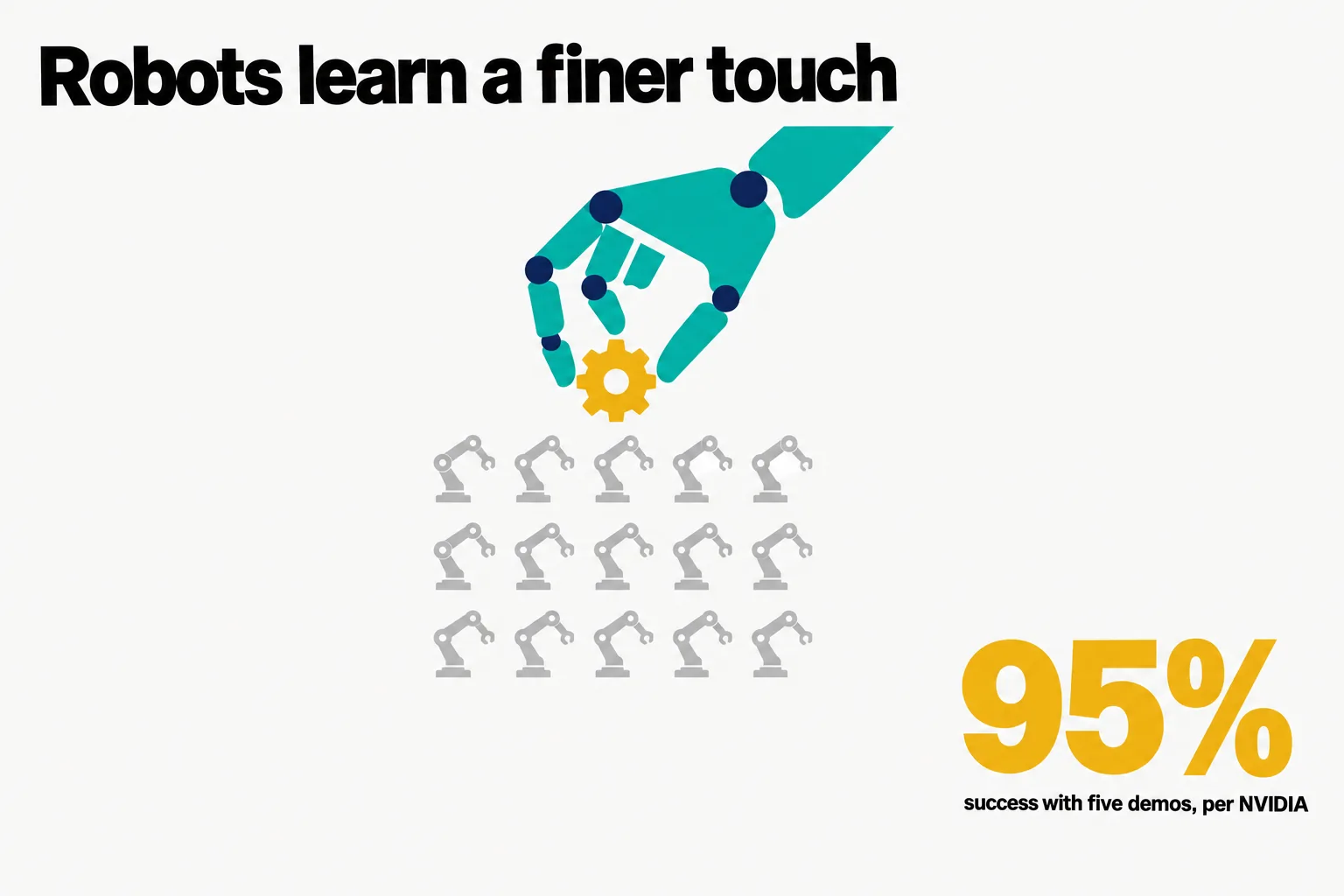
 By NVIDIA’s tests it completed 40 of 50 tasks at least once with no demonstrations, and averaged 71% success with one demo per task and 95% with five.
 Isaac Lab 3.0 adds agent-built training scenes, the Newton physics engine for cables, cloth and many-jointed hands, and up to 2.5x training throughput.
 Two new open benchmarks, DexBench and VABAR, test robots on industrial tasks in Isaac Lab-Arena.
 NVIDIA calls GR00T 2 open but published no model size, license or weights link.
§ 01GR00T 2: fewer demonstrations per task
GR00T 2 is built on NVIDIA Cosmos and trained on robot and human data, including 100,000 hours of NVIDIA’s open egocentric human video. NVIDIA reports three results, all its own.

| Demonstrations per task | Result across 50 tasks |
|---|---|
| None | 40 of 50 tasks completed at least once |
| One | 71% average success |
| Five | 95% average success |
It also learns from human demonstrations and moves skills between robot bodies without robot demonstrations, NVIDIA says, and AI agents can call it through an API to run skills in sequence and recover from errors. NVIDIA says it ranks in the top three across vision language action and world action model categories on RoboCasa365, RoboLab, RoboDojo and MolmoSpaces.
Early users named in the post: Nexuni is testing it for laundry handling, Foxconn for server manufacturing, and Siemens is evaluating it for industrial work. MicroAGI post-trained it with reinforcement learning to swap Ethernet cables with a YAM robotic arm.
§ 02Isaac Lab 3.0: practice in simulation
“Simulation lets researchers train, refine and evaluate skills at scale before deploying them on physical robots.” That is NVIDIA’s case for Isaac Lab, its open-source robot-learning framework. Version 3.0 lets agents set up training environments with simulation-ready assets, switches between the PhysX and Newton physics engines, and adds a reinforcement post-training library for models like GR00T.
Tighter integration with Newton lets Isaac Lab model deformable objects such as cables and cloth, and robot hands with many joints. On a vision-based dexterous manipulation benchmark, NVIDIA reports Isaac Lab 3.0 with Newton reached up to 2.5x the training throughput of Isaac Lab 2.3 with PhysX.
Precision is the theme. AlphaNIST, built in Isaac Lab, trains one policy on all 20 tasks of the NIST Assembly Task Board using only a yes-or-no success signal: more than 98% training success versus 81% for separate per-task policies, with roughly 39x less GPU time, per NVIDIA.
§ 03New benchmarks and partners
- DexBench, from RLWRLD with NVIDIA: 15 tasks across four scenes in retail, logistics, manufacturing and hospitality.
- VABAR, from UC Berkeley and NVIDIA: industrial tasks with standard variations and success metrics.
- Isaac Lab-Arena 0.4, the evaluation framework both run on, arrives at CoRL as a developer preview.
- Partners include Skild AI, which announced a Newton-based physics solver called STEEL, Flexion, FieldAI, Dyna Robotics and Walden Robotics.
Two NVIDIA papers, GRAIL and RoboTTT, are among the six Best Paper finalists at CoRL. Its EgoHand model, which reconstructs 3D hand motion, passed 40,000 Hugging Face downloads in its first two weeks.
| Item | Status in the November 9 post |
|---|---|
| GR00T 2 results | Published (NVIDIA’s own tests) |
| GR00T 2 model size | Not stated |
| GR00T 2 license and weights link | Not stated |
| Isaac Lab 3.0 throughput | Up to 2.5x, NVIDIA’s benchmark |
| Isaac Lab-Arena 0.4 | Developer preview |
NVIDIA calls GR00T 2 open, but the post gives no model card, weights link or license, so whether and how you can download it is still open.
§ 04What this means if you build on AI
- Robot learning looks like model training now. Pretrain a foundation model, then post-train it on a few demonstrations, the same pattern as language models.
- Simulation is where the compute goes. A million parallel environments and agent-built scenes mean robot teams buy GPUs the way model labs do, as in Wayve’s deal with CoreWeave.
- Agents are moving into the loop. Agents that write simulation scenes and call robot skills through an API connect today’s coding agents to physical work.
§ 05What we are watching
- Weights. A GR00T 2 model card with size and license.
- Independent results. Third-party numbers on DexBench and VABAR.
- The awards. Whether GRAIL or RoboTTT wins Best Paper this week.
§ 06Sources
- NVIDIA, Practice Makes Precise: At CoRL, NVIDIA and Partners Reveal How Robots Rehearse Delicate Work in Simulation, November 9, 2026
- NVIDIA Robotics on X, the announcement post, November 9, 2026
- Isaac Lab, documentation
- CellCog, NVIDIA AI Day Seoul
Q1What is a world action model?
A model that predicts how a robot’s actions will change its surroundings and chooses actions from that; NVIDIA builds GR00T 2 on its Cosmos world models.
Q2What data was GR00T 2 trained on?
Robot and human data, including 100,000 hours of NVIDIA’s open egocentric human video, per NVIDIA.
Q3Who is using GR00T 2?
NVIDIA names Nexuni for laundry handling, Foxconn for server manufacturing, Siemens for industrial evaluation and MicroAGI for Ethernet cable swapping.
Q4What is new in Isaac Lab 3.0?
Agent-assisted environment setup, a choice of PhysX or Newton physics, a reinforcement post-training library and better modeling of deformable objects.
Q5What is AlphaNIST?
A single policy trained in Isaac Lab on all 20 NIST Assembly Task Board tasks: over 98% training success versus 81% for per-task policies, with about 39x less GPU time, per NVIDIA.