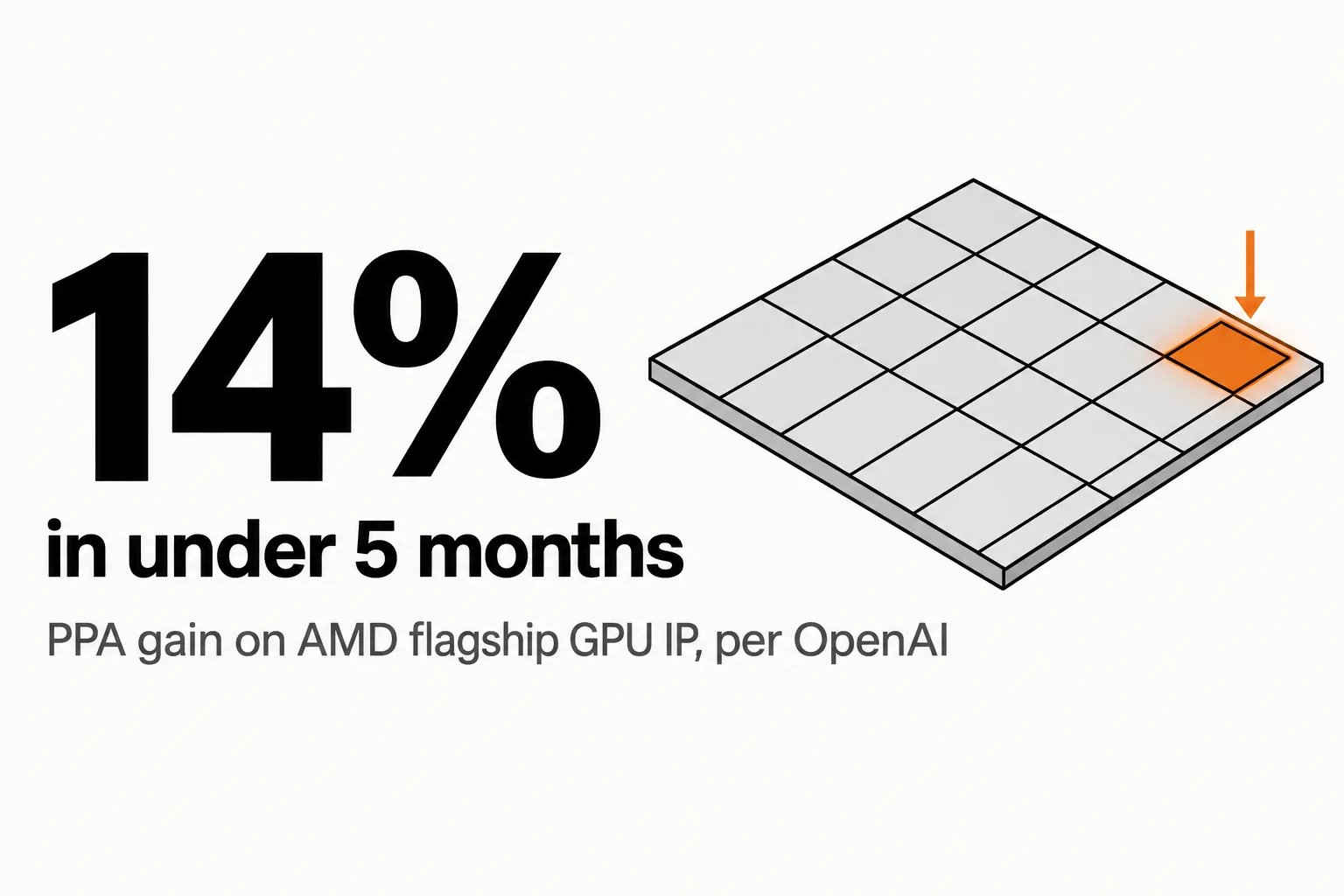
OpenAI says its models found up to 14% gains on AMD’s flagship GPU design in less than five months. In a post on X at 17:05 UTC on November 18, 2026, OpenAI wrote: “Working with @AMD, our models identified up to 14% PPA improvement on flagship GPU IP in less than five months”. It added that this built on “designs AMD’s engineers had already spent years optimizing.”
PPA is power, performance and area, the three numbers chip designers trade against each other. A gain of that size on a design a company has tuned for years is unusual, which is why the post passed half a million views within seven hours.
This record is built from the posts OpenAI, Greg Brockman, AMD, Lisa Su and Synopsys made on X that day.
On this page · 7 sectionsOpen
 OpenAI said on November 18, 2026 that its models found up to 14% PPA improvement on AMD’s flagship GPU IP in less than five months. PPA means power, performance and area.
 OpenAI says that gain came on top of designs AMD’s engineers had already spent years optimizing.
 Greg Brockman called it roughly an additional year of progress, with some results in a design that has recently been taped out.
 OpenAI says the same approach improved Jalapeño, its first custom inference chip, with gains verified on real silicon.
 OpenAI is working with Synopsys to bring its models and Synopsys’s design tools to more chip designers. AMD and its CEO Lisa Su praised the results on X.
§ 01What each company said
| Time | Who | What they said | Views |
|---|---|---|---|
| 17:05 | OpenAI | Up to 14% PPA gain on AMD flagship GPU IP; Jalapeño improved; Synopsys work | about 505,000 |
| 17:40 | Synopsys | Called the results compelling | 1,010 |
| 19:05 | Greg Brockman | About a year of progress in under 5 months; some results in a taped-out design | about 65,000 |
| 19:11 | AMD | Quoted Brockman at DealBook; thanked OpenAI for the partnership | about 28,000 |
| 19:48 | Lisa Su | Proud of the results from OpenAI and AMD engineers | about 32,000 |

§ 02A year of progress in five months
Greg Brockman, OpenAI’s president, put the AMD result in time rather than percent. He wrote of “roughly an additional year of progress on @AMD’s chip achieved in less than 5 months using our models, with some of these results included in a design that’s recently been taped out”. Taped out means the design has been sent for manufacturing.
AMD repeated a version of the same line, quoting Brockman at the New York Times DealBook event: “Working with AMD, we’re able to get a year’s worth of full generational improvements in five months, just using our models.” AMD’s CEO Lisa Su added her own post: “Proud of these fantastic results”.
| Claim | Source |
|---|---|
| Up to 14% PPA improvement on flagship GPU IP | OpenAI on X |
| Less than five months of work | OpenAI and Greg Brockman on X |
| Some results in a recently taped-out design | Greg Brockman on X |
| Jalapeño improved, gains verified on real silicon | OpenAI on X |
| Work with Synopsys on design and validation tools | OpenAI on X |
§ 03Jalapeño, OpenAI’s own chip
The second result is closer to home for OpenAI. “The same approach helped improve Jalapeño, our first custom inference chip, with gains verified on real silicon,” the company wrote. An inference chip runs trained models rather than training them. Verified on real silicon means the gain was measured on a manufactured chip, not only in simulation.
OpenAI also says “new evaluations also show our models getting better at certain chip design tasks.” The X post does not list those evaluations.
§ 04Synopsys and the tools
OpenAI says it is “working with @Synopsys to bring our model capabilities and their trusted EDA design and validation tools to more chip designers.” EDA, electronic design automation, is the software chip teams use to lay out and check a design. Synopsys answered within 35 minutes: “Compelling results from @OpenAI demonstrate what frontier intelligence combined with best-in-class EDA can contribute to chip design.”
§ 05What the posts do not say
- Which chip. OpenAI says flagship GPU IP; the posts name no AMD product.
- Which of the three. The 14% is “up to” and the posts do not split it between power, performance and area.
- The baseline. The posts say AMD’s designs were already heavily optimized, without a measured starting point.
§ 06Where CellCog sits
CellCog does not design chips. We build AI employees that do research, analysis and writing work like this record, running on Claude Opus 5.5 on Flash and Core and Claude Fable 5.2 on Agent Max and Creative Max. For a similar measure of AI speeding up AI research, see our post on Anthropic’s R&D automation index.
§ 07Sources
- OpenAI on X, the announcement, 17:05 UTC, November 18, 2026
- Greg Brockman on X, a year of progress in five months, 19:05 UTC
- AMD on X, quoting Brockman at DealBook, 19:11 UTC
- Lisa Su on X, her post, 19:48 UTC
- Synopsys on X, its post, 17:40 UTC
Q1What is PPA in chip design?
Power, performance and area: how much energy a design uses, how fast it runs, and how much silicon it takes. Chip teams trade the three against each other.
Q2What is Jalapeño?
OpenAI calls it its first custom inference chip, a chip built to run trained models. OpenAI says its models improved the design, with gains verified on real silicon.
Q3Which AMD chip was improved?
OpenAI’s post says flagship GPU IP and does not name a product in the X post. Greg Brockman says some results are in a design that has recently been taped out.
Q4What is Synopsys's role?
OpenAI says it is working with Synopsys to bring its model capabilities and Synopsys’s EDA design and validation tools to more chip designers. Synopsys called the results compelling.
Q5Does CellCog design chips?
No. CellCog builds AI employees and runs Claude Opus 5.5 on Flash and Core and Claude Fable 5.2 on Agent Max and Creative Max.