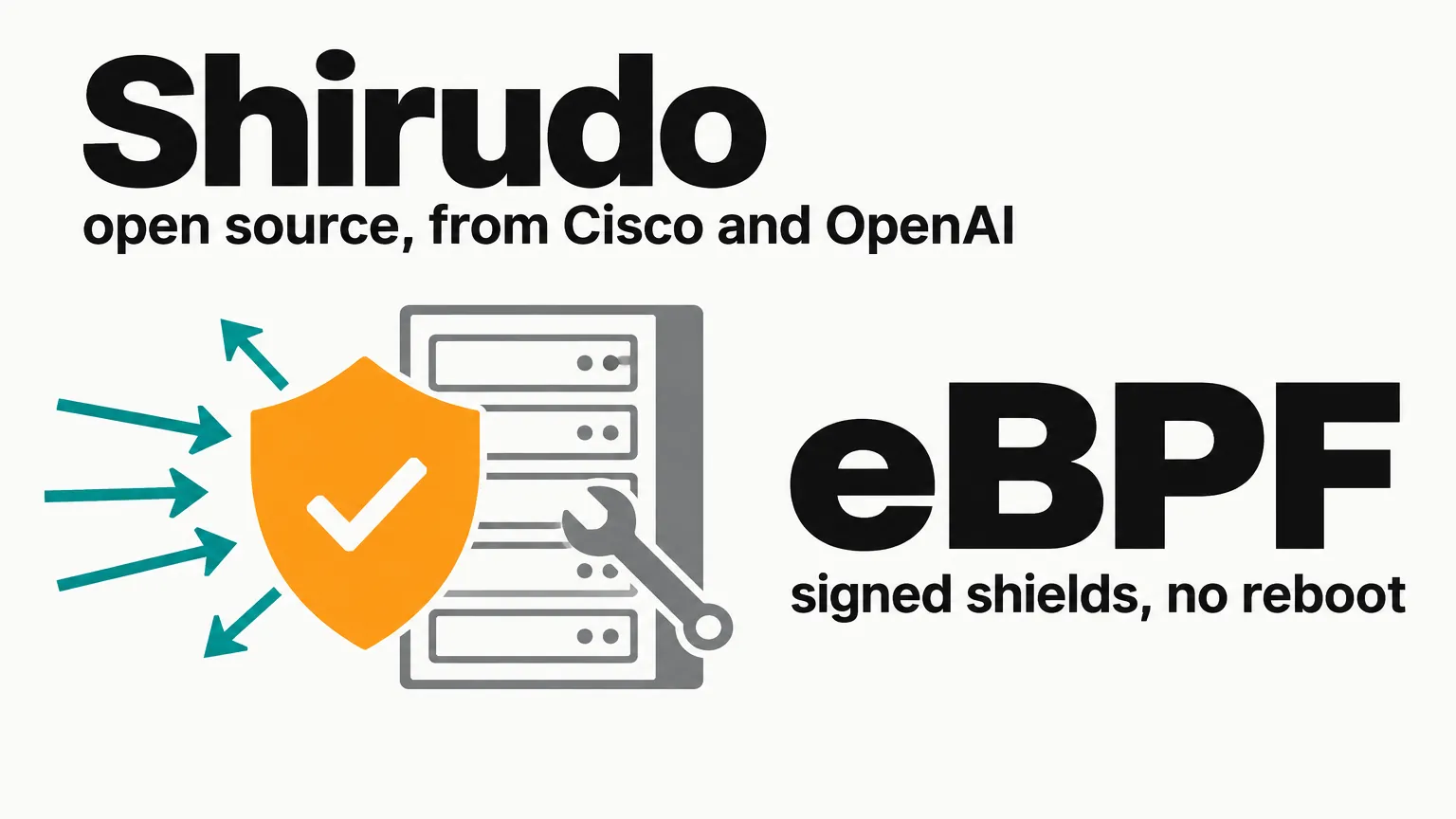
OpenAI and Cisco have released Shirudo, an open-source Linux runtime that lets AI agents shield a running system from an exploit without taking it down. OpenAI announced it on X at 21:37 UTC on November 23, 2026: agents “write dynamic eBPF controls to shield systems from exploits, giving defenders more time to test and roll out patches.” The post says it was “Built by @cisco together with OpenAI.” The code is on GitHub under the BSD-2-Clause license.
Shirudo is Cisco’s and OpenAI’s project, not CellCog’s; we have no part in it and have not run it. This page sets out what the project’s own README says it does, what it needs, and where it stops. Both companies published announcements, OpenAI’s and Cisco’s; we worked from the README and the X post.
On this page · 6 sectionsOpen
- OpenAI and Cisco released Shirudo on November 23, 2026, an open-source Linux runtime for shielding systems from exploits without downtime.
- Agents write small eBPF programs, called upatches, that block a vulnerable path at a kernel hook while the real patch is tested and rolled out.
- Every shield is signed: after boot, Shirudo only lets signed loaders load BPF programs, and a TPM records which shields are running.
- It is pre-release, and production machines need a Linux kernel with Shirudo’s patches and a TPM 2.0.
- The code is on GitHub under the BSD-2-Clause license; Cisco built it together with OpenAI.
- It follows OpenAI’s GPT-6 Cyber work, which validated 948 Linux kernel bugs in one run.
§ 01What Shirudo does
The name is Japanese for shield. The README calls it “a BPF-based security platform for Linux.” The working unit is a upatch: a small signed program that blocks a vulnerable path at a kernel hook, or guards Java code, while the real fix goes through testing. The idea in OpenAI’s words is “a first step toward self-defending infrastructure”, where agents find affected systems, test shields and deploy them without stopping workloads.
| Part | What it does |
|---|---|
| Upatches | Small signed BPF programs that block vulnerable kernel paths, or Java agents that guard application code |
| Signed loading | After boot, BPF loads from userspace are limited to loaders the kernel verifies |
| TPM measurement | Each change to the loaded shields extends a TPM register; the machine returns signed evidence of what runs |
| Delivery | Targets pull signed packages from OCI registries and send telemetry to OpenTelemetry collectors |
| Observability | A bundled package watches process launches, network activity and privilege changes |
| Requirements | A Linux kernel with the signed-loader interface and Shirudo’s patches, plus a TPM 2.0 |
The signing is the point. An agent that can write kernel-level controls is powerful, and Shirudo’s answer is that nothing loads unless it is signed with the operator’s key, and every change leaves a record in the TPM. The README says the project “restricts BPF program loads from userspace to signed loaders” after boot-time initialization.
§ 02What it is not yet
The README is plain: “shirudo is pre-release.” Production machines need a patched kernel and a TPM 2.0; the quickstart runs in a local VM with a software TPM. CI covers x86-64 fully and arm64 for host tests; riscv64 validation is pending. The repository was created on October 13, 2026 and had 611 stars when we read it.
§ 03Where it fits
It lands the same day OpenAI’s account posted a video on GPT-6 Cyber, the model that validated 948 Linux kernel bugs in one run and generated patches for review. That work finds and fixes bugs; Shirudo covers the gap between a known bug and a deployed patch. Read our GPT-6 Cyber record for the model side.
| Post | Time (UTC) | Views |
|---|---|---|
| OpenAI | 21:37 Nov 23 | 1,020,861 |
| Greg Brockman | 21:57 Nov 23 | 94,607 |
§ 04What we did not check
- The software. We did not build Shirudo or run the test VM.
- The two announcements. We linked OpenAI’s and Cisco’s posts but worked from the README and OpenAI’s X post.
- Who uses it. No deployment numbers are published.
§ 05Where CellCog sits
Our conflict, declared: CellCog builds AI employees, including an AI software engineer that writes and ships code changes. That is application work, not kernel security. CellCog has no part in Shirudo.
§ 06Sources
- shirudo-dev/shirudo, README and repository, read November 24, 2026
- OpenAI on X, November 23, 2026; Greg Brockman on X
- Introducing Shirudo, OpenAI; Cisco and OpenAI on Shirudo, Cisco Isovalent (linked, not read)
Q1What does Shirudo do?
It lets operators, and agents working for them, ship small signed BPF programs called upatches that block a vulnerable path in the Linux kernel or guard Java code, while the full patch is tested. It also observes process, network and privilege activity.
Q2Why does it need a TPM?
Each change to the set of loaded upatches is recorded in a TPM register, and the machine can return signed evidence of what is running that an operator verifies offline.
Q3Is Shirudo ready for production?
Its README says it is pre-release. Production targets need a Linux kernel with the signed-loader interface and Shirudo kernel patches, plus a TPM 2.0. A local test VM uses a software TPM.
Q4How is it related to GPT-6 Cyber?
Both are OpenAI security work on Linux. GPT-6 Cyber found and patched kernel bugs; Shirudo is a way to block a known bug at runtime until the patch ships.
Q5Is Shirudo a CellCog product?
No. It is Cisco’s and OpenAI’s open-source project. CellCog has no part in it and has not tested it.