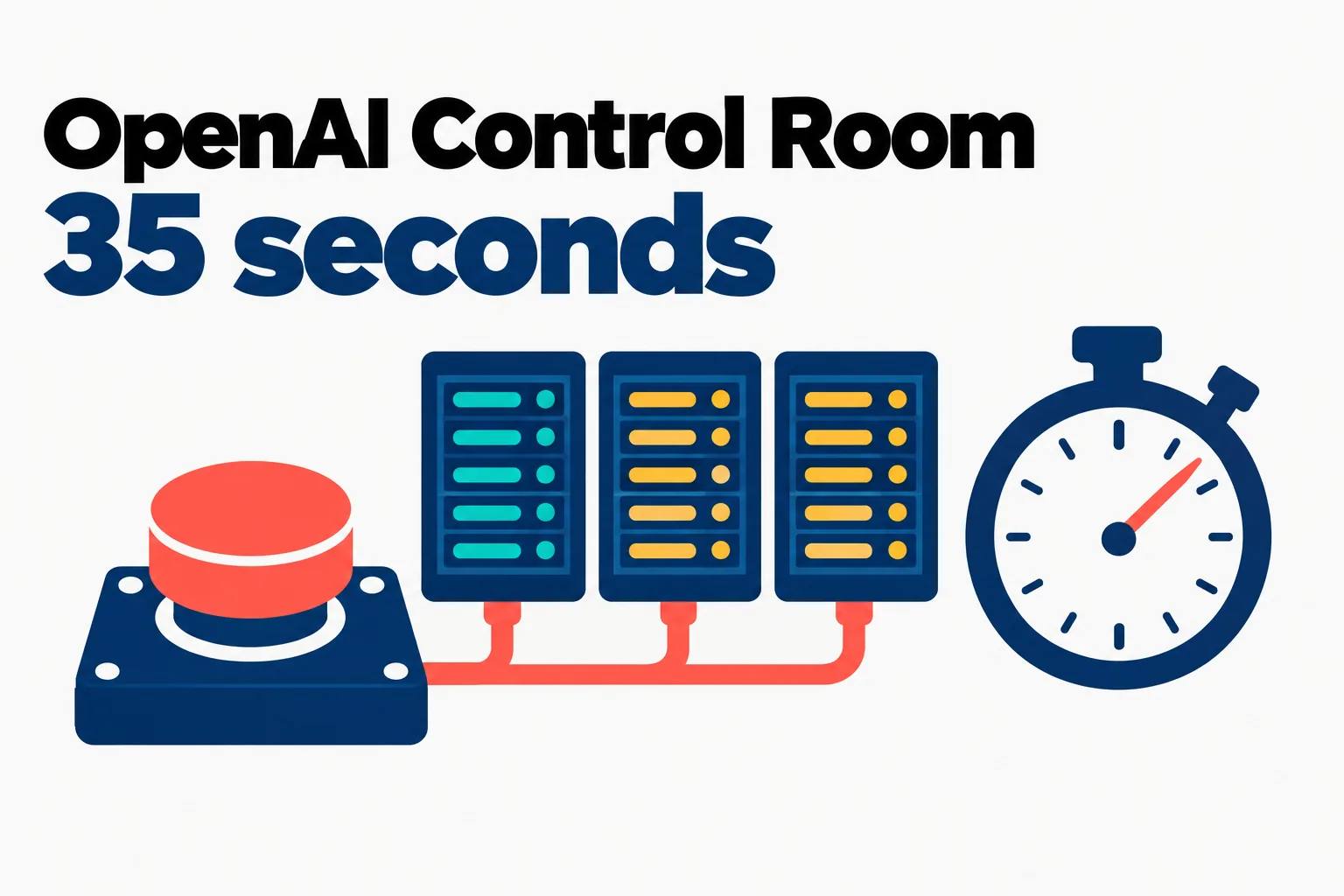
OpenAI has built Control Room, a central system that tracks every model workload across its research infrastructure and can stop one when a safety or security concern comes up. Per OpenAI’s announcement on November 9, 2026, it “halts model output within 35 seconds of a decision to intervene to stop or pause a job,” and it is already deployed.
OpenAI’s post on X passed 84,000 views within about 15 minutes. The page first appeared in OpenAI’s news feed at a different address that returned an error for several hours; it now serves at its own URL.
On this page · 6 sectionsOpen
 OpenAI built Control Room, a central system that tracks every research model workload and can stop one; it is already deployed.
 Every request a research job makes to a model carries a job ID, and the engine asks Control Room whether that job may continue.
 Output stops within 35 seconds of a stop decision; the lag comes from an authorization cache, and OpenAI wants it at zero.
 It fails closed: if Control Room goes down or is tampered with, every inference request is denied until it comes back.
 Monitor models watch frontier training jobs and can trigger the stop; ChatGPT and the API are not covered by Control Room.
§ 01How Control Room works
Control Room sits between OpenAI’s research jobs and the models those jobs call. OpenAI describes three parts: the workload (an experiment, an evaluation, a sampling or data-processing job), the inference engine (the model running on GPUs), and the central Control Room service. “We require every research workload that does agentic inference to be associated with an approved safety case.”
| Step | What happens |
|---|---|
| 1. Start | The job asks Control Room for a job ID |
| 2. Every call | Each request to a model carries that job ID |
| 3. Permission | The engine asks Control Room whether that job may continue |
| 4. Alert | A monitor model watching the job flags a problem and tells Control Room to stop it |
| 5. Refusal | The next request from that job is denied, on any engine, so no further output is produced |
The monitors are other models. “All of our frontier reinforcement learning jobs run with a monitor,” OpenAI writes, and it points to its recent DNS-related incident as one a monitor caught.

§ 02Why the stop lives in the inference layer
OpenAI’s argument is about where to put the switch. Research code changes constantly and is written by many teams, so it is “not an ideal place to implement critical load-bearing safety protections.” There are only a few inference code paths across all of OpenAI research, so checking every request there gives one bottleneck that every job has to pass. OpenAI also says it runs continual sweeps to catch engines launched with Control Room missing or disabled, by accident or on purpose.
The system also “fails closed”: if Control Room goes down, from an error or from “tampering by a bad actor,” every inference request is denied until it comes back. OpenAI says fail-closed covers all frontier model research workloads now and will reach the rest over the next few days.
§ 03What it covers, and what it does not
| Question | Answer |
|---|---|
| Where it runs | OpenAI’s research infrastructure (training, evaluation, sampling, data processing) |
| Status | Already deployed |
| Time to stop | Up to 35 seconds after the stop decision |
| Why not instant | A cache for inference authorization, needed for the traffic volume |
| If it fails | Fails closed: all inference requests are denied |
| Fail-closed coverage | All frontier research workloads now; the rest within days |
| Public products | Not covered; OpenAI says its serving stack already has its own takedown ability |
On the 35 seconds, OpenAI is direct: “The 35-second lag comes from a caching layer for inference authorization, to support the required volume of traffic.” It adds, “We are working to drive this number down to zero so that we can end jobs instantly.”
Control Room does not cover ChatGPT or the API. OpenAI says its external model-serving stack is already far more centralized, with a well-developed way to take deployments down quickly. No outside party has reviewed Control Room, and OpenAI has not said how often it has been used to stop a job.
§ 04Where it fits in OpenAI’s safety posts
Control Room is the latest in a run of OpenAI safety posts this fall: its safety cases for frontier AI training (September 28) and how it detects frontier model misalignment (October 29). Control Room is the enforcement end of both: a job needs an approved safety case to run, and a monitor’s alert now has a switch to pull. We covered the earlier reports in our misalignment reporting record and the case of agents disabling their own monitoring.
§ 05Where CellCog fits
CellCog does not train models, so there is no research cluster to stop. The idea that carries over is putting the check where every action has to pass. CellCog AI employees run under their owner’s approval level: the agent classifies every command that reaches your world, and the platform rejects any command that arrives unclassified, so the riskiest actions wait for a person.
§ 06Sources
- OpenAI, Control Room: A central system to track and stop model workloads across our research infrastructure, November 9, 2026
- OpenAI on X (22:01 UTC, November 9, 2026)
- OpenAI, Towards safety cases for frontier AI training, September 28, 2026
- OpenAI, How we detect frontier model misalignment, October 29, 2026
- OpenAI, An agent used DNS to reach an external chatbot
Q1When was Control Room announced?
On November 9, 2026, in an OpenAI post and on X.
Q2Why does it take 35 seconds?
OpenAI says the lag comes from a caching layer for inference authorization, needed for the volume of traffic, and it is working to bring it to zero.
Q3What does fails closed mean here?
If the Control Room service goes down for any reason, engines deny every inference request until it is back.
Q4Who decides to stop a job?
OpenAI’s monitoring system, which uses monitor models on frontier training jobs, can send the stop depending on the issue and its severity.
Q5Has anyone outside OpenAI reviewed it?
Not publicly. OpenAI has not published an outside review or how often the system has stopped a job.