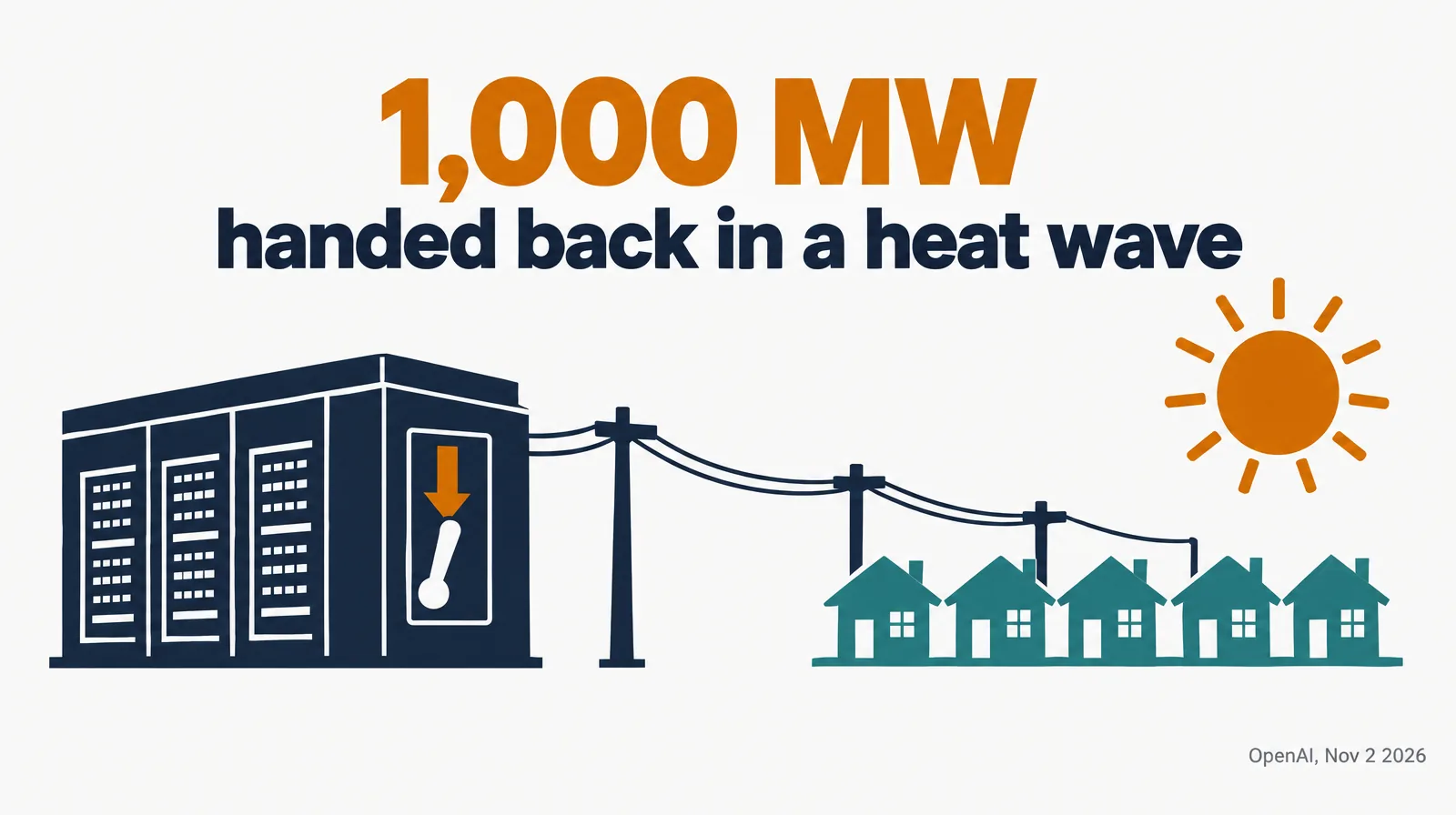
OpenAI launched the Grid Protectors Program on November 2, 2026. Its future compute campuses will cut their electricity use when the local grid is under strain, so that homes and businesses keep their power. The first commitment is in Georgia: up to 1,000 megawatts of flexible demand at the planned Effingham County campus, which OpenAI puts at the average demand of about 700,000 households.
“Georgia is our starting point.” OpenAI says it will agree with each utility how much demand can be cut, how quickly and for how long, and that “The arrangements will differ by location, and we will share additional commitments as they are finalized.”
On this page · 7 sectionsOpen
 OpenAI launched the Grid Protectors Program on November 2, 2026: its future compute campuses will cut power use when the local grid is under strain.
 Arrangements are agreed per utility: how much demand can be cut, how quickly and for how long.
 The first is Georgia: up to 1,000 MW of flexible demand at the planned Effingham County campus, about 700,000 households’ worth by OpenAI’s count.
 OpenAI says it pays the full infrastructure and electric-service costs to serve that campus.
 The campus is still in development, so the 1,000 MW is a commitment for later, and Georgia Power’s savings figures cover its whole large-load portfolio.
§ 01How the program works

The idea is that a compute campus is a big, steady customer that can bend. On most days it uses power the grid has spare, which helps pay for lines and substations that cost the same whether demand is high or low. On the hottest or coldest days it backs off. OpenAI’s own analogy is a restaurant in a vacation town that needs regulars to cover the off season: “We are proposing to be that regular customer.”
Beyond turning down, OpenAI says it may supply power from on-site generation or storage where local grids need it, and use batteries and power controls to smooth swings in demand.
| Item | Commitment |
|---|---|
| Campus | Planned Effingham County campus, Georgia |
| Costs | OpenAI pays the full infrastructure and electric-service costs to serve it |
| Flexible demand | Up to 1,000 MW of demand response under its Georgia Power agreement |
| Scale, per OpenAI | About 700,000 households at average use, more than Washington, D.C. and Boston combined |
| Expected campus demand | About 3,200 MW, per Georgia Power |
| Contract term | 25 years, per Georgia Power |
| Status | Campus still in development; Effingham is the program’s pilot |
| Protection if plans change | Long-term contracts and financial assurances if a project is delayed, reduced or canceled |
§ 02The numbers behind it
OpenAI frames the program against the growth of data centers: U.S. capacity is projected to pass 100 gigawatts by 2030, citing BloombergNEF, whose latest outlook puts it at 118 GW.
Georgia Power’s own release adds a number OpenAI’s post leaves out: the campus is expected to need about 3,200 MW. The 1,000 MW of flexible demand is about 31% of that, under a 25-year agreement that lets the utility reduce the energy it delivers to the site in times of high demand. Georgia Power, which says its OpenAI contract has been approved, projects about $950 million a year in customer savings from 2029 across its portfolio of large-load agreements and expected growth, which includes OpenAI’s Project Camellia, and a benefit of at least $15 a month for a typical home using 1,000 kilowatt-hours.
| Figure | Value | Source named by OpenAI |
|---|---|---|
| Flexible demand at Effingham | Up to 1,000 MW (1 GW) | Georgia Power agreement |
| U.S. data center capacity by 2030 | Over 100 GW, projected | BloombergNEF (its latest outlook: 118 GW) |
| Georgia Power customer savings | About $950 million a year from 2029 | Georgia Power, whole large-load portfolio |
| Typical residential benefit | At least $15 a month | Georgia Power, at 1,000 kWh a month |
Two cautions. The $950 million and $15 figures are Georgia Power’s estimates for its whole large-load portfolio, not savings from OpenAI alone. And the campus is not running yet, so the 1,000 MW is a commitment for later.
§ 03Update, November 5, 2026: a community compact and a policy blueprint
Three days later OpenAI widened the program into a National Community Compact and a Compute Campus Policy Blueprint. The compact is a pledge for campuses OpenAI owns and operates: “Every future compute campus OpenAI owns and operates will have its own local compact.” The blueprint asks lawmakers to make similar rules apply to everyone who builds.
| Area | Commitment |
|---|---|
| Energy | Pay the full cost of its electricity and the infrastructure to serve it, with financial assurances before major spending |
| Water and noise | A water plan per campus, site-level water and electricity reporting, independent noise studies before and after opening |
| Public officials | No non-disclosure agreements with public officials, beyond narrow security and trade-secret protections |
| Jobs | Published hiring forecasts, union and training partnerships, annual reports on hiring and apprenticeships |
| Local investment | Projects residents help pick, such as a $4.8 million school-meals grant in Effingham County, Georgia, and a $6 million childcare commitment in Pike County, Ohio |
The blueprint is the bigger ask. “Voluntary commitments from companies are an important starting point, but our blueprint goes further,” the post says. It wants state utility commissions to make large customers cover the grid costs they add, faster transmission upgrades from Congress, public terms for tax incentives with a way to claw them back, and limits on NDAs with officials. The Georgia demand-response deal from this page is its worked example: Georgia Power can cut up to 1,000 megawatts to the campus at times of high demand.
§ 04Why OpenAI is saying this now
Data center power is a political fight in many towns, and OpenAI states the principle directly: “Families and small businesses should not be asked to subsidize” the electricity needs of a compute campus. The post also says what the program is not: “Flexibility cannot replace investment in new energy supply and transmission.”
It follows OpenAI’s revised funding target and sits beside other labs’ bets on power for compute, such as Google’s Project Suncatcher, which looks at solar-powered chips in orbit.
§ 05What this means for businesses using AI
Our conflict, declared: we build CellCog, where businesses hire AI employees, and they run on Claude Opus 5.5 from Anthropic, not on OpenAI. Every AI tool, ours included, runs on compute that needs power, and the cost of that power ends up in the price of AI work. A grid that can absorb new campuses without raising everyone’s bills is good for anyone who buys AI. Whether flexible campuses deliver that is something the first heat wave at a running site will show.
§ 06What we are watching
- More commitments. OpenAI says it will publish arrangements for other campuses as they are finalized; the November 5 compact promises a local compact and an annual public report for each one.
- The blueprint in law. Whether any state utility commission or Congress takes up the cost-allocation and NDA proposals.
- Effingham coming online. The first real test of whether a campus turns down on a hot day.
- Other labs. Whether Anthropic, Google or Microsoft sign similar demand-response terms.
§ 07Sources
-
OpenAI: Setting a new standard for responsible AI infrastructure, November 5, 2026, read directly.
-
OpenAI: Introducing the Grid Protectors Program, November 2, 2026, read directly.
- Georgia Power: OpenAI project in Effingham County and contract approval and savings, read November 2, 2026.
- BloombergNEF: U.S. data center capacity outlook.
Q1How much power will OpenAI give back?
Up to 1,000 MW of flexible demand at its Georgia campus, which OpenAI compares to the average demand of about 700,000 households.
Q2Is the Georgia campus running?
No. OpenAI says the Effingham County campus is still in development and will serve as the program’s pilot.
Q3Who pays for the grid upgrades?
OpenAI says it pays the full infrastructure and electric-service costs required to serve the Effingham campus.
Q4Will other campuses join?
OpenAI says arrangements will differ by location and it will share more commitments as they are finalized.
Q5Does CellCog run on OpenAI?
No. CellCog’s AI employees run on Anthropic’s Claude models (Claude Opus 5.5 on most tiers; Claude Fable 5.2 on Agent Max and Creative Max since November 11, 2026); we cover the program because power costs shape the price of all AI work.