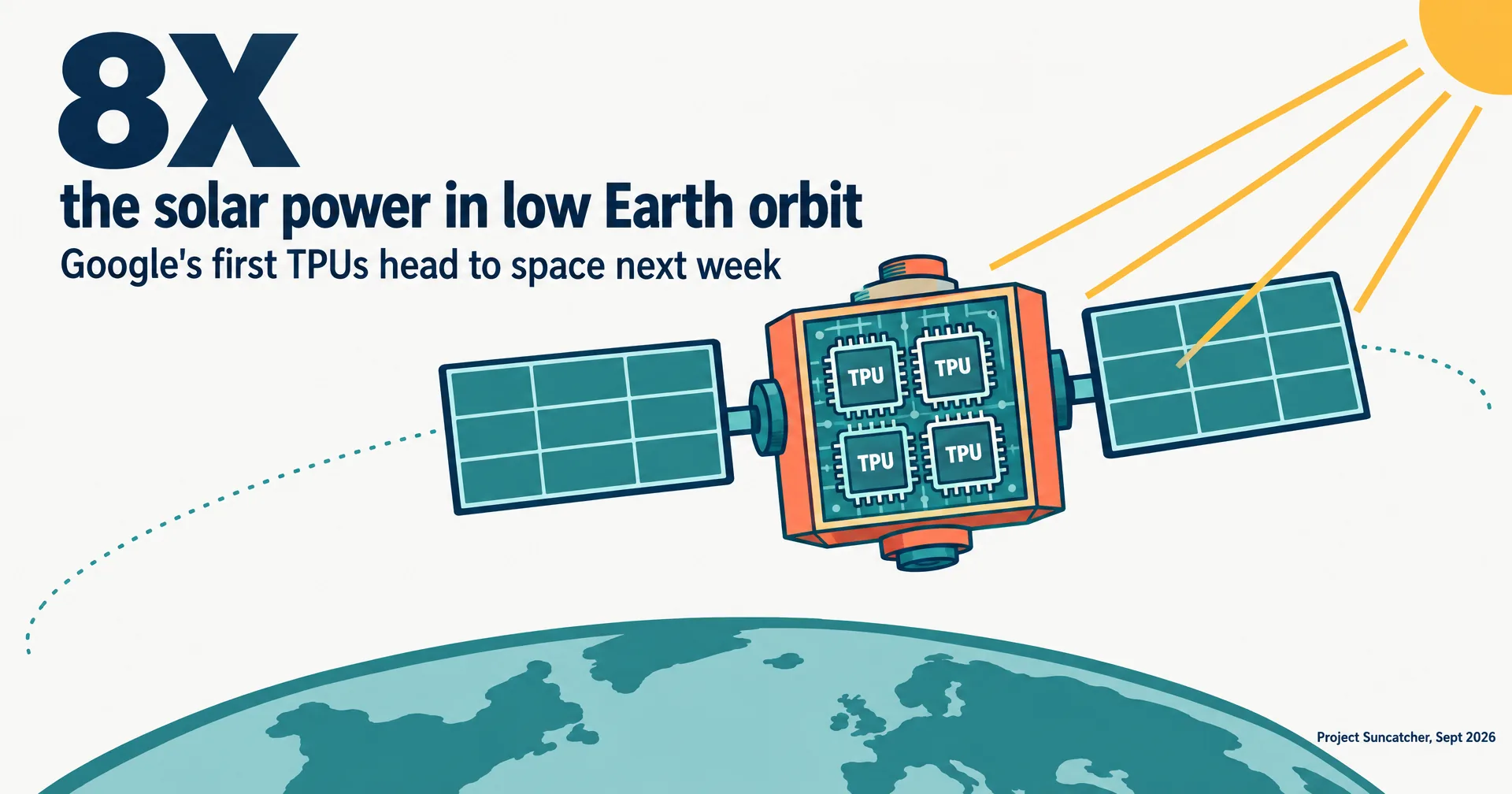
Google said on Wednesday that its space AI moonshot, Project Suncatcher, will put its first Tensor Processing Units in orbit next week. It is one small satellite, built with Planet, riding a SpaceX rideshare, with four chips and about a kilowatt of solar power, per Ars Technica. This page reads Google’s post, its 2025 research paper, Planet’s announcement and the reporting from Ars Technica and The Verge, and dates each claim.
On this page · 7 sectionsOpen
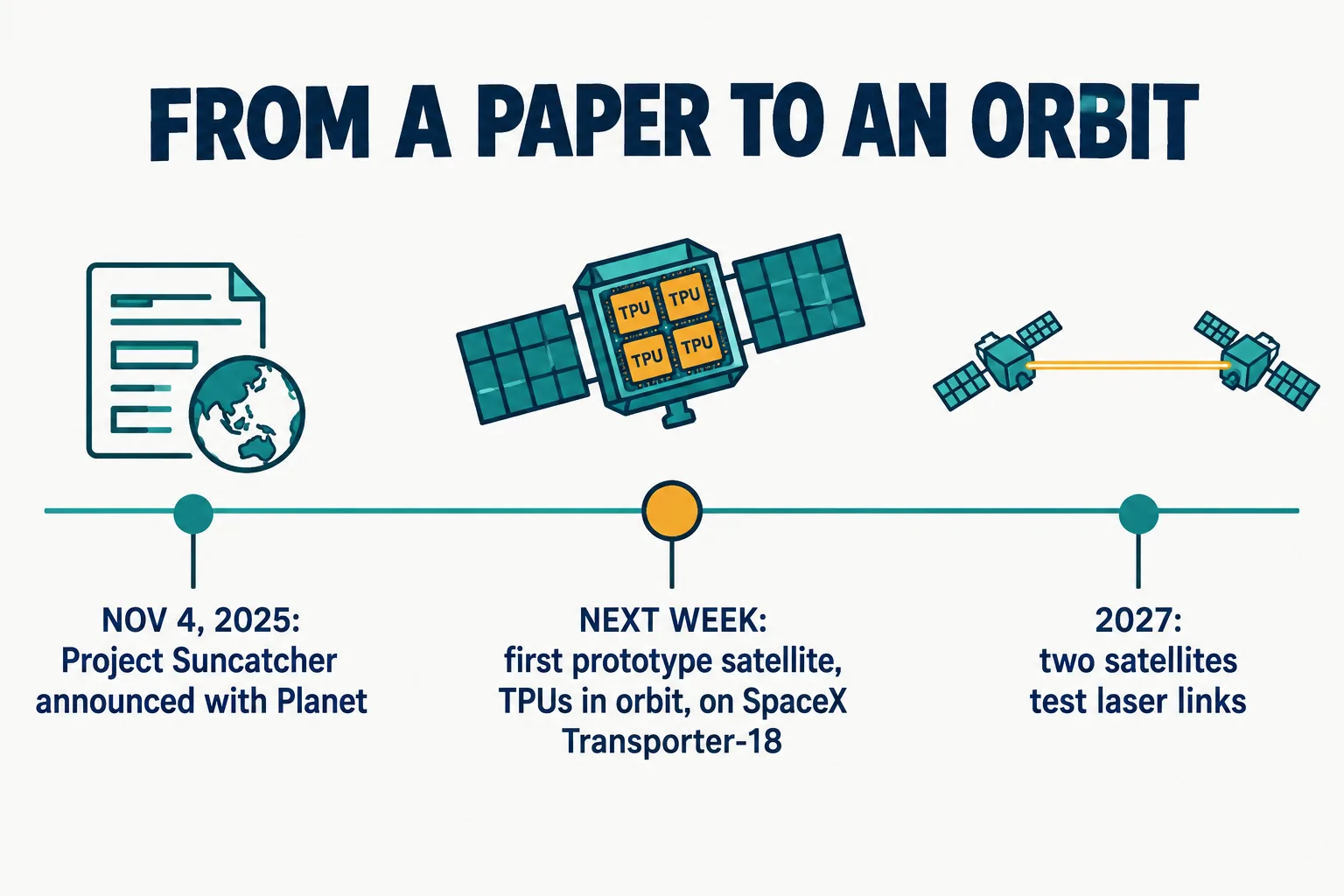
 Google said on September 24, 2026 that Project Suncatcher, its moonshot to run machine learning compute in space, will put its first TPUs in orbit next week on a prototype satellite built with Planet and flown on SpaceX’s Transporter-18 rideshare. Ars Technica and The Verge put the launch on October 1.
 It is one satellite, not a data center. Ars Technica reports the spacecraft, called MVP, is about the size of a refrigerator, carries four Google TPUs and draws about one kilowatt of solar power, per The New York Times. Planet had already built it; Google fitted its chips to move faster than the two satellites planned for 2027.
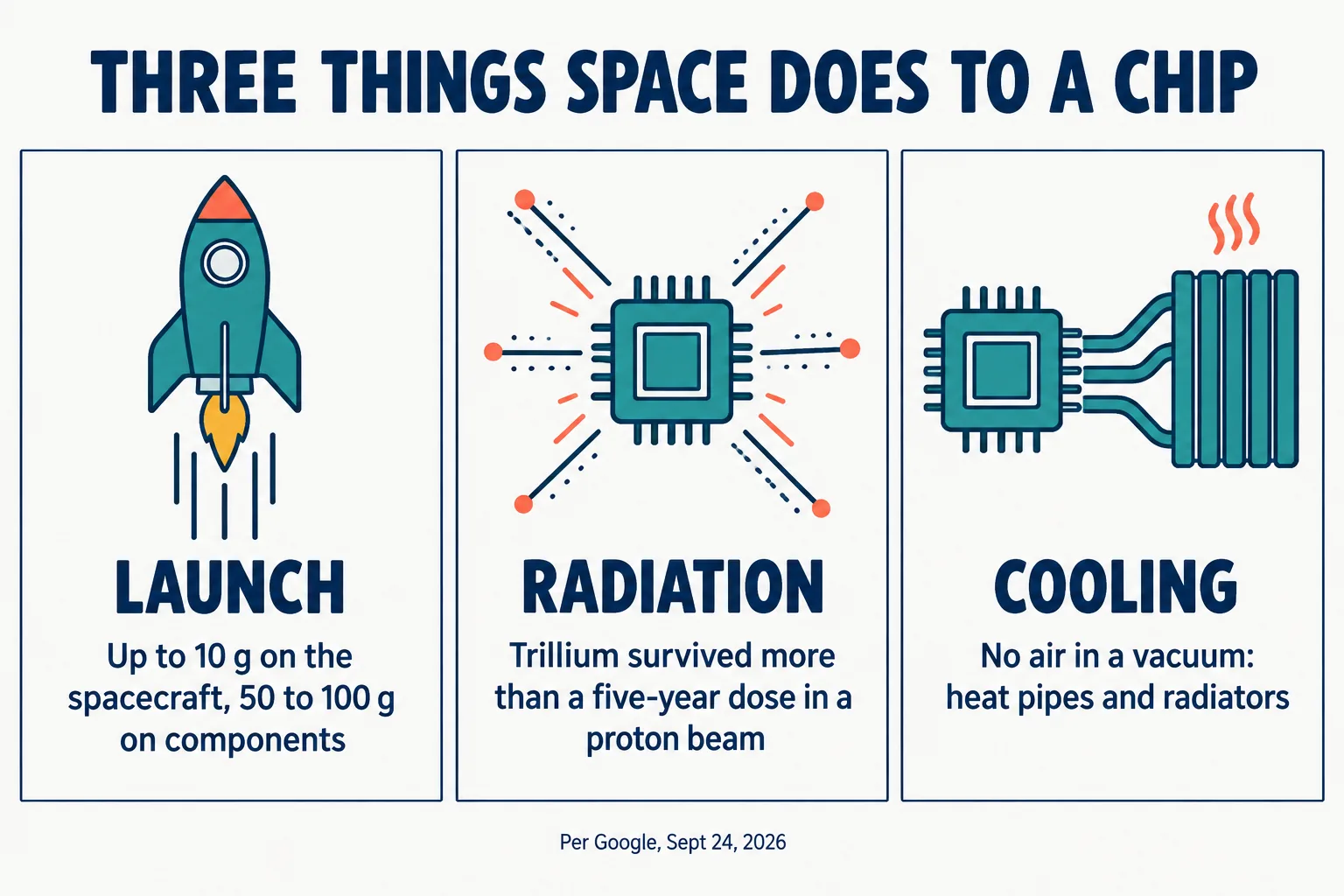
 The test is survival. Google says launch loads reach 10 times the force of gravity on the spacecraft and 50 to 100 g on components, and that its Trillium TPUs survived a proton beam dose greater than a five-year space mission would deliver. Google’s own words: some things can only be tested in space.
 Cooling is the hard part. There is no air in a vacuum, so Google uses heat pipes and radiators. Ars reports the chips can run in bursts of about 15 minutes before shutting down to let the radiators catch up, and that Google will run Gemini models on them.
 The architecture still needs a second launch. Suncatcher’s end state is clusters of satellites linked by lasers at very high bandwidth over short distances; Google says it will test that in 2027 with two satellites in orbit.
 For a business, nothing changes this year. The models doing your work run in ordinary data centers. What the launch tests is whether the next decade’s compute could be solar-powered in orbit, which is a bet on the cost of AI, not on what an agent can do for you today.
§ 01What Google confirmed
Google’s post, dated September 24, 2026 and written by Travis Beals, Senior Director, Paradigms of Intelligence, opens with the news: “After years of research, Project Suncatcher is scheduled to embark on its first test in orbit, launching a prototype satellite to evaluate how Google Tensor Processing Units (TPUs) perform in space.” The ride: “This initial mission onboard the upcoming Transporter-18 rideshare mission with SpaceX was developed in partnership with Planet.” The timing: “Putting our first TPUs in orbit next week will help us get data and learnings to inform future launches.”
The New York Times reported it first, as The Verge credits in its 14:15 UTC story. Ars Technica followed at 16:16 UTC with the date, October 1, and the spacecraft’s details.
| Question | Answer | Source |
|---|---|---|
| Launch | Next week; October 1, 2026 | Google; Ars Technica and The Verge |
| Rocket | SpaceX Falcon 9, Transporter-18 rideshare | Google; Ars Technica |
| Spacecraft | One satellite, called MVP, about the size of a refrigerator, built by Planet | Ars Technica |
| Chips | Four Google TPUs; Trillium named in the radiation results | Ars Technica; Google |
| Power | About one kilowatt of solar power | Ars Technica, citing The New York Times |
| Workload | Gemini models, in bursts of about 15 minutes | Ars Technica |
| Mission length | A few months | Ars Technica |
| Laser links between satellites | Not on this flight; two satellites in 2027 |
§ 02What the satellite tests
Google frames the whole mission as one question: “Can our AI hardware operate in space?” Its stated goal: “It’s designed to gather in-orbit data on how our TPUs handle the physical stress of spaceflight and the radiation and thermal extremes of space.”
Launch. Google says a trip to low Earth orbit brings “sustained acceleration loads up to 10 times the force of gravity”, and that chips can see “even greater forces up to 50 to 100 g”. The team shook the satellite on all three axes and, in Google’s words, “we were pleasantly surprised that the hardware held up to the force.”
Radiation. Google tested TPUs in a proton beam at UC Davis’s Crocker Nuclear Laboratory while they ran AI workloads, and reports: “Initial results have shown that our Trillium TPUs hold up remarkably well, and can survive a radiation total ionizing dose greater than what they would receive during a five-year space mission.” The numbers behind that line are in Google Research’s 2025 paper summary.
| Measure | Dose, rad(Si) |
|---|---|
| Expected shielded dose over a five-year mission | 750 |
| Memory (HBM) first shows irregularities | 2000 |
| Highest dose tested on one chip, no hard failures | 15000 |
Cooling. “But in space, there’s no airflow,” Google writes; heat can only leave through radiators, so the team uses “a combination of heat pipes and radiators to cool the chips.” Ars reports the design as a thermal interface material feeding aluminum and copper heat pipes, and that the system can only keep up for about 15 minutes before the TPUs shut down to let the radiators catch up.
§ 03What it does not test yet
The Suncatcher idea is not one satellite. Google’s end state is clusters of satellites, each with dozens of TPUs, talking to each other over lasers at very high bandwidth across very short distances. Google compares the pointing problem to “hitting a coin-size target from miles away while both points are in motion”, and says: “We’ll test our work on this in 2027 when we put two satellites in orbit.”
That 2027 flight was the original first step. When Google announced Suncatcher on November 4, 2025, the plan was “to launch two prototype satellites by early 2027”, and Planet described the same pair flying in tandem with cross-links. Per Ars, Google wanted to move faster, so it fitted its chips into a satellite Planet had already built. The 2027 launches are still planned.
§ 04Why Google wants chips in orbit
Google’s answer is power: in low Earth orbit, satellites “can access near-constant sunlight, generating up to eight times more solar power than on Earth.” The 2025 paper models an illustrative 81-satellite cluster at a mean altitude of 650 km, and argues that if launch prices keep falling, “prices may fall to less than $200/kg by the mid-2030s”, the point at which launching and operating a space data center could roughly compare with the energy costs of one on Earth.
That is a long bet, and Google writes it as one: “This first launch is about seeing what works, identifying points of failure, and applying those findings to future missions.” Ars adds that the team expects years before Suncatcher moves from project to product.
§ 05What it means if you run AI on real work
Nothing about your workload moves to orbit. The Gemini models behind Gemini 3.8 Flash, which runs CellCog’s Flash-tier agents, are served from data centers on the ground, and so is everything else a business uses today. Suncatcher is Google testing whether the power that runs AI a decade from now could come from sunlight above the atmosphere rather than from a grid that is already fighting over data centers.
What a business can use now is the thing those chips run: models good enough to do real work, and a harness that points them at your tasks, checks the results and asks before anything leaves your walls. The Gemini 4 tracker follows the next model Google says is on its way.
§ 06What we are watching for
- The launch itself, October 1, and whether Transporter-18 holds its date.
- Google’s first in-orbit results: whether the TPUs, the cooling bursts and the radiation numbers hold up outside the lab.
- The two-satellite laser-link test in 2027, the flight that tests the actual Suncatcher architecture.
- Planet’s side of the mission, and whether its Owl satellite bus carries the 2027 pair.
§ 07The record
As of September 24, 2026, 18:30 UTC: page opened. Google’s post is dated September 24 with no time shown; The Verge published at 14:15 UTC crediting The New York Times; an X post from @ns123abc spread the news at 15:22 UTC; Ars Technica published at 16:16 UTC with the October 1 date. The New York Times article itself was not read for this page; its figures appear here only as Ars Technica and The Verge report them.
Q1When does Project Suncatcher launch?
Google’s September 24 post says its first TPUs go into orbit next week on SpaceX’s Transporter-18 rideshare mission. Ars Technica and The Verge both report October 1, 2026, on a Falcon 9. Rideshare dates can slip; this page updates if it does.
Q2How many TPUs are on the satellite, and which kind?
Four, per Ars Technica. Google’s post names Trillium TPUs in its radiation results, and Google Research’s 2025 paper describes Trillium as its v6e Cloud TPU. These are the same chips Google puts in servers on the ground, not radiation-hardened parts.
Q3How long can the chips run in orbit?
In short bursts. Ars Technica reports the cooling system can only keep up for about 15 minutes at a time, after which the TPUs shut down so the radiators can catch up, and The Verge attributes the 15-minute figure to Travis Beals speaking to The New York Times. Ars reports the satellite will operate for a few months.
Q4Why put AI chips in space at all?
Power. Google says satellites in low Earth orbit get near-constant sunlight and up to eight times more solar power than on Earth. Its 2025 research paper argues launch prices may fall below $200 per kilogram by the mid-2030s, at which point a space data center’s costs could roughly compare with a terrestrial one’s energy costs.
Q5Does this change anything for companies using AI today?
Not in the near term. It is a first hardware test of a research project; the models businesses use today, including the Gemini models behind some of CellCog’s agents, run on Earth. It matters as a signal about where the cost of compute could go over a decade.