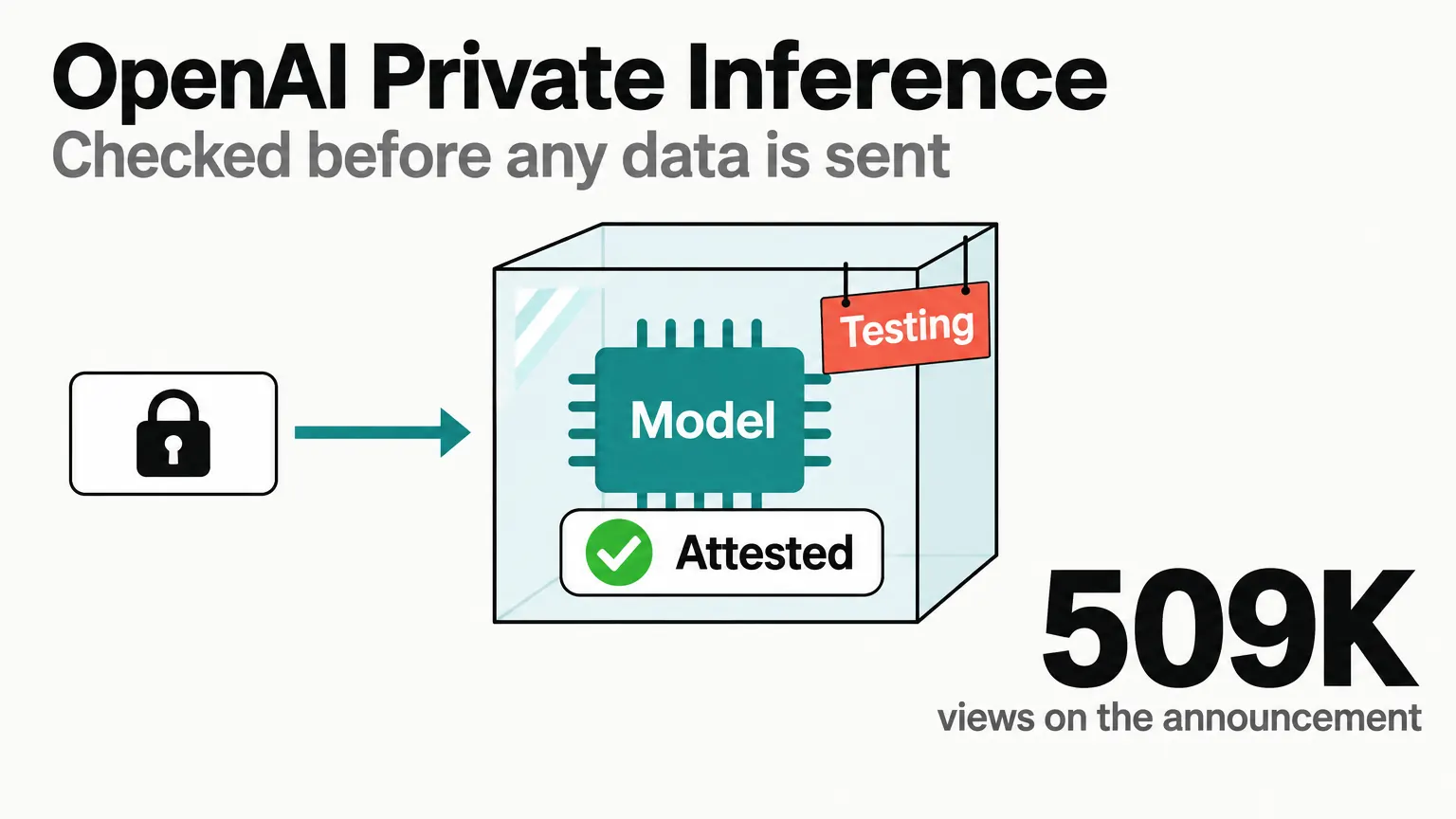
OpenAI is testing a way to run its models on private data with guarantees a customer can check. Sam Altman wrote on X at 17:12 UTC on November 25, 2026: “We’re now testing Private Inference, our latest offering as part of OpenAI Private Intelligence, with a small group of customers.” His reason: “Stronger privacy protections will make frontier AI useful for a lot more work”. By 21:00 UTC the post had about 508k views.
The posts link no documentation page. Everything below comes from what Altman and the OpenAI team wrote on X, read through the X API, and it is graded by how firmly each part is stated.
On this page · 7 sectionsOpen
 OpenAI is testing Private Inference with a small group of customers, Sam Altman posted on X at 17:12 UTC on November 25, 2026.
 It is part of OpenAI Private Intelligence; @shekar4x, who says he works on it, wrote that OpenAI is getting the confidential compute capacity to scale it up.
 According to @shekar4x, the SDK verifies attestations locally before it sends any data.
 Altman also named ZDR with Private Safety Processing: automated safety reviews without OpenAI staff access to the content.
 The stated audience is regulated customers whose only option today is to run models on their own premises.
 No price, model list, documentation or general-availability date has been announced; Anthropic launched its own answer, Enterprise Frontier Safeguards, two days earlier.
§ 01What is confirmed, and what is not
| Claim | Status | Source |
|---|---|---|
| OpenAI is testing Private Inference with a small group of customers | Confirmed | Altman |
| It is part of OpenAI Private Intelligence | Confirmed | Altman |
| The SDK checks attestations before sending any data | Stated by the team | @shekar4x, who says he works on it |
| It needs special hardware | Stated by the team | @shekar4x |
| It runs on the customer’s own hosting | Not confirmed | TestingCatalog; the team describes OpenAI’s confidential compute |
| ZDR with Private Safety Processing | Confirmed, named alongside | Altman |
| Price, models, general availability | Not announced | None |
§ 02What the team said
- A first step. @shekar4x, the contact Altman named, wrote: “this is the first step towards private intelligence for everyone!” and “we’re getting the confidential compute capacity to scale this up much more”.
- Checked before sending. Asked about it in a reply, he wrote: “yes, the sdk verifies attestations locally before sending any data”. An attestation is a signed report from the hardware about what is running on it; checking it first means data only leaves the customer’s machine for a server that proves itself.
- Not easy to widen. In another reply: “working on it. requires special hardware and a lot of engineering effort”.
- Who it is for. “some customers are so tied up in regulation that their only option is onprem”, he wrote, and the goal is to give them “cryptographically verifiable guarantees that openai isn’t retaining/accessing/etc”.
- A second, separate promise. Altman added that “ZDR with Private Safety Processing enables automated safety reviews without giving OpenAI personnel access to the underlying content.” ZDR means zero data retention.

§ 03The one claim to hold
TestingCatalog wrote that Private Inference lets users “process inference via their own hosting”. Nothing the OpenAI team posted says that. Their words point the other way: OpenAI’s confidential compute capacity, special hardware, and attestations the customer’s SDK checks. Until OpenAI publishes a description, read “own hosting” as a report, not a fact.
§ 04How it compares to Anthropic
Two days earlier, Anthropic put Enterprise Frontier Safeguards into beta. Both answer the same buyer, a regulated firm that wants top models without handing over its data, in different ways.
| OpenAI Private Inference | Anthropic Enterprise Frontier Safeguards | |
|---|---|---|
| Stage | Testing with a small group, Nov 25 | Beta for eligible organizations, Nov 23 |
| Core promise | Verifiable guarantee OpenAI is not retaining or accessing data, per the team | Zero data retention on its most capable Claude models |
| How the customer knows | The SDK checks hardware attestations before sending | Encrypted safety copies kept in the customer’s own cloud bucket |
| Safety reviews | Automated, no staff access, under ZDR with Private Safety Processing | Sealed safety data in the customer’s bucket |
| Public documentation | None linked yet | Release notes and setup guide |
§ 05What would settle the open questions
- A documentation page or paper describing the hardware, the attestation and what OpenAI can and cannot see.
- Which models it covers, its price, and when the test opens beyond a small group.
§ 06Where CellCog stands
Our conflict, declared: CellCog’s AI employees run on Claude and Gemini models, and our image agent runs on OpenAI’s GPT Image 2.6. We have no zero data retention agreement with any AI provider and are not part of OpenAI’s test.
§ 07Sources
- @sama on X, 17:12 UTC, November 25, 2026, read through the X API
- @shekar4x on X and his replies on November 25, 2026, read through the X API
- @testingcatalog on X, 17:28 UTC, November 25, 2026, read through the X API
- CellCog, Claude Enterprise Frontier Safeguards: What It Changes, November 23, 2026
Q1What did OpenAI announce?
Sam Altman wrote on November 25, 2026 that OpenAI is now testing Private Inference, its latest offering as part of OpenAI Private Intelligence, with a small group of customers.
Q2How does Private Inference work?
OpenAI has not published details in the posts. @shekar4x, who says he works on it, wrote that the SDK verifies attestations locally before sending any data and that it requires special hardware.
Q3Does it run on the customer's own servers?
TestingCatalog says it lets users process inference via their own hosting. The OpenAI team’s own posts describe OpenAI’s confidential compute capacity instead, so that claim is not confirmed.
Q4What is ZDR with Private Safety Processing?
Altman says it enables automated safety reviews without giving OpenAI personnel access to the underlying content. ZDR stands for zero data retention.
Q5How does it compare to Anthropic's Enterprise Frontier Safeguards?
Anthropic’s beta, launched November 23, 2026, gives eligible organizations zero data retention on its top Claude models, with encrypted safety data kept in the customer’s own cloud bucket. OpenAI’s test centres on attested hardware checked before data is sent.
Q6Is CellCog part of this test?
No. CellCog has no zero data retention agreement with any AI provider and is not in OpenAI’s test.