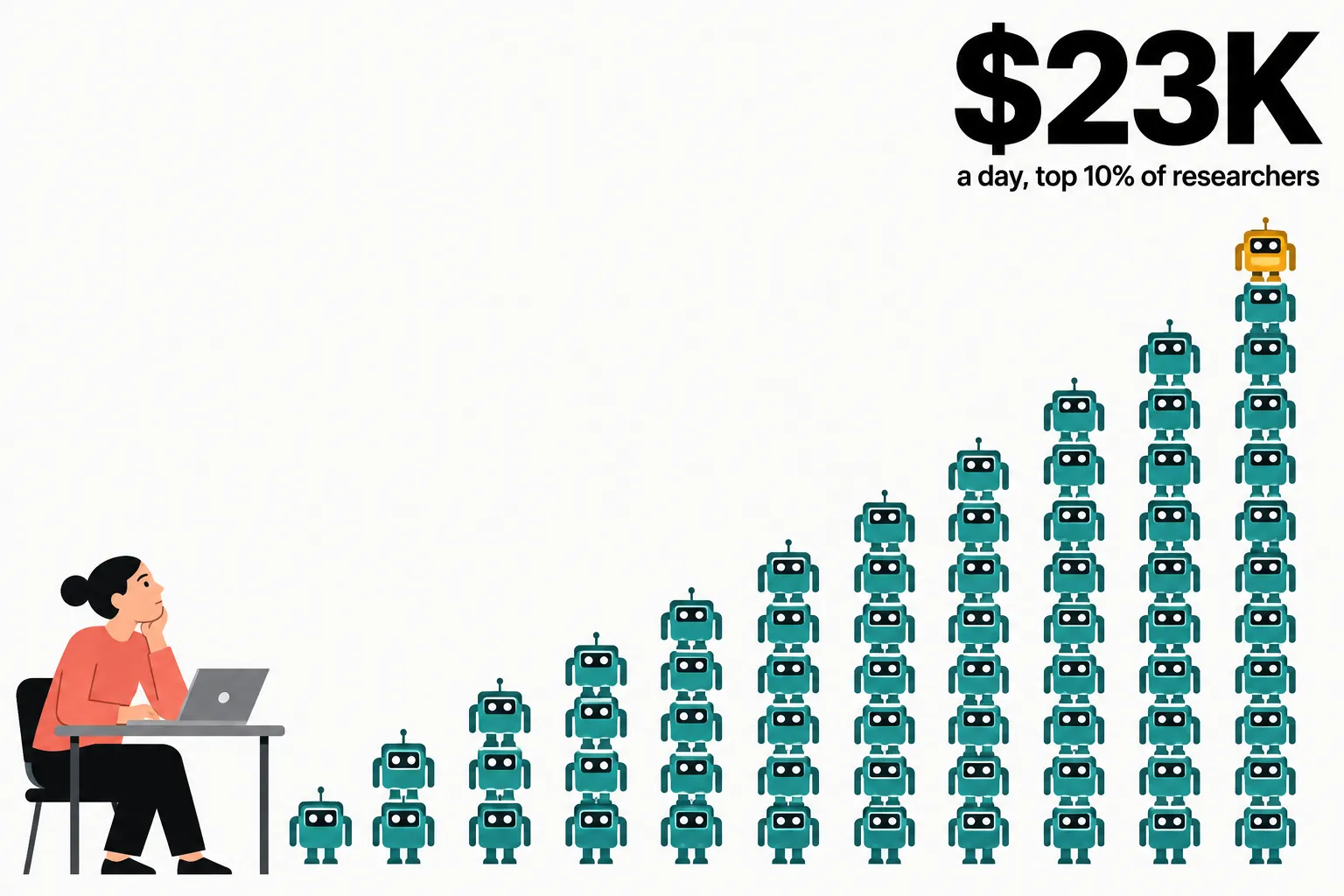
OpenAI says its agents now finish about twice as many long research tasks on their own as they did in March, and its heaviest users spend $23,000 a day on them. The company published the report, titled Research acceleration: The jagged frontier, on November 18, 2026, and posted it on X at 23:07 UTC. By 15:09 UTC the next day that post had 564,124 views.
OpenAI’s own summary of what it found: “We find researchers’ AI use continues to rise exponentially, and agents are completing longer tasks, but human involvement remains central in research.” This page reads the numbers OpenAI and one of its authors posted on X, with OpenAI’s charts, and says which ones nobody outside OpenAI can check.
On this page · 7 sectionsOpen
 OpenAI published a report on November 18, 2026 on how AI is changing research inside OpenAI, and said labs should be required to report signs of AI speeding up its own development.
 On OpenAI’s own chart, agents finished about 46% of research tasks a human would need two to four hours for without any help in October, up from about 23% in March.
 The longer the task, the lower the rate: about 35% for four-to-eight-hour tasks in October, which is why OpenAI calls the frontier jagged.
 Spend keeps climbing. The researcher at the 90th percentile spends $23,000 a day on agentic AI tools at API list prices, per an OpenAI researcher’s post; the median is about $2,400 on OpenAI’s chart.
 In OpenAI’s survey, the median researcher would give up 40% of team headcount, or 30% of team compute, to keep 2026 coding agents.
 Every figure is OpenAI measuring itself. Nobody outside OpenAI has checked them, and we read them from OpenAI’s posts and charts on X.
§ 01What OpenAI published
The report measures how AI is changing research at OpenAI: how much researchers use agents, how long the tasks are that agents finish alone, what researchers say the agents are worth, and where human effort is going. On that last point, OpenAI says researchers are spending more time on safety and alignment, with “human effort in these areas growing faster than in any other individual research area”.
The report also makes a policy argument. In OpenAI’s words: “We believe that AI labs should be required to track and publicly report indicators of recursive self-improvement (RSI)”. OpenAI defines that as the process by which AI accelerates the development of future AI systems. “Our hope is that this expanded report will help sustain and advance shared measurement norms across the industry.”
§ 02The jagged part: task length
The chart OpenAI researcher Kevin Liu posted at 23:18 UTC carries the main result: how often agents finish a task with zero human interventions, by how long the task would take a person, month by month from March to October 18. His line on it: “Success rates on internal tasks are increasing smoothly.”
| Task length for a person | March 2026 | October 1-18, 2026 |
|---|---|---|
| 2 to 4 hours | about 23% | about 46% |
| 4 to 8 hours | about 13% | about 35% |
- Short tasks were already easy. Tasks under 15 minutes sit near 80% on the chart in every month.
- Long tasks moved most. The two-to-four-hour and four-to-eight-hour bands roughly doubled or better.
- Most long tasks still need a person. Even in October, the chart shows agents failing more than half of two-to-four-hour tasks without help.
- The chart shows ranges. OpenAI draws bounds and approximate 95% confidence intervals around each point; the numbers above are the midpoints, read by eye.

§ 03What researchers say agents are worth
OpenAI asked its research staff what they would give up to keep today’s agents. Kevin Liu’s summary: “The median respondent reported a willingness to trade 40% of headcount or 30% of compute to retain access to 2026 coding agents (vs. reverting to GPT-5.2).”
| Asked to give up | Median answer |
|---|---|
| Team headcount | 40% |
| Team compute | 30% |
| Team compute, if asked in January 2027 | 50% |
The answers spread widely: on the headcount chart, the most common single answer is around half of the team, and a few researchers put it near zero.
§ 04The spend
Kevin Liu’s third post: “At API list prices, the 90th percentile researcher now spends $23,000 on agentic AI tools.” Andrew Curran, reading the report, added that the figure is up 105% from September.
OpenAI’s two spend charts cover Codex, ChatGPT Work and Dots spend per researcher, as a 28-day average. The median line ends October just under $2,500 a day, and the 90th-percentile line ends above $23,000. Both curves are nearly flat until July and climb steeply after it. Each chart marks a temporary harness efficiency improvement in late August, a few weeks where spend stopped rising.
These are list-price values of usage, not what OpenAI pays itself. They show how much agent work a researcher runs, not a cash bill.
§ 05What we could not check
Every number here is OpenAI measuring its own staff and its own agents; no outside party has audited them. We did not open the report page: OpenAI’s Terms of Use bar automatically or programmatically extracting data from its services, which include its websites, so this page uses only what OpenAI and its researchers posted on X, and the charts in those posts. Other numbers attributed to the report in coverage, such as agent workdays per researcher, do not appear in those posts and are left out until we can read them.
§ 06What it means if you run AI on real work
OpenAI’s chart is a measure of what agents can finish alone: the shorter and more defined the task, the better the odds, and multi-hour work still needs a person checking it. That matches how a business should hand work to AI today. Give an agent a role with clear tasks, keep a person on the results, and widen the task length as it proves itself.
The other lesson is cost. OpenAI’s heaviest users run agent work worth more each day than many companies spend on AI in a month. Most businesses do not need that much; they need the right tasks handed to a capable agent, with approvals before anything reaches the outside world.
§ 07The record
As of November 19, 2026, 15:20 UTC: page opened. Sources: OpenAI’s post on X (23:07 UTC, November 18; 564,124 views at 15:09 UTC), Kevin Liu’s thread on X (23:18 UTC) with OpenAI’s task-success, survey and spend charts, and Andrew Curran’s post (00:00 UTC, November 19). Chart values are read by eye from OpenAI’s charts. The report page on openai.com was not opened.
Q1What does jagged frontier mean here?
That agents are strong at some research work and weak at other work. Success falls as tasks get longer, and short tasks are far easier than multi-hour ones.
Q2How much do OpenAI researchers spend on AI agents?
At API list prices, the 90th percentile researcher spends $23,000 a day on agentic AI tools, per OpenAI researcher Kevin Liu. OpenAI’s chart puts the median near $2,400 a day in October 2026.
Q3Is AI doing OpenAI's research on its own now?
No. OpenAI’s own summary says human involvement remains central in research. Agents finish more long tasks alone than in March, but most multi-hour tasks still need a person.
Q4Are these numbers independent?
No. They are OpenAI’s internal measurements and survey answers. We read them from OpenAI’s posts and charts on X and did not open the report page itself.
Q5What is recursive self-improvement?
OpenAI’s definition: the process by which AI accelerates the development of future AI systems. OpenAI argues labs should be required to report measures of it.