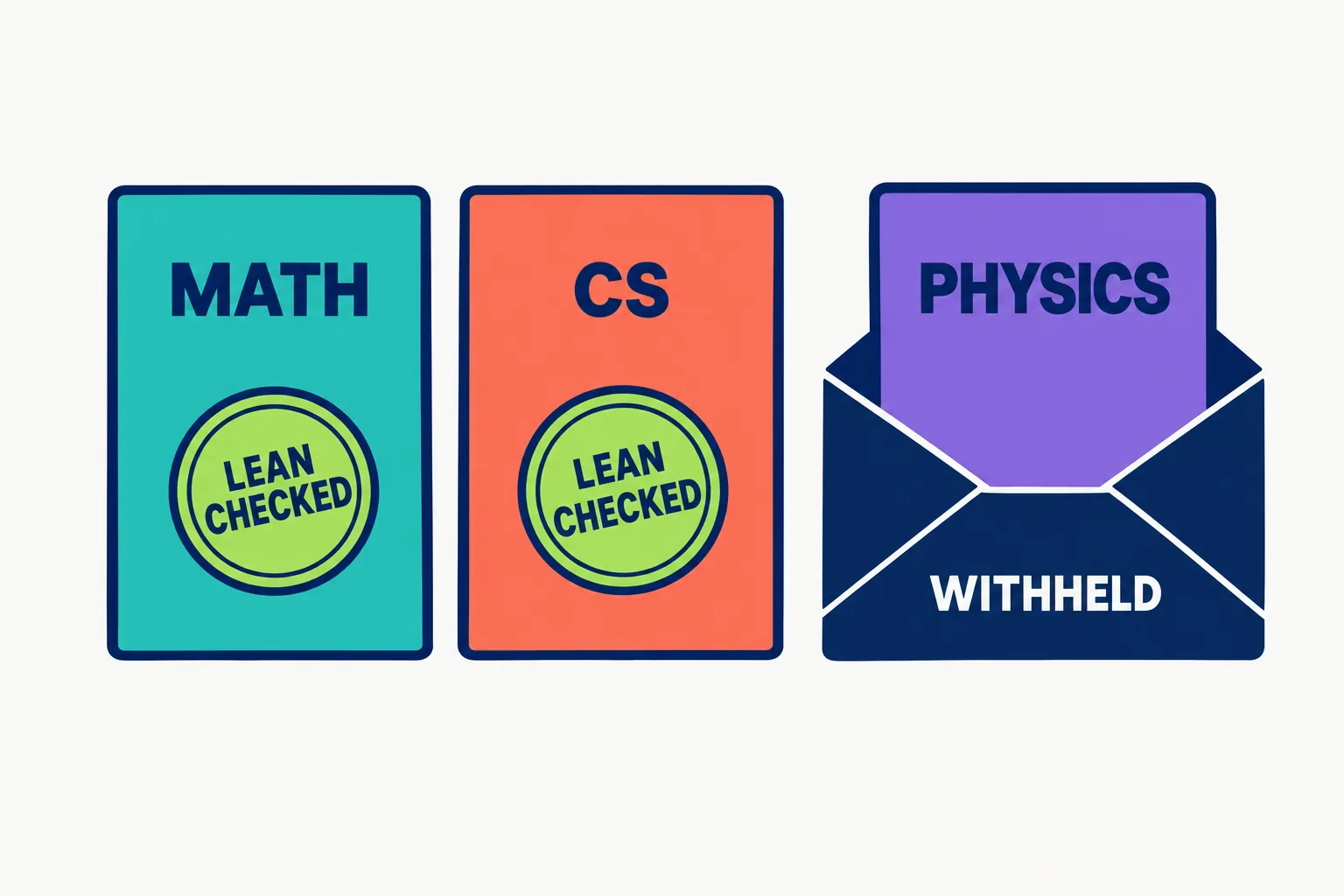
OpenAI announced on October 26, 2026 that its internal models produced three results that would each be landmarks: local smoothing and the Kakeya conjecture in every dimension, a refutation of the Exponential Time Hypothesis, and an existence proof for quantum chromodynamics that includes pure Yang-Mills theory. Two come with public Lean proofs; the physics one is being held by the experts checking it.
OpenAI frames the manuscripts as raw material, not finished science: “In our view, these manuscripts are best understood as a form of raw research data.” Each result now goes to a group of outside experts.
On this page · 8 sectionsOpen
 On October 26, 2026 OpenAI announced three results its internal models produced: local smoothing and Kakeya in every dimension, a refutation of the Exponential Time Hypothesis, and an existence proof for QCD and pure Yang-Mills theory.
 The math and computer science results come with an AI-written paper and a Lean proof on OpenAI’s public GitHub; the physics group chose to hold the AI artifacts back and write it up themselves.
 If the ETH result holds, 3-SAT has a subexponential-time algorithm; it does not settle P versus NP, and OpenAI says practical speedups need significant further research.
 The Yang-Mills claim covers existence, which OpenAI calls part of the Clay Millennium Prize problem; the problem as Clay states it also asks for a mass gap, which the post does not claim.
 Outside experts shepherd each result, unpaid and without NDAs: Impagliazzo, Paturi and Williams for ETH, and a group led by Nobel laureate David Gross for the physics.
§ 01The three results

| Field | Claim | AI output | Lean | Public artifacts | Shepherds |
|---|---|---|---|---|---|
| Math | Local smoothing in every dimension, so Kakeya and Stein restriction in all dimensions | Oct 18 | Oct 19 | Paper and Lean proof | One outside expert advised open release |
| Computer science | The Exponential Time Hypothesis is false | Oct 16 | Oct 17 | Paper and Lean proof | Impagliazzo, Paturi (UC San Diego), Williams (MIT) |
| Physics | Existence of QCD and a unified Standard Model completion in 4D, including pure Yang-Mills | Sep 9 (Yang-Mills), Sep 18 (QCD) | Yang-Mills Oct 16 | Held by the group | David Gross, Douglas, Jaffe, Klebanov, Nekrasov |
OpenAI says it waited on the physics result “given the length and complexity of the work” until the Lean formalization finished.
§ 02Local smoothing and Kakeya
Sogge proposed the local smoothing conjecture in 1991; it says the most extreme focusing of waves is short-lived. Guth, Wang and Zhang proved it in two dimensions in 2019, and Wang and Zahl proved Kakeya in three dimensions in 2025. OpenAI’s claim: “Our models produced a proof of the local smoothing conjecture in every dimension and therefore also resolve the Kakeya conjecture and Stein’s restriction conjecture in all dimensions.”
OpenAI says the proof rests on “a novel auxiliary partial differential equation.” The paper and Lean proof are on GitHub, and OpenAI left it to researchers to organize their own effort to explain it.
§ 03The Exponential Time Hypothesis
ETH says 3-SAT cannot be solved in time that grows slower than exponentially in the number of variables, and hundreds of conditional hardness results rest on it. OpenAI: “Surprisingly, our system has recently proved that the ETH is false, a result that was subsequently verified in Lean.”
Ryan Williams, one of the three shepherds, summarized the claimed bound on X: “it’s claimed that 3SAT on n variables is in about exp(n/(log n)^{1/2+o(1)}) time”. That is faster than any 2^(cn), but still far from polynomial.
What it means if it holds: a subexponential algorithm for 3-SAT exists, and a long list of results that assumed no faster algorithm exists lose their footing. What it does not mean: P equals NP. OpenAI itself says practical algorithms “will require significant further research.” The checkers include two of the conjecture’s original authors, Russell Impagliazzo and Ramamohan Paturi, plus Ryan Williams. At the group’s request, OpenAI will fund a conference on the implications.
§ 04Yang-Mills and the Millennium Prize
The physics claim is an existence proof for interacting quantum field theories with gauge fields and fermions in four dimensions, built on Balaban’s approach. OpenAI’s wording on the prize is careful: “As a subproblem, this work also includes a proof of the existence of pure Yang–Mills theory, which is part of the Quantum Yang–Mills Theory Clay Mathematics Institute Millennium Prize problem.”
Part is the operative word. The Clay problem statement asks for existence and a mass gap; the post claims existence and says nothing about the gap. The group led by Nobel laureate David Gross, with Arthur Jaffe, who co-wrote the prize problem, will write it up before any AI artifacts are released.
§ 05How to read a Lean proof
Lean checks that a proof proves its formal statement, with no gaps. It cannot check that the formal statement matches the conjecture mathematicians care about. That translation step is exactly where experts will spend the next weeks, and why OpenAI calls the outputs raw data rather than results.
§ 06Our angle
Our conflict, declared: CellCog runs on Claude Opus 5.5 and has no stake in OpenAI’s research models. We cover this because it is the strongest public claim yet that frontier models can produce research, and because the release terms matter: no NDAs, no academic credit sought (“We do not seek academic credit for the discoveries produced by our internal models.”), unpaid volunteer shepherds and a $5 million Simons Foundation fund for workshops. That is a template others will be judged against.
We covered OpenAI’s earlier batch in its 722 math papers and the disputed Navier-Stokes post.
§ 07What we are watching
- The ETH group’s first readout. Impagliazzo, Paturi and Williams on whether the formal statement is the real ETH.
- The physics write-up. When the Gross group releases materials, and whether anyone claims the mass gap.
- Independent checks. Outside mathematicians compiling the Lean proofs and reviewing the local smoothing paper.
§ 08Sources
- OpenAI, Working with academic communities to build scientific understanding, October 26, 2026.
- OpenAI, ETH paper and Lean proof, openai/math on GitHub, committed October 26, 2026.
- OpenAI, local smoothing paper and Lean proof.
- Ryan Williams on X, October 26, 2026, 21:44 UTC.
- Clay Mathematics Institute, Quantum Yang-Mills Theory problem statement.
Q1What is the Exponential Time Hypothesis?
A 1999 conjecture by Impagliazzo and Paturi that 3-SAT cannot be solved in time that grows slower than exponentially in the number of variables. Hundreds of hardness results assume it.
Q2Does disproving ETH mean P equals NP?
No. A subexponential algorithm is still far slower than polynomial time. OpenAI says turning the result into practical speedups will require significant further research.
Q3Can I read the proofs?
Yes, for two of them. OpenAI posted the AI-written papers and Lean proofs for the local smoothing and ETH results in its openai/math GitHub repository. The physics materials are being held by the expert group.
Q4Does a Lean proof settle it?
Lean checks that the proof proves the formal statement. Experts still have to confirm the formal statement says what the conjecture says, which is part of what the shepherd groups will do.
Q5Is OpenAI claiming credit for the discoveries?
OpenAI says it does not seek academic credit for discoveries produced by its internal models, and that the shepherd groups should get credit for the understanding they build.