On September 8, 2026, OpenAI published a post titled “On the Navier-Stokes Millennium Prize Problem.” Its first sentence: “We’re sharing a solution to the Navier-Stokes existence and smoothness problem, one of the Millennium Prize Problems.” The proof, OpenAI says, was produced by an internal system, and the company released a writeup and a Lean formalization the same day.
Most of the coverage on September 8 is about whether the mathematics holds and about a priority dispute with two mathematicians. Both matter, and both are below. But the part of OpenAI’s post that will outlast the argument is the description of how the proof was produced. It was not one model in one context window. It was an organization of agents, and OpenAI wrote down its shape. This page keeps the claim, the numbers, the dispute and the record straight, using only what the parties themselves published.
On this page · 10 sectionsOpen
- On September 8, 2026, OpenAI published ‘On the Navier-Stokes Millennium Prize Problem’, claiming that an internal system produced an analytical proof and a Lean formalization that a smooth fluid at rest, under a smooth force, can develop a singularity in finite time with finite energy. OpenAI says this establishes statements C and D of the Clay formulation and says it does ‘not intend to claim the Millennium Prize’.
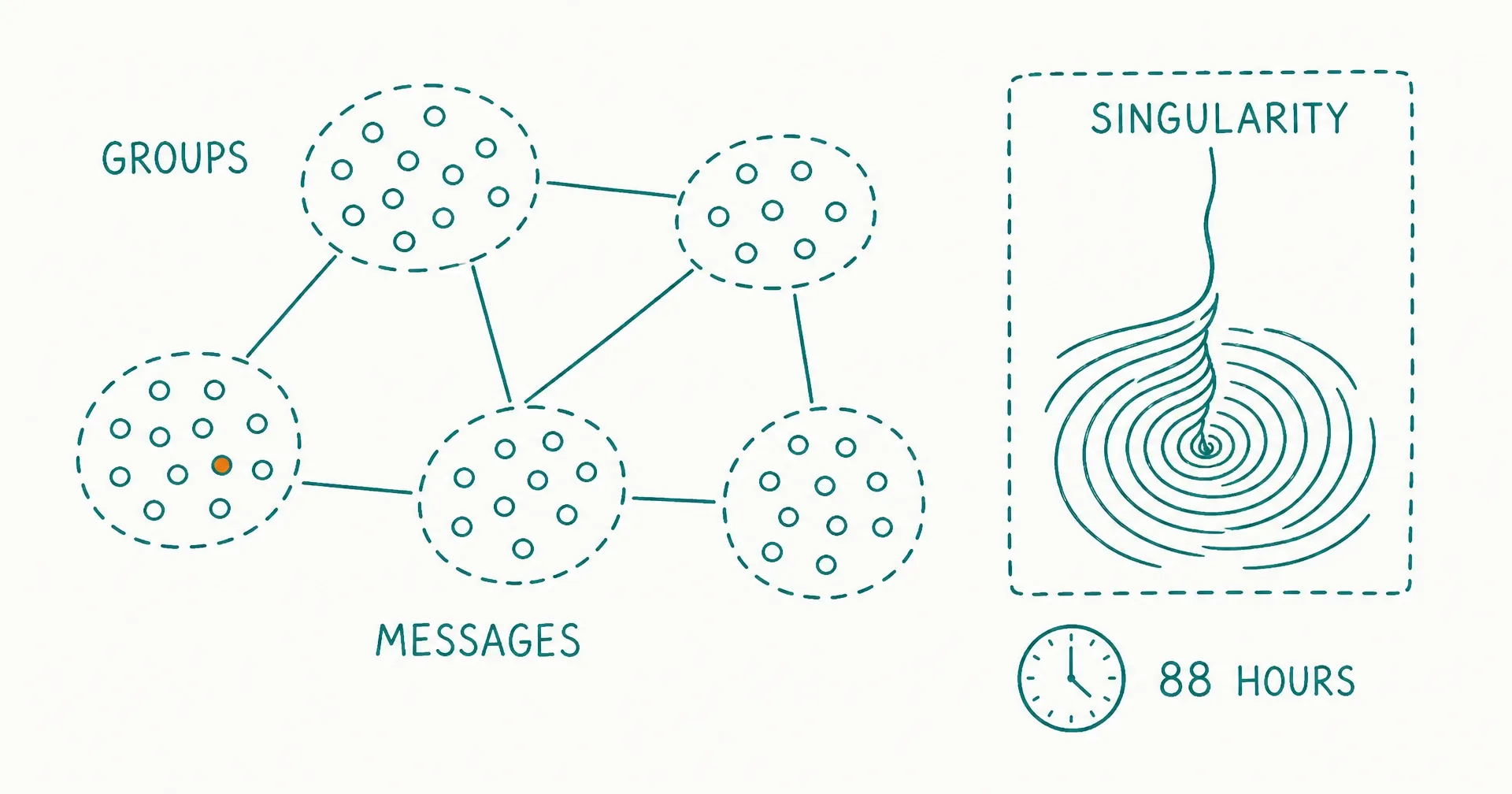
- The system was ‘a system of coordinating agents powered by our internal model’, a model OpenAI describes as ‘significantly more capable than GPT-6 Astra’ and in training since August 28. Agents were split into groups that could communicate within the group; the group that produced the result ‘involved on the order of 10,000 concurrent agents’.
- The run took about 88 hours from first launch to resolution on Saturday, September 5, plus 17 hours of Lean formalization via GPT-6 Astra. OpenAI reports 2.7 million messages and about 130 billion output tokens for Navier-Stokes, and 4.9 million messages and about 300 billion tokens across every problem it tried.
- Method, in OpenAI’s words: different groups got different variants of the problem, easier problems were tried first (nearly 100 agents resolved an unforced Euler blow-up in about 50 hours), the Euler result was fed back to the Navier-Stokes groups, and Codex was used to ‘cross-pollinate’ the groups by consolidating each one’s most useful insights.
- The result is Lean-checked but not peer-reviewed. A Lean certificate checks that the formal statements follow within the formal system; it does not settle whether the formalization matches the Clay problem as mathematicians read it, and Clay’s rules require refereed publication and a waiting period before any prize.
- There is a priority dispute. NYU’s Tristan Buckmaster and Anthropic’s Levent Alpöge released smooth-forcing blow-up results for three simpler equations, including 3D Euler, around September 7, with a statement describing their contacts with OpenAI. OpenAI says it did not see their work and that the proofs and even the Euler results differ (forced vs unforced). Terence Tao wrote on September 7 that the pair ‘do not quite achieve these goals yet’ for Navier-Stokes.
- Whatever the mathematics settles to, the engineering record is the part that lands for anyone building with agents: the result came from an organization of agents with groups, messaging and consolidation, not from one model in one context window.
§ 01What OpenAI actually claims
| Claim | What the post says | How to read it |
|---|---|---|
| The result | “An initially smooth fluid at rest can develop a singularity in a finite time. The fluid has a smooth force applied to it, and its energy remains finite through the entire dynamics” | A blow-up result with smooth forcing: a disproof of global smoothness, not a proof that solutions always stay smooth |
| Which Clay statement | “This resolves the Navier-Stokes Millennium Prize problem by establishing statement ‘C’ (and also ‘D’) in the official Millennium Prize formulation” | C and D are the breakdown alternatives on the whole space and the torus; the public repository states both for every positive viscosity |
| What was released | “Both a writeup of the proof and a formalization in Lean” | The Lean repository is public; the writeup is linked from the post |
| Who produced it | “An internal model that is significantly more capable than GPT-6 Astra”, running inside “a system of coordinating agents” | Unnamed model, unreleased, described as still training |
| The prize | “We do not intend to claim the Millennium Prize for this result” | OpenAI frames the release as a report on AI progress |
| Verification status | Lean formalization and verification “took an additional 17 hours via GPT-6 Astra” | Machine-checked, not peer-reviewed or community-accepted |
Two readings to hold apart. A Lean certificate proves that the formal statements follow, within Lean and the libraries it imports, from the formal definitions. It does not by itself prove that those definitions are the Clay problem as mathematicians read it, and it does not replace the reading that experts will now do on the 100-page writeup. OpenAI’s post says as much in its own way: the goal of the release “is to report on the substantial progress of our AI models.”
§ 02The agent run, by the numbers
| Measure | Figure | Note |
|---|---|---|
| Agents in the winning group | “On the order of 10,000 concurrent agents” | Groups “varied in size” |
| Time to resolution | “About 88 hours after the first agents were launched” | Resolution on Saturday, September 5 |
| Lean formalization | “An additional 17 hours via GPT-6 Astra” | Complete September 6 per the post |
| Messages, Navier-Stokes | 2.7 million | Between agents |
| Output tokens, Navier-Stokes | “Approximately 130 billion” | |
| Messages, all problems attempted | 4.9 million | Every Millennium problem plus “easier” ones |
| Output tokens, all problems | “About 300 billion” | |
| The Euler warm-up | “Nearly 100 agents worked together for approximately 50 hours” | Unforced Euler blow-up, tried as an easier problem |
| Model | Internal, “significantly more capable than GPT-6 Astra”, training since August 28 | Agents updated to a further-trained version mid-run |
The ratio worth noticing is between the two Euler and Navier-Stokes rows: roughly a hundred agents and fifty hours for the warm-up, roughly ten thousand agents and eighty-eight hours for the main problem. OpenAI does not say how the 10,000 figure relates to distinct agent processes versus a rolling population, or what fraction of the 130 billion tokens went to attempts that failed. Read the numbers as OpenAI’s description of scale, not as an audited cost.
§ 03How the run was organized
This is the section that matters to anyone who builds with agents, so here is OpenAI’s account in order.
The agents “had access to tools such as the ability to read from a cached version of the internet and the ability to run code.” They “were subdivided into groups with the ability to communicate within the group.” For each problem, different groups were given different variants of the statement: for Navier-Stokes, versions A and B (which would yield a proof of smoothness) and versions C and D (which would yield a disproof) went to separate groups.
Alongside the Millennium problems, OpenAI gave the system “a set of ‘easier’ problems.” One was the blow-up question for the Euler equations, the inviscid limit of Navier-Stokes. “Our agents surprised us by resolving this question,” in its unforced form, with nearly 100 agents over about 50 hours. That result changed the plan: “we decided to devote our resources to Navier-Stokes”, moving agents off the other problems and prompting them with the Euler resolution.
Then the consolidation step. “We encouraged different groups of agents to explore a diversity of approaches. After some time, we cross-pollinated the agent groups by using Codex to consolidate the most useful insights from each agent group. These follow-up prompts drew on the agents’ own intermediate results. The group that found the solution to Navier-Stokes was guided in such a way.” And a model swap mid-run: “When a further trained version of our internal model became available over the course of the effort, we updated our agents to that model.”
Read that as an org chart rather than as a prompt. Teams with an internal channel. Different teams given different framings of the same goal. A pilot problem before the real one. A step that moves what one team learned into every other team. A capability upgrade rolled out to the whole organization without stopping the work. None of those are properties of a model. All of them are properties of what OpenAI built around it.
§ 04The dated record
| Date | Event | Source |
|---|---|---|
| August 28 | OpenAI begins training the internal model it credits | OpenAI post |
| September 1 | OpenAI hears “rumors that two Millennium Prize problems had been resolved” and launches the effort | OpenAI post |
| September 3 | Buckmaster emails a mathematician at OpenAI; Tao posts a thread on premature AI solutions | Buckmaster statement; Mathstodon |
| September 5 | The Navier-Stokes group arrives at its resolution, about 88 hours in | OpenAI post |
| September 6 | Lean verification complete; two calls between Buckmaster and OpenAI | OpenAI post; Buckmaster statement |
| September 7 | Alpöge and Buckmaster release IPM, Boussinesq and Euler papers with Lean; Tao’s blog post | Tao’s blog; NYU pages |
| September 8 | OpenAI publishes the post, the writeup and the Lean repository | OpenAI post; GitHub |
| September 11 | 25 Fields Medalists, Tao among them, publish “A Severe Misalignment of AI in Mathematics” at mathandai.org (17:27 UTC on Tao’s blog) | mathandai.org; Tao’s blog |
| September 21 | OpenAI announces an independent Advisory Group on Mathematics and Artificial Intelligence, hosted at the Institute for Advanced Study, nine initial members; says the internal model “has now resolved more than 100 long-standing open problems across most areas of mathematics” | OpenAI post |
The GitHub repository, openai/NavierStokesAndEuler, was created on September 8 at 10:53 UTC and describes itself as “Lean certificates accompanying Navier-Stokes and Euler results”, with build instructions and a section on independent proof checking.
§ 05The dispute
Around September 7, Tristan Buckmaster of NYU’s Courant Institute and Levent Alpöge of Anthropic made public three results: finite-time blow-up with smooth forcing for the incompressible porous media equation, for the 2D inviscid Boussinesq system, and for the 3D incompressible Euler equations, each with a Lean formalization. Buckmaster’s accompanying statement is specific about what they did not release: “We believe we also have blowup for hypo-dissipative Navier-Stokes. We are not releasing that paper today: unlike the above, the Lean verification has not yet finished.” Hypo-dissipative Navier-Stokes is a modified equation, not the Clay problem.
The statement credits the underlying program to Diego Córdoba and Luis Martínez-Zoroa, says the pair used “Anthropic’s Claude, OpenAI’s Codex, especially with GPT-5.6 Sol and, more recently, Astra” as a “purely personal collaboration”, and dates the Boussinesq and Euler results to August 15 with Lean verification on August 22. It then describes a September 3 email to OpenAI, two calls on September 6 with Sébastien Bubeck, and two proposals for coordinating publication that Buckmaster declined. He writes that he has not seen OpenAI’s proof and, in his words, “I am not accusing anyone of anything.” The most-quoted lines in the press are his reported quotations from those calls; this page leaves them in his document, which is linked below.
OpenAI’s post addresses the pair directly. It says its effort “began on September 1st after hearing a rumor”, that after completing Lean verification on September 6 it “reached out to them to offer a concurrent release of our result and to recognize their priority in a joint announcement”, and that “we (the researchers and the agents) did not see any of their work through any means until they released it publicly.” It adds: “While unlikely, we cannot rule out that de-identified data derived from their usage of our products helped improve our models.” It notes the proofs “differ significantly” and that even the Euler results are different, forced versus unforced. It congratulates them on “their remarkable mathematical achievement.”
Terence Tao’s blog post of September 7, about the Alpöge and Buckmaster papers, is the clearest independent statement of where the human work stood: “While these authors do not quite achieve these goals yet, they have made enough of a breakthrough that it looks very feasible to complete these goals in the near future.” The goals in that sentence are smooth-data blow-up for Navier-Stokes, with or without forcing. Tao adds that “the arguments here are heavily AI-assisted” and that the authors were “forced to release their preliminary preprints before they were completely digested and polished, due to external events.”
Five days earlier, on September 3, Tao had ended a thread on the same subject with a warning that reads differently now: “Prematurely solving the problem by purely AI-powered methods - particularly without full transparency into the solution process - can contaminate this process to the point where it actually becomes a net negative for the progress of mathematics as a whole.”
Update, September 11: the mathematicians answered as a group. Twenty-five Fields Medalists, from Pierre Deligne (1978) to Yu Deng (2026) and including Tao, Peter Scholze, Maryna Viazovska and Cédric Villani, published a joint declaration at mathandai.org, titled “A Severe Misalignment of AI in Mathematics” (Tao’s blog post carries it at 17:27 UTC). It does not dispute the proofs. Its charge is about purpose: “the push by AI companies to solve mathematical problems as a benchmark is detrimental to the science of mathematics”, and “The goals of the AI companies and the goals of the mathematical community are severely misaligned.” The declaration says “solving problems is only a tool and proxy for achieving the primary goal of conceptual understanding and insight”, and names the same failure this record documents: solutions “announced in a rush, leaving no time for a proper writeup, the isolation of new methods and ideas, and citing relevant previous work of others.” It is not anti-AI; it says “AI offers the potential of enhancing and accelerating genuine mathematical study and understanding.” The page invites further signatories. For a record of a run that OpenAI itself launched “after hearing a rumor”, this is the mathematicians’ read the watch list below was waiting for.
On September 21 OpenAI answered the letter with a structure rather than an argument: an independent Advisory Group on Mathematics and Artificial Intelligence, hosted at the Institute for Advanced Study, with nine initial members including Timothy Gowers, Martin Hairer and Edward Witten. OpenAI says the group will advise on the review and communication of results, “giving mathematicians a voice in how we move forward”, that “Its members will not be paid by OpenAI”, and, in the line that matters most for the dispute, “Importantly, the group will not be responsible for advising us on how to pace our internal progress on mathematics.” The same post moves the count: the internal model “has now resolved more than 100 long-standing open problems across most areas of mathematics”, a pace OpenAI says “surprised the mathematicians within OpenAI”.
§ 06What is verified and what is not
- Verified: the Lean repository exists, is public, and states the theorems for both the whole space and the torus. Anyone with Lean and Mathlib can build it.
- Verified: OpenAI’s description of the run, as OpenAI’s own account. No outside party has audited the agent counts, the messages, or the tokens.
- Not verified: that the formalization captures the Clay problem as the mathematical community reads it, or that the 100-page writeup is correct as mathematics. That is the reading that starts now.
- Not verified: either side’s account of the September 3 to 6 contacts beyond what each published. Buckmaster’s statement and OpenAI’s paragraph are the record; the phone calls are not.
- Not on the table: the prize. OpenAI says it will not claim it; Clay’s published rules require refereed publication and a two-year waiting period before an award is considered in any case.
§ 07What this means for a company that runs on AI employees
Our engineering post, published the same day, argues that harnessing foundation models is the next battleground: that the same model behaves like a different system under a different harness, and that the harnesses worth building are organizations of agents rather than a single loop around a single model. The same day, OpenAI described exactly that. Not a bigger context window. Groups, a channel inside each group, a consolidation step across groups, a pilot task, and a model upgrade rolled out to a running organization.
Two honest limits. First, CellCog does not run 10,000 agents on anything, and this page is not a claim that a business needs to. A company’s version of that organization is a team of AI employees, each owning a role, each with its own inbox, task board and memory, coordinating through channels and delegation, with humans setting direction and reviewing output. Second, the scale OpenAI reports is a frontier-lab scale, and the pattern is what transfers, not the numbers.
The pattern is the same one OpenAI’s research-acceleration report described two days earlier at the level of a whole lab: agents outworking humans in hours while humans keep the decisions. On CellCog that decision layer is built into the rails. Every command that reaches your world is classified by the agent before it runs, and the platform rejects any command that arrives unclassified; the owner sets the threshold above which a command waits for a human. What an owner hands a new AI employee is context; what the employees hand each other is work; and what the organization produces spans research, code, dashboards, spreadsheets, PDFs, video, images and audio.
§ 08What we are watching for
- The mathematicians’ read. The group verdict arrived on September 11 (the Fields Medalists’ declaration above); the technical read of the 100-page writeup, and whether the formalization is accepted as matching the Clay statement, is still open.
- The Alpöge and Buckmaster Navier-Stokes paper. They say a hypo-dissipative result exists and is awaiting Lean verification; its release will reframe the priority question.
- The internal model. OpenAI says it is more capable than Astra and still training. Any product or API announcement of it is a release-day story. As of September 21 OpenAI counts more than 100 resolved open problems for it and says it is “working through how broader deployment of math-related AI capabilities can be done responsibly”; still no product or API date.
- Clay’s response. The institute has not spoken as of this writing.
- The method paper. OpenAI describes the run in a few paragraphs. A technical writeup of the agent organization would be the more important document for everyone building with agents.
§ 09Update log
- September 22, 2026, 01:30 UTC. Added OpenAI’s September 21 Advisory Group on Mathematics and Artificial Intelligence (nine initial members, the independence terms, the pacing carve-out) to the dispute section, the dated record, the timeline and the watching list, with OpenAI’s new count of more than 100 resolved open problems.
§ 10Sources
OpenAI, On the Navier-Stokes Millennium Prize Problem, September 8, 2026, and the openai/NavierStokesAndEuler Lean repository. Tristan Buckmaster, statement, with the Euler and Boussinesq papers. Terence Tao, Finite time blowup with smooth forcing term for the incompressible porous medium, Boussinesq, and incompressible Euler equations, September 7, 2026, and his Mathstodon thread of September 3. Twenty-five Fields Medalists, A Severe Misalignment of AI in Mathematics, mathandai.org, September 11, 2026 (Tao’s announcement 17:40 UTC). Clay Mathematics Institute, official problem description and prize rules. Every quotation on this page is from those documents as read on September 8, 2026.
Added September 22, 2026: OpenAI, Advisory Group on Mathematics and Artificial Intelligence, openai.com, September 21, 2026 (page time 07:00 UTC; the openai.com news feed lists 12:00 UTC); read September 22, 2026, in Chrome.
Q1Did OpenAI solve the Navier-Stokes Millennium Prize problem?
OpenAI says its system ‘resolves’ the problem by proving finite-time blow-up with smooth forcing, which is statements C and D in the official Clay formulation, and it published a writeup plus a Lean formalization. Whether the mathematical community accepts that as the resolution of the problem as posed is a process that has just started. OpenAI itself says it does not intend to claim the prize, and Clay’s rules require refereed publication and a two-year waiting period before an award is considered.
Q2What exactly is the result?
In OpenAI’s words: ‘an initially smooth fluid at rest can develop a singularity in a finite time. The fluid has a smooth force applied to it, and its energy remains finite through the entire dynamics.’ The public repository states it for both the whole space and the periodic torus, for every positive viscosity. The mechanism OpenAI describes is a vortex that spirals inward and elongates while its energy stays finite.
Q3How was the agent system organized?
OpenAI describes coordinating agents with access to a cached copy of the internet and code execution, subdivided into groups that could communicate within the group. Different groups were prompted with different variants of each problem (versions A and B toward a proof, C and D toward a disproof). Easier problems were tried first; nearly 100 agents resolved an unforced Euler blow-up in about 50 hours, and that result was then given to the Navier-Stokes groups. Codex consolidated the most useful insights across groups. When a further-trained version of the internal model became available mid-run, the agents were updated to it.
Q4What is the dispute with Buckmaster and Alpöge?
Tristan Buckmaster (NYU) and Levent Alpöge (Anthropic) released smooth-forcing blow-up results for incompressible porous media, 2D Boussinesq and 3D Euler around September 7, and Buckmaster published a statement describing calls with OpenAI on September 6. He writes that he has not seen OpenAI’s proof and ‘I am not accusing anyone of anything’, while raising questions about timing, prompting and whether their Codex sessions could have informed OpenAI’s model. OpenAI says it and its agents ‘did not see any of their work through any means until they released it publicly’, that no specific user data was accessed, and that it cannot rule out that de-identified usage data helped improve its models. OpenAI recognizes their priority on forced Euler.
Q5Does this have anything to do with AI employees?
The mathematics does not. The engineering does. OpenAI’s own account is of an organization of agents: groups that talk to each other, a consolidation step that moves insight between groups, staged problems, and a model swap mid-run. That is the harness argument, that what sits around the model decides what the model can do. CellCog AI employees are built on that argument at business scale: employees with their own inbox, task board and memory, working in teams. Every command that reaches your world is classified by the agent before it runs, and the platform rejects any command that arrives unclassified. Try it free, no credit card needed.