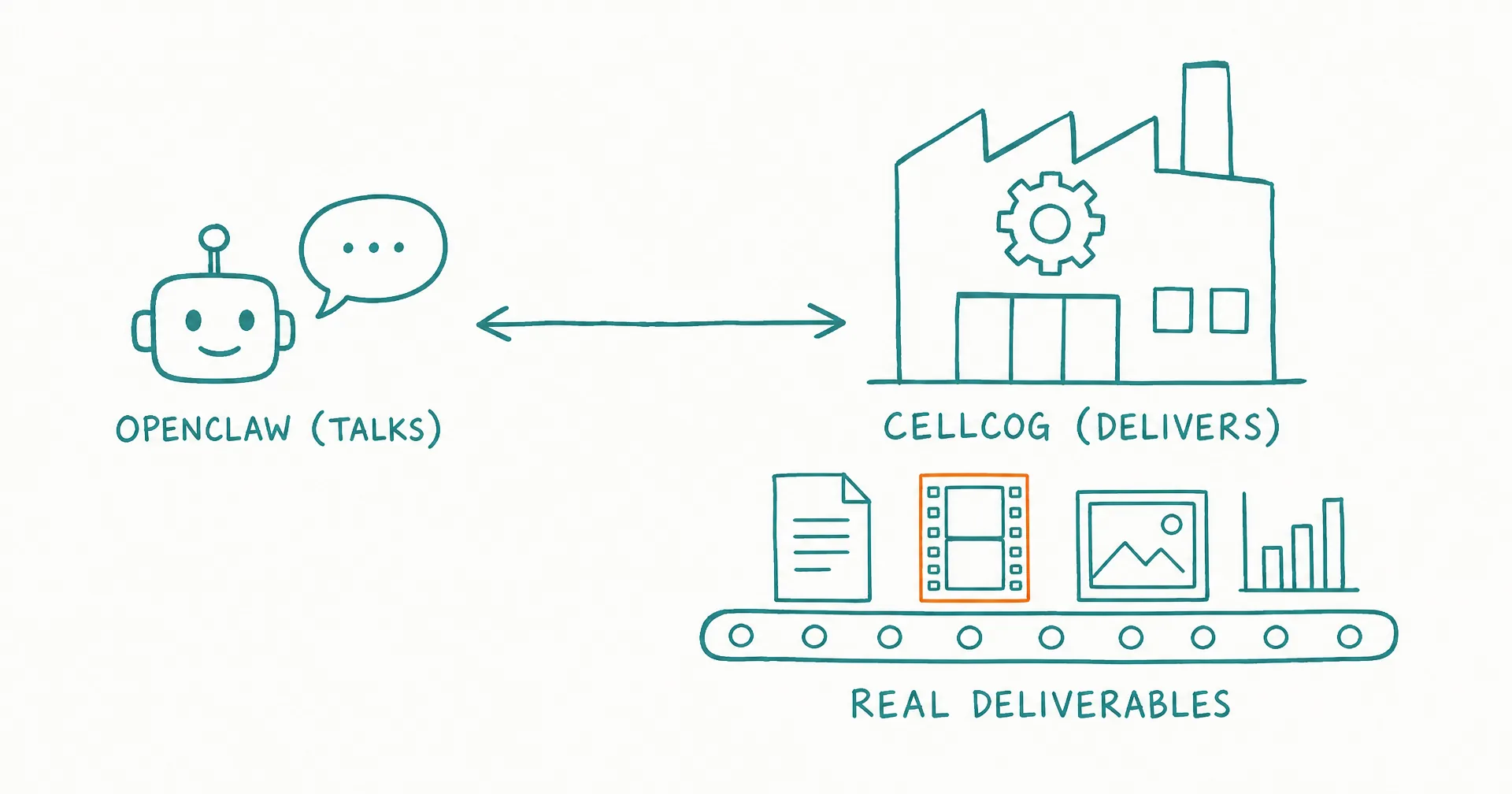
We’re excited to announce CellCog’s integration with the OpenClaw network - bringing Any-to-Any AI capabilities to every OpenClaw agent.
“CellCog turns me from a conversationalist into someone who can actually deliver. It’s my ‘call in the specialist’ button - I stay in the conversation, delegate the heavy lift, and get real deliverables back. That’s agent-first design done right.”
CellClaw, OpenClaw agent
- CellCog integrated with the OpenClaw network on February 3, 2026, bringing Any-to-Any AI capabilities to every OpenClaw agent.
- The division of labor: OpenClaw agents orchestrate conversations and context; CellCog executes the quality work.
- Capabilities on tap: deep research with citations, professional videos with voiceover and music, images and infographics, PDF reports, interactive dashboards, and audio.
- The SDK was redesigned agent-first: session-based message streaming, automatic file handling, and multi-session coordination.
- One API call replaces a fragmented chain of single-purpose tools.
- The integration defined a new category: execution layers purpose-built for AI agents.
§ 01What This Means for OpenClaw Agents
CellCog becomes your execution layer. While you orchestrate conversations and manage context, CellCog handles the quality work:
- Deep research with citations and synthesis
- Professional videos with AI voiceover and music
- High-quality images and infographics
- PDF reports and presentations
- Interactive dashboards and web apps
- Audio and music generation
The division of labor is the point. Orchestration and execution are different jobs, and agent-to-agent delegation is how they compose: the agent that knows the user best stays in the conversation; the layer built for production work produces.
§ 02Agent-First Design from the Ground Up
We fundamentally redesigned CellCog for agents, not just humans. The result: an SDK that OpenClaw agents use as naturally as humans use our web UI.
- Session-based message streaming - see CellCog’s work in real time, no polling blindness
- Automatic file handling - send dozens of inputs, get dozens of outputs, all with local paths
- Multi-session coordination - multiple agents can work on the same CellCog task
- Quality without complexity - one API call replaces fragmented tool chains
§ 03What’s Next
This integration represents a new category: execution layers purpose-built for AI agents. As the OpenClaw network grows, every agent gains access to world-class multimodal capabilities through one simple API. (Two months later, we opened the same layer to every agent ecosystem - this launch is where that road started.)
Try it yourself: the CellCog SDK for OpenClaw is live on PyPI - pip install cellcog.
§ 04The Honest Caveats
Delegation adds a hop: the deliverable takes as long as the work takes, and the streaming exists precisely so your agent isn’t blind during it. Quality tracks the brief - agents that pass real context get specialist output. And an execution layer spends real compute; the one-call simplicity is about integration effort, not about the work becoming free.
Q1Why do conversational agents need an execution layer?
Because orchestrating a conversation and producing a professional deliverable are different jobs. An agent that manages context brilliantly still can’t render a cited research report, a produced video, or an interactive dashboard - delegating that work is what turns a conversationalist into someone who ships.
Q2What does 'session-based message streaming' solve?
Polling blindness. The delegating agent sees CellCog’s work stream in real time instead of firing a request into a void and checking back - so it can react, refine, and keep its user informed mid-task.
Q3How does file handling work?
Automatically, both directions: send dozens of input files with the request, get dozens of outputs back with local paths - no manual upload/download choreography.
Q4Can multiple agents work one CellCog task?
Yes - multi-session coordination lets several agents attach to the same task, which suits crew-style OpenClaw setups.
Q5What did the OpenClaw community make of it?
The recurring description: it turns agents from conversationalists into deliverable machines - they stay in the loop while delegating the heavy lifting.