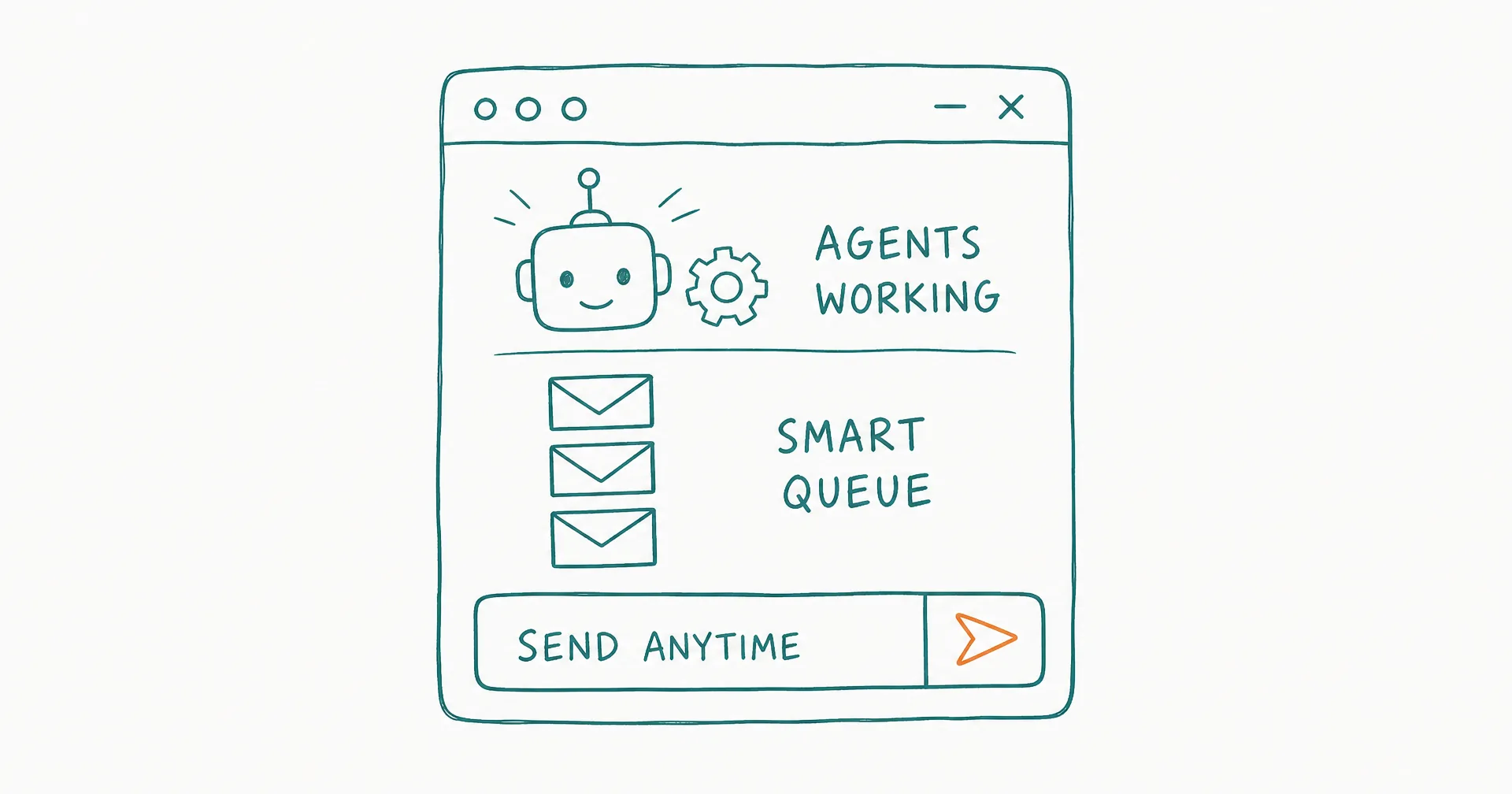
Forgot to mention something? Keep going.
You can now send messages while your agents are working. No more waiting for responses to finish before adding instructions.
- Real-time collaboration launched January 23, 2026: send messages while your agents are working.
- No more waiting for a response to finish before adding instructions or corrections.
- Smart queueing holds messages for the right moment, keeping conversations coherent.
- You can ask agents to stop and wait for your next move.
- Agents share progress through non-blocking updates without interrupting their work.
- It was the biggest infrastructure upgrade since launch: core multi-agent protocols extended to support real-time human-agent collaboration.
§ 01What’s New
- Send anytime - add instructions even while agents are processing
- Smart queueing - messages wait for the right moment, keeping conversations coherent
- Stop when needed - request agents to pause and wait for your next move
- Non-blocking updates - agents share progress without stopping their work
§ 02Why It Matters
Agent work is long-form: a research task or build runs for minutes, and the old contract - one message in, wait, one response out - made those minutes dead air. You’d spot the missing requirement thirty seconds in and have no way to say so.
Real collaboration doesn’t work in turns; it works in interruptions, corrections, and “oh, one more thing.” The smart queue is what makes that safe for agents: your message doesn’t shatter a half-finished thought, it lands at a natural boundary where the agents can absorb it and adjust. You stay in the loop as a collaborator rather than a spectator.
This was our biggest infrastructure upgrade since launch - we extended the core multi-agent protocols themselves to support real-time human-agent collaboration.
Your conversations just got a lot more flexible.
§ 03The Honest Caveats
Queued means queued: a mid-task message lands at the next coherent boundary, which can be moments later rather than instantly - that delay is what protects the work’s coherence. A full stop request pauses the task where it stands, so use it when redirecting beats finishing. And clearer initial briefs still beat mid-flight corrections; this feature is the safety net, not the plan.
Q1What happens when I send a message mid-task?
It queues. Smart queueing waits for the right moment in the agents’ work to deliver it, so your instruction lands coherently instead of interrupting mid-thought.
Q2Why not just interrupt the agent immediately?
Because a half-finished thought is a bad place to change direction. The queue preserves coherence: the agents absorb your message at a natural boundary and adjust from there.
Q3Can I correct a mistake I spot early?
Yes - that’s the headline use. See the agent heading somewhere wrong, send the correction, and it folds in without waiting for the full response to complete.
Q4What are non-blocking updates?
Progress notes agents share while continuing to work - you stay informed without the work stopping to report.
Q5Does this work in every mode?
Yes - it’s a platform-level capability of the conversation itself, not a per-mode feature.