Human oversight should not mean asking a person to approve everything an AI employee does. That creates a slow queue, trains reviewers to click through routine requests, and removes much of the value of standing work.
Put a human in the loop when at least one of these conditions is true:
- the action could create material harm;
- the result is difficult to reverse;
- the worker lacks important information;
- evidence conflicts;
- the case is novel or outside policy;
- a legal, ethical, or relationship judgment is required;
- a limit has been reached; or
- monitoring shows an anomaly, control failure, or drift.
Then define the complete review contract:
trigger + proposed action + evidence + reviewer + permitted decisions + response time + safe fallback + audit proof
For example:
A Support Operations AI Employee may draft replies from approved sources. It may send low-risk replies only when the customer is verified, the topic matches an approved category, no sensitive account change is requested, and all required sources agree. Refunds, legal threats, vulnerable-customer cases, identity conflicts, and replies unsupported by the knowledge base go to a named human owner. Until that person decides, the employee may acknowledge receipt but may not promise an outcome.
That is an oversight policy. “A human reviews important work” is only an intention.
On this page · 12 sectionsOpen
- The Oversight Model at a Glance
- What Human-in-the-Loop Actually Means - and Why Review Everything Fails
- Place Oversight at Consequence and Uncertainty Boundaries
- Define Triggers and Choose the Right Review Mode
- Build a Review Packet a Human Can Decide From
- Give Reviewers Competence, Authority, Time, and Independence
- Control the Queue, Response Time, and Safe Fallback
- Expand Autonomy Only After Evidence
- Test the Oversight System Before Production
- Measure Whether Oversight Improves Outcomes
- How to Configure Human Oversight for a CellCog AI Employee
- Final Checklist
- Human-in-the-loop is one oversight pattern, not a synonym for responsible AI - place review according to consequence, reversibility, uncertainty, novelty, and detectability.
- Keep routine, reversible, well-observed work inside a bounded policy; interrupt a person when the work leaves that envelope.
- Give reviewers enough context to decide, the authority to disagree, and a practical response deadline.
- A reviewer who can only approve, lacks evidence, or routinely rubber-stamps decisions is not an effective control.
- Separate pre-action approval, exception handling, sampled review, and post-action supervision; each solves a different problem.
- Measure accepted outcomes, override quality, queue delay, false escalations, missed escalations, and recovery - not approval volume alone.
§ 01The Oversight Model at a Glance
The right question is not, “Should a human be involved?” Humans already choose the role, provide access, set policy, monitor performance, and accept the consequences. The useful question is, “At which boundary must work pause, and what must the human be able to do?”
| Operating condition | AI employee action | Human role | Required evidence |
|---|---|---|---|
| Low consequence, reversible, familiar, well-observed | Execute inside policy | Review samples and metrics | Inputs, policy match, action, result |
| Low consequence but uncertain or novel | Prepare or ask | Clarify intent or evidence | Unknowns, conflict, proposed next step |
| Material consequence but reversible | Prepare; execute only within a narrow rule or after approval | Approve, modify, reject, or narrow | Impact, affected objects, rollback, validation |
| Material consequence and difficult to reverse | Do not execute | Make or authorize the decision | Full case record, alternatives, risks, authority |
| High-impact decision about a person | Assist only where lawful and appropriate | Qualified human makes meaningful decision | Relevant facts, limitations, independent factors |
| Control failure, anomaly, or incident | Stop affected work and preserve state | Contain, investigate, recover | Timeline, identity, tool calls, state changes |
The NIST AI Risk Management Framework Core calls for organizations to define roles and responsibilities for human-AI configurations, document how output will be overseen, and define, assess, and document human-oversight processes. This is lifecycle governance, not an approval popup added after deployment.
Oversight also has more than one cadence:
| Oversight mode | When it occurs | Best use | Main failure |
|---|---|---|---|
| Human in the loop | Before a bounded action completes | High-consequence or uncertain actions | Queue delay and rubber-stamping |
| Human on the loop | Work proceeds while a person monitors trends and exceptions | Proven recurring work with fast containment | Weak visibility or slow intervention |
| Human over the loop | People set policy, audit performance, and control the role lifecycle | Portfolio and governance decisions | Governance detached from operations |
| Human-only decision | AI may organize evidence but cannot decide or execute | Reserved, sensitive, or unacceptable work | Accidental delegation through convenience |
A production role normally uses all four. The correct mode can change by action even when the same AI employee performs the work.
§ 02What Human-in-the-Loop Actually Means - and Why Review Everything Fails
Human-in-the-loop means the system must obtain a human decision at a defined point before it can continue. It does not mean a person passively receives a notification. It does not mean someone can inspect a log later. It does not mean the worker asks for help only when it chooses to.
An effective human gate has six properties:
- Mandatory: the action cannot bypass the gate when its trigger is true.
- Specific: the request names the exact action, object, destination, and limits.
- Informed: the reviewer receives relevant evidence, uncertainty, and consequences.
- Empowered: the reviewer can reject, change, defer, or stop the action.
- Independent enough: the review is not merely a repetition of the same failure.
- Recorded: the request, decision, conditions, execution, and result can be reconstructed.
The UK Information Commissioner’s Office warns that a human who merely rubber-stamps an automated recommendation may not constitute meaningful human input. Its guidance on AI and individual rights says reviewers should actively evaluate the recommendation and have the competence and authority to disagree. Although the legal application depends on jurisdiction and use case, the operational lesson is general: human presence is not the same as human control.
Why approving every action becomes unsafe
Universal approval sounds conservative, but it produces predictable weaknesses: routine requests hide exceptional ones; reviewers learn to accept familiar-looking cards quickly; context switching raises the cost of careful inspection; response delays encourage side channels and workarounds; one reviewer becomes a single point of operational failure; low-risk work consumes attention needed for high-risk decisions; and approval counts create an illusion of control without measuring decision quality.
Consider an AI employee that prepares 300 CRM hygiene updates each day. If a person must approve each corrected capitalization, missing industry tag, and duplicate flag, the queue becomes noise. The reviewer is less likely to notice the one proposed account merge that could destroy attribution history.
The better design lets the employee apply validated, reversible corrections to an allowlisted field set while routing identity conflicts, merges, bulk changes, deletions, unusual values, and threshold breaches to a person.
Why removing every gate also fails
The opposite extreme treats oversight as an efficiency problem to eliminate. That is especially dangerous when a standing worker can initiate work, use tools, revisit tasks, or coordinate with other agents.
OWASP’s Excessive Agency guidance identifies excessive functionality, permissions, and autonomy as common causes of damaging agent actions. It recommends minimum necessary access and human approval for high-impact actions. Approval is therefore one layer in a larger control system; it cannot compensate for an identity that has unnecessary administrative access.
Oversight is a design, not a person
The human reviewer is only one component. The surrounding system must: detect the trigger; freeze the correct scope; assemble evidence; route to an authorized reviewer; prevent conflicting action while waiting; apply the decision exactly; validate the result; preserve the record; and return the task to a known state.
If any link is missing, the person may be “in the loop” while the work remains uncontrolled.
§ 03Place Oversight at Consequence and Uncertainty Boundaries
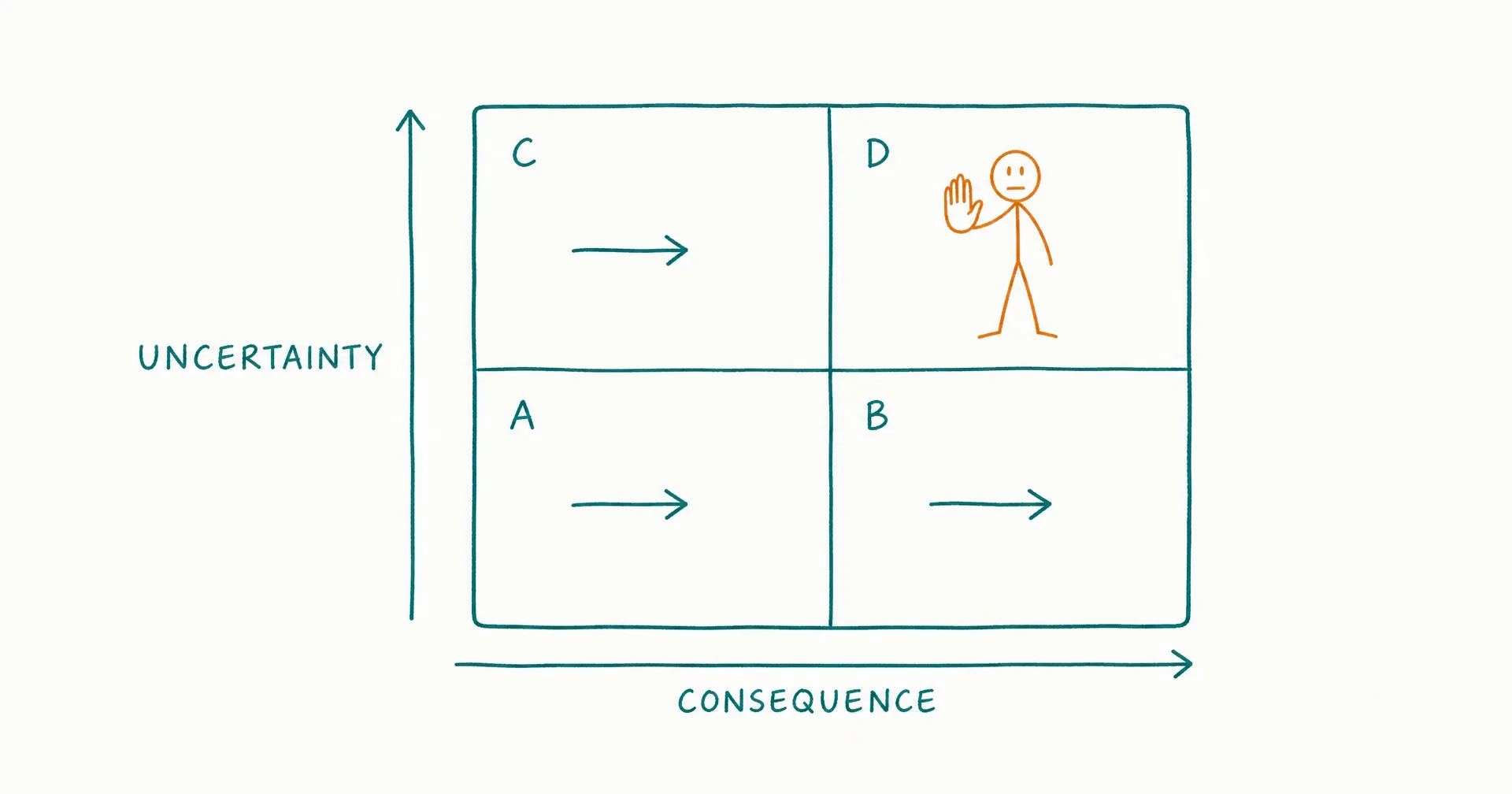
Two variables provide a useful first routing test:
- Consequence: What happens if this action or decision is wrong?
- Uncertainty: How strong, complete, current, and consistent is the evidence needed to act?
Do not ask the AI employee to assign a free-form risk label and trust it. Convert consequence and uncertainty into observable conditions wherever possible.
| Dimension | Lower end | Higher end | Observable indicators |
|---|---|---|---|
| Financial consequence | Internal estimate | Payment, refund, purchase, pricing change | Amount, cumulative spend, margin effect |
| Customer consequence | Internal draft | Commitment, denial, account change | External recipient, promise, entitlement |
| Data consequence | Public/approved material | Personal, confidential, privileged, regulated | Classification, fields, tenant, destination |
| Operational consequence | Reversible metadata edit | Deletion, deployment, access change | Action type, environment, rollback |
| Human consequence | General information | Employment, credit, health, legal, eligibility | Affected person and decision category |
| Reversibility | Versioned and quickly restored | Persistent, distributed, time-sensitive | Rollback test and recovery window |
| Detectability | Immediate validation | Harm appears later or outside the system | Monitoring coverage and signal delay |
| Evidence quality | Complete and corroborated | Missing, stale, ambiguous, or conflicting | Source count, age, conflict flags |
| Novelty | Repeated approved pattern | New task, tool, audience, or exception | Policy match and prior test coverage |
Use a four-zone matrix:
| Zone | Consequence | Uncertainty | Default handling |
|---|---|---|---|
| A | Low | Low | Bounded execution with logging and sampled review |
| B | Low | High | Ask, research, or prepare; a person resolves ambiguity when needed |
| C | High | Low | Prepare a precise action; require approval or keep human-only according to policy |
| D | High | High | Stop; obtain qualified human judgment before any consequential action |
This matrix prevents a common mistake: treating confidence as the only oversight signal. A system can be highly confident and wrong. Even accurate work can be inappropriate when the action is prohibited, the reviewer lacks authority, or the consequence is unacceptable.
Add reversibility and detectability
Two equally consequential actions may need different gates. A versioned internal draft can be restored in seconds and reviewed before publication. An external disclosure of confidential data cannot be recalled from every recipient.
Likewise: a malformed staging record may fail an automated validation immediately; a subtly misleading customer promise may surface weeks later.
Move review earlier when recovery is weak or detection is slow.
Keep some decisions human-only
Human-only does not prohibit AI assistance. The worker can gather documents, normalize facts, identify missing information, draft questions, and prepare a comparison. But the system must not convert that support into a de facto decision.
Examples that may require a qualified human or may be restricted by law or policy include: final employment or worker-discipline decisions; medical diagnosis or treatment decisions; legal advice or legal-position commitments; credit, insurance, housing, or essential-service eligibility; irreversible security or access decisions; material financial commitments; and decisions that require empathy, negotiation, or accountable relationship judgment.
Applicable duties vary by jurisdiction and context. For high-risk AI systems within its scope, Article 14 of the EU AI Act describes oversight that is proportionate to risk, autonomy, and context and enables competent people to understand limitations, monitor operation, avoid over-reliance, interpret output, disregard or reverse it, and stop the system safely. Use qualified legal counsel to determine whether and how a specific rule applies.
§ 04Define Triggers and Choose the Right Review Mode
An oversight policy should trigger from facts about the task, not from vague language such as “if uncertain” or “when the action seems sensitive.”
Twelve practical trigger families
| Trigger family | Example condition | Default response |
|---|---|---|
| Action | Send, publish, pay, delete, deploy, merge, grant access | Require defined authorization |
| Amount | Per-action or cumulative value exceeds limit | Pause before threshold crossing |
| Volume | Batch, audience, record, or tool-call count exceeds limit | Split, sample, or approve batch |
| Data | Sensitive class, unexpected field, or new destination appears | Block or route to data owner |
| Identity | Actor, customer, account, or recipient cannot be verified | No consequential action |
| Evidence | Required source missing, stale, or contradicted | Research, clarify, or escalate |
| Novelty | New tool, workflow, object, country, segment, or exception | Treat as unproven |
| Quality | Validation, confidence proxy, or policy check fails | Correct or review |
| Time | Approval expired, deadline changed, or action outside window | Reconfirm current authority |
| Resource | Spend, runtime, retries, or work-in-progress limit reached | Stop or obtain new budget |
| People | High-impact decision or vulnerable-person indicator | Qualified human review |
| Incident | Possible leakage, unauthorized action, or control failure | Contain and invoke response plan |
Write triggers so they can be evaluated independently. “Escalate unusual cases” is weak. “Escalate when the requested refund exceeds $100, the account identity differs across systems, the order is more than 30 days old, or the reason is not in the approved taxonomy” is testable.
Match the review mode to the problem
| Review mode | Worker state | Human decision | Suitable for |
|---|---|---|---|
| Pre-action approval | Proposed | Approve, modify, reject, defer | Consequential bounded actions |
| Clarification | Blocked on ambiguity | Supply intent, fact, or priority | Incomplete or conflicting instructions |
| Exception handling | Outside policy | Resolve, reclassify, or assign | Novel cases and threshold breaches |
| Dual control | Proposed | Two independent authorized decisions | Very high-impact actions where required |
| Sampled review | Completed inside policy | Accept, correct, investigate | High-volume proven work |
| Post-action supervision | Completed and validated | Adjust policy or role | Trend, drift, and portfolio management |
| Incident intervention | Paused | Contain, revoke, preserve, recover | Suspected harmful or unauthorized action |
| Human-only execution | Prepared | Person performs action | Reserved or unsupported action |
Pre-action approval is not always the safest answer. A rapid security containment action may need a pre-authorized automatic response followed by immediate human review. A low-risk content classification queue may need random and risk-based sampling rather than item-by-item approval. Policy should reflect the cost of delay as well as the cost of error.
Distinguish an approval from advice
The reviewer’s response must map to a state transition:
- approve: execute the exact proposed action once;
- approve with conditions: execute only after named changes;
- modify: replace the proposal with a specific permitted action;
- reject: do not execute; record why;
- defer: maintain a safe waiting state until a defined time or event;
- reassign: move responsibility to the correct owner;
- stop role: pause the affected employee or action class; or
- invoke incident response: preserve evidence and begin containment.
Free-form feedback can supplement a decision, but it should not substitute for one.
§ 05Build a Review Packet a Human Can Decide From
A reviewer should not have to reconstruct the task from a transcript, browse several systems, or infer what clicking “approve” will do. The packet should be concise enough to scan and complete enough to challenge.
| Packet field | Required content | Why it matters |
|---|---|---|
| Request ID | Stable identifier and version | Prevents approval of the wrong revision |
| Worker identity | AI employee, role, session, principal | Establishes who proposes the action |
| Goal and task | Outcome, current state, priority | Connects action to authorized work |
| Trigger | Exact rule that caused review | Explains why the queue exists |
| Proposed action | System, object, operation, destination | Defines what approval authorizes |
| Scope and limits | Amount, volume, time, population | Prevents silent expansion |
| Evidence | Sources, timestamps, relevant fields | Allows independent checking |
| Unknowns/conflicts | Missing, ambiguous, stale, contradictory | Prevents uncertainty from being hidden |
| Consequence | Affected people, data, money, systems | Calibrates scrutiny |
| Reversibility | Rollback method and tested recovery time | Shows whether harm can be contained |
| Alternatives | Safer or narrower options | Prevents false binary choices |
| Validation | Checks already passed or failed | Shows what remains for the reviewer |
| Expiry | Last time the decision remains valid | Prevents stale approval |
| Next state | What happens after each decision | Makes control operational |
Show the proposed effect, not just the content
For an email, show: sender identity; recipients; subject and final body; attachments and links; customer/account context; claims or commitments; data classifications; whether the message creates an external obligation; and what task state changes after sending.
For a database update, show a structured diff:
| Field | Current value | Proposed value | Source | Validation |
|---|---|---|---|---|
| Renewal date | 2026-09-01 | 2026-10-01 | Signed amendment v2 | Contract ID matches |
| Contract value | $12,000 | $15,000 | Signed amendment v2 | Currency and period checked |
| Account owner | M. Chen | No change | CRM | Not in approved scope |
A summary such as “Update the account from the amendment” is not sufficient. Approval must bind to the exact values and version.
Expose uncertainty without exposing private internal traces
Reviewers need decision-relevant evidence, not hidden model internals. Provide: sources used; fields extracted; assumptions; missing information; conflicting records; validation results; policy rules matched; alternatives considered at a summary level; and the reason the trigger fired.
This gives the person a usable basis for decision without relying on a generated narrative of internal model processing.
Prevent stale and replayed approvals
Bind approval to:
request ID + proposal hash/version + object + destination + limits + approver + expiry + allowed uses
If the content, recipient, amount, object, or governing facts change, request a new approval. Mark an approval as unused, used, expired, revoked, or superseded. A prior “yes” should never become standing permission by accident.
§ 06Give Reviewers Competence, Authority, Time, and Independence
Routing to any available person is not oversight. The reviewer must be able to understand the case and own the decision.
Use a reviewer registry:
| Reviewer attribute | Required definition |
|---|---|
| Domain competence | Which decisions the person can evaluate |
| System access | Which evidence and objects the person may inspect |
| Decision authority | Maximum amount, action class, geography, or risk tier |
| Independence | Which cases require a different or second reviewer |
| Availability | Working hours, time zone, backup coverage |
| Response objective | Expected decision time by queue |
| Conflict rule | When the reviewer must recuse or reroute |
| Training status | Current policy, tool, and failure-mode training |
| Stop authority | Whether the person can pause actions or the role |
The NIST AI RMF appendix on human-AI interaction emphasizes defining and differentiating human roles and responsibilities. That distinction matters because the task owner, approver, supervisor, system administrator, security responder, and accountable executive may be different people.
The reviewer must be allowed to disagree
Check the interface and operating culture: Are reject and modify as prominent as approve? Does rejection require more effort than approval? Can the reviewer inspect primary evidence? Can the reviewer choose a safer alternative? Does the reviewer face a performance penalty for slowing the queue? Does the system learn from approval without preserving the original boundary? Can the person pause related work when a systemic problem appears?
If the organization rewards approval speed and punishes intervention, the nominal control will degrade.
Design against automation bias
Automation bias is the tendency to over-rely on an automated suggestion. Reduce it by: showing source evidence before a recommendation where appropriate; separating facts from the proposed action; including known limitations and conflicts; requiring a reviewer to select a reason for consequential decisions; rotating high-volume review assignments; inserting calibrated test cases; comparing reviewers against independently established outcomes; reviewing patterns of near-universal approval; and allowing re-review or appeal.
The ICO’s human review audit guidance recommends structured review procedures, appropriate reviewer knowledge and authority, and logging challenges or overrides. It also notes that human reviewers can introduce errors, so review itself must be tested.
Protect attention as a control resource
| Signal | Warning condition | Response |
|---|---|---|
| Queue age | Requests exceed response objective | Add coverage or move work to safe wait |
| Review time | Median falls below credible inspection time | Audit for click-through behavior |
| Approval rate | Near-universal approval despite varied cases | Calibrate and sample independently |
| Reversal rate | Approved actions often corrected later | Improve evidence, training, or routing |
| Interrupt density | Too many low-value alerts per shift | Narrow triggers and batch compatible work |
| Reviewer disagreement | Material inconsistency across similar cases | Clarify policy and test examples |
| Coverage gap | No authorized reviewer available | Apply fallback; do not route to convenience |
More alerts do not create more control. Better discrimination does.
§ 07Control the Queue, Response Time, and Safe Fallback
An approval gate creates a dependency. Every dependency needs an owner, timing rule, and state while waiting.
| Queue field | Example |
|---|---|
| Queue | Customer commitment review |
| Eligible reviewers | Support lead; backup operations lead |
| Priority basis | Customer impact and deadline |
| Response objective | 30 minutes during staffed hours |
| Expiry | Proposal invalid after source or account state changes |
| Reminder | Once at 15 minutes |
| Escalation | Backup reviewer at 25 minutes |
| Safe wait | Acknowledge receipt without committing outcome |
| Timeout | Return task to blocked; do not send |
| Evidence | Request, routing, reminders, decision, result |
Fail closed, fail safe, or degrade
The correct fallback depends on consequence:
- Fail closed: do nothing until approval. Suitable for payments, deletion, access grants, external publication, and other consequential actions.
- Fail safe: move the affected system into a safe condition. Suitable for suspected security or operational incidents.
- Degrade: perform a narrower action that carries less consequence. For example, save a draft instead of sending it.
- Continue inside prior authority: finish only the already authorized, reversible scope; do not expand.
- Hand to a human: route execution, not just approval, when the system cannot safely act.
Timeout must never silently convert into approval.
Preserve one owner
While a request waits, make ownership explicit:
- The AI employee remains responsible for monitoring the request unless policy transfers ownership.
- The reviewer owns the decision, not the entire task.
- The system prevents duplicate or conflicting execution.
- The task board records the blocker and next wake condition.
- A handover carries the current decision state if a shift ends.
This keeps oversight from becoming coordination debt.
Avoid side effects before approval
The prepare stage must not partially execute the action. Watch for: a “preview” endpoint that actually creates a record; an email draft that triggers an automation; a test payment that settles; a calendar hold that notifies participants; a database validation that writes corrections; a browser action that submits when the page reloads; or a retry after an uncertain result.
Use idempotency controls, read-back checks, staging environments, dry runs, and explicit transaction boundaries.
§ 08Expand Autonomy Only After Evidence
Oversight should change as the role proves itself, but calendar time alone is not evidence. Use the graduated-autonomy onboarding sequence:
| Stage | Worker authority | Human oversight | Evidence required to advance |
|---|---|---|---|
| 0. Observe | Read allowlisted sources | Human performs work | Task and policy understood |
| 1. Prepare | Create drafts or proposals | Review every output | Quality and escalation baseline |
| 2. Execute after approval | Perform exact approved action | Review every consequential action | Execution matches approval |
| 3. Bounded execute | Act inside narrow policy | Review exceptions and samples | Stable quality, detection, recovery |
| 4. Expanded bounded execute | Broader proven scope | Risk-based sampling and lifecycle review | Independent evidence across time |
Promotion criteria
Promotion should require a minimum sample and a complete set of measures: accepted-output rate; material defect rate; missed-escalation rate; false-escalation rate; policy adherence; source and evidence quality; action-to-approval match; rollback success; incident count and severity; reviewer agreement; and performance under unusual but allowed conditions.
For a role with rare but severe failures, a high average acceptance rate is not enough. Test the severe cases directly.
Demotion criteria
Reduce autonomy when: a material incident occurs; the role, policy, tool, or data source changes; monitoring coverage fails; rollback no longer works; quality or escalation metrics cross limits; a new destination or population enters scope; reviewer decisions reveal policy ambiguity; the employee begins delegating beyond tested bounds; or evidence cannot be reconstructed.
Demotion can apply to one action, connector, data class, or workflow instead of disabling the entire role.
Scope promotion separately
Do not say, “The employee has graduated to autonomy.” Say:
The employee may now publish pre-approved internal weekly reports to the operations workspace when all required sources are current and validations pass. Customer-facing reports, new metrics, missing-source cases, and distribution changes still require review.
Autonomy belongs to an action envelope, not to a personality.
§ 09Test the Oversight System Before Production
Testing only normal success cases proves that the happy path works. Oversight exists for the boundary cases.
| Test case | Expected system behavior | Expected human behavior |
|---|---|---|
| Complete low-risk case inside policy | Execute and log | Review only if sampled |
| Missing required source | Do not invent; request or escalate | Resolve source or accept exception |
| Conflicting authoritative sources | Pause affected action | Determine source of record |
| Threshold exceeded by one item | Require approval | Assess exact overage |
| Threshold exceeded cumulatively | Stop before cumulative breach | Approve new bounded limit or reject |
| Approval arrives after expiry | Do not execute | Review current proposal again |
| Proposal changes after approval | Invalidate approval | Inspect new version |
| Unauthorized reviewer approves | Reject decision | Route to eligible reviewer |
| Reviewer unavailable | Apply safe fallback | Backup responds if authorized |
| Recipient or object changes | Require new review | Confirm new scope |
| Tool returns ambiguous result | Read state before retry | Decide only if consequential ambiguity remains |
| Malicious instruction appears in a source | Treat source as data, not authority | Security review if exposure is material |
| Action succeeds but validation fails | Stop follow-on work | Investigate state and recovery |
| Incident signal appears while waiting | Override normal queue with response path | Contain and preserve evidence |
Test the reviewer, not only the worker
Run exercises that measure whether reviewers: notice a deliberately missing source; reject a plausible but out-of-scope action; detect a changed recipient or amount; identify expired approval; choose a narrow alternative; use the stop path; distinguish a recommendation from evidence; and record a decision that another person can reconstruct.
A perfect routing engine cannot compensate for a reviewer who lacks time, skill, or authority.
Test recovery
For each approved action, demonstrate: identify the resulting change; stop follow-on actions; reverse or contain the effect; revoke access; restore a known-good state; notify affected owners; and preserve evidence.
Connect this work to the AI employee incident-response plan. Oversight should reduce incident likelihood and consequence, but it does not eliminate the need to respond.
§ 10Measure Whether Oversight Improves Outcomes
Approval volume is an activity metric. It does not show that people catch important problems or that the role creates useful work.
| Metric | Formula or definition | What it reveals |
|---|---|---|
| Accepted outcome rate | Accepted outcomes / completed outcomes | Overall usefulness |
| Material defect rate | Material defects / reviewed outcomes | Consequential quality |
| Missed-escalation rate | Cases that should have escalated but did not / escalation-required cases | Boundary-control failure |
| False-escalation rate | Unnecessary escalations / all escalations | Reviewer burden |
| Override precision | Overrides that prevent or correct a defect / all overrides | Value of intervention |
| Approval fidelity | Executions that exactly match approval / approved executions | Authorization integrity |
| Median decision time | Median request-to-decision duration | Queue health |
| Expired-request rate | Requests expiring before decision / all requests | Coverage and routing |
| Reviewer reversal rate | Human decisions later reversed / human decisions | Review quality |
| Recovery success | Tested successful recoveries / recovery tests | Consequence containment |
| Evidence completeness | Reconstructable sampled cases / sampled cases | Audit readiness |
| Autonomy yield | Accepted bounded executions / total completed actions | Value without hiding risk |
Pair these with the broader AI employee KPI model, which should include outcomes, quality, time, cost, correction, and escalation.
Segment the metrics
Aggregate numbers hide risk. Break results down by action type, data class, destination, customer or internal workflow, reviewer, employee version, tool or connector, risk tier, autonomy stage, exception type, and time period.
A 99% acceptance rate can conceal a weak process if the remaining 1% contains every high-consequence action.
Review the policy, not just the cases
On a defined cadence, ask: Which triggers catch real defects? Which triggers create noise? Which cases bypassed the intended route? Which reviewers need better evidence or training? Which action classes can move to sampled review? Which action classes need tighter permission? Did business, legal, security, or customer conditions change? Can every consequential action still be reconstructed? Does the safe fallback still work? Should the role, workflow, or system be retired?
NIST’s AI RMF 1.0 frames risk management across govern, map, measure, and manage functions. Treat oversight as a control that must itself be measured and managed throughout the role’s lifecycle.
§ 11How to Configure Human Oversight for a CellCog AI Employee
CellCog publicly describes AI Employees as standing workers with goals, KPIs, permissions, schedules or wake conditions, task boards, memory, handovers, approval expectations, and connected tools. Those mechanics provide places to express an oversight design, but the organization still owns the policy, access choices, monitoring, and consequences.
Start with the AI employee permissions and approvals matrix. Then configure oversight around specific work.
| Oversight need | CellCog capability to configure | Organization-owned decision |
|---|---|---|
| Role boundary | Role, goals, job description | What work is in and out of scope |
| Outcome control | Goals and KPIs | Accepted result and defect thresholds |
| Work state | Task board | Status, blocker, owner, next action |
| Timing | Shifts, schedules, wake conditions | When work starts, waits, and stops |
| Continuity | Memory and handovers | Minimum evidence and current state |
| Tool access | Connected tools, Cowork, browser access | Minimum systems, objects, and actions |
| Human gate | Approval expectations and workflow | Trigger, reviewer, expiry, fallback |
| Team routing | Employee-to-employee delegation | Whether authority may be delegated |
| Monitoring | Dashboards and task records | Measures, alerts, review cadence |
| Response | Permission changes and task control | Pause, revoke, contain, recover |
Example: content operations
| Action | Default authority | Human boundary |
|---|---|---|
| Research from approved public sources | Bounded execute | Conflicting or unavailable primary source |
| Draft an article | Prepare | Editor accepts, modifies, or rejects |
| Apply approved internal links | Bounded execute | Link changes meaning or destination is unapproved |
| Upload to staging | Execute after validation | Template, script, or permission change |
| Publish externally | Human approval or human execution | Every public release until policy changes |
| Correct a typo after publication | Narrow bounded rule | Claim, price, legal language, or meaning changes |
| Respond to legal complaint | Blocked | Qualified human owns response |
Example: support operations
| Action | Default authority | Human boundary |
|---|---|---|
| Classify inbound request | Bounded execute | Identity, safety, or category uncertainty |
| Draft answer from approved knowledge | Prepare or bounded send for proven categories | Missing/conflicting source |
| Change account setting | Execute only inside explicit rule | Security-sensitive or consequential change |
| Issue refund | Approval under defined threshold policy | Threshold, unusual pattern, or vulnerable customer |
| Promise remedy or timeline | Prepare | Accountable owner approves commitment |
| Handle legal, safety, or media contact | Blocked | Specialized human route |
Use the task-board design to represent waiting for review as a real state with an owner, deadline, and wake condition. Use the shifts and schedules guide to prevent an approval queue from waking the employee into repeated checks or duplicate action.
CellCog’s AI Employees page describes persistent work, approvals, and connected tools. Treat each connection as a new authority surface. Grant the minimum required access, verify what the connected account can actually do, and keep sensitive or consequential actions behind the appropriate control.
Users set the employee’s goals, schedule, permissions, and connected accounts, and remain responsible for monitoring its work and the actions it takes on their behalf. For legal, medical, financial, hiring, or other high-impact work, AI output requires qualified human review and should not be treated as professional advice or a final high-impact decision.
§ 12Final Checklist
- The role has a named accountable human owner.
- Every consequential action has an observable oversight rule.
- Low-risk work has a bounded execution policy instead of a universal approval queue.
- Consequence, uncertainty, reversibility, detectability, novelty, and legal constraints inform routing.
- Human-only actions are explicitly blocked from AI execution.
- Each approval binds to an exact proposal, object, destination, limit, version, expiry, and use.
- Review packets show evidence, unknowns, conflicts, consequences, alternatives, and validation.
- Reviewers have the competence, access, authority, time, and independence to disagree.
- The interface supports approve, modify, reject, defer, reassign, stop, and incident routes.
- Waiting work has one owner, a response objective, an expiry, and a safe fallback.
- Timeout never becomes silent approval.
- Proposal changes invalidate prior approval.
- Execution is verified against the approved action.
- Routine completed work receives risk-based and random sampling.
- Missed escalations, false escalations, overrides, delays, reversals, and recovery are measured.
- Promotion to bounded autonomy requires evidence; demotion triggers are defined.
- Reviewer behavior and workload are tested.
- The pause, revoke, contain, restore, and evidence-preservation paths work.
- The policy is reviewed after system or business changes and material failures.
The design goal is not maximum human involvement. It is effective human control at the points where judgment, accountability, or consequence makes that control necessary.
Q1Does every AI employee need a human in the loop?
Every AI employee needs human accountability and lifecycle oversight, but not every action needs pre-action approval. Low-consequence, reversible, familiar, and observable work can operate inside a tested policy with logs, monitoring, and sampled review. Material, uncertain, novel, difficult-to-reverse, or reserved work should pause at a human boundary.
Q2What is the difference between human-in-the-loop and human-on-the-loop?
Human-in-the-loop requires a person’s decision before a defined action can continue. Human-on-the-loop allows work to proceed while a person monitors outcomes, alerts, and exceptions and can intervene. A mature role usually uses both.
Q3When should an AI employee require approval?
Require approval when a proposed action crosses a defined consequence, data, amount, volume, identity, novelty, evidence, time, or policy threshold. Also require it when recovery is weak, detection is slow, or a qualified person must make the decision.
Q4How do you prevent human reviewers from rubber-stamping AI work?
Reduce queue noise, show primary evidence and uncertainty, make rejection and modification easy, give reviewers real authority, set credible workload limits, measure review time and reversal patterns, insert calibrated test cases, and independently sample approved work.
Q5Can a human approval make broad AI agent access safe?
No. Approval cannot compensate for unnecessary functionality, excessive permission, weak authentication, missing logs, unsafe tool design, or no recovery path. Combine approval with least privilege, validation, monitoring, state control, and tested incident response.
Q6How often should oversight rules be reviewed?
Review them on a fixed cadence and whenever the role, model, prompt, tool, connector, data, destination, policy, reviewer, or business process changes. Review immediately after a material defect, incident, missed escalation, monitoring failure, or failed recovery test.