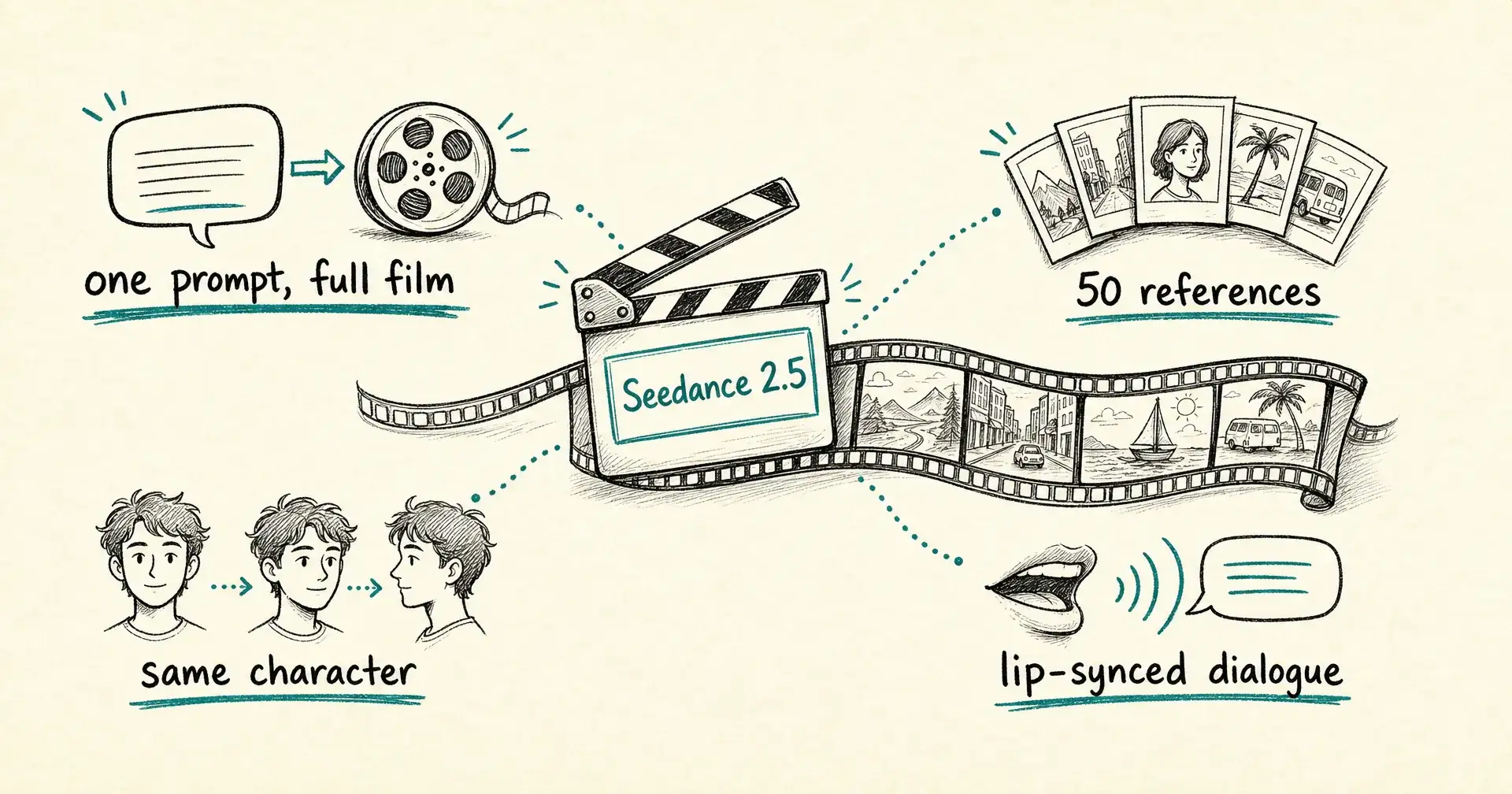
CellCog’s video suite now runs on Seedance 2.5.
CellCog’s video promise has always been bigger than a clip: a single prompt in, a complete film out. Script, scenes, voices, music, editing - the agent orchestrates the whole production, and the result is minutes of finished video. When Seedance 2.0 launched in April, we said reference-to-video was the part we hadn’t fully harnessed yet. Seedance 2.5 is that unlock - and what it strengthens is the films themselves.
The film is still the product. What changed is the strength of every building block inside it.
- CellCog’s video generation now runs on Seedance 2.5, ByteDance’s newest reference-to-video model - live since August 9, 2026.
- The core is unchanged and stronger: complete multi-minute films from a single prompt, with the agent orchestrating script, scenes, voices, music, and editing.
- Generated takes now run up to 30 seconds, doubled from 15 - so a multi-minute film has half the seams to defend.
- Up to 50 reference files per generation (30 images, 10 videos, 10 audio), up from 12 - locking every character, set, outfit, and voice across a whole film.
- Multi-view character references (the same face from several angles) keep identity rock-solid from the film’s first minute to its last.
- ByteDance reports roughly 20% better prompt adherence than Seedance 2.0, which shows up most in multi-shot scenes and camera direction (Seedance 2.5 announcement, July 2026).
- Generations are 720p, the AI-video production standard: 2.5 trades the resolution ceiling for longer takes and far richer referencing.
§ 01What’s New
- Takes doubled to 30 seconds per generation, up from 15
- Up to 50 reference files per generation: 30 images, 10 videos, 10 audio clips (up from 12 total)
- Multi-view character locking: the same face from several angles, declared as one person, holds identity across an entire film
- Broader inputs: HEIC and GIF images now work as references, video references can run up to 200MB per file, and voice or narration references stretch to 30 seconds
- Sharper direction: ByteDance reports roughly 20% better prompt adherence than 2.0 (Seedance 2.5 announcement, July 2026), which shows up most in multi-shot scenes and camera control
§ 02Better Blocks, Better Films
Multi-minute AI video is an orchestration problem, and it is the problem CellCog is built for. A four-minute film on Seedance 2.0 was assembled from fifteen-second segments - every joint a place where wardrobe could shift, lighting could jump, or a character’s voice could drift. The agent defended those joints with continuity anchors and voice references, and it worked: three-to-four-minute films from one prompt were the everyday output.
Seedance 2.5 cuts the problem in half and reinforces what remains. The same film now needs half as many segments, and every segment carries up to 50 reference files: your characters from several angles, their wardrobe, the sets, a style frame that locks the film’s look, and a voice sample for everyone who speaks. The last minute of the film matches the first, because the same anchors traveled through every generation in between.
§ 03Scenes That Need No Seams at All
Scenes that fit inside 30 seconds now generate as one continuous take - a spokesperson’s complete message, a product demo from unboxing to hero shot, a location walkthrough in a single camera move. These were exactly the scenes the agent used to stitch from two or three segments. Now they don’t need stitching, and the seam count for the whole film drops again.
§ 04How It Works
Nothing changes in how you ask. Describe the film you want - the story, the audience, the platform - and hand over any assets that matter. The agent handles the production: scripting, storyboarding, reference preparation, scene-by-scene generation, voice consistency, and final assembly with music. The pipeline from Video Suite v3 still stands; 2.5 raises what every generation inside it can do.
§ 05The Honest Caveats
Seedance 2.5 generates at 720p, the standard for AI-video production work. The 1080p and 4K options we shipped on the 2.0 pipeline in July were retired with this migration: the model trades its resolution ceiling for take length and referencing depth, and we chose the capabilities that make films better. If a deliverable strictly needs higher resolution, the agent can upscale the finished film in post.
Cost is real too. Per second of output, 2.5 runs about 1.5x the price of 2.0. The agent manages this the sensible way: drafts short, final takes long, and per-generation credit usage always visible in your chat costs.
And frontier video remains probabilistic. The director’s loop is still generate, review, refine - 2.5 just means every loop covers more of the film, with fewer places for it to fall apart.
Q1What is Seedance 2.5?
ByteDance’s newest reference-to-video model, announced in July 2026: it generates up to 30 seconds of video in a single pass, guided by up to 50 of your own reference files, with native audio and lip-synced dialogue. Inside CellCog it is the engine under full film production.
Q2Does this change how long CellCog films can be?
The product is unchanged: complete multi-minute films from a single prompt - we were producing three-to-four-minute films on Seedance 2.0, and that orchestration is CellCog’s core. What 2.5 changes is the strength of the segments those films are made of: each one covers twice the film and carries far more of your references, so long films hold together better.
Q3How is it different from Seedance 2.0?
Twice the take length (30s vs 15s), four times the reference capacity (50 files vs 12), broader input formats, and stronger consistency for characters, sets, and style. ByteDance also reports roughly 20% better prompt adherence.
Q4What happened to 1080p and 4K?
They were retired with this migration. Seedance 2.5 generates at 720p, the standard for AI video production; the model trades the resolution ceiling for take length and referencing depth. If a deliverable strictly needs a higher resolution, the agent can upscale the finished film in post.
Q5What are reference files for?
They anchor the whole production to your assets: character faces from multiple angles, wardrobe, sets, a style frame, voice samples, even a video whose camera movement you want to borrow. The agent assigns each file a specific job and carries the same references into every segment of the film.
Q6Does it cost more?
Per second of output, 2.5 runs about 1.5x the price of 2.0. The agent manages the budget the sensible way - short drafts while iterating, full-length takes for finals - and you always see credit usage per generation in your chat costs.