Tesla showed the second-generation Roadster near Waco, Texas, on the evening of October 15, 2026, nine years after it first teased the car. On stage it drove up a curved ramp until it hung upside down, lifted itself over the rest of Tesla’s lineup on jets of compressed air, and ran 0 to 60 mph in 0.81 seconds.
This is an engineering read of how that works: each subsystem, the physics behind it, and the arithmetic. Where Tesla gave a number we use it and say who gave it. Where Tesla gave none, we work it out, label it as our estimate and show every input, so anyone can check it.
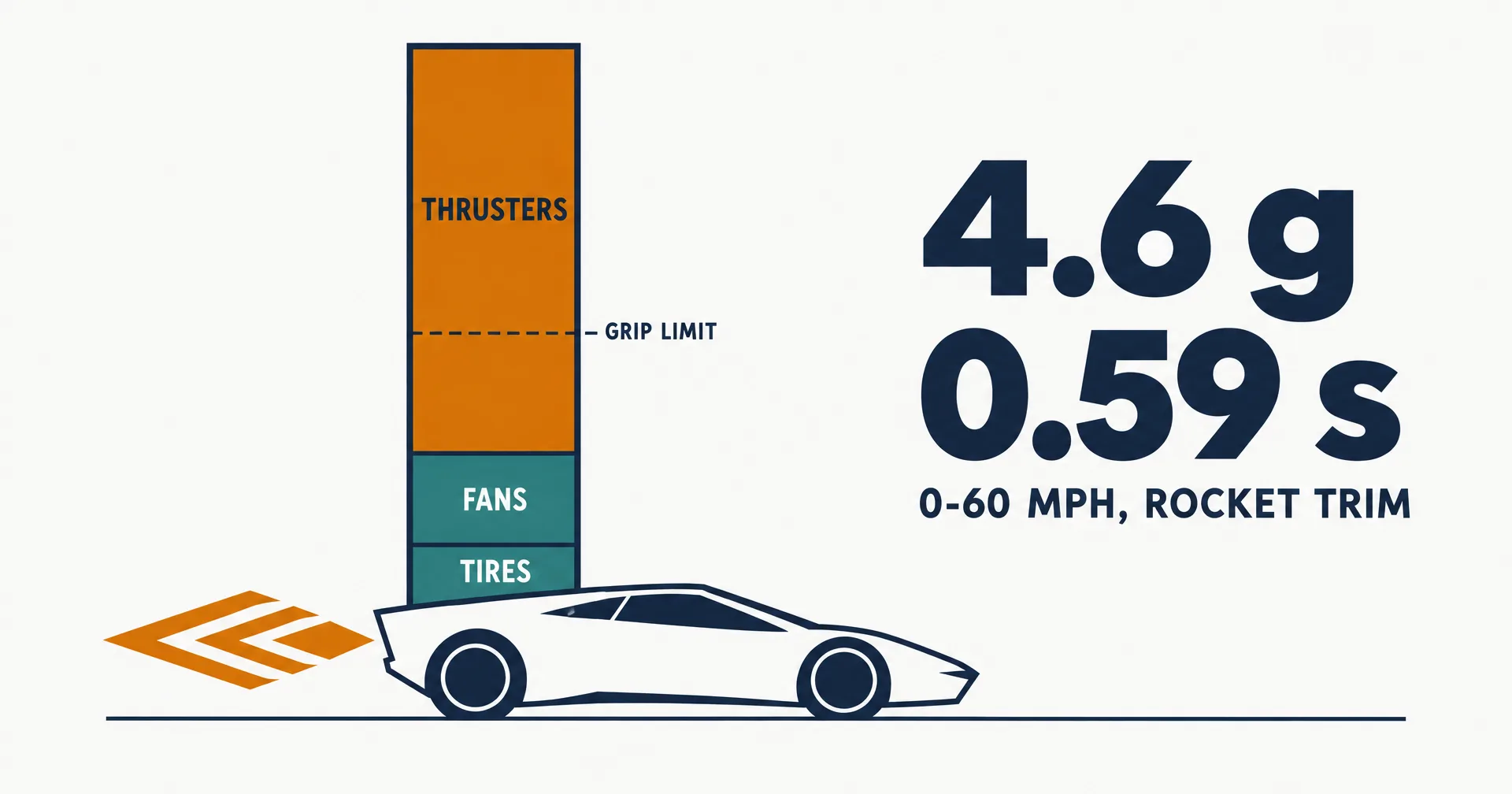
Two ideas carry the whole car. The fans pull it down onto the road, which buys grip. The thrusters push it along against the air, which needs no grip at all. Everything else (the tanks, the valves, the skirts, the flight) exists to make those two work.
On this page · 13 sectionsOpen
- What Tesla actually said
- 1. The grip ceiling every car hits
- 2. Fan suction: pressing the car down without speed
- 3. Cold-gas thrusters: pushing on the air
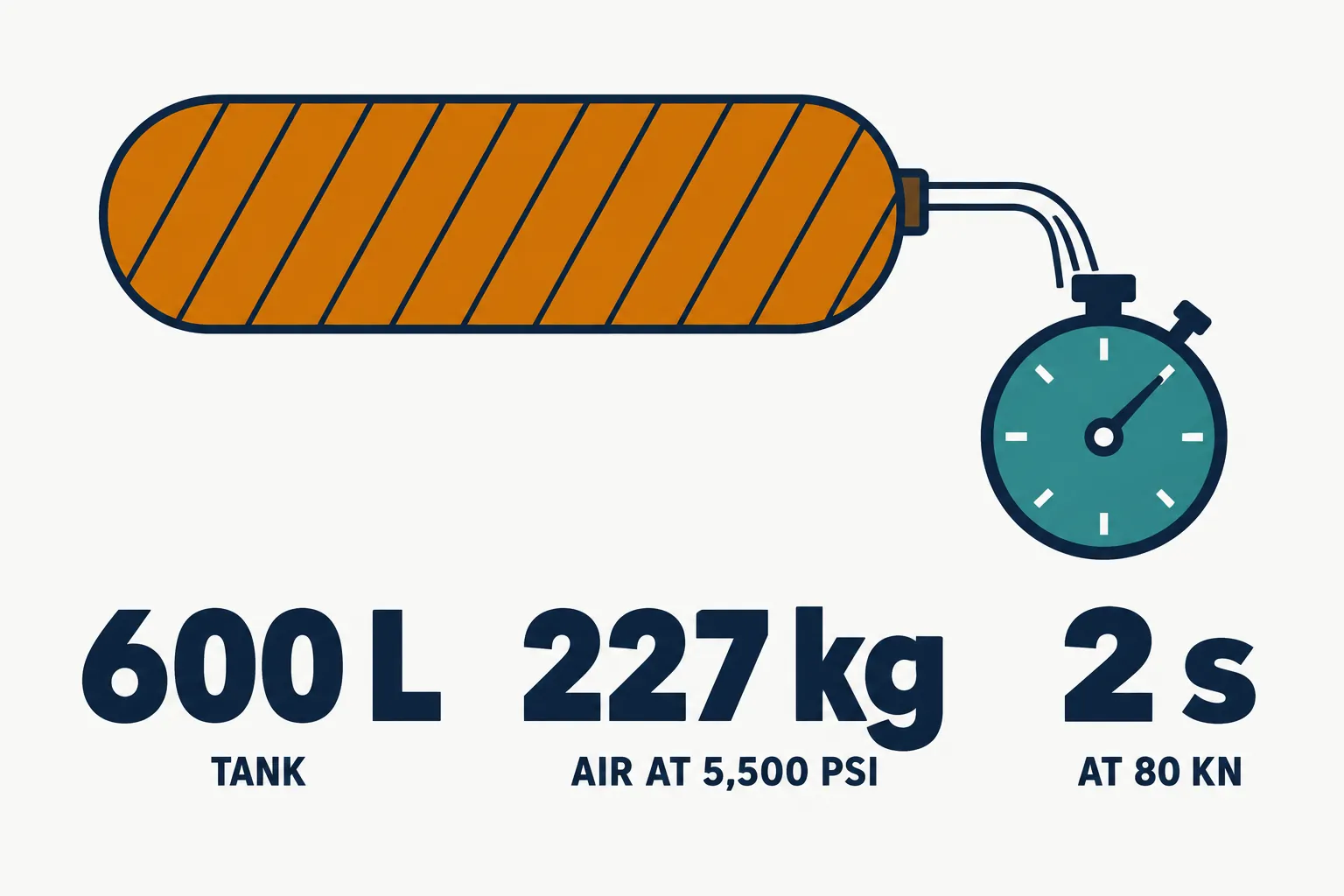
- 4. The tank: 600 liters at 5,500 psi
- 5. Does it add up? Thrust, grip and 0.59 seconds
- 6. Flight: hovering and rolling on air
- 7. Active aero, the yoke and the weight budget
- 8. What 4.6 g feels like
- 9. Nine years of promises
- 10. What a rival would have to solve
- What Tesla has not said
- Sources
 Every tire-only car is capped by grip: Tesla’s Lars Moravy put it at about 1.26 g. The Rocket trim’s 0.59 s to 60 mph needs 4.64 g on average, so most of the push has to come from somewhere other than the tires.
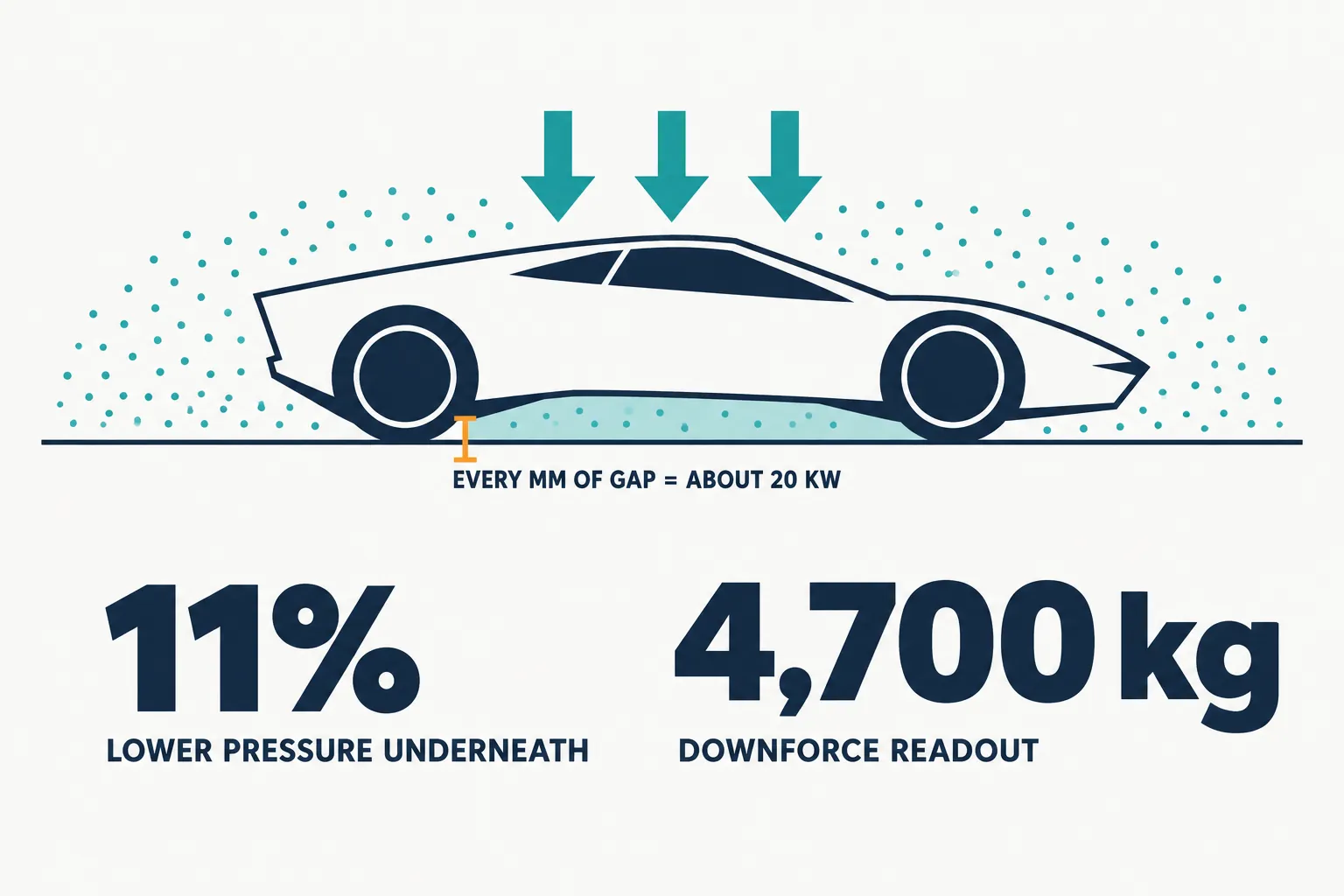
 Fans make downforce at zero speed by lowering the air pressure under a sealed floor. Holding the 4,700 kg readout needs only about a tenth of an atmosphere; the hard part is the seal, where each millimeter of skirt gap costs roughly 20 kW of fan power (our estimate).
 The thrusters are cold-gas rockets: air stored at 5,500 psi leaves a nozzle faster than sound. Ideal air gives about 693 m/s and 71 s of specific impulse at sea level, so 80 kN burns about 115 kg of air a second.
 Tesla’s own numbers check out: 600 liters at 5,500 psi holds about 227 kg of real air, close to Moravy’s 250 kg. At full thrust that is about two seconds; a 0.59 s launch uses roughly a third of the tank.
 If the 4,700 kg readout was the fans at Musk’s two g, the car weighs about 2,350 kg. Then tires plus 80 kN give 4.73 g, just enough for 0.59 s, but thrust is about 2.8 times tire force, not the 4-5x Tesla claimed.
 Flight is a hop: hovering a 2,350 kg car burns about 33 kg of air a second, so one tank gives at most four to five seconds. Rolls come from firing one side’s thrusters and stopping with the other.
§ 01What Tesla actually said
| Item | Figure | Source |
|---|---|---|
| Trims | Performance, Thrust, Rocket | Tesla roadster page |
| 0-60 mph | Under 1.6 s, under 0.9 s, under 0.59 s | Tesla’s trim claims, via Electrek |
| Stage run | 0-60 mph in 0.81 s | Event coverage; TechCrunch says “in one second” |
| Thrusters | 10, fed by 600 liters of compressed air | Lars Moravy, via TechCrunch |
| Tanks | Two COPVs, about 250 kg of air | Moravy, via Paul Tan |
| Storage pressure | 5,500 psi (about 380 bar) | Track screen in Tesla’s photos, via Paul Tan |
| Thrust | Over 80 kN | Tesla, via Paul Tan |
| Tire grip | About 1.26 g | Moravy, via Paul Tan and Drive Tesla Canada |
| Suction | Up to 2 g; 4,700 kg readout upside down | Musk on stage; on-screen readout |
| Range, speed | About 300 miles, over 230 mph | Tesla, via TechCrunch |
| Production | 2028 | Musk, via TechCrunch and Reuters |
| Reservation | $50,000 Performance, $250,000 Thrust, Rocket invite only | Tesla reservation page, via TechCrunch and Reuters |
Tesla did not give a weight, a battery size, a fan power, a refill method or time, or a flight time. Those gaps matter, and the physics below closes several of them.

§ 021. The grip ceiling every car hits
A tire can only push the road as hard as the road pushes back on it. Friction caps the forward force at the friction coefficient times the load on the tires, and on a flat road that load is the car’s weight. Divide by the mass and the weight cancels: the best possible acceleration is the friction coefficient times gravity, whatever the car weighs and however strong its motors are.
Tesla put it in one line on X: “Every car on the road today is limited by one thing: tire grip.” Moravy put a number on it: tires alone give about 1.26 g. That is why the fastest tire-only cars have stalled near 1.7 to 2 seconds to 60 mph for years. Rimac’s Nevera ran 1.74 s (with a one-foot rollout, which skips the slowest part), and Xiaomi quotes 1.98 s for the SU7 Ultra to 100 km/h.

Here is what each Roadster time demands, at a constant average push:
| Run | Time | Average acceleration | In g | Distance to 60 mph |
|---|---|---|---|---|
| Performance trim | under 1.6 s | 16.8 m/s² | 1.71 | 21.5 m |
| Thrust trim | under 0.9 s | 29.8 m/s² | 3.04 | 12.1 m |
| Stage run | 0.81 s | 33.1 m/s² | 3.38 | 10.9 m |
| Rocket trim | under 0.59 s | 45.5 m/s² | 4.64 | 7.9 m |
| Rimac Nevera (rollout) | 1.74 s | 15.4 m/s² | 1.57 | 23.3 m |
| Tires alone (Moravy) | n/a | 12.4 m/s² | 1.26 | n/a |
Even the base Performance trim asks for more than tires can give. So the grip has to come from somewhere else, and that is the job of the fans.
§ 032. Fan suction: pressing the car down without speed
Wings make downforce from speed: at a standstill they make nothing. Tesla’s fans make it from a pressure difference instead. In Tesla’s words: “Our multi-mode fan and ground sealing system acts as a downforce generator, pulling air out from beneath the vehicle. This provides enough suction to hold the vehicle upside down, even when stationary.”
The fans do not stick the car to anything. They lower the air pressure in the sealed space under the floor. The ordinary air on the other side of the body then pushes harder than the thinner air underneath, and that difference, multiplied by the sealed area, is the downforce. Musk gave the size on stage: “We have a fan suction system on the bottom of the car that can pull up to two g’s in order to make the car go upside down.” When the car hung inverted at the top of the ramp, the on-screen readout showed 4,700 kg of downforce.

That needs far less vacuum than people imagine:
| Sealed floor area | Pressure drop | Share of normal air pressure |
|---|---|---|
| 3.5 m² | 13.2 kPa | 13% |
| 4.0 m² | 11.5 kPa | 11% |
| 4.5 m² | 10.2 kPa | 10% |
About a tenth of an atmosphere. The hard part is not the fan, it is the seal. Air rushes in through every gap between the skirts and the road, and the fans must pump it out as fast as it leaks in. The leak, not the vacuum, sets the power bill:
| Average gap at the skirts | Air leaking in | Fan power |
|---|---|---|
| 3 mm | 3.2 m³/s | 62 kW |
| 5 mm | 5.4 m³/s | 104 kW |
| 10 mm | 10.8 m³/s | 208 kW |
Every extra millimeter of gap costs roughly 20 kW. On a smooth test ramp that is manageable. On a real road with seams, bumps and debris, keeping a skirt within a few millimeters of the surface is the engineering problem. Drive Tesla Canada reports the system has two modes: suction for low speed, and a high-speed mode that opens front and rear air passages. A Tesla patent describes deployable underbody skirts; Tesla has not said whether the production car uses them.
This has been done before, and banned
| Car | Year | Fan drive | Downforce claim | What happened |
|---|---|---|---|---|
| Chaparral 2J | 1970 | Two fans on a separate 45 hp two-stroke engine | About 2,200 lb (estimate) | Ruled out by the SCCA after one season |
| Brabham BT46B | 1978 | One fan off the race engine, about 30 bhp | Not published | Won the Swedish Grand Prix, then withdrawn |
| McMurtry Spéirling | 2022-2026 | Electric fans, up to 23,000 rpm | Up to 2,000 kg from 0 mph, on a car of about 1,350 kg | Drove upside down on a rotating rig, April 2025 |
| Tesla Roadster | 2026 | Not stated | 4,700 kg readout, up to 2 g | Held inverted on stage, October 15 |
McMurtry’s claim is about 1.5 times its car’s weight. Tesla’s readout is 2.35 times McMurtry’s number, on what is clearly a heavier car.
What the readout says about the weight
Tesla never stated a weight. But if the 4,700 kg readout was the fans at the two g Musk described, the car weighs about 4,700 / 2 = 2,350 kg, or about 5,180 lb. That is our inference, not Tesla’s figure, and the readout may not have been at the maximum. It is consistent with Marques Brownlee’s description of a “4000+ pound car”. We carry 2,350 kg forward as the working weight and show the results at 1,800 and 2,000 kg too.
§ 043. Cold-gas thrusters: pushing on the air
Fans add grip. They cannot add force beyond grip: once the tires are at their limit, more push has to come from pushing on something other than the road. The only thing there is the air. Tesla’s line on X: “Roadster’s thruster system generates 4–5x the force the tires can. More force on the same mass means significantly better acceleration – physics does the rest.”
A cold-gas thruster is the simplest rocket there is. No fuel burns. Air stored at high pressure flows through a valve into a nozzle that narrows to a throat and then flares. At the throat the flow reaches the speed of sound. In the flaring section it keeps accelerating, supersonic, while its pressure and temperature fall. The car is pushed the opposite way, with a force equal to the mass of air leaving each second times its exit speed, plus a pressure term for whatever the exhaust pressure exceeds the surrounding air.

That second term is why Tesla said atmosphere was harder than space. In a vacuum the surrounding pressure is zero; at sea level the air outside presses back on the nozzle exit. SpaceX uses cold-gas thrusters to steer spacecraft, and Tesla wrote that “Making them work in a vehicle instead of a vacuum took all-new hardware & controls.”
How hard can stored air push? The ideal numbers for air at 5,500 psi and 20°C, expanded to sea-level pressure:
| Quantity | Value |
|---|---|
| Exhaust speed, fully expanded to sea level | 693 m/s |
| Specific impulse at sea level | 70.7 s |
| Textbook vacuum value for air, 50:1 nozzle | 74 s |
| Air flow needed for 80 kN | 115 kg/s |
| Total throat area at full tank pressure | 12.9 cm² |
| Throat diameter if four main nozzles carry it | about 20 mm each |
| Exit Mach number for full expansion | 4.7 |
| Exit temperature for full expansion | 54 K (minus 219°C) |
The last row is the interesting one. Expanding air all the way from 380 bar to sea level would cool it to 54 K, below the temperature at which nitrogen (77 K) and oxygen (90 K) condense. A real air nozzle cannot get there cleanly: the gas would start to liquefy and frost in the nozzle. In practice the exhaust leaves above ambient pressure and finishes expanding outside the nozzle, through a train of shock waves. Tesla said the exhaust leaves faster than sound and pointed to the Mach diamonds in the plume, the bright bands those shocks make. They are what you would expect from a nozzle like this.
A two-second rocket
At 80 kN the air goes fast. With the tank holding roughly 230 to 250 kg:
| Effective exhaust speed | Air flow | Seconds at full thrust |
|---|---|---|
| 530 m/s | 151 kg/s | 1.5 |
| 600 m/s | 133 kg/s | 1.7 |
| 693 m/s (ideal) | 115 kg/s | 2.0 |
About two seconds of full thrust per fill, at best. And the thrust does not stay at 80 kN, because the tank empties as it fires.
Blowdown: the tank gets colder and weaker as it empties
As gas leaves, the gas left behind expands and cools, and its pressure falls faster than its mass. Thrust follows pressure.
| Air left | Pressure | Gas temperature | Thrust, share of full |
|---|---|---|---|
| 100% | 379 bar | 20°C | 100% |
| 75% | 253 bar | minus 12°C | 67% |
| 50% | 144 bar | minus 51°C | 38% |
| 25% | 54 bar | minus 105°C | 14% |
A real tank sits between this case and the isothermal one, because the carbon wall warms the gas. Either way the valves, lines and nozzles have to work while their parts go far below freezing, and any moisture in the air would turn to ice. The air has to be very dry.
Tesla says the valves are electric: “Advanced cold-gas thrusters use all-electric actuators to offer precise thrust, completing micro adjustments within a fraction of a second.” That speed is what makes the thrusters usable for control and not just for straight-line launches.
Thrust is wasteful, and that is fine
A jet pushing a car at road speed is a poor engine. At 60 mph its propulsive efficiency (twice the car speed over the car speed plus the exhaust speed) is about 7.5%. At 80 kN the exhaust carries about 28 MW of power, while accelerating a 2,350 kg car at 4.64 g through 60 mph takes about 2.9 MW. The thrusters do not exist to make speed efficiently. They exist to make force the tires cannot, for about a second.
§ 054. The tank: 600 liters at 5,500 psi
Tesla wrote on X: “Every usable void in the car is packed with Carbon Fiber Overwrapped Pressure Vessels (COPVs).” A COPV is a thin liner wrapped in carbon fiber, which carries almost all of the load. It is the lightest way to hold gas at hundreds of bar, which is why rockets use them for helium and hydrogen cars use them at 700 bar.
First, a check on Tesla’s own figures. Does 600 liters at 5,500 psi hold about 250 kg of air?
| Method | Density | Air mass |
|---|---|---|
| Ideal gas | 451 kg/m³ | 270 kg |
| Real gas, compressibility Z about 1.19 | 378 kg/m³ | 227 kg |
| Moravy’s figure | n/a | about 250 kg |
At these pressures air is about 19% less dense than the ideal-gas law predicts. Tesla’s 250 kg sits between the two estimates, within about 10% of the real-gas number, which a slightly cooler fill or a slightly larger tank would cover. The figures hang together.
How much energy is in that tank
| Measure | Energy | kWh | TNT equivalent |
|---|---|---|---|
| Ideal work to compress it (isothermal) | 135 MJ | 37 kWh | about 32 kg |
| Useful work available (exergy) | 112 MJ | 31 kWh | about 27 kg |
| Sudden release if a vessel bursts (adiabatic) | 46 MJ | 13 kWh | about 11 kg |
That is why the vessel matters. SpaceX lost a Falcon 9 and its satellite on September 1, 2016, in the AMOS-6 static fire, when one of three COPVs inside the second stage’s liquid-oxygen tank failed. SpaceX said the likely cause was oxygen trapped between the liner and the carbon overwrap. Room-temperature air is not that failure mode, but a road car adds others: crashes, fire, fatigue from thousands of fills. Hydrogen and natural-gas cars already certify tanks against those (UN Regulation 134 for hydrogen vehicles, FMVSS 304 for natural-gas containers in the US). A road-legal Roadster with thrusters would need an equivalent case for compressed air.
Refilling
Moravy said the tank can be recharged. Musk put it this way: “It literally is just going to puff itself up”. Tesla did not say how or how fast. The energy sets the scale:
| Compressor efficiency | Electricity per fill | Hours at 11 kW | Hours at 20 kW |
|---|---|---|---|
| 50% | 75 kWh | 6.8 | 3.7 |
| 65% | 58 kWh | 5.2 | 2.9 |
A full refill from the car’s own battery would take something like 60 to 75 kWh, a large share of a big battery, and hours with a compressor small enough to carry. That points to partial top-ups on board, or a shop or track compressor for full fills. It is the least-explained part of the system.
§ 065. Does it add up? Thrust, grip and 0.59 seconds
Now the numbers can meet. A 0.59 s run to 60 mph needs 4.64 g on average. With 80 kN of thrust and tires at 1.26 g, the result depends on the weight:
| Car mass | Tire force | Thrust over tire force | Tires plus thrust | Force a 0.59 s run needs |
|---|---|---|---|---|
| 1,800 kg | 22.2 kN | 3.6x | 5.79 g | 81.8 kN |
| 2,000 kg | 24.7 kN | 3.2x | 5.34 g | 90.9 kN |
| 2,350 kg | 29.0 kN | 2.8x | 4.73 g | 106.8 kN |
At the 2,350 kg we inferred from the downforce readout, tires plus thrusters make 4.73 g against the 4.64 g a 0.59 s run requires. The claim fits, with almost nothing to spare. The stage run’s 0.81 s (3.38 g) fits easily, which is what you would expect from a run Tesla said was cut short for space.
One claim does not fit as neatly. At 2,350 kg, 80 kN is about 2.8 times the tire force, not the four to five times Tesla claimed. For 80 kN to be four to five times a 1.26 g tire force, the car would weigh about 1,440 to 1,620 kg. Three readings could close the gap: the thrust is well “over” 80 kN, the comparison uses a lower tire figure than 1.26 g, or the one-seat Rocket is much lighter than the car that hung on the ramp. Tesla has not said which.
A 0.59 s launch uses about 68 kg of air at the ideal exhaust speed, roughly 30% of the tank. Because thrust falls as the tank empties, the car gets perhaps one or two full-strength launches per fill.
§ 076. Flight: hovering and rolling on air
To leave the ground, upward thrust must exceed the weight. At 2,350 kg that is 23 kN, about 29% of 80 kN. Holding it there burns about 33 kg of air per second at the ideal exhaust speed.
| Tank behavior | Air usable before thrust drops below weight | Hover time |
|---|---|---|
| No heat from the walls (adiabatic) | about 134 kg | about 4 s |
| Gas kept warm by the walls (isothermal) | about 161 kg | about 5 s |
Four or five seconds is an upper bound. Flight in this car is a hop, not a trip. The demonstrations matched that: lifts, a spin, a flip and a landing, each a few seconds long.
Rolling the car is a matter of torque. Fire the thrusters on one side and the car rotates about its center of mass. Fire the other side to stop the rotation. Treating the car as a solid box 2.0 m wide and 1.1 m tall:
| Time for a full roll | Peak torque | Side thrust |
|---|---|---|
| 2.0 s | 6.4 kN·m | 7 kN |
| 1.5 s | 11.4 kN·m | 13 kN |
| 1.0 s | 25.6 kN·m | 28 kN |
That is why Tesla’s perimeter thrusters on the Rocket trim “support forward and upward acceleration as well as lateral rotational movement.” A roll is a controlled sequence of pulses, started on one side and stopped on the other, with the valves correcting many times a second. Musk said the demonstration car flew under computer control, not a driver’s.

§ 087. Active aero, the yoke and the weight budget
Above the floor, the Roadster carries conventional aerodynamics too. Tesla on X: “These aero features aren’t just for looks: they provide the best passive downforce package of any road car (approaching F1 levels!) with wing actuation driven by the @Tesla_Optimus actuator system.” Track Mode lowers the car and switches between high-downforce and low-drag settings.
The rest of the design serves mass. Tesla’s page lists “magnesium, titanium and carbon fiber”, a fixed seat position and manual controls to cut weight, and a yoke “designed specifically for steer by wire”. Lower mass multiplies everything above: every kilogram saved raises the g that 80 kN can make.
§ 098. What 4.6 g feels like
| Machine | g | Kind of figure | Source |
|---|---|---|---|
| Roadster Rocket, 0-60 mph | 4.64 | Average over the run | CellCog math from Tesla’s time |
| Roadster Thrust, 0-60 mph | 3.04 | Average over the run | CellCog math from Tesla’s time |
| Top Fuel dragster | over 4 | Average over a pass | Competition Plus |
| Formula 1 braking | about 5 | Typical hard stop | Mercedes-AMG F1 |
| Saturn V | nearly 4 | Peak, end of first stage | NASA |
| Crew Dragon ascent | 3.8 | Nominal peak | NASA |
| Tesla tires alone | 1.26 | Grip limit | Lars Moravy |
A Rocket launch averages more than a crew capsule pulls on the way to orbit, but for about half a second rather than minutes. NASA rates 4 g pressing back into a seat as tolerable for an hour, so the load is survivable; the surprise is how fast it arrives.
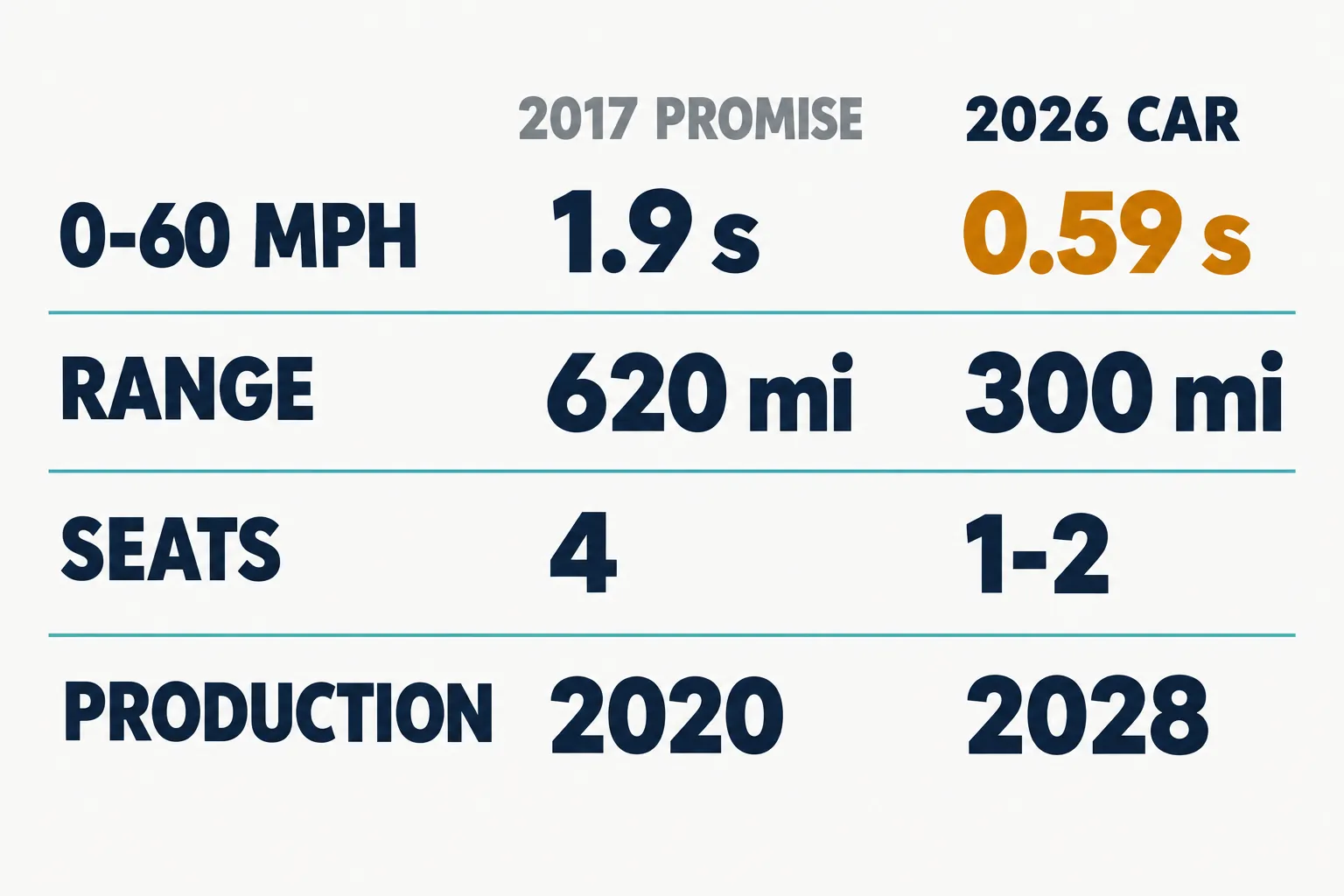
§ 109. Nine years of promises
| Item | November 2017 | October 2026 |
|---|---|---|
| 0-60 mph | 1.9 s | under 1.6, 0.9 or 0.59 s by trim |
| Range | 620 miles | about 300 miles |
| Top speed | over 250 mph | over 230 mph |
| Seats | 2+2 | 2, 2 or 1 by trim |
| Price | $200,000 base, $250,000 Founders | not announced; $50,000 or $250,000 to reserve |
| Production | 2020 | 2028 |
| When | What was said |
|---|---|
| November 16, 2017 | Roadster revealed at the Semi event; production in 2020 |
| June 9, 2018 | Musk: a SpaceX option package with about 10 small thrusters |
| September 1, 2021 | Musk: “new Roadster should ship in 2023”, if 2022 is calm |
| May 16, 2023 | Musk: production hopefully in 2024, “not a commitment” |
| February 28, 2024 | Musk: under one second to 60 mph, shipping next year |
| November 6, 2025 | The reveal moved to April 1, 2026 |
| September 28, 2026 | An October 1 event postponed to October 15 for weather |
| October 15, 2026 | Revealed near Waco; production in 2028 |
The new car gave up range and seats for force. The 2017 car was a very fast electric grand tourer. This one is an air-powered force machine with a battery attached.
§ 1110. What a rival would have to solve
Ranked from hardest to easiest, by our reading of the physics above:
- Carrying 250 kg of air at 380 bar in a road car and certifying it. Crash, fire and fatigue cases for a pressure vessel holding tens of megajoules, packed into every void of a sports car.
- Thrusters that work at sea level. Flows above 100 kg per second through small, fast electric valves, with parts dropping far below freezing during a firing and no moisture allowed in the air.
- Sealing the floor on a real road. A few millimeters of gap is the difference between 60 kW and 200 kW of fan power.
- Flight control. Sensors and software that pulse ten thrusters many times a second to hold attitude through a roll and land level.
- Refilling. 60 to 75 kWh of electricity per full fill, and a compressor somewhere that can deliver it.
- The law. Supersonic air jets pointed at the car behind, the noise, and a Rocket trim Tesla itself marks “Not approved for public road use.”
The fans are the most copyable part: McMurtry already sells a fan car. The thrusters are the moat, because the hard part is the tank and the valves, not the idea.
§ 12What Tesla has not said
- The car’s weight, by trim.
- Battery size, motor count and power.
- Fan count, fan power and whether skirts deploy.
- How the tank refills, how long it takes, and how many launches a fill gives.
- Flight time and any limits on where the thrusters may be used.
- Whether the Thrust trim can be driven on public roads with the thrusters armed.
- The price.
We will add each one here as Tesla publishes it.
§ 13Sources
- Tesla, Roadster page, read October 16, 2026.
- Tesla on X, October 16, 2026 UTC: design, Track Mode, the last best driver’s car, the thread on tire grip, thrusters and COPVs, livestream replay.
- TechCrunch, Tesla reveals SpaceX-powered Roadster that flies and falls with style, October 15, 2026.
- Electrek, Tesla unveils new Roadster, October 15, 2026 (trim acceleration claims).
- Paul Tan, Tesla Roadster revealed, October 16, 2026 (two COPVs, 250 kg, 5,500 psi screen reading, over 80 kN, 1.26 g, Mach diamonds).
- Drive Tesla Canada, Roadster’s fan suction system, October 16, 2026.
- Reuters via The Spokesman-Review, Tesla unveils next generation Roadster, October 15, 2026.
- McMurtry, Spéirling PURE production specification and upside-down driving.
- Road & Track, Chaparral 2J history; The Race, Brabham BT46B.
- TU Delft, Cold gas microthruster (air 74 s vacuum specific impulse); NASA, Small Spacecraft State of the Art: in-space propulsion.
- SpaceX, AMOS-6 investigation updates.
- NASA, Acceleration technical brief; Saturn V flight evaluation; Mercedes-AMG F1, brake systems explained; Competition Plus, Top Fuel dragster.
- Rimac, Nevera performance records; Xiaomi, SU7 Ultra.
- Air compressibility at 300 and 500 bar: NIST-derived table.
- Timeline: TechCrunch 2017, Musk 2018, Reuters 2021, TechCrunch 2023, Reuters 2024, Electrek 2026.
Every figure marked as CellCog math or estimate is ours, computed from the stated inputs; scripts and assumptions are in the tables. Images are made by CellCog’s image agent, running GPT Image 2.5; the animated diagrams are drawn as code.
Q1How do the Tesla Roadster's thrusters work?
They are cold-gas thrusters. Air stored in carbon-overwrapped tanks at about 5,500 psi flows through fast electric valves into nozzles that narrow and then flare. The flow passes the speed of sound at the throat and leaves supersonic, and the reaction pushes the car the other way. Nothing burns. Tesla says 10 thrusters share 600 liters of air and make over 80 kN.
Q2How can a car drive upside down?
Fans pump air out of the space between a sealed floor and the surface. The normal air pressure on the other side of the car then presses it against the surface harder than gravity pulls it away. Tesla showed a 4,700 kg downforce readout with the car inverted; by our math that needs the pressure under the floor to be only about 10 to 13 percent lower than outside.
Q3How long can the Tesla Roadster fly?
Tesla has not said. Our estimate: at about 2,350 kg the car needs 23 kN to hover, which burns about 33 kg of air per second, and the thrusters can only beat its weight until the tank pressure falls by roughly two thirds. That gives an upper bound of about four to five seconds per fill.
Q4Is 0-60 mph in 0.59 seconds physically possible?
Yes, with thrust. It needs 4.64 g on average. Tires alone manage about 1.26 g, so the rest must come from pushing on the air. With 80 kN of thrust the numbers work if the car weighs about 2,350 kg or less; at that weight tires plus thrust give 4.73 g.
Q5How does the Roadster refill its air tank?
Tesla says the tank can be recharged and Musk said the car will ‘puff itself up’, but Tesla gave no method or time. Compressing 600 liters to 5,500 psi takes about 37 kWh in theory and roughly 58 to 75 kWh with a real compressor, which is hours with a small onboard unit.