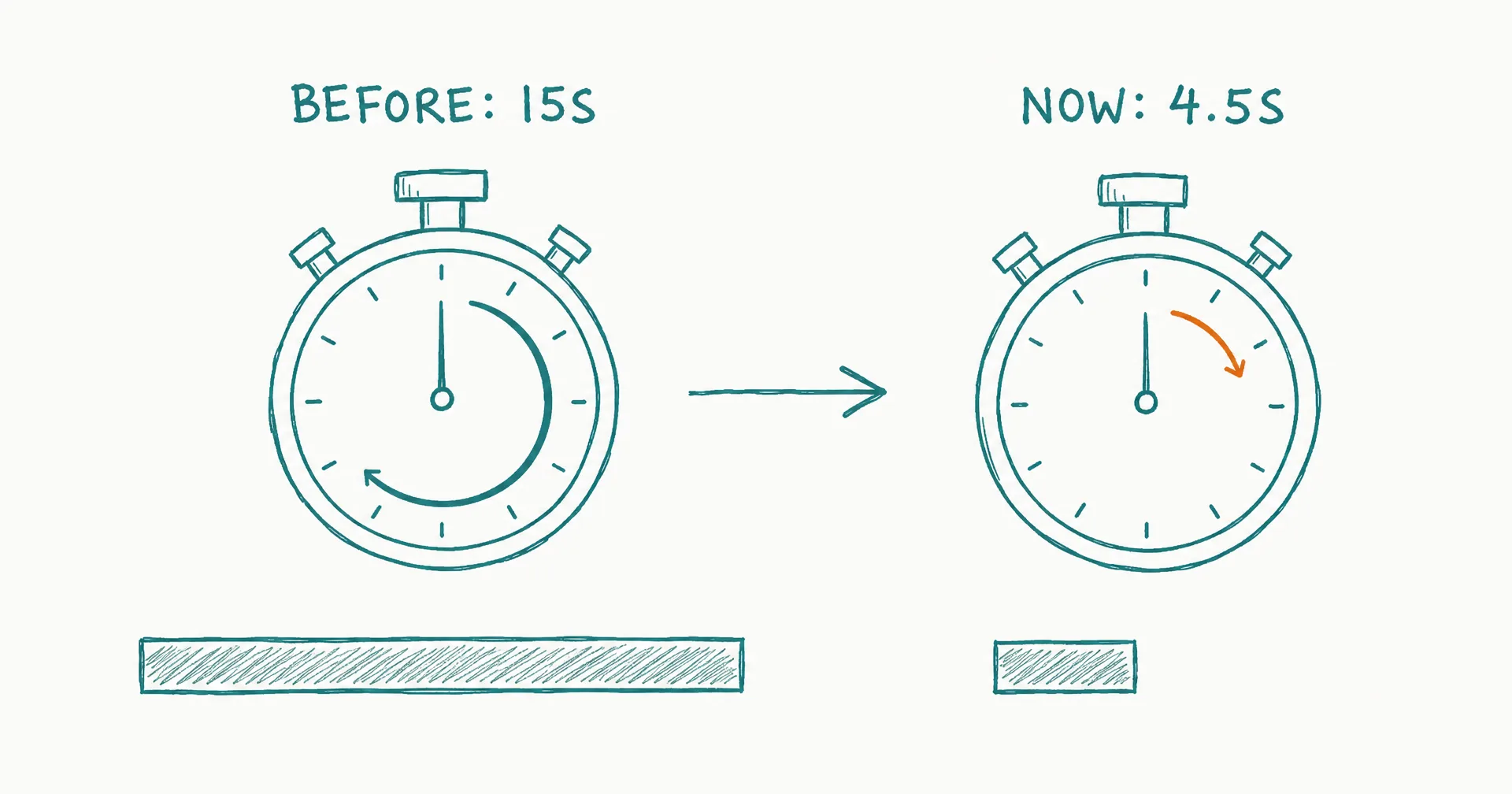
We’ve dramatically reduced CellCog’s agent startup time from 15 seconds to 4.5 seconds - a 70% improvement that changes how you can use AI agents.
- CellCog’s agent startup time dropped from 15 seconds to 4.5 seconds - a 70% improvement, shipped January 14, 2026.
- That put CellCog at 4.5s next to Manus at 4.2s and ahead of Genspark at 6.0s, measured at the time.
- The notable part: CellCog runs one of the most complex agent ecosystems in the industry, yet now matches the fastest platforms for simple queries.
- Fast startup changes usage: quick tasks that used to go to a plain chatbot can now go to a full agent.
- Post-processing also got 90% faster: credit tracking, icon generation, and cleanup now run asynchronously.
- The bet, stated openly: LLM-only chats will disappear when full agents respond just as fast.
§ 01How We Compare
| Platform | Time to first token |
|---|---|
| Manus | 4.2 seconds |
| CellCog | 4.5 seconds |
| Genspark | 6.0 seconds |
What makes this remarkable? CellCog has one of the most complex agent ecosystems in the industry - tools, protocols, multi-agent coordination, every modality. Despite that complexity, we now match the fastest platforms for simple queries.
§ 02Why It Matters
AI agents have traditionally been “too slow” for quick tasks. Need to edit an email? Check a date? Get a quick summary? You’d open a plain chatbot instead - and lose the agent’s abilities the moment the task turned out to be bigger than it looked.
At 4.5 seconds, that trade disappears. CellCog agents can replace your LLM chat for everyday tasks - while still having the full power of a super-agent when you need it. The quick email edit and the deep research report now live in the same window.
We believe LLM-only chats will disappear. Why use a limited chatbot when a full agent responds just as fast? CellCog is ready for that future.
§ 03Post-Processing: 90% Faster
We also optimized what happens after responses - credit tracking, icon generation, and cleanup now run asynchronously. Your next message starts processing immediately instead of waiting for the bookkeeping.
§ 04The Honest Caveats
The comparison numbers are a January 2026 snapshot - every platform in that table keeps improving, so the ranking carries its date. Startup speed is for the first response; deep work still takes the time deep work takes. And 4.5 seconds is the simple-query path - a task that immediately fans out into heavy tool use will spend its time on the work, as it should.
Q1What is time to first token?
The delay between sending your message and the agent’s response beginning. It’s the metric that determines whether an agent feels like a conversation or a queue.
Q2Why were agents slow to start?
Agent platforms load tools, protocols, and context before responding - a heavier lift than a plain LLM chat answering from nothing. CellCog runs one of the most complex agent ecosystems in the industry, which made the old 15 seconds understandable and the new 4.5 notable.
Q3What does this change in practice?
The quick tasks - edit an email, check a date, summarize a paragraph - used to be chatbot territory because agents felt too slow. At 4.5 seconds, the full agent handles those AND scales up when the task turns out to be bigger.
Q4What's the 90% post-processing improvement?
Everything that happens after a response - credit tracking, icon generation, cleanup - now runs asynchronously, so your next message starts processing immediately instead of waiting.
Q5Are these numbers still current?
They were measured in January 2026 and platforms keep improving - treat the comparison as a snapshot with its date, not a permanent ranking.