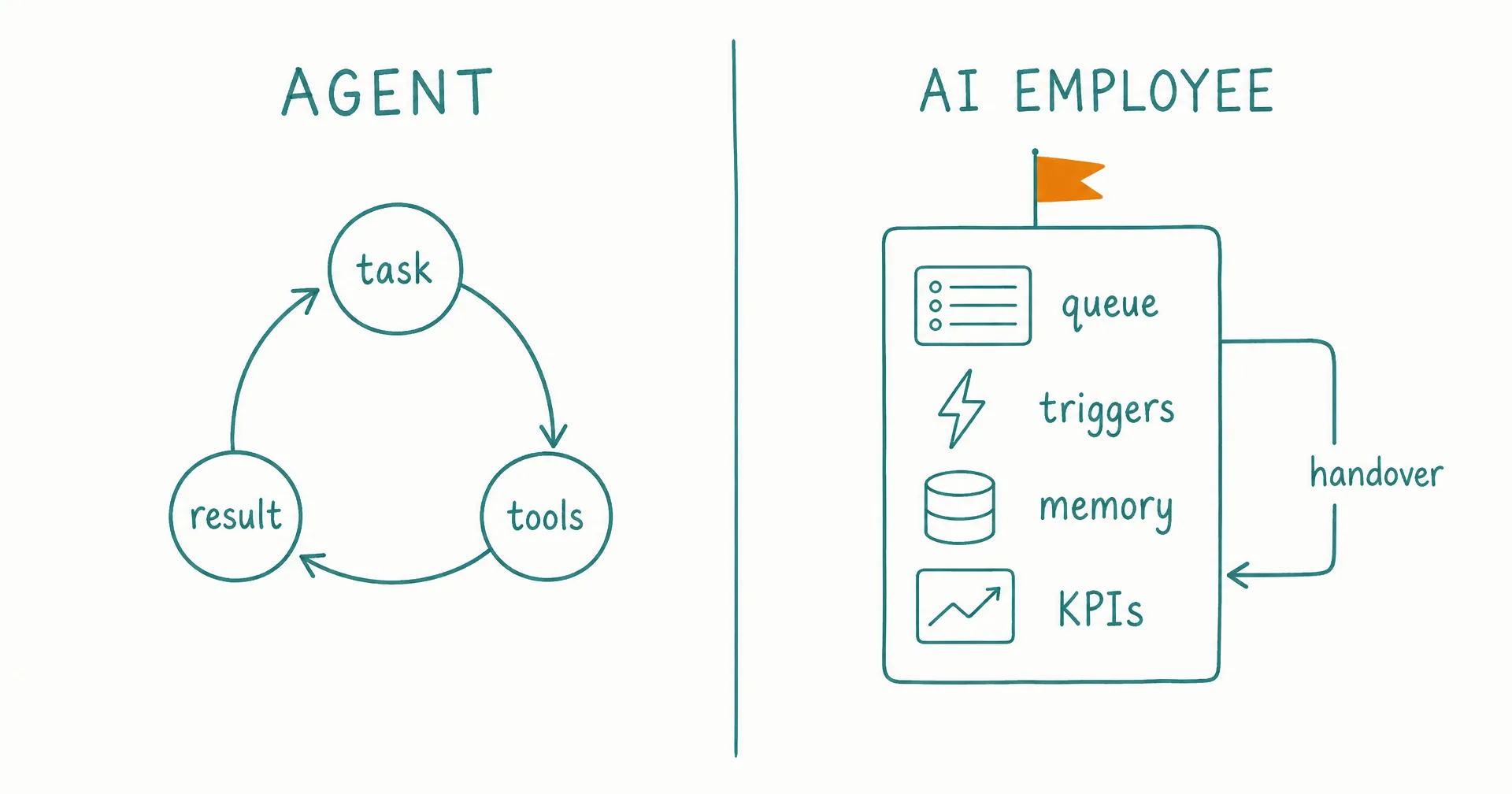
An AI agent is a software system that can pursue a goal, choose steps, and use tools. An AI employee is an operating structure that assigns that agentic capability an ongoing role, recurring work, approved context, defined authority, and an accountability loop.
The shortest useful distinction is capability versus responsibility. An agent can complete a task. An AI employee is expected to keep owning a bounded outcome across tasks, triggers, and work sessions.
That does not make every AI employee more capable than every AI agent. “AI employee” is an emerging vendor category, not a technical standard or legal employment status. A sophisticated agent may outperform a badly configured AI employee, and a one-off agent may be the simpler, safer choice when the work does not recur.
Use this comparison to decide which operating pattern you need - not which label sounds more advanced.
On this page · 15 sectionsOpen
- AI Agent vs AI Employee at a Glance
- What Is an AI Agent?
- What Is an AI Employee?
- Is Every AI Employee an AI Agent?
- What Are the 10 Practical Differences Between an AI Agent and an AI Employee?
- How Does an Agent Become an AI Employee?
- When Should You Use an AI Agent Instead of an AI Employee?
- When Should You Use an AI Employee Instead of a Standalone Agent?
- Why the Best Production Design Is Usually Hybrid
- How Do Permissions, Approvals, and Accountability Change?
- How Should You Compare AI-Agent and AI-Employee Platforms?
- Where Does CellCog Fit in This Comparison?
- What Is a Safe 4-Stage Adoption Path?
- What Usually Breaks After You Add the Employee Layer?
- What Is the Final Decision Rule?
- An AI agent is primarily an execution capability: it interprets a goal, plans, calls tools, observes results, and continues until it reaches a stop condition.
- An AI employee is primarily an accountable role: it wraps one or more agents in a job scope, recurring triggers, persistent context, permissions, tasks, metrics, approvals, escalation, and handovers.
- Choose an agent for a bounded, irregular, or exploratory task. Choose an AI employee when the same responsibility returns every day, week, message, queue event, or business cycle.
- The employee layer does not remove human ownership. It moves human work toward role design, access policy, approval rules, exception handling, quality sampling, and performance review.
- Deterministic workflow automation still wins for stable rules. The strongest production design often combines fixed controls, agentic judgment, and human approval.
- CellCog AI Employees implement the employee pattern with roles, goals, KPIs, inboxes, shifts, wake conditions, memory, task boards, approvals, and handovers around a general-purpose super-agent.
§ 01AI Agent vs AI Employee at a Glance
| Decision dimension | AI agent | AI employee | Buyer implication |
|---|---|---|---|
| Primary unit | Task or goal | Ongoing role or outcome | Decide whether the work ends with one run or persists across runs |
| Typical start | User request, API call, or system event | Assignment, schedule, inbox event, queue, KPI condition, or another worker | Recurring work needs trigger policy, not only a prompt |
| Planning | Chooses steps inside a run | Chooses steps across a role’s current priorities | Employee design adds prioritization between competing tasks |
| Context | Run, session, or application state | Approved role, business, and open-work context across shifts | Persistent context needs freshness and deletion controls |
| Tool access | Tools available to the agent | Tools scoped to the role and its authority | Access should follow least privilege in both cases |
| Success test | Task completion or evaluator result | Accepted outcomes, cycle time, quality, cost, exceptions, and KPI movement | Role performance cannot be measured by prompt count |
| Human involvement | Initiates, reviews, or handles exceptions | Sets policy and reviews outcomes, approvals, and exceptions | Oversight changes position; it does not disappear |
| Handover | Optional run result | Required when work remains open or changes owner | Continuity depends on durable next-step state |
| Best fit | One-off or irregular ambiguous work | Recurring digital responsibility with observable outputs | Recurrence and accountability are stronger signals than task complexity |
| Main risk | A bad run or over-broad action | Repeated error, stale memory, excess authority, or silent drift | Persistent systems require stronger operating controls |
The dividing line is not whether the software uses a large language model, calls an API, or acts autonomously. Both patterns can do all 3. The line is whether the business is buying a capable run or assigning a continuing responsibility.
§ 02What Is an AI Agent?
An AI agent is an application that can pursue a goal through a multi-step loop. It interprets instructions, decides what to do next, calls tools, observes the result, and either continues, asks for help, or stops.
OpenAI’s practical guide to building agents describes the basic agent foundation as a model, tools, and instructions. Its implementation guidance treats the agent loop as central: the system keeps acting until an exit condition is reached. The current OpenAI Agents SDK documentation similarly describes agents as applications that plan, call tools, collaborate across specialists, and retain enough state to complete multi-step work.
Anthropic’s engineering guide draws an important boundary between workflows and agents:
- A workflow follows predefined code paths that orchestrate models and tools.
- An agent dynamically directs its own process and tool use.
That distinction is about execution architecture. It says who chooses the next step: application code or the model-driven agent.
The agent’s core unit is a run
A typical agent run has 6 parts:
- Receive a task and current context.
- Form or update a plan.
- Select an approved tool.
- Act and observe the result.
- Evaluate whether the goal is complete.
- Stop, continue, or hand control to a person or another agent.
The run may last 30 seconds or several hours. It may create a research report, debug code, reconcile files, investigate an incident, or prepare a presentation. Duration does not make it an employee. What matters is whether that run belongs to a durable business role with a continuing queue and operating controls.
An agent can be general-purpose or specialized
“Agent” does not imply a narrow bot. A general-purpose agent may research, analyze, code, create documents, and operate software. A specialist may do only one job, such as qualifying a lead or triaging a ticket.
A separate comparison of general-purpose versus specialized agents weighs those shapes on task variance, context, tool choice, permissions, evaluation, coordination tax, and cost per accepted final outcome.
Google Cloud’s current AI-agent definition includes reasoning, planning, memory, goal pursuit, and task completion. That means memory and autonomy alone cannot distinguish an agent from an AI employee. The employee distinction comes from how those components are organized around a recurring role.
§ 03What Is an AI Employee?
An AI employee is one or more agents placed inside a continuing operating assignment. The assignment defines the role, goals, queue, triggers, memory scope, permissions, deliverables, metrics, approvals, escalation conditions, and human owner.
If you need the category definition before the comparison, the five-part test for an AI employee checks for role, continuity, initiative, agency, and accountability. Agentic execution is necessary for many AI employees, but it is not sufficient to create a standing, accountable role.
The employee’s core unit is a role
A usable role answers at least 10 questions:
- What recurring outcome does this worker own?
- Which tasks belong in scope?
- Which tasks are explicitly out of scope?
- What events or schedules start work?
- Which sources count as approved context?
- Which tools may the worker read?
- Which systems may it change?
- Which actions require approval?
- How is acceptable work measured?
- What happens when the worker is blocked, uncertain, or wrong?
A job-title prompt answers none of these by itself. “You are an operations manager” can change tone, but it does not create an operating role. The role becomes real only when the surrounding system supplies work, authority, evidence, and review.
“Employee” is an operating metaphor, not a legal claim
An AI employee is software. It is not a human employee, legal person, licensed professional, or independent bearer of responsibility.
The accountable person or organization still decides what the system may do and remains responsible for monitoring actions taken on its behalf. That boundary matters most in hiring, legal, medical, financial, security, and other high-impact work where AI output requires qualified human review.
§ 04Is Every AI Employee an AI Agent?
Most credible AI-employee products use agentic capability, but the labels are not governed by one standard. Some vendors may apply “AI employee” to a chatbot, a prompt template, a fixed workflow, or a narrow automation.
Evaluate observable behavior instead of assuming equivalence.
| Claim on the page | Evidence to request | What the evidence proves |
|---|---|---|
| “Owns a role” | Scope, goals, non-goals, current queue | The worker has a bounded responsibility |
| “Works autonomously” | Trigger log, tool trace, stop conditions | Work can begin and progress inside controls |
| “Remembers” | Memory sources, freshness, edit/delete behavior | Continuity is durable and governable |
| “Takes action” | Connected systems, read/write scope, approval record | Agency reaches real tools without unlimited authority |
| “Improves outcomes” | Accepted-output rate, correction time, cycle time, cost per outcome | Performance is measured beyond activity |
| “Works with a team” | Delegation object, task ownership, handover record | Work can move without losing context or responsibility |
If the vendor can demonstrate only a goal-directed run, it may still offer a good agent. If it can also demonstrate durable role ownership, it supports the employee operating model.
The reverse also matters. A fixed nightly report automation may have a recurring schedule, a named owner, and a dashboard, yet use no agentic planning at all. It behaves like an operational worker in the organizational sense, but its execution engine is deterministic automation. Labels overlap because the market combines technical architecture and organizational metaphor in the same phrase.
§ 05What Are the 10 Practical Differences Between an AI Agent and an AI Employee?
The strongest comparison uses operating evidence. These 10 dimensions reveal whether you need a task runner or a standing digital role.
1. Task ownership versus role ownership
An agent usually receives a goal for a run: analyze this dataset, research this market, or update this application. The business judges whether the requested result arrived.
An AI employee receives a responsibility: maintain the weekly competitive briefing, keep the support knowledge base current, or own first-pass pipeline research. Individual tasks enter and leave, but the role persists.
This changes scoping. A task prompt can optimize one output. A role needs non-goals, service boundaries, prioritization rules, and an accountable human owner.
2. One run versus continuing work
An agent run has an entry point and an exit condition. It may save state, but the application can still treat each future run as a new assignment.
An AI employee must resume open work. It needs to know which task is waiting, what changed since the last shift, which promises were made, and what deserves attention next.
Continuity is not an infinite transcript. It is selected, source-linked state that remains useful across work sessions.
3. Prompt initiation versus operating triggers
A person often starts an agent with a prompt. An API or event can also start it, so trigger support is not unique to employees.
The employee difference is trigger governance across a role. A new email, Slack message, schedule, task assignment, queue event, or KPI condition may start a shift, but the system also needs duplicate suppression, priority rules, frequency limits, quiet periods, and stop conditions.
4. Run context versus role context
An agent needs enough context to complete its current goal. An employee needs approved context about the role, the business, prior decisions, open work, and current exceptions.
The employee’s memory therefore needs a governed operating lifecycle that defines what should persist, what should never be captured, and how records are scoped, corrected, and retired:
- source and provenance;
- role and account scope;
- freshness or expiry;
- conflict resolution;
- authorized visibility;
- correction;
- deletion; and
- a record of when memory affected action.
CellCog documents persistent role and organization context through its memory system and Context Trees. Whether you use CellCog or another platform, ask how stored context becomes evidence rather than silent lore.
5. Available tools versus delegated authority
An agent may have 20 tools. That says what it can technically attempt, not what the business has authorized it to do.
An employee needs job-shaped authority. A research worker may read public sources and write to a project folder but never send email. A support worker may read the customer record and draft a response but need approval for refunds. An operations worker may update low-risk fields but escalate any change above a policy threshold.
The distinction is not the number of integrations. It is the mapping from role to tool to action to approval.
6. Completion versus performance
An agent evaluator may grade whether a single output is correct, complete, grounded, or safe. That remains necessary inside an employee.
Role performance adds longitudinal measures:
- accepted-output rate;
- correction minutes per accepted output;
- cycle time;
- source-completeness rate;
- escalation precision;
- reopened-task rate;
- error severity;
- cost per accepted outcome; and
- KPI movement where causality can be stated carefully.
Tokens, prompts, and tasks started explain activity or cost. They do not prove that the role is working.
7. Result delivery versus handover
An agent can return a result and stop. An AI employee must preserve the state of unfinished work.
A useful handover identifies:
- what was completed;
- what remains open;
- which evidence supports the current conclusion;
- which external event is pending;
- which person or worker owns the next step;
- which risk or uncertainty remains; and
- when the work should wake again.
Without that structure, each shift pays a context-reconstruction tax and may repeat or contradict prior work.
8. Guardrails around a run versus governance around a role
Both agents and AI employees need input controls, output checks, tool constraints, and stop conditions. The employee layer adds recurring governance:
- who may change the role;
- who grants and revokes access;
- how policy changes reach future shifts;
- how quality is sampled;
- how incidents are recorded;
- when the role is paused; and
- when the organization redesigns or retires it.
NIST’s Generative AI Profile notes that generative-AI use may require different human-AI configurations, more review, tracking, documentation, and management oversight. A persistent worker increases the importance of those controls because one weak assumption can affect many future runs.
9. Single-agent orchestration versus organizational coordination
An agent may call specialist agents as tools or hand work to peers. Those are technical orchestration patterns.
An AI employee adds organizational semantics: which role accepted the task, which queue now owns it, what context traveled with it, what completion contract applies, and who resolves a dispute.
The difference resembles the gap between calling a function and delegating a responsibility. Both can move work, but only the second needs durable ownership and a return path.
A collaboration operating model turns that return path into task and artifact state, authority, acceptance, review, failure handling, evidence, and one owner of final closure.
10. Per-run economics versus role economics
An agent run can be evaluated on model, tool, compute, latency, and review cost. An employee must be evaluated over a recurring workload.
The total operating cost can include:
AI usage + platform fees + integration work + supervision + corrections + incidents + change management
Compare that total with the value of accepted outcomes, not with a human salary headline. An AI employee can be much cheaper than a full-time hire and still be a poor investment if outputs are not accepted or if oversight consumes the claimed savings.
For a reusable calculator, normalize the role with the AI employee total-cost framework, then divide the result by accepted - not merely completed - outcomes.
§ 06How Does an Agent Become an AI Employee?
The employee layer is a control system around agentic execution. It adds the organizational objects that a standalone run does not necessarily provide.
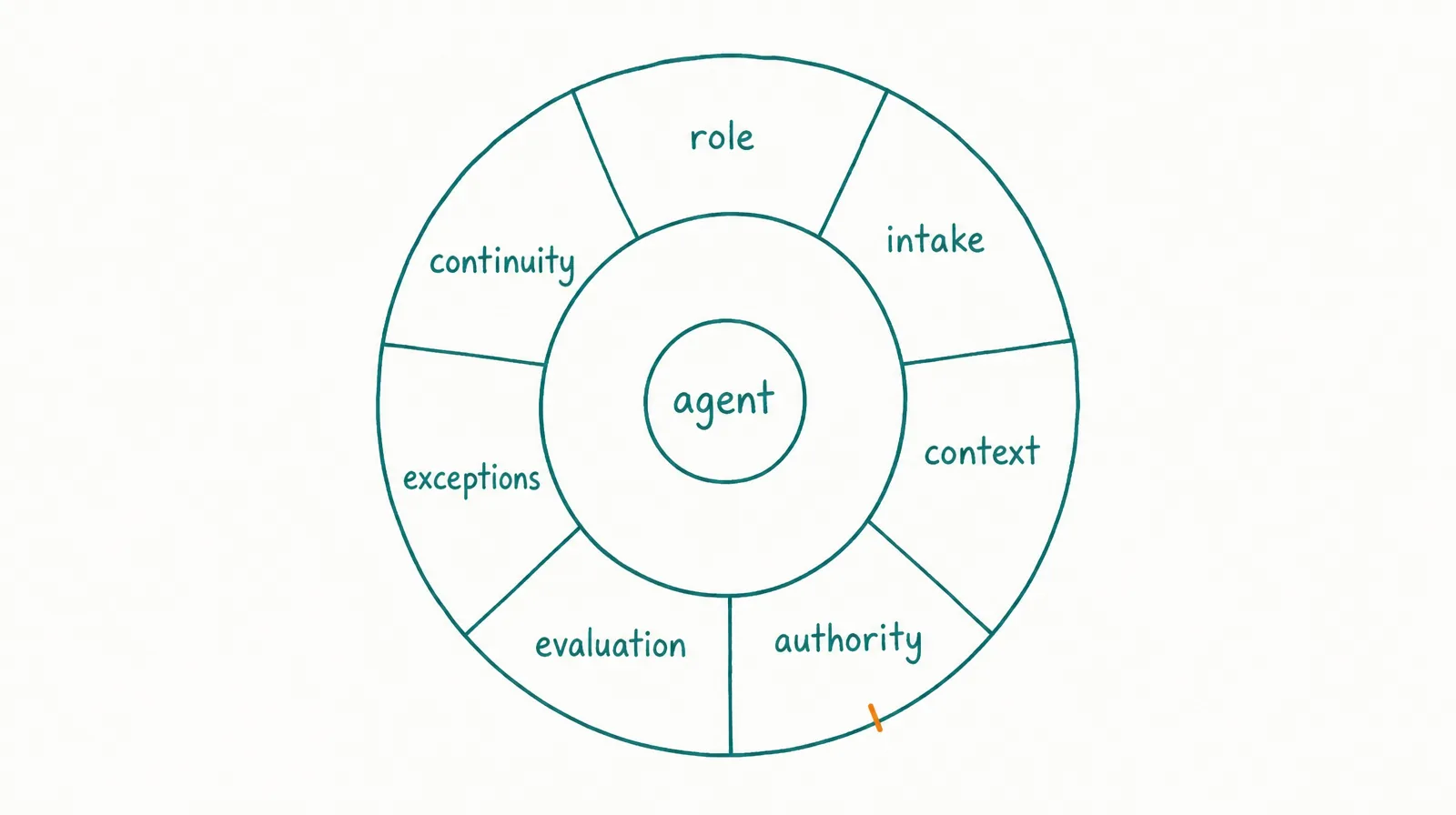
| Layer | Object | Purpose | Failure if missing |
|---|---|---|---|
| Assignment | Role, outcome, non-goals | Defines what the worker owns | Scope expands with every prompt |
| Work intake | Inbox, queue, task board, schedule, event trigger | Supplies and prioritizes work | Important work waits or duplicates |
| Context | Policies, source documents, open-task state, prior decisions | Preserves approved continuity | Each run restarts or uses stale assumptions |
| Execution | Model, tools, planner, runtime | Performs the actual task | The role cannot act |
| Authority | Read/write scope, approval gates, spend limits | Restricts action to delegated power | Convenience becomes uncontrolled access |
| Evaluation | Output tests, KPI definitions, quality samples | Measures accepted work | Activity is mistaken for performance |
| Exception handling | Escalation, pause, incident, rollback | Returns consequential judgment to people | Errors compound silently |
| Continuity | Handover, next owner, wake condition | Carries work across shifts | Open loops disappear |
The architecture can contain one agent or several. OpenAI’s guide describes both a manager pattern, where a central agent calls specialists as tools, and a decentralized pattern, where agents hand control to one another. Either can power an AI employee. The employment layer defines the role around that architecture.
A 7-step conversion example
Suppose you already use an agent to create a weekly competitor report.
- Current agent: a person asks for the report every Friday.
- Role: define “maintain a source-backed weekly competitor-change briefing.”
- Trigger: start Thursday at 6:00 p.m. and wake on material pricing-page changes.
- Context: provide the competitor list, comparison dimensions, prior briefings, approved sources, and customer segments.
- Authority: permit public-web research and project-folder writes; prohibit outbound publication.
- Evaluation: require citations, change evidence, decision implications, and editor acceptance.
- Handover: record monitored changes, unresolved claims, next review date, and editor feedback.
The underlying research agent may remain unchanged. The business value comes from converting an isolated capability into a dependable operating cadence.
§ 07When Should You Use an AI Agent Instead of an AI Employee?
Choose an agent when the work is bounded and the business does not need a standing role.
| Situation | Why an agent is the better fit | Control to add |
|---|---|---|
| One-off market analysis | The task ends with one decision artifact | Source requirements and human review |
| Irregular code migration | The goal is complex but not continuously owned | Repository scope, tests, and rollback |
| Exploratory data analysis | The path is unknown and a person remains the active investigator | Read-only data access and result validation |
| High-variance creative project | A human will direct each iteration | Asset rights, brand constraints, and approval |
| Temporary incident investigation | The run ends when the incident is resolved | Logs, time-bounded credentials, and incident owner |
| Early capability test | The team has not proved repeatability or value | Sandbox, small sample, and acceptance rubric |
An employee wrapper creates overhead. You need role configuration, persistent context, trigger rules, access reviews, metrics, and operational ownership. If the task happens once per quarter with a different goal every time, that overhead may not earn its keep.
Use a capable on-demand system such as a general-purpose super-agent when you need deep, multi-step execution but do not need a continuing queue.
§ 08When Should You Use an AI Employee Instead of a Standalone Agent?
Choose the employee pattern when the same bounded responsibility returns and the result can be observed.
| Readiness signal | Practical test | Why it favors an AI employee |
|---|---|---|
| Recurrence | Work appears on a schedule or predictable event | Triggers can replace repeated prompting |
| Digital inputs | Required information is available through approved files, messages, databases, or web tools | The worker can receive context consistently |
| Digital outputs | The result is a report, draft, update, task, record, or escalation | Completion can be inspected |
| Stable scope | The role has clear non-goals | Permissions and evaluations can be bounded |
| Observable quality | A reviewer can define accepted versus rejected output | Performance can improve from evidence |
| Manageable exceptions | Uncertainty can be routed to a named person | Human judgment remains available |
| Repeatable context | Policies and source documents recur across runs | Persistent memory reduces reconstruction |
| Recoverable action | Mistakes can be reviewed, corrected, or rolled back | Autonomy can expand in stages |
Strong first tasks for an AI employee are rarely “run the entire department.” Better starting points include a Monday executive briefing, a maintained content-production queue, first-pass account research, or support-message triage with policy-bound draft responses.
CellCog publishes role-specific examples on its AI Employees hub, but the useful buying test is not whether the title matches your org chart. It is whether you can define one recurring outcome and the evidence required to accept it.
§ 09Why the Best Production Design Is Usually Hybrid
The agent-versus-employee question is not an either/or architecture decision. An AI employee commonly combines agents with deterministic workflow automation for stable rules and transactions.
| Work component | Best default | Example |
|---|---|---|
| Ambiguous interpretation | Agent | Understand a messy customer request |
| Open-ended research | Agent | Find and reconcile relevant evidence |
| Stable validation rule | Deterministic workflow | Check whether a required field is present |
| Policy threshold | Deterministic workflow | Route an amount above a configured limit for approval |
| Consequential judgment | Qualified human | Approve a legal position or employment decision |
| Recurring ownership | Employee operating layer | Keep the queue, schedule, KPIs, and handovers current |
This division keeps flexible reasoning where inputs vary and predictable code where the rule is stable. It also limits the number of decisions exposed to model variance.
Example: customer-support triage
A support AI employee could:
- Wake when a ticket arrives.
- Use an agent to interpret the request.
- Retrieve the current policy and customer record.
- Run deterministic eligibility checks.
- Draft a response.
- Send only low-risk answers inside delegated authority.
- Ask a person to approve refunds or exceptions.
- Update the ticket and write a handover.
The employee layer owns the queue and evidence. The agent handles ambiguous language. Code enforces stable policy. The human owns the consequential exception.
Example: project operations
A project AI employee could monitor due dates, meeting notes, task status, and risk registers. It may use an agent to infer emerging blockers, but a deterministic rule can flag every task overdue by more than the configured period.
The system should not silently rewrite scope, budget, or accountable ownership. It can prepare the decision and route it to the project owner.
§ 10How Do Permissions, Approvals, and Accountability Change?
The employee pattern increases the blast radius of weak access design because the system can act repeatedly. A one-time agent with temporary read access and a standing worker with recurring write access are different risk profiles.
Use 4 authority tiers:
| Tier | Authority | Example actions | Default review |
|---|---|---|---|
| 0. Observe | Read approved sources | Search documents, inspect dashboards | Source and access review |
| 1. Prepare | Create drafts or proposed changes | Draft email, prepare CRM update, generate report | Human accepts output |
| 2. Act within policy | Execute low-risk reversible actions | Send approved template, update non-critical field | Sample review plus exception alerts |
| 3. Escalate consequential action | Prepare but do not finalize high-impact decisions | Refund exception, contract change, hiring decision | Explicit qualified-human approval |
Start lower than the vendor maximum. Expand authority only after the role shows acceptable quality across representative cases.
CellCog’s public AI Employees guide describes goals, permissions, inboxes, task boards, memory, shifts, wake conditions, and handovers. Its product terms place responsibility for autonomous actions on the user. That combination is the right evaluation frame: available autonomy must be matched by organizational accountability.
Audit evidence to retain
For each meaningful run, a reviewer should be able to reconstruct:
- the trigger;
- the active role instructions;
- the context and source versions;
- the plan or task record;
- the tools called;
- the changes made;
- approvals and denials;
- output evaluation;
- escalation;
- final owner; and
- the next wake condition.
The exact log format varies by platform. The requirement does not: if the result matters, the evidence should survive the chat window.
§ 11How Should You Compare AI-Agent and AI-Employee Platforms?
Do not start with the demo’s smartest answer. Start with the operating model your team must sustain.
| Evaluation field | Question to ask | Evidence to inspect | Red flag |
|---|---|---|---|
| Goal fit | What class of task does the agent complete reliably? | Representative evaluation set | Only a polished showcase |
| Role definition | Can we set outcomes, non-goals, and ownership? | Role configuration | Job title with no scope |
| Triggering | What starts work, and how are duplicates controlled? | Trigger and run history | “Always on” with no suppression |
| Context | What persists, where did it come from, and can we correct it? | Memory controls and provenance | Invisible or undeletable memory |
| Tools | Which actions are read-only, writable, or approval-gated? | Permission matrix | Connector count without action scope |
| Evaluation | How do we measure accepted outcomes over time? | KPI and quality-review workflow | Tokens or tasks presented as value |
| Handover | How does unfinished work survive a shift or owner change? | Task state and handover artifact | New run reconstructs everything |
| Governance | Who can change instructions and access? | Admin roles and change history | Shared unrestricted credentials |
| Recovery | Can we pause, revoke, correct, and roll back? | Incident workflow | No kill switch or owner |
| Economics | What is cost per accepted outcome at our workload? | Usage export and same-scenario model | Entry plan presented as role cost |
Run the same 20–50 representative cases through any shortlisted approach. This is an illustrative evaluation range, not an industry benchmark: the point is to include normal cases, edge cases, outdated context, missing data, tool failure, policy exceptions, and deliberate stop conditions.
Measure at least:
- accepted without edits;
- accepted after correction;
- rejected;
- escalated correctly;
- escalated unnecessarily;
- cost;
- elapsed time;
- reviewer time; and
- severity of the worst failure.
Averages can hide the failure that matters most. Review the tail, not only the mean.
§ 12Where Does CellCog Fit in This Comparison?
CellCog exposes both sides of the distinction.
Its Super-Agent is the execution base: an on-demand system designed to plan, research, analyze, code, and create finished artifacts across documents, spreadsheets, presentations, images, video, audio, dashboards, apps, and other modalities.
Its AI Employee layer wraps that capability in operating structure:
- a named role;
- goals and KPIs;
- a dedicated inbox;
- scheduled shifts and wake conditions;
- persistent memory;
- a task board;
- permissions and approvals;
- handovers; and
- delegation between AI employees.
That architecture preserves the core distinction. The Super-Agent answers, “Can the system perform this complex task?” The employee layer answers, “Can the business assign this recurring responsibility and inspect how it is carried?”
First-party evidence, with the right caveat
As of July 18, 2026, CellCog’s public AI Organization showed one human founder and 8 AI Employees, including a Sales Lead managing 5 AI sales representatives. CellCog self-reported a 6x increase in outbound throughput and a 1.5% bounce rate after the team formed.
This is a company-authored operating story, not an audited customer benchmark. Its strongest evidentiary use is to show how CellCog represents roles, reporting lines, delegation, shared context, and manager-to-worker handovers - not to promise that another buyer will reproduce the same metrics.
What CellCog buyers should still verify
CellCog’s breadth does not eliminate buyer responsibility. Before granting access:
- test the chosen role on your own representative work;
- grant the minimum files, systems, and actions needed;
- define approval conditions explicitly;
- verify what memory persists and who can remove it;
- inspect how a failed task becomes visible;
- calculate role cost under your actual shift and workload assumptions; and
- require qualified human review for high-impact outputs.
Its connector documentation explains how outside systems can be connected, while the privacy policy and product terms should be reviewed for current data-handling and responsibility details. Connector breadth is not a substitute for a permission design.
§ 13What Is a Safe 4-Stage Adoption Path?
Move from capability to responsibility in stages. Do not begin by granting the full authority implied by a human job title.
| Stage | System behavior | Human role | Promotion gate |
|---|---|---|---|
| 1. Shadow | Agent performs representative work without changing live systems | Compare output with current process | Quality rubric and failure inventory are credible |
| 2. Prepare | Worker drafts outputs and proposed actions in a queue | Approve or reject each meaningful result | Accepted-output rate and correction burden are viable |
| 3. Bounded action | Worker executes reversible actions inside explicit policy | Review samples and handle exceptions | Logs, alerts, and recovery work under stress |
| 4. Standing role | Worker owns the recurring queue across shifts | Set policy, review KPIs, and audit outcomes | Benefits exceed full operating cost and residual risk |
The gate between stages should use evidence from your workload. Do not promote the role because a fixed number of days passed.
Define the first role narrowly
Use an outcome-first hiring process to write a 1-page role charter:
- Outcome: one recurring result.
- Inputs: approved sources and systems.
- Outputs: inspectable artifacts or actions.
- Non-goals: work the role must refuse.
- Authority: read, prepare, act, and approval boundaries.
- Quality: acceptance rubric.
- Escalation: uncertainty and high-impact conditions.
- Owner: one human accountable for policy and review.
- Cadence: trigger, shift, sampling, and performance review.
- Exit: conditions for pause, redesign, or retirement.
Then configure the platform. Starting with the platform’s maximum capability and inventing a role afterward reverses the logic.
Price the role, not the plan badge
CellCog uses a credit model. As of July 19, 2026, its public pricing page stated that more complex work consumes more credits. It also stated that additional credits could be purchased at 90 credits per $1 and that subscription credits remained valid for 60 days after the billing period.
Do not use the entry-plan price as the cost of a full-time role. Model:
expected shifts x expected work per shift + top-ups + review labor + integration and incident cost
Credit consumption varies with task complexity, mode, tools, and output. Run the actual role before setting a budget or ROI claim.
§ 14What Usually Breaks After You Add the Employee Layer?
Persistence magnifies both value and error. The most common failures are operational, not theatrical “rogue AI” scenarios.
| Failure mode | What happens | Early warning | Control |
|---|---|---|---|
| Vague role | The worker pursues whatever sounds useful | Growing queue with inconsistent outputs | One outcome, explicit non-goals |
| Stale memory | Old facts guide new actions | Contradictions or outdated references | Provenance, freshness, correction, expiry |
| Excess authority | Convenience grants unnecessary write access | Actions outside the acceptance rubric | Least privilege and approval tiers |
| Trigger storm | Duplicate events start repeated work | Cost spike or repeated messages | Deduplication, rate limit, quiet period |
| Silent quality drift | Outputs remain fluent but less useful | Rising correction time | Sampling and stable evaluation set |
| Handover loss | Open work disappears between shifts | Repeated research and broken promises | Structured task state and next owner |
| Bad KPI | The worker optimizes activity instead of outcome | More volume with worse acceptance | Outcome and quality metrics |
| Human ambiguity | Nobody owns exceptions | Long waiting queue | Named supervisor and response expectation |
| Tool failure | Partial action leaves systems inconsistent | Task marked done despite failed write | Transaction checks, reconciliation, retry policy |
| Scope creep | Adjacent tasks become permanent duties | Permission and context sprawl | Change review for role expansion |
These problems can affect any long-running agent, whether the vendor calls it an employee, assistant, or automation. When the decision is specifically user-led help versus standing follow-through, use the AI assistant vs AI employee operating test. The employee framing is valuable only if it makes the organization more explicit about ownership and control.
§ 15What Is the Final Decision Rule?
Use an AI agent when you need a capable run. Use an AI employee when you need a recurring responsibility.
Choose a standalone agent if:
- the goal is irregular or temporary;
- a person will initiate and steer the work;
- persistent role context creates more burden than value;
- the result ends the assignment; or
- the team is still testing whether the capability works.
Choose an AI employee if:
- one bounded outcome returns repeatedly;
- work starts from a schedule, message, queue, or event;
- approved context must survive across work sessions;
- the system needs role-shaped access to real tools;
- output quality and exceptions are measurable;
- unfinished work needs a handover; and
- one human owner can govern the role.
Keep deterministic automation for stable rules, and keep consequential judgment with qualified people. The winning architecture is usually not the most autonomous one. It is the simplest combination that can finish the work, expose the evidence, and fail safely.
Q1Is an AI employee just an AI agent with a job title?
No - not if the term is used meaningfully. A job title changes the prompt. An employee operating layer adds a recurring outcome, work intake, persistent context, scoped permissions, metrics, approvals, escalation, and handovers. Without those objects, the product may still be a useful agent, but the title does not create durable responsibility.
Q2Can one AI employee contain multiple AI agents?
Yes. One role can use a manager agent that calls specialists as tools, or it can hand tasks to peer agents. The employee remains the business-facing unit of ownership while several agents perform parts of the work.
Q3Can an AI agent work on a schedule without becoming an AI employee?
Yes. Scheduled initiation is only one dimension. A scheduled agent may still execute an isolated task with no persistent role, queue, KPI, approval model, or handover. Evaluate the full operating structure.
Q4Is an AI employee more autonomous than an AI agent?
Not necessarily. A standalone agent may receive broad autonomy for one task, while an AI employee may prepare work and stop for approval on every consequential action. The useful question is what authority each system has and how that authority is governed.
Q5Does an AI employee replace a human employee?
It can absorb part of a digital workload, but it does not become a legal employee or replace human accountability. People still define the role, grant access, review high-impact work, handle exceptions, manage risk, and decide whether the results are acceptable.
Q6What should I test first: the agent or the employee workflow?
Test the underlying agent on representative tasks first. Once it can produce acceptable work, add the employee layer in stages: role, trigger, context, permissions, evaluation, escalation, and handover. Automating an unproven capability only repeats its failures faster.