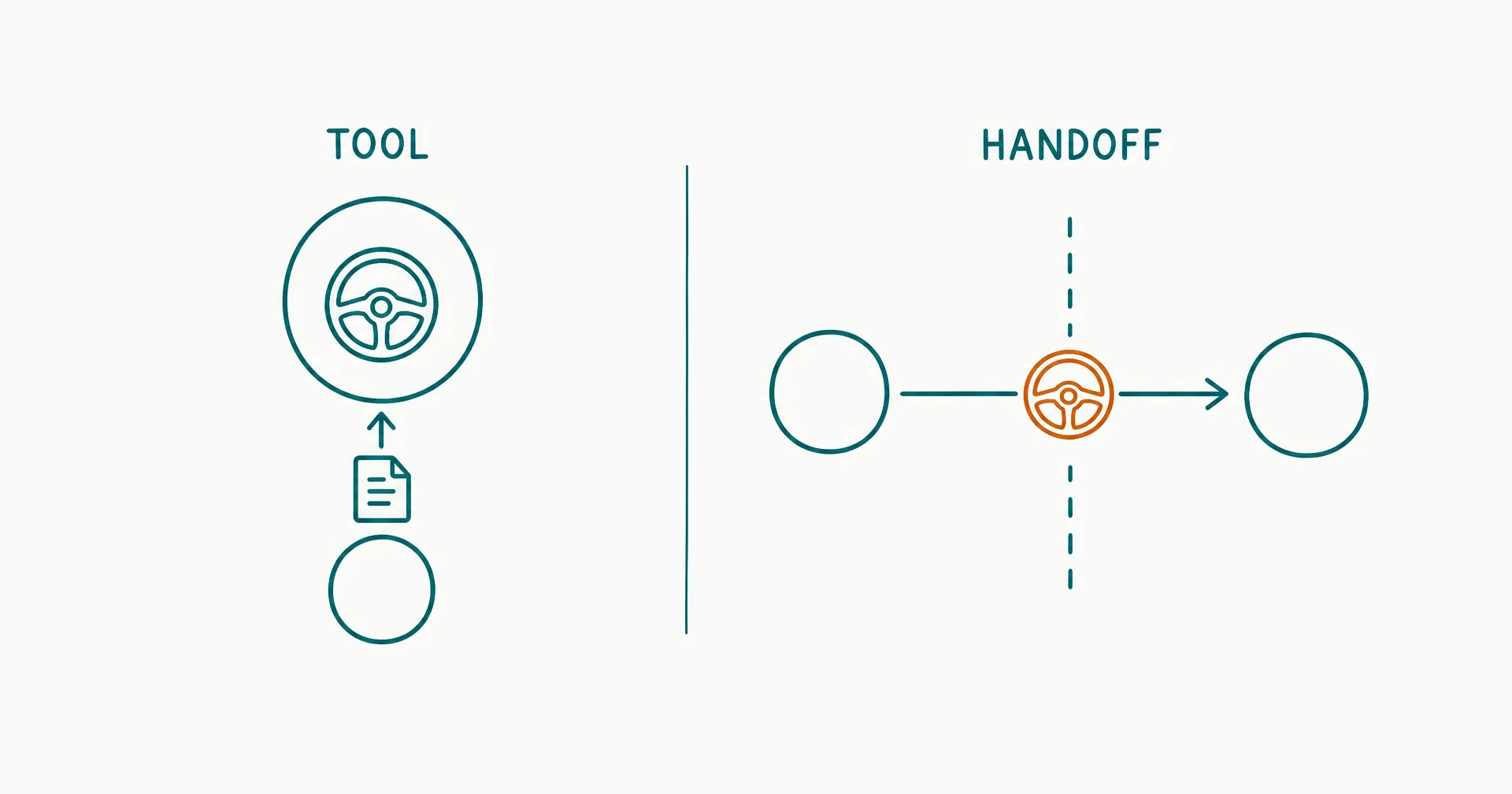
The difference between agent handoffs and agents as tools is not the number of agents involved. It is who controls the interaction and who owns the final result.
When an agent invokes another agent as a tool, the caller retains control. The specialist receives a bounded request, returns a contribution, and the caller decides how to use it. When an agent hands off, the receiving agent becomes the active owner for a defined part of the interaction.
That distinction sounds small until a failure occurs. Then the system must know who may ask the user a question, who can approve a result, whose authority applies, where recovery resumes, and who must close the outcome.
The broader model of agent-to-agent communication covers the messages, tasks, artifacts, and state that agents exchange. The architecture choice here is narrower: should a specialist contribute behind the current owner, or should ownership move?
On this page · 22 sectionsOpen
- Agent Handoffs vs Agents as Tools at a Glance
- What Does “Agent as a Tool” Mean?
- What Does an Agent Handoff Mean?
- Choose by Ownership Before Capability
- Compare the Context Each Pattern Receives
- Authority Must Be Recalculated
- Guardrails Follow Workflow Boundaries
- Model the State Explicitly
- Understand the Latency and Cost Shape
- Compare Failure and Recovery
- Use Agents as Tools for Bounded Capability
- Use Handoffs for Necessary Ownership Transfer
- Recognize When Either Choice Is Wrong
- Combine the Patterns in a Hybrid Design
- Walk Through a Support Example
- Keep Protocol Separate from Topology
- Build a Decision Matrix
- Evaluate Pattern Choice, Not Just Output Quality
- Roll Out in Increasing Risk
- Where CellCog Fits
- Use a Pre-Launch Checklist
- Default to Contribution; Transfer Only When Ownership Must Move
- Use an agent as a tool when one parent should own the user interaction, integrate several contributions, and return the final result.
- Use a handoff when the specialist must become the active owner, interact directly, apply a distinct operating policy, or continue the work across follow-up turns.
- Choose according to ownership, not capability. The same specialist can be invoked as a tool in one workflow and receive a handoff in another.
- A tool-style invocation should receive purpose-built input rather than an unfiltered transcript. Its output remains a contribution until the parent accepts it.
- A handoff needs explicit transfer, receiver acceptance, scoped authority, context rules, and a terminal or return path.
- Neither pattern should inherit the caller’s permissions automatically. The receiving agent acts under its own identity plus a task-specific grant.
- A useful default is agents as tools. Move control only when direct specialist ownership creates a measurable benefit.
§ 01Agent Handoffs vs Agents as Tools at a Glance
OpenAI’s current orchestration documentation describes the two patterns directly. In the agents-as-tools pattern, a manager keeps control of the conversation and combines specialist outputs. In a handoff, the selected specialist becomes the active agent for the rest of the turn. OpenAI also notes that the patterns can be combined.
| Decision dimension | Agent as a tool | Agent handoff |
|---|---|---|
| Active control | Caller retains it | Receiver acquires it |
| User-facing voice | Usually the caller | Usually the receiver |
| Final-result owner | Caller | Receiver for transferred scope |
| Specialist input | Purpose-built request | Selected history plus transfer data |
| Specialist output | Contribution returned to caller | Direct response, artifact, or terminal status |
| Clarification | Usually relayed by caller | Receiver can ask directly |
| Synthesis | Caller combines results | Receiver owns its scope; later return is optional |
| State transition | Child call opens and returns | Active owner changes after acceptance |
| Best fit | Bounded expertise | Sustained specialist ownership |
| Common failure | Lossy request or weak synthesis | Ambiguous ownership or broken return path |
The practical test is simple: if the original agent must still answer for the result, the specialist is functioning as a tool. If the receiver is expected to own the next interaction and its outcome, the system has performed a handoff.
§ 02What Does “Agent as a Tool” Mean?
An agent used as a tool is a specialist invoked within another agent’s workflow. The parent forms the request, supplies the allowed context, receives the result either synchronously or asynchronously, evaluates it, and continues as the active owner.
OpenAI’s as_tool() reference identifies two defining properties. The nested agent receives generated input rather than automatically receiving the conversation history, and the original agent continues the conversation after the nested run returns.
The specialist may still be sophisticated. It can use tools, maintain task-local state, request approval through an application-defined mechanism, or execute a multistep task. None of those capabilities changes the ownership relationship.
The parent owns the outcome
The specialist owns a contribution such as:
- a verified research memo;
- a classification with evidence;
- a reconciled data table;
- a policy check;
- a generated media asset;
- a risk assessment;
- or a structured recommendation.
The parent owns:
- whether the specialist should be called;
- whether the returned contribution is acceptable;
- how it combines with other evidence;
- what the user sees;
- and whether the parent task is complete.
That structure is the execution form of bounded agent task delegation: the child performs a defined contribution, while the parent keeps responsibility for the larger outcome.
A nested agent is not automatically a handoff
Teams sometimes label every call to another model or agent a handoff. That obscures the control boundary. If a parent calls a specialist, receives its output, and continues the interaction, the specialist functioned as a tool even if its internal implementation was fully agentic.
§ 03What Does an Agent Handoff Mean?
A handoff changes the active owner for a defined scope. The sender proposes or initiates the transfer, the receiver accepts it, and subsequent interaction is governed by the receiver’s role, instructions, state, and permitted actions.
OpenAI’s handoff documentation represents transfers as callable operations such as transfer_to_refund_agent. Its helper transfers control to the selected receiver, and the receiver ordinarily sees prior conversation history unless an input filter or history setting changes what is forwarded.
A robust handoff has more semantics than a routing label. It should identify:
- the scope moving to the receiver;
- why that receiver is eligible;
- which context is relevant;
- which authority is granted;
- what remains with the sender;
- whether the receiver may contact the user;
- how refusal or timeout is handled;
- and whether work terminates with the receiver or returns elsewhere.
The full AI agent handoff protocol specifies those transfer fields and lifecycle requirements. The narrower choice here is whether the workflow needs a change of owner at all.
Control transfer needs acceptance
A sender cannot create reliable ownership merely by emitting “assigned.” The receiver may be unavailable, ineligible, unable to access the required data, or unwilling to accept the risk class. Ownership should change only after a valid acceptance event.
Until then, the sender remains responsible for user continuity and recovery.
§ 04Choose by Ownership Before Capability
Asking “Which agent is best at the task?” is necessary but incomplete. The more important first question is “Who should own the interaction and final result?”
| Ownership question | If the answer is the parent | If the answer is the specialist |
|---|---|---|
| Who speaks to the user? | Tool | Handoff |
| Who resolves ambiguity? | Tool, with relayed questions | Handoff |
| Who integrates multiple outputs? | Tool | Handoff only if integration scope also moves |
| Who applies the final acceptance rule? | Tool | Handoff |
| Who owns follow-up turns? | Tool | Handoff |
| Who reports failure and recovery? | Tool | Handoff |
| Who is accountable for closure? | Tool | Handoff |
Treat each row as a control question rather than tallying the answers. A workflow with five parent answers and one specialist answer may still need a handoff if that one answer concerns sustained user interaction. Conversely, a highly capable specialist can remain a tool when the parent must reconcile its output with several other contributions.
Capability does not determine topology
The same tax specialist could be:
- a tool that returns a tax treatment to a finance manager;
- a handoff receiver that takes over a tax-support conversation;
- or both, depending on the task.
Architecture follows the required control relationship. It should not be permanently encoded in a specialist’s name.
§ 05Compare the Context Each Pattern Receives
Context behaves differently under the two patterns.
A tool-style specialist should receive a purpose-built task request. The parent selects relevant facts, supplies references, defines the expected output, and excludes unrelated conversation. The smaller boundary reduces data exposure and makes evaluation clearer, but it can fail if the parent omits a material fact.
A handoff receiver often needs enough prior interaction to continue without forcing the user to repeat everything. Forwarding the complete transcript may preserve continuity, but it can also expose irrelevant data, conflicting instructions, stale decisions, and malicious content.
| Context concern | Agent as a tool | Agent handoff |
|---|---|---|
| Default input shape | Bounded request | Filtered interaction history plus transfer data |
| Main advantage | Relevance and isolation | Continuity |
| Main risk | Parent omits a needed fact | Receiver gets excessive or unsafe history |
| User clarification | Relayed or returned as input_required | Asked directly by receiver |
| State scope | Child-task state | Transferred interaction state |
| Evidence references | Explicitly selected | Must be preserved across transfer |
| Sensitive data | Include only what the child needs | Recalculate need after owner change |
The right rule is neither “always send the transcript” nor “always summarize.” Send the minimum sufficient context for the receiver’s accepted scope, preserve authoritative references, and record what was excluded.
Do not confuse summary with source
A compact transfer summary helps the receiver orient itself. It should not replace source records for approvals, amounts, legal terms, account identifiers, or other facts that must be exact. Those values should travel as typed fields or references to authoritative state.
Treat transferred content as untrusted
User messages, retrieved documents, tool outputs, and prior agent text can carry malicious or irrelevant instructions. OWASP’s AI Agent Security Cheat Sheet recommends validating external inputs and inter-agent communications, separating trust boundaries, and preventing privilege escalation through agent chains.
§ 06Authority Must Be Recalculated
Control transfer and permission transfer are different operations.
The receiving agent should act under:
- its verified identity;
- its normal role and tenant boundary;
- a task-specific grant;
- current policy;
- exact approvals for high-impact actions;
- and workflow budgets.
It should not inherit every tool or credential held by the sender. The same rule applies to a nested specialist invoked as a tool.
| Authority control | Why it matters | Required behavior |
|---|---|---|
| Receiver identity | Establishes the actor | Authenticate independently |
| Task grant | Limits purpose and scope | Bind to task, resources, actions, and expiry |
| Tool eligibility | Prevents capability inflation | Expose only approved tools |
| Data scope | Protects tenant and privacy boundaries | Recheck before disclosure |
| Approval binding | Prevents broad consent reuse | Bind to exact action and parameters |
| Budget reservation | Prevents fan-out escape | Debit the parent allocation |
| Revocation | Stops stale authority | Check at action time |
OWASP recommends minimum tool privileges, resource-level scoping, separate tool sets for different trust levels, and explicit authorization for sensitive operations. These are useful invariants for both patterns.
A handoff is not an approval
“Transfer to payments” does not authorize a refund. The receiver may investigate and prepare a proposed action, while a policy service or human approval remains responsible for authorization.
A parent does not sanitize authority by relaying it
An unsafe action does not become safe because a manager asks a specialist to perform it. The action boundary must evaluate the initiating principal, active agent, affected resource, action parameters, and current approval.
§ 07Guardrails Follow Workflow Boundaries
Teams often assume every agent-level check automatically applies throughout a multi-agent run. In practice, a framework may apply a check only at specific points in that run.
OpenAI’s current guardrail documentation states that input guardrails apply to the first agent in a chain and output guardrails apply to the agent producing the final output. It recommends tool guardrails around custom function calls when checks are needed at each invocation. The same documentation notes two present SDK details: handoff calls use a separate pipeline from normal function tools, and Agent.as_tool() does not directly expose tool-guardrail options.
Those are implementation details of the current SDK, not universal properties of the two architecture patterns. The general requirement is broader: identify every trust and action boundary, then prove that a check runs at that exact boundary.
Build a boundary matrix
For each user input, transfer, specialist request, tool call, artifact return, and external action, record:
- the validator;
- the policy version;
- blocking versus nonblocking behavior;
- the failure state;
- and the recovery owner.
An agent prompt saying “be safe” is not a boundary control.
§ 08Model the State Explicitly
The two patterns need different state machines because they answer different ownership questions.
For a tool-style specialist call, an illustrative lifecycle is:
requested > accepted > executing > returned > evaluated > accepted | repair_required | failed | canceled
The parent remains active throughout. Child returned does not mean the parent is complete.
For a handoff, an illustrative lifecycle is:
proposed > accepted > active_owner_changed > executing > completed | returned | escalated | failed | canceled
The owner changes only at accepted. A return transition should name the next owner and the state it receives.
| Event | Tool-style call | Handoff |
|---|---|---|
| Request emitted | Parent creates child request | Sender proposes transfer |
| Receiver accepts | Child begins work | Ownership can change |
| Receiver refuses | Parent reroutes or handles locally | Sender remains owner |
| More input needed | Child returns structured request | Receiver asks directly or returns |
| Result created | Child returns contribution | Receiver delivers within its scope |
| Result rejected | Parent requests repair | Current owner repairs or escalates |
| Timeout | Parent cancels, retries, or reroutes | Recovery owner resumes |
| Closure | Parent closes parent task | Receiver closes transferred scope |
The state record should be durable and queryable. A chat message can explain an event, but it should not be the only evidence that ownership changed.
§ 09Understand the Latency and Cost Shape
Neither pattern is always faster.
For agents as tools, elapsed time is approximately:
parent setup + specialist execution + parent evaluation + parent synthesis
If several independent specialists run concurrently, wall-clock time can approach the slowest eligible child plus parent overhead. If the parent invokes them serially without a dependency, latency rises unnecessarily.
For a handoff, elapsed time is approximately:
transfer validation + receiver work + direct interaction + optional return
Direct clarification can remove relay delay. Yet transferring too much context, switching instructions, or handing back repeatedly can add more latency than one bounded call.
| Cost source | Tool | Handoff |
|---|---|---|
| Parent request construction | High | Medium |
| Context filtering | High | High |
| Specialist execution | Variable | Variable |
| Parent synthesis | Usually required | Optional |
| Direct clarification | Indirect | Direct |
| Transfer validation | Low | High |
| Return processing | Normal result path | Only if control returns |
| Ownership recovery | Parent already active | Requires explicit recovery |
Measure cost per accepted outcome, not cost per model call. Include repeated clarification, rejected results, duplicate work, context assembly, evaluation, user waiting time, and recovery.
§ 10Compare Failure and Recovery
The patterns concentrate failure in different places.
With agents as tools, the parent is the recovery anchor. It can retry a child, choose another specialist, reduce the task, ask the user for missing input, or continue with a partial result. The parent can still fail through weak decomposition, missing context, poor evaluation, or incorrect synthesis.
With handoffs, direct specialist ownership can reduce relay loss, but recovery becomes more demanding. The workflow must identify what happens when the receiver refuses, disappears, exceeds its deadline, needs unavailable authority, or cannot return control.
| Failure | Tool response | Handoff response |
|---|---|---|
| Receiver unavailable | Parent chooses another eligible specialist | Sender keeps ownership and reroutes |
| Input incomplete | Child returns typed missing fields | Receiver requests clarification or returns |
| Output invalid | Parent rejects and requests repair | Current owner repairs before closure |
| Permission denied | Parent narrows task or escalates | Receiver pauses; no permission inheritance |
| Deadline exceeded | Parent cancels or accepts partial evidence | Recovery owner resumes from durable state |
| Duplicate request | Reuse idempotent child result | Reconcile transfer ID and active owner |
| User cancels | Parent cancels descendants | Active owner stops work and propagates cancel |
| Receiver fails after acceptance | Parent may still be available | Supervisor or named fallback reclaims scope |
Every handoff needs a reclaim rule. Every tool-style call needs a child-result acceptance rule.
Prevent transfer loops
One agent should not hand to a second, the second to a third, and the third back to the first without a bounded loop policy. Cap transfer depth, repeated route pairs, elapsed time, spend, and unresolved clarification cycles. OWASP recommends circuit breakers to prevent cascading multi-agent failures.
§ 11Use Agents as Tools for Bounded Capability
Agents as tools are usually the better choice when:
- one agent must own the user experience;
- the task needs several independent expert contributions;
- the parent must compare or reconcile outputs;
- the expected result has a stable schema;
- the specialist does not need sustained direct interaction;
- the parent has enough domain ability to evaluate the contribution;
- or a single acceptance policy must govern the final result.
Typical examples include:
- retrieving and validating market evidence;
- classifying a support request;
- extracting obligations from a contract;
- reconciling a spreadsheet;
- generating one media asset;
- checking a policy condition;
- calculating a price;
- or reviewing a proposed response.
The manager-agent architecture provides the parent-side controls for worker selection, child state, budgets, review, repair, synthesis, and parent closure.
Prefer a typed contribution
Ask the specialist to return:
- status;
- artifact or answer;
- evidence references;
- confidence or uncertainty category;
- assumptions supplied by the request;
- unmet requirements;
- requested clarification;
- and machine-readable errors.
A fluent paragraph alone makes it harder to distinguish verified evidence from a plausible claim.
Keep the parent competent enough to evaluate
If the parent cannot detect a materially wrong specialist result, it should not silently synthesize that result. Add deterministic checks, a qualified evaluator, independent review, or transfer ownership to a role that can accept the risk.
§ 12Use Handoffs for Necessary Ownership Transfer
A handoff is usually justified when:
- the specialist must interact directly with the user;
- several follow-up turns are likely;
- the receiver’s role requires distinct instructions or disclosure;
- the receiver owns a separate service-level commitment;
- the task carries domain-specific approval or escalation duties;
- the parent would become a lossy relay;
- or the receiver must retain continuity until a defined terminal state.
Examples include:
- moving a support conversation from general triage to account security;
- transferring an incident to the active responder;
- moving a patient-intake conversation to a qualified clinical channel;
- escalating an employee case to a restricted HR workflow;
- or transferring a complex tax inquiry to a specialist who must ask direct questions.
Direct interaction must create value
Do not hand off merely because a specialist exists. Transfer when direct ownership reduces ambiguity, protects a trust boundary, satisfies accountability, or materially improves the user’s path to a valid outcome.
Name the scope that stays behind
A partial handoff may move “refund eligibility investigation” while the sender keeps “overall support case closure.” If so, the interaction needs two linked scopes and an explicit return. Otherwise both agents may believe the other owns the final response.
§ 13Recognize When Either Choice Is Wrong
Use neither pattern by habit.
A specialist should not be used as a tool when the parent:
- repeatedly paraphrases questions between user and specialist;
- lacks the competence to evaluate the result;
- strips material context;
- changes the specialist’s meaning during synthesis;
- or becomes a bottleneck for unrelated child work.
A handoff should not be used when:
- the work is one bounded calculation or lookup;
- the parent must integrate several results;
- the user would gain nothing from a new active agent;
- the receiver cannot actually own closure;
- authority cannot be scoped safely;
- or the system lacks acceptance and recovery semantics.
The AI agent orchestration pattern comparison helps when the real need is a deterministic sequence, parallel fan-out, peer collaboration, an evaluator loop, or a different topology.
§ 14Combine the Patterns in a Hybrid Design
A hybrid design often produces the clearest ownership model.
- A triage agent receives the user’s request.
- It hands off to the domain owner.
- The domain owner interacts directly with the user.
- The domain owner invokes research, calculation, retrieval, or media specialists as tools.
- The specialists return bounded contributions.
- The domain owner evaluates them and closes the transferred scope.
OpenAI explicitly supports combining the two patterns. Google’s current ADK collaboration modes add another distinction. A subagent can have full interaction with manual return, clarification-only interaction with automatic return, or no user interaction with automatic return. The important dimensions are control, user access, return behavior, and context isolation - not a single binary label.
| Hybrid role | Ownership | User access | Return behavior |
|---|---|---|---|
| Triage agent | Intake until transfer acceptance | Direct | Ends or supervises after transfer |
| Domain owner | Transferred case scope | Direct | Closes or explicitly returns |
| Research specialist | Research contribution only | None | Automatic result |
| Calculation specialist | Typed calculation only | None | Automatic result |
| Restricted reviewer | Approval recommendation only | Optional, policy-defined | Returns decision |
| Recovery supervisor | Failed or abandoned scope | Usually indirect | Reclaims and reroutes |
The hybrid works because each edge states whether it carries a contribution or ownership.
§ 15Walk Through a Support Example
Consider a customer asking:
“I was charged twice, and one charge appears on a card I no longer use. Can you reverse it?”
The first agent can classify the request and retrieve safe account metadata. The request involves billing evidence, account identity, a potentially consequential refund, and likely clarification.
Option A: billing specialist as a tool
The support owner sends the billing specialist a bounded request containing:
- verified account reference;
- the two transaction IDs;
- payment-status data;
- the requested comparison;
- permitted read-only sources;
- and an output schema for duplicate-charge findings.
The specialist returns evidence and a recommendation. The support owner asks the user any follow-up question, requests approval if needed, and returns the final answer.
That works when the support owner can evaluate the evidence and the specialist does not need a sustained direct exchange.
Option B: handoff to billing
The support owner proposes a transfer to billing with:
- accepted scope;
- relevant conversation history;
- verified identity state;
- unresolved questions;
- resource references;
- authority boundaries;
- deadline;
- and return or closure rules.
Billing accepts, becomes the active owner, asks the user directly about the old card, and carries the case until completion or escalation.
That works when billing must own the interaction or apply a distinct restricted workflow.
Option C: hybrid
The general support agent hands the case to billing. Billing then invokes transaction retrieval and duplicate-charge analysis as tool-style specialists. Billing remains the user-facing owner and cannot execute a refund until the exact action passes policy and approval.
The hybrid separates three concerns cleanly: case ownership, bounded analysis, and action authorization.
§ 16Keep Protocol Separate from Topology
A communication protocol can support both patterns.
The current A2A specification defines messages, tasks, status, history, artifacts, cancellation, streaming updates, and multi-turn interaction. A task can move through states such as submitted, working, completed, failed, canceled, input required, rejected, or authentication required.
Those protocol elements do not decide whether the caller remains the user-facing owner. A manager can send an A2A task to a specialist and keep ownership, or an application can use protocol messages as part of a larger control transfer.
Add ownership semantics above transport
At the workflow layer, record:
- active owner;
- parent outcome owner;
- transferred scope;
- contribution scope;
- transfer acceptance;
- return destination;
- authority grant;
- and closure rule.
Transport interoperability is useful. It does not remove the need for workflow semantics.
§ 17Build a Decision Matrix
Score each factor against the real workflow. Do not select a pattern from a product label.
| Factor | Prefer tool when | Prefer handoff when |
|---|---|---|
| Final synthesis | Parent must combine evidence | Specialist owns the complete scoped result |
| User continuity | One voice is valuable | Specialist continuity is more valuable |
| Clarification load | Questions are rare and structured | Questions are frequent or domain-specific |
| Context | Small request is sufficient | Prior interaction materially affects work |
| Expertise | Parent can evaluate specialist output | Specialist must apply final domain judgment |
| Authority | Parent owns action path | Receiver owns a distinct controlled path |
| Duration | One bounded run | Sustained or multi-turn work |
| Failure recovery | Parent can reroute easily | Receiver has domain-specific recovery |
| Parallelism | Several contributions can run together | One owner must coordinate the scope |
| Disclosure | Parent can explain result accurately | Receiver must disclose role or limitations |
If the matrix is mixed, use a hybrid or split the scope. For example, transfer the user-facing case to a domain owner, then keep evidence retrieval and calculation as tool calls.
§ 18Evaluate Pattern Choice, Not Just Output Quality
A valid final answer can hide a poor control design. Evaluation should test whether the workflow chose the correct ownership pattern and maintained its invariants.
Use a case set containing:
- bounded lookups;
- multi-source synthesis;
- ambiguous requests;
- sensitive data;
- direct specialist clarification;
- receiver refusal;
- receiver timeout;
- invalid artifacts;
- expired approval;
- user cancellation;
- duplicate delivery;
- and attempted transfer loops.
An illustrative 32-case set might contain four cases from each of eight risk and interaction categories. The number is an example, not a benchmark.
| Metric | What it measures | Failure signal |
|---|---|---|
| Pattern-choice accuracy | Correct tool, handoff, or hybrid choice | Unnecessary transfer or lossy relay |
| Ownership continuity | One known active owner at every state | Zero or multiple active owners |
| Context sufficiency | Receiver gets required facts | Repeated questions or incorrect assumptions |
| Context minimization | Irrelevant data stays out | Excessive transcript exposure |
| Authority containment | Actions stay within grant | Permission inheritance or scope escape |
| Result acceptance quality | Parent catches invalid contributions | Fluent errors pass synthesis |
| Handoff completion | Accepted transfers reach valid terminal state | Abandoned scope |
| Recovery success | Failures return to a valid owner | Stalled or looping work |
| Accepted-outcome latency | Time to valid completion | Fast calls with slow repair |
| Accepted-outcome cost | Total resources for valid completion | Cheap attempts with expensive recovery |
Pass criteria should be defined before testing. A team might require zero unauthorized actions and zero ambiguous active-owner states while using measured thresholds for latency, context defects, and recovery. Those thresholds must come from the organization’s risk tolerance and observed baseline.
§ 19Roll Out in Increasing Risk
Start with tasks that make ownership easy to inspect.
Stage 1: read-only tool calls
Use one parent and one bounded specialist. Require typed input, typed output, an acceptance rule, timeout, idempotency key, and child state.
Stage 2: several tool-style specialists
Add parallel calls and synthesis. Test conflicting evidence, partial failure, budget exhaustion, and result-order differences.
Stage 3: low-risk handoffs
Transfer informational conversations where the receiver can ask direct questions but cannot execute consequential actions. Test acceptance, refusal, return, timeout, and user cancellation.
Stage 4: hybrid workflows
Let the domain owner invoke bounded specialists. Verify that child failures do not erase the active owner and that specialist outputs cannot silently expand authority.
Stage 5: controlled actions
Add reversible or externally visible actions only after identity, policy, exact approvals, idempotency, reconciliation, and recovery are proven. High-impact actions need independent validation.
§ 20Where CellCog Fits
CellCog’s public Agent-to-Agent platform exposes research, media, document, app, and dashboard capabilities to other agents through one interface. The page says a calling agent delegates a task and receives a finished artifact.
That public interaction maps naturally to the agents-as-tools pattern when the caller retains the user relationship, evaluates the returned artifact, and owns the final result. A coding agent could request a research PDF, receive the artifact, verify that it meets the parent task, and continue.
The public page alone does not establish that every integration performs a control handoff. A handoff would require deployment-specific evidence that CellCog accepts active ownership for a defined scope, receives appropriate context and authority, can interact as allowed, and follows explicit completion or return semantics.
Use the same ownership test for CellCog as for any specialist:
- If the caller delegates a bounded capability and receives finished work, treat CellCog as a tool-like specialist.
- If the workflow intentionally transfers active ownership and proves the transfer contract, treat the interaction as a handoff.
- If a CellCog agent becomes the domain owner and calls other capabilities for contributions, treat it as a hybrid.
The terminology should follow observed control behavior, not the integration name.
§ 21Use a Pre-Launch Checklist
Before using an agent as a tool, confirm:
- the parent is the named outcome owner;
- the child request has bounded purpose, inputs, output, deadline, and budget;
- only necessary context and authority are included;
- the specialist can refuse or request input structurally;
- the result has an acceptance rule;
- retries are idempotent and bounded;
- the parent can repair, reroute, or escalate;
- and parent closure requires more than child completion.
Before enabling a handoff, confirm:
- the transferred scope is explicit;
- the receiver is eligible and authenticated;
- acceptance occurs before ownership changes;
- the active owner is queryable;
- forwarded context is sufficient and minimized;
- authority is recalculated;
- direct user interaction is allowed and disclosed where required;
- terminal, return, refusal, timeout, and cancellation states exist;
- a supervisor can reclaim abandoned work;
- and no transfer can self-authorize a consequential action.
§ 22Default to Contribution; Transfer Only When Ownership Must Move
Agents as tools and agent handoffs solve different control problems.
Use a tool-style specialist when the parent should retain the user interaction and final result. Give the child a bounded request, minimum necessary context, scoped authority, a typed return, and an acceptance rule.
Use a handoff when direct specialist ownership is necessary. Transfer only after acceptance, recalculate authority, preserve sufficient context, name the return or terminal path, and keep a recovery owner.
When both needs exist, combine the patterns: hand off to the right domain owner, then let that owner call specialists for bounded contributions.
The decisive question is not “Did another agent run?” It is “Who owns the next interaction and who must close the outcome?”
Q1Are agents as tools less autonomous than handoff agents?
Not necessarily. A tool-style specialist may perform complex work with several internal actions. The difference is external ownership: it returns a contribution to the parent instead of becoming the active owner of the interaction.
Q2When should one agent hand control to another?
Use a handoff when the receiver must own direct interaction, follow-up turns, a distinct controlled workflow, or final closure for the transferred scope. Do not transfer control for a bounded lookup, calculation, or artifact that the parent still needs to integrate.
Q3Can an agent invoked as a tool ask the user a question?
It can return a structured request for missing input, which the parent relays. Some frameworks also allow constrained specialist interaction. If the specialist starts owning sustained direct conversation, the relationship is moving toward handoff semantics and should be modeled accordingly.
Q4Does sending conversation history make a call a handoff?
No. History transfer is a context decision. Ownership transfer is a control decision. A nested specialist could receive selected history while the parent still controls the conversation, although broad history should be minimized.
Q5Can the same agent be both a tool and a handoff target?
Yes. The invocation contract determines the role. A security specialist might return a bounded risk assessment in one workflow and take ownership of an incident conversation in another.
Q6Which pattern is safer?
Neither is inherently safe. Tool-style calls can leak context, inherit excessive authority, or return bad evidence that a parent accepts. Handoffs can create ambiguous ownership, expose too much history, or lose recovery. Safety depends on identity, least privilege, validation, state, approval, observability, and bounded recovery.