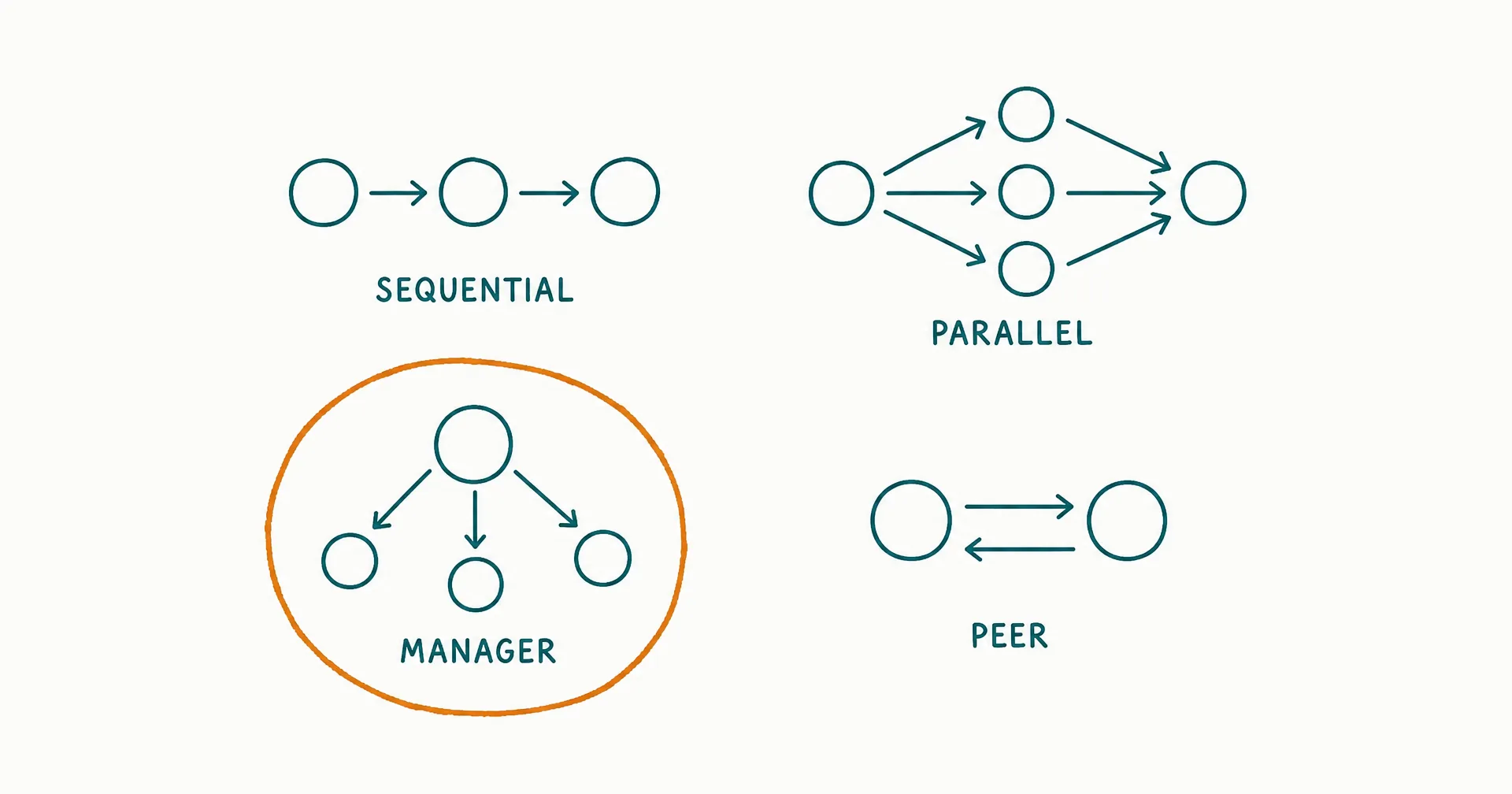
AI agent orchestration patterns define how work moves between agents, tools, deterministic services, and people. The topology decides who selects the next step, which tasks may run together, where state lives, how authority moves, and who accepts the final result.
The right pattern is usually the least complex one that removes a measured bottleneck. A sequential workflow is appropriate when one result must precede the next. Parallel execution helps when branches are genuinely independent. A manager-specialist topology earns its overhead when decomposition changes from case to case. Peer collaboration belongs where ownership can move or be divided under an explicit contract.
Those choices sit above the communication layer. Agent-to-agent communication defines how participants discover capabilities, exchange task state, and return results. Orchestration defines which participant acts, in what order, and under whose control.
On this page · 18 sectionsOpen
- What Are the Main AI Agent Orchestration Patterns?
- Why Should a Single Agent Be the Baseline?
- When Does Sequential Orchestration Work Best?
- When Should a Router Select One Specialist?
- When Does Parallel Orchestration Reduce Time?
- When Does a Manager-Specialist Pattern Earn Its Cost?
- When Should Agents Work as Peers or Hand Off Control?
- When Does an Evaluator-Optimizer Loop Help?
- How Do Hybrid Orchestration Patterns Work?
- How Should Teams Choose an Orchestration Pattern?
- How Do Latency, Cost, and Reliability Change by Pattern?
- How Should State, Authority, and Failure Containment Work?
- What Does the Same Workflow Look Like Across Patterns?
- How Should an Orchestration Evaluation Be Run?
- How Can Teams Introduce Multi-Agent Orchestration Safely?
- Where Can CellCog Fit an Orchestrated System?
- What Should Be on the Architecture Checklist?
- What Is the Final Decision?
- Start with one agent plus well-defined tools. Add another agent only when tests reveal a persistent coordination, specialization, context, review, or latency problem.
- Use sequential orchestration when each step depends on the accepted output of the preceding step.
- Use routing when one classifier or controller can select a single specialist without running every branch.
- Use parallel fan-out and fan-in when branches can work from a stable snapshot and the result can be reconciled safely.
- Use a manager with specialists when the task must be decomposed dynamically and one owner should control the workflow and final response.
- Use peers or handoffs when responsibility for a defined scope must genuinely transfer, not merely because two agents exchange messages.
- Use evaluator-optimizer loops only when a clear rubric can identify improvement and a strict stopping rule can bound cost.
§ 01What Are the Main AI Agent Orchestration Patterns?
Six patterns cover most deployed designs: sequential, routing, parallel, manager-specialist, peer or handoff, and evaluator-optimizer. They can be combined, but each adds a different control structure.
| Pattern | Control shape | Best fit | Main benefit | Main risk |
|---|---|---|---|---|
| Single agent plus tools | One agent owns the path | Cohesive work with clear tools | Lowest coordination burden | One context or role becomes overloaded |
| Sequential | Fixed ordered stages | Stable dependency chain | Predictable state and validation | Delay and errors accumulate down the chain |
| Routing | One decision selects one branch | Distinct request categories | Specialist fit without running all workers | Misrouting at the entry point |
| Parallel fan-out/fan-in | Independent branches rejoin | Research, independent checks, batch work | Lower elapsed time or broader coverage | Conflicting results and shared-dependency failures |
| Manager-specialist | Central controller delegates dynamically | Variable decomposition and synthesis | Adaptive coordination with one closure owner | Manager becomes a bottleneck or single failure point |
| Peer or handoff | Control moves between capable participants | Ownership or user interaction must transfer | Local autonomy across boundaries | Lost ownership, cycles, and inconsistent state |
| Evaluator-optimizer | Generate, assess, revise | Outputs with a stable quality rubric | Bounded iterative improvement | Endless loops or rubric gaming |
The table is a starting point, not a scorecard. The same business workflow may use a deterministic sequence at the top, a router inside one stage, parallel specialists inside another, and an independent reviewer before release. Each additional edge still needs a measurable purpose.
§ 02Why Should a Single Agent Be the Baseline?
A multi-agent system is not automatically more capable than a well-designed single agent. It introduces task interfaces, state transitions, extra model calls, additional credentials, more failure modes, and more evaluation surfaces.
OpenAI’s practical guide to building agents recommends maximizing a single agent before splitting the system. The guide notes that multi-agent designs can help when instructions become too complex or tool descriptions overlap, but there is no universal tool-count threshold. Some agents can select among many distinct tools, while others struggle with a smaller set of similar tools.
Anthropic reaches a similar conclusion in Building Effective Agents: begin with the simplest solution and add complexity only when it demonstrably improves outcomes. Anthropic distinguishes workflows, where code controls predefined paths, from agents, where the model dynamically directs its own process and tool use.
The general-purpose versus specialized AI agent framework provides the next diagnostic step. It shows when a cohesive agent should remain intact and when recurring role, context, permission, or evaluation differences justify a specialist boundary.
What should the baseline include?
A credible single-agent baseline needs more than one prompt. It should have:
- a bounded job and acceptance criteria;
- typed tools with distinct names and descriptions;
- relevant context rather than a complete data dump;
- deterministic checks for formats, permissions, and record state;
- approval gates for consequential actions;
- a retry and recovery policy;
- and an evaluation set that represents normal, ambiguous, and hostile cases.
If that system meets the target, another agent has no economic job. If it fails, classify the failure before changing the architecture.
| Repeated failure | First intervention | When another agent may help |
|---|---|---|
| Wrong tool selected | Clarify tool boundaries and schemas | Tools still overlap by domain or permission |
| Instructions collide | Separate policies from task context | Distinct roles need incompatible context |
| Output misses a known check | Add deterministic validation | Quality requires independent judgment |
| Work is too slow | Cache, reduce context, optimize tools | Independent branches dominate elapsed time |
| Context becomes noisy | Retrieve only relevant information | Separate domains need separate memory or corpora |
| Human keeps decomposing tasks | Encode a fixed workflow | Decomposition varies materially by case |
| Self-review misses defects | Add external checks and rubrics | Independent evidence or specialist review improves detection |
The takeaway is diagnostic: split a system to address a named failure, not to imitate an organizational chart. The measured defect determines whether the next step is better tooling, deterministic workflow code, one specialist, or a broader topology.
§ 03When Does Sequential Orchestration Work Best?
Sequential orchestration runs stages in a fixed order. Each stage consumes an accepted output or state change from the preceding stage.
Google’s Sequential Agent documentation describes a deterministic parent that executes subagents in strict order. Anthropic calls the same general structure prompt chaining when one model call feeds the next and optional gates check intermediate results.
A sequence fits work such as:
- retrieve the approved source set;
- extract facts into a schema;
- validate required fields;
- draft from the accepted record;
- verify citations and policy constraints;
- submit for approval.
The order matters. Writing before extraction would leave claims disconnected from the accepted source record. Releasing the result before verification would make that safeguard meaningless.
Use sequential stages when dependencies are real
The strongest signal is a data or authority dependency. Step B cannot begin safely until step A produces a valid artifact, approval, or state transition.
Good sequential candidates include:
- document intake followed by extraction and reconciliation;
- code generation followed by tests and review;
- lead enrichment followed by qualification and approved outreach;
- media creation followed by policy checks and release;
- and any workflow where a later action requires an earlier authorization.
Keep stage contracts explicit
Every stage should declare:
- accepted input type and version;
- output schema and evidence;
- permitted tools and data;
- validation rule;
- timeout and retry policy;
- terminal states;
- and the owner of repair.
Without those contracts, a sequence becomes a chain of conversational guesses. A polished downstream answer may conceal an upstream extraction error.
Watch the critical path
For a purely sequential workflow, a useful approximation is:
elapsed time = sum of stage time + validation time + handoff overhead
This is an engineering estimate, not a performance guarantee. It highlights the main weakness: every stage sits on the critical path. Reducing the duration of one stage reduces the total, while adding a reviewer or retry increases it.
Sequential execution is a control choice, not an argument for using a separate agent at every step. Code should own deterministic transitions. Agents belong only in stages that require flexible interpretation or generation.
§ 04When Should a Router Select One Specialist?
Routing sends each request to one appropriate worker, model, workflow, or tool set. The entry component classifies the case, applies policy, and chooses a destination.
Anthropic describes routing as a way to separate distinct request categories so each can use a specialized downstream process. Google’s routing documentation similarly separates explicit one-destination routing from fixed sequential or parallel execution.
A router fits when categories are:
- materially different;
- observable from the available request;
- stable enough to evaluate;
- and safer or more efficient under separate instructions, tools, or permissions.
Examples include sending billing questions to a billing specialist, technical incidents to an operations workflow, and contract questions to an approved legal-review path.
A router needs an abstain path
Forced classification turns uncertainty into hidden error. The router should be able to return:
- insufficient information;
- unsupported request;
- policy review required;
- low confidence;
- or human triage.
The evaluation should therefore measure more than top-line accuracy.
| Routing measure | What it reveals |
|---|---|
| Correct-route rate | Whether eligible cases reach the right destination |
| False-route rate | How often a case reaches a wrong specialist |
| Abstention quality | Whether ambiguous cases are withheld appropriately |
| Policy-violation rate | Whether restricted work enters an unauthorized route |
| Reroute rate | Whether specialists frequently reject assigned work |
| End-to-end acceptance | Whether the chosen path produces a usable outcome |
The last row matters most. A classifier may look accurate while downstream work still fails. Evaluate routing as part of the complete task, with extra weight on costly false routes and unsafe authorization decisions.
Do not confuse routing with delegation
A router chooses a path. It does not necessarily create a subordinate task, retain parent outcome ownership, or synthesize multiple results. If a central agent must decompose one goal into several changing assignments, routing alone is too narrow.
§ 05When Does Parallel Orchestration Reduce Time?
Parallel orchestration sends independent branches to run concurrently, then gathers their outputs. Google’s Parallel Agent documentation recommends it for independent tasks. Anthropic separates two variations:
- sectioning, where branches handle different subtasks; and
- voting, where multiple attempts or perspectives address the same question.
The pattern can reduce elapsed time, expand coverage, or provide independent evidence. It cannot remove a dependency that actually exists.
Test independence before fan-out
Two branches are independent only when each can work from a stable input snapshot without waiting for the other. Ask:
- Does either branch need the other’s output?
- Can both safely read the same data version?
- Could both write to the same record or external system?
- Will one branch invalidate the assumptions of another?
- Is there a deterministic way to reconcile conflicts?
- Can the parent identify partial completion?
If the branches share mutable state, credentials, rate limits, or a critical source, a parallel diagram may hide the fact that they can still fail together.
Estimate the real critical path
For independent branches that start together:
elapsed time = max(branch time) + fan-out overhead + fan-in and review time
The formula is illustrative. It shows why adding branches may stop helping. The slowest branch defines execution time, and synthesis grows as outputs become larger or more contradictory.
| Parallel design | Use it for | Required fan-in control |
|---|---|---|
| Sectioned research | Different markets, sources, or questions | Coverage map, provenance, deduplication |
| Multiple candidates | Alternative plans, drafts, or solutions | Stable scoring rubric |
| Independent verification | Separate checks of one claim or artifact | Disagreement and escalation policy |
| Batch processing | Independent records or files | Idempotency, per-item state, partial retry |
| Red-team branch | Adversarial test of a proposed action | Severity rule and release gate |
Parallelism creates value only when the fan-in produces one accountable result. If the parent merely concatenates outputs, conflicts, duplicates, and unsupported claims move downstream.
Avoid unsafe concurrent writes
Read-only exploration is easier to parallelize than action. Concurrent writes need locks, idempotency keys, conflict detection, transactional rules, or separate resource partitions. When the side effect is consequential, one controlled execution path is often safer than several autonomous branches.
§ 06When Does a Manager-Specialist Pattern Earn Its Cost?
A manager agent interprets the parent goal, creates or selects assignments, invokes specialists, tracks progress, evaluates returns, requests repair, and closes the parent task. Specialists own bounded domain outputs.
Anthropic calls this orchestrator-workers and recommends it when the required subtasks cannot be predicted in advance. OpenAI describes a manager pattern in which a central agent uses specialized agents as tools while retaining control of workflow execution and the user interaction.
That distinction matters. A manager should not exist merely to forward messages. It earns its cost when decomposition, scheduling, or integration changes from task to task.
Split coordination outputs from domain outputs
The manager-agent versus specialist-agent comparison separates two jobs:
- the manager owns task structure, assignments, state, review, integration, escalation, and closure;
- the specialist owns a typed domain artifact supported by relevant evidence.
The boundary lets each role use different context, tools, permissions, and evaluations. A research specialist may need broad read access to sources, while a manager may need task visibility but no authority to publish or modify records.
Keep one closure owner
The manager should know whether every required contribution was accepted, rejected, timed out, superseded, or escalated. It should not mark the parent task complete because all workers returned text.
| Field | Purpose |
|---|---|
| Parent task and acceptance rule | Defines the outcome the manager must close |
| Assignment IDs and owners | Makes every contribution attributable |
| Dependency and priority | Controls eligible work and scheduling |
| Input snapshot and authority | Prevents silent scope drift |
| Worker state and deadline | Supports recovery and escalation |
| Returned artifact and evidence | Enables review rather than trust by message |
| Acceptance or repair decision | Records why a result advances |
| Parent closure state | Distinguishes worker completion from business completion |
The record prevents “all workers replied” from becoming a false success condition. Manager quality is measured by accepted parent outcomes, not delegation volume.
Watch the manager bottleneck
A central manager can become a latency, cost, and reliability bottleneck. It may:
- over-decompose simple work;
- assign overlapping tasks;
- pass excessive context;
- repeatedly invoke weak specialists;
- accept fluent but unsupported results;
- or fail and strand every branch.
Bound the number of active tasks, total delegation depth, retries, spend, and elapsed time. Give the manager a deterministic worker registry and policy service rather than asking it to invent capability or authority.
The manager-agent architecture turns that boundary into an implementable controller with a task graph, eligibility filters, child contracts, durable state, budget invariants, review, repair, escalation, and parent closure.
§ 07When Should Agents Work as Peers or Hand Off Control?
Peer and handoff patterns distribute control. One participant may transfer responsibility for a defined scope, or several participants may own complementary scopes and reconcile their results.
This design fits organizational or platform boundaries where a central manager cannot or should not control every participant. It may also fit a user journey in which the active specialist must change.
The formal Agent2Agent Protocol specification provides task, message, artifact, capability, and state objects for communication between independent agent systems. Those interface semantics can support cross-boundary work, but a communication protocol does not decide whether a peer topology is appropriate.
A message is not a handoff
Control has moved only when the receiving participant:
- accepts a named scope;
- receives task-scoped authority;
- becomes responsible for its declared outcome;
- exposes a visible state;
- can request clarification or reject the task;
- and returns, escalates, or closes under a defined rule.
If the caller still selects every operation and owns every decision, the receiver is functioning as a tool or worker, even if both sides use agent technology.
The focused comparison of agent handoffs and agents as tools shows how that control choice changes context, user access, authority, latency, and recovery.
Use an ownership ledger
Peer systems need an explicit answer to “who owns this now?”
| Ownership field | Required answer |
|---|---|
| Transferred scope | Which outcome or user interaction moved? |
| Current owner | Which authenticated participant is accountable now? |
| Retained scope | What does the sender still own? |
| Authority | Which data, tools, spend, and actions are allowed? |
| Acceptance | Did the receiver accept, reject, or request clarification? |
| Return condition | When and how does control come back? |
| Terminal result | Which artifact or state closes the transferred scope? |
Without this ledger, handoffs become conversational drift. Both agents may act, neither may close, or each may assume the other handled an exception.
Limit the edge set
An unrestricted network of n agents has a structural maximum of n x (n - 1) directed communication edges. Five agents could therefore create up to 20 directed relationships, each with its own authentication, authorization, state, validation, and recovery burden. The maximum describes possible connectivity, not a recommended design.
Prefer an allowlisted graph. Permit only the edges required by observed workflows. A hub, broker, registry, or task service may reduce uncontrolled peer connections while preserving local ownership.
§ 08When Does an Evaluator-Optimizer Loop Help?
An evaluator-optimizer pattern alternates between producing an output and evaluating it against a defined standard. The evaluator returns actionable defects, and the producer revises until the output passes or a stopping condition fires.
Anthropic recommends the pattern when evaluation criteria are clear and iterative improvement has measurable value. Google’s Loop Agent documentation describes repeatable execution with a termination condition or maximum iteration count.
Good candidates include:
- code that must pass tests and static checks;
- a document that must satisfy a structured compliance rubric;
- an extraction that must reconcile to source totals;
- or a plan that can be tested against explicit constraints.
Poor candidates include subjective work with no stable acceptance rule, high-cost revisions with weak feedback, or actions that cannot be safely reversed.
Separate evaluation from vague criticism
“Improve this” is not a control. The evaluator should return:
- criterion ID;
- observed defect;
- supporting evidence;
- severity;
- required correction;
- and pass, repair, escalate, or reject status.
The loop should also have strict limits on iterations, spend, elapsed time, repeated defects, and permitted changes. Stop if the same defect recurs without material progress.
Preserve independent checks
An evaluator that sees the producer’s complete context and accepts the same unsupported assumptions may create the appearance of review without error independence. Use deterministic checks where possible. For judgment-based review, vary the evidence path, rubric, context, model, or human authority when the risk justifies it.
§ 09How Do Hybrid Orchestration Patterns Work?
Live systems often combine patterns because a business process contains different dependency shapes.
Consider a market-entry decision packet:
- A deterministic intake stage validates country, product, deadline, and source policy.
- A router selects the relevant regulatory and market specialists.
- Research branches run in parallel from one approved input snapshot.
- A manager identifies coverage gaps and commissions targeted follow-up.
- An independent evaluator checks claims against the evidence rubric.
- A human approves the final recommendation.
The top-level workflow is sequential, its research phase is parallel, specialist selection is routed, dynamic repair is manager-led, and final quality uses evaluator-optimizer logic.
Nest patterns deliberately
Each nested pattern should answer one specific need:
| Layer | Pattern | Why it exists |
|---|---|---|
| Business state | Deterministic sequence | Enforces required order and approvals |
| Case selection | Router | Chooses only relevant domain paths |
| Evidence collection | Parallel fan-out | Reduces elapsed time and broadens coverage |
| Gap repair | Manager-specialist | Handles case-specific decomposition |
| Quality | Evaluator-optimizer | Applies a stable acceptance rubric |
| External execution | Handoff or peer task | Transfers a bounded outcome across a system boundary |
The table shows why “multi-agent” is too broad to describe an architecture. Name the control pattern at each layer, then test whether that layer improves the complete outcome.
Avoid nesting for its own sake
Every nested controller adds prompts, state, latency, cost, and recovery paths. A deterministic function can often replace a routing agent. A fixed task list can replace dynamic management. A schema validator can replace an evaluator call. Keep model judgment where ambiguity is real.
§ 10How Should Teams Choose an Orchestration Pattern?
Choose from the structure of the work, not the desired number of agents. The following factors expose most of the tradeoff.
| Decision factor | Sequential | Routing | Parallel | Manager-specialist | Peer or handoff | Evaluator-optimizer |
|---|---|---|---|---|---|---|
| Dependency | High and ordered | One selected path | Low between branches | Variable | Contractual between owners | Revision depends on feedback |
| Path predictability | High | Usually high after classification | High branch set | Low to medium | Local path may be private | High loop shape |
| Decomposition | Known in advance | Known destinations | Known independent slices | Created dynamically | Divided by ownership | Same artifact revisited |
| Latency goal | Predictability | Avoid irrelevant work | Reduce elapsed time | Adapt to variable work | Local autonomy | Improve quality within a bound |
| Shared state | Passed stage to stage | Limited to selected route | Stable snapshot preferred | Manager tracks parent state | Explicit task state per owner | Versioned artifact and defect state |
| Authority | Stage-specific | Route-specific | Branch-specific | Manager and worker scopes differ | Authority may transfer | Producer and approver should differ |
| Review | Gate between stages | Check route plus result | Reconcile branches | Manager accepts contributions | Receiver and sender acceptance | Core purpose of the loop |
| Failure containment | Stop at failed stage | Isolate wrong route | Isolate failed branch | Manager limits lineage | Trust boundary at every edge | Stop on budget or no progress |
| Best initial signal | Stable process order | Distinct request classes | Independent work dominates time | Humans repeatedly re-plan tasks | Ownership must genuinely move | Clear rubric catches repairable defects |
No column wins universally. A workflow with ordered approvals and one ambiguous research stage may use sequential control around a manager-specialist subsystem. A support operation may use routing without any agent-to-agent delegation.
Dependency comes first
Draw the task as a directed graph. An edge means the target needs an artifact, decision, or authorization from the source.
- A long chain suggests sequential control.
- Several independent nodes with one join suggest parallel fan-out and fan-in.
- A variable graph created at runtime suggests a manager.
- Separate owners with negotiated boundaries suggest peer tasks or handoffs.
- A repeated producer-critic edge suggests evaluator-optimizer.
Do not parallelize a chain by launching its stages together. Do not appoint a manager when the graph is stable enough to encode.
Uncertainty determines where model control belongs
Use deterministic code for known transitions, permissions, schemas, arithmetic, timeouts, and side effects. Use agent judgment for ambiguous classification, decomposition, synthesis, and exception handling - then constrain those decisions with policy and validation.
Review independence determines role separation
If one artifact could trigger a financial, legal, administrative, public, or irreversible action, separate creation from approval. That separation may use another agent for evidence review, but the execution gate should independently verify authorization and exact action parameters.
OWASP’s AI Agent Security Cheat Sheet recommends least-privilege tools, validation of external data and outputs, explicit approval for high-impact actions, trust boundaries between agents, and circuit breakers for cascading failures.
§ 11How Do Latency, Cost, and Reliability Change by Pattern?
Agent count is a poor proxy for value. Measure the accepted business result.
Estimate complete outcome cost
A useful accounting model is:
accepted-outcome cost = control + execution + integration + review + repair + failed-run cost
The calculation should include model calls, tool fees, infrastructure, human review, retries, abandoned tasks, and incident recovery. A cheaper worker may increase total cost if its output creates more synthesis or repair.
Separate elapsed time from total work
Parallelism can reduce elapsed time while increasing total compute. A manager can reduce human coordination while adding controller calls. An evaluator can increase task cost while reducing costly defects.
| Measure | Why it matters |
|---|---|
| Median and tail elapsed time | Reveals routine speed and slow failures |
| Cost per accepted outcome | Includes retries and rejected work |
| First-pass acceptance | Shows how often repair is unnecessary |
| Severe-error rate | Weights consequential defects separately |
| Human review minutes | Captures displaced or added labor |
| Recovery success | Shows whether partial failures can be contained |
| Evidence completeness | Tests whether the result is verifiable |
| Duplicate side effects | Detects retry and concurrency defects |
The table keeps architecture economics tied to completed work. Token cost per call cannot show whether a multi-agent run finished, repeated an action, or required a human to reconstruct missing state.
Model reliability across edges
Do not multiply nominal agent success rates and call the result reliable. Failures are often correlated through shared sources, models, credentials, prompts, or evaluators.
Test the complete system against:
- one branch returning late;
- one worker returning a malformed artifact;
- the manager failing after workers finish;
- a shared data source becoming unavailable;
- a retry repeating an external write;
- contradictory specialist conclusions;
- and an injected instruction propagating through an artifact.
Observed recovery under representative faults is more useful than a theoretical independence assumption.
§ 12How Should State, Authority, and Failure Containment Work?
The orchestration graph is also a trust graph. Every edge carries some combination of data, instructions, authority, state, and evidence.
Give each edge a task contract
The AI agent task delegation framework treats delegation as a bounded operating contract. At minimum, an assignment should specify:
- parent and child task IDs;
- authenticated sender and receiver;
- requested outcome and acceptance rule;
- input references and versions;
- permitted tools, data, spend, and side effects;
- expected artifact schema and evidence;
- deadline, retry, cancellation, and escalation;
- and ownership after return.
The receiver should get the authority needed for the assignment, not a copy of the sender’s credentials.
Treat returned content as untrusted
External documents, messages, web content, tool results, and peer artifacts may contain malicious or irrelevant instructions. Validate structure, provenance, content, and permissions on the receiving side. A trusted agent does not make every source it touched trustworthy.
Bound propagation
The multi-agent failure-mode analysis shows how a local defect can become a cascade through delegation, shared memory, review, or action.
Containment controls should include:
- maximum delegation depth and fan-out;
- task-level spend and time budgets;
- per-agent tool and data scopes;
- immutable lineage and artifact versions;
- validation before memory or downstream reuse;
- idempotency for side effects;
- circuit breakers that halt the complete task lineage;
- and one accountable closure owner.
Design recovery before scale
For every node and edge, decide:
- Can the task be retried safely?
- Can only the failed branch be replayed?
- Can a completed artifact be retrieved after manager failure?
- Can authority be revoked while work is active?
- Can a human pause the full lineage?
- Can a duplicate action be detected?
- Can the system resume from the last accepted checkpoint?
An architecture that works only on an uninterrupted happy path is not ready for more agents.
§ 13What Does the Same Workflow Look Like Across Patterns?
Suppose a team needs a market-entry packet covering demand, competition, regulation, channel options, risks, and a final recommendation.
Single agent plus tools
One agent retrieves approved sources, analyzes each dimension, and produces the packet.
Use it when the scope is cohesive, source volume is manageable, and one context improves synthesis. It is the baseline against which other designs should be compared.
Sequential
An intake stage fixes the scope before research begins. Validation then checks source coverage, the recommendation uses only accepted evidence, and approval releases the packet.
Use it when later work should not begin until earlier evidence and scope are valid.
Routing
A classifier sends each case to the appropriate jurisdiction-specific workflow, market database, or product specialist.
Use it when each case needs one of several distinct paths rather than every path.
Parallel
Demand, competition, regulation, and channels are researched concurrently from the same approved scope. A fan-in stage reconciles conclusions and sources.
Use it when those branches do not depend on each other and elapsed research time is the bottleneck.
Manager-specialist
A manager reviews the case, creates a task graph, assigns specialists, notices a missing distribution question, commissions follow-up, and accepts or repairs each contribution before synthesis.
Use it when decomposition changes substantially by market and humans otherwise spend time directing the work.
Peer or handoff
An internal strategy agent transfers the regulatory scope to an independently operated legal-research agent, which accepts the task, manages its own process, and returns a versioned artifact.
Use it when ownership crosses a real system or organizational boundary.
Evaluator-optimizer
A reviewer scores the packet against source coverage, contradiction, freshness, uncertainty, and decision criteria. The producer repairs named defects within a fixed iteration budget.
Use it when the rubric can reliably distinguish a better packet.
This comparison makes the choice concrete: the business deliverable stays constant while control changes. Evaluate which topology improves the accepted packet enough to justify its added edges.
§ 14How Should an Orchestration Evaluation Be Run?
Evaluate architecture candidates on the same cases, sources, tool permissions, and acceptance rules.
An illustrative 30-case test pack might contain:
- 12 routine cases;
- 6 cases with missing or conflicting input;
- 4 cases with one unavailable source or tool;
- 4 adversarial cases containing injected instructions or misleading artifacts;
- 2 cases requiring high-impact approval;
- and 2 cases designed to trigger timeout, cancellation, or partial recovery.
These counts are illustrative, not a universal benchmark. The mix should follow the workflow’s real risk and volume.
Compare at least two architectures
Run:
- the strongest single-agent or deterministic baseline;
- the proposed orchestration pattern;
- and, when practical, a simpler intermediate design.
For example, compare one agent against a fixed parallel workflow before adding a dynamic manager. The fixed version may capture most of the latency gain with easier state and recovery.
Score the complete result
| Evaluation layer | Example measure |
|---|---|
| Task outcome | Accepted packet, resolved case, tested change |
| Local output | Specialist artifact accuracy and completeness |
| Coordination | Correct assignment, no duplicate work, complete synthesis |
| Control | Authorization, approval, idempotency, policy adherence |
| Recovery | Safe retry, partial resume, cancellation, artifact retrieval |
| Economics | Elapsed time, total cost, human minutes |
| Evidence | Source coverage, provenance, uncertainty, version history |
The hierarchy prevents a strong specialist score from hiding a weak overall result. An architecture passes only when the complete task improves without creating unacceptable control or recovery failures.
Define the promotion gate
A pattern should enter live use only if it:
- improves a named target over the baseline;
- stays within cost and latency budgets;
- passes severe-risk cases;
- produces recoverable state;
- preserves complete evidence;
- and reduces or justifies human work.
If the improvement appears only on easy examples, keep the simpler design.
§ 15How Can Teams Introduce Multi-Agent Orchestration Safely?
Scale one governed edge at a time.
Phase 1: establish the baseline
Instrument the current workflow. Record accepted outcomes, common failure classes, elapsed time, total cost, human intervention, and recovery behavior.
Phase 2: isolate one bottleneck
Choose one recurring problem: independent research dominates elapsed time, specialist review catches valuable defects, humans repeatedly route cases, or context conflicts reduce quality.
Phase 3: add the smallest useful pattern
Examples include:
- one deterministic route to two specialist paths;
- one parallel read-only research branch;
- one independent evaluator behind a rubric;
- or one bounded delegated task with a typed artifact.
Phase 4: add state and controls
Before increasing volume, implement task IDs, ownership, scoped authority, deadlines, cancellation, idempotency, lineage, spend limits, and circuit breakers.
Phase 5: fault-test the edge
Make the worker time out, reject the task, return malformed data, contradict another source, and attempt an unauthorized action. Confirm that the parent can recover without reconstructing the run from logs.
Phase 6: expand only on measured benefit
Add another branch, specialist, or handoff only when the existing design exposes a new bottleneck. A growing agent roster is not a success metric.
§ 16Where Can CellCog Fit an Orchestrated System?
CellCog presents two relevant surfaces: an external execution layer for artifact-shaped work and an internal example of manager-specialist organization.
On its Agent-to-Agent page, CellCog says an external agent can call CellCog through one API and receive finished research, media, document, application, dashboard, or code artifacts. That positioning fits a bounded worker or external task node when the parent system retains a clear acceptance and closure process.
CellCog’s AI Organization page shows a first-party operating structure in which an AI Sales Lead manages five sales representatives while other AI employees perform distinct functions. The page also reports current operating counts and spend. Those figures describe CellCog’s own implementation; they are not universal performance benchmarks.
What should a buyer verify?
Before adding any external execution service to an orchestration graph, verify:
- capability discovery and versioning;
- authentication and tenant isolation;
- task state, cancellation, timeout, and retrieval;
- artifact schemas, evidence, and provenance;
- data retention and deletion;
- task-scoped authority;
- cost and concurrency controls;
- duplicate-request behavior;
- evaluation and repair;
- and recovery after partial failure.
CellCog’s public Agent-to-Agent page describes an API-based execution surface. It does not, by itself, establish implementation of every requirement in the formal A2A 1.0 specification. Protocol compatibility should be confirmed against the exact version, transport, operations, authentication behavior, states, errors, and conformance tests a deployment requires.
Where does it fit by pattern?
| Pattern | Possible CellCog role | Parent-system responsibility |
|---|---|---|
| Sequential | Artifact-producing stage | Validate inputs and gate the returned artifact |
| Routing | Destination for supported work categories | Classify accurately and handle abstention |
| Parallel | One or more independent artifact branches | Supply stable inputs and reconcile outputs |
| Manager-specialist | Specialist worker under a parent manager | Own decomposition, acceptance, and parent closure |
| Peer or handoff | External participant for a bounded task | Define ownership, authority, state, and return condition |
| Evaluator-optimizer | Producer or reviewer when the job is supported | Keep the rubric, stop rule, and release authority independent |
The safest fit begins with one narrow, measurable job. A parent agent might request a research artifact or dashboard update, validate the result, and keep all external action authority outside the worker. Broader topology should follow only after that edge passes quality, security, cost, and recovery tests.
§ 17What Should Be on the Architecture Checklist?
Before approving an orchestration pattern, confirm:
- A single agent plus tools was evaluated as the baseline.
- The recurring bottleneck is named and measured.
- The task dependency graph is explicit.
- Every agent has a bounded job and acceptance rule.
- Every edge has authenticated identity and scoped authority.
- Deterministic transitions remain in code where possible.
- External content and returned artifacts are treated as untrusted.
- State distinguishes submitted, active, interrupted, accepted, rejected, and terminal work.
- Parallel branches use stable inputs and safe write controls.
- Handoffs record current and retained ownership.
- Managers cannot silently close incomplete parent tasks.
- Review has a rubric and enough independence for the risk.
- Loops have iteration, time, spend, and no-progress limits.
- Retries are idempotent for external effects.
- Circuit breakers halt the complete affected lineage.
- Tests cover timeouts, malformed results, contradictions, shared failures, and hostile inputs.
- Cost is measured per accepted outcome.
- Live expansion depends on measured improvement.
One failed box may be more important than several passed boxes. Missing authority boundaries, recovery, or closure rules should stop deployment even when average output quality looks strong.
§ 18What Is the Final Decision?
Use topology to match the dependency graph.
Keep one agent when the work is cohesive. Use a sequence for real dependencies, a router for distinct destinations, parallel branches for independent work, a manager for dynamic decomposition, peers for genuine ownership transfer, and an evaluator loop for bounded rubric-driven repair.
Then evaluate the complete accepted outcome. The winning architecture is not the one with the most agents or the most flexible diagram. It is the smallest system that meets the required quality, latency, cost, authority, evidence, and recovery standard under representative failures.
Start with one governed edge. Expand only when a measured bottleneck proves that another edge will pay for itself.
Q1What is an AI agent orchestration pattern?
AI agent orchestration is the control structure that determines how agents, tools, services, and people divide work. It defines order, routing, parallelism, delegation, ownership, state, review, and final closure.
Q2When should a workflow use sequential instead of parallel agents?
Use sequential execution when a later stage depends on an accepted output, state change, or authorization from an earlier stage. Use parallel execution when branches can operate independently from a stable snapshot and can be reconciled safely.
Q3Is a manager agent always needed in a multi-agent system?
No. A fixed workflow, router, or deterministic fan-out may be simpler and more reliable. A manager earns its overhead when decomposition changes by case and one controller must assign, track, repair, integrate, and close dynamic work.
Q4What is the difference between a manager pattern and a peer pattern?
A manager retains control of the parent workflow and invokes specialists as workers or tools. In a peer or handoff pattern, ownership of a defined scope moves or is divided between independent participants under an explicit task contract.
Q5How many agents should run in parallel?
There is no universal safe count. Start with the fewest branches that address the measured bottleneck. Increase fan-out only after inputs, rate limits, review capacity, spend, state, failure containment, and recovery pass representative tests.
Q6Can different orchestration patterns be combined?
Yes. A deterministic sequence can contain a router, a parallel research stage, manager-led repair, and an evaluator loop. Each nested pattern should have one clear operational purpose and its own state and recovery rules.