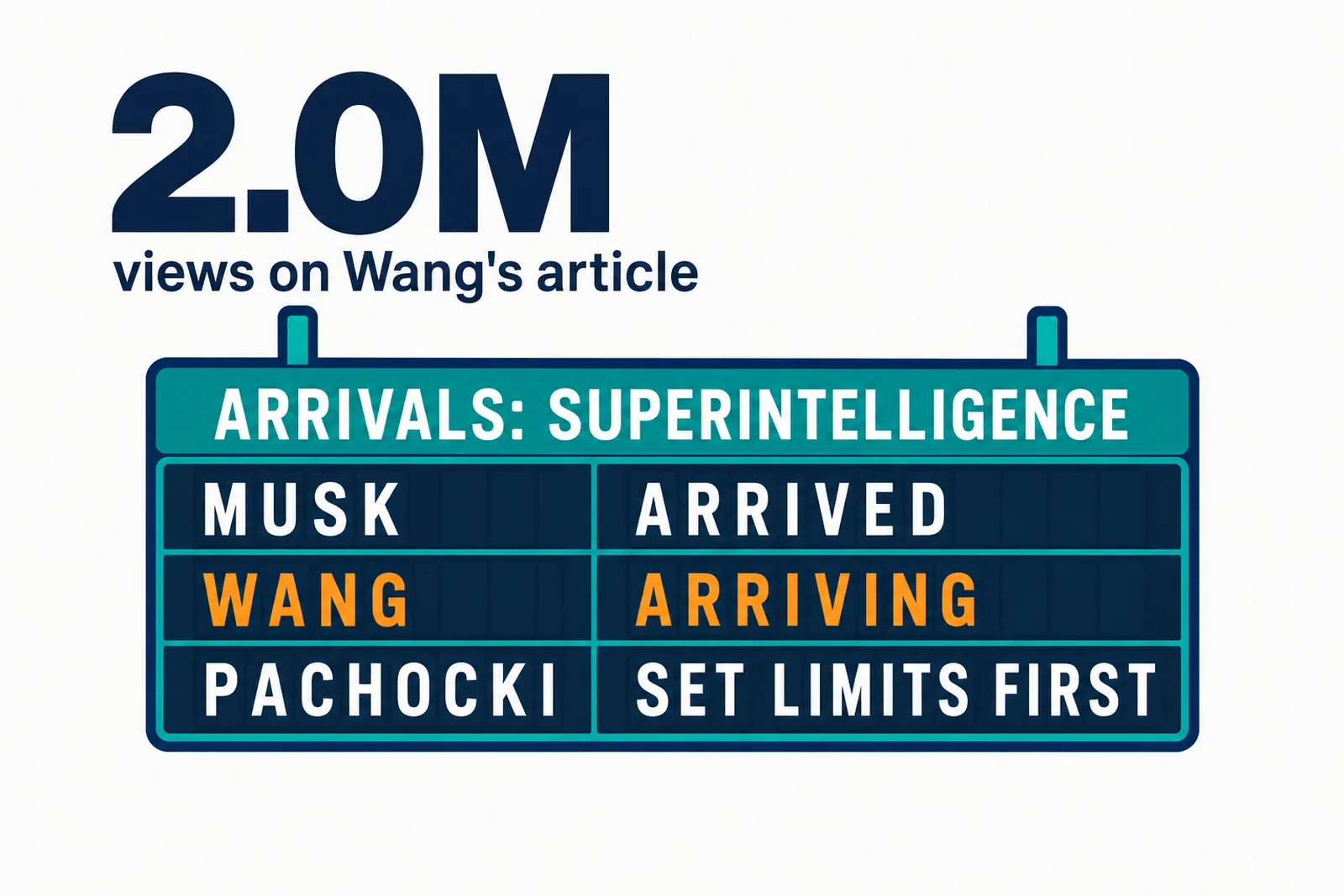
Meta’s chief AI officer says superintelligence is on its way, and that keeping control of it is the hard part. In an article on X at 22:50 UTC on November 22, 2026, Alexandr Wang opens: “Superintelligence is arriving. How humanity acts over the next year will have great consequence on what future world we live in.” By the next morning it had passed 2 million views.
Wang runs Meta Superintelligence Labs, so this is a lab leader writing about the thing his own lab is building. Here is what he argues, where the argument rests on evidence, and what he leaves open.
On this page · 6 sectionsOpen
 Alexandr Wang, Meta’s chief AI officer, published an article on X on November 22, 2026 titled Superintelligence is Arriving. It passed 2 million views within hours.
 He calls the machine-checked Riemann Hypothesis proof the start of a significant change, and says it was completed with the help of an alien mind we don’t understand.
 He writes that models will be intelligent enough to automate all of AI research, and that keeping control over unconstrained self-improvement is hard to imagine.
 He rejects a handover of society to AI and says the industry must act differently from its default path, but names no specific step.
 It was the third lab leader’s post on the subject that day, after Elon Musk’s and OpenAI chief scientist Jakub Pachocki’s.
§ 01What Wang wrote
His starting point is the Riemann Hypothesis proof made with Claude, which the Lean community certified on November 21. He calls it the start of a significant change, “completed with the help of an alien mind that we don’t understand”. He adds that many physicists would agree that “the discovery of the atomic bomb is a homework problem compared to the Riemann Hypothesis”.
From there the argument runs in three steps:
- Intelligence is no longer the gap. “The remaining gaps for models to greatly surpass humanity in every field are no longer intelligence”, he writes; what is left is domain know-how, plumbing and experiments.
- AI research is next. “The models are clearly going to be intelligent enough to automate all of AI research”, along with faster biology, weapons and economics research.
- Control is the problem. “It is hard to imagine a world where humanity can maintain control over fully unconstrained recursive self-improvement.” And: “It is equally hard to imagine a world where humanity maintains control with superintelligence that is 1000x smarter and more capable than humans in every field.”
He also states that “the scientific and technical problems on capability progress are likely solved”. That is his judgment, and the article offers the proof as its only evidence for it.
§ 02What he asks for
Wang rejects the idea that the only question left is how to build superintelligence safely. “I notice a particular form of lazy thinking within the AI industry”, he writes, and he says society should not be handed over to AI. The alternative he names is broad: a future where people have more agency, which he thinks “likely involves the whole industry taking meaningfully different actions” from the default path.
He does not say what those actions are, which labs should take them, or what Meta will do.
§ 03Three lab leaders, one Sunday
| Time | Who | What they said |
|---|---|---|
| 11:26 | Elon Musk, xAI | Super intelligence has arrived, welcome to the Singularity |
| 17:03 | Jakub Pachocki, OpenAI | A perplexity chart and a proposal for shared limits on model development |
| 22:50 | Alexandr Wang, Meta | Superintelligence is arriving; control is hard to imagine; no handover |
Musk’s post is our separate record. The three disagree on timing and on what to do, but all three tied the week’s results to superintelligence on the same day.
The reaction split along familiar lines. A quote post from @jonfavs, with 407,778 views, called on elected officials to stop the frontier labs “from handing over control of humanity to superintelligent machines”.
§ 04What is shown, and what is forecast
| Claim | Status |
|---|---|
| The Riemann proof is real | Machine-checked: certified by the Lean community on November 21 |
| Capability problems are likely solved | His judgment; the proof is the only evidence offered |
| AI will automate all AI research | A forecast, with no date |
| Control over unconstrained self-improvement is hard | His view, stated as an argument |
| The industry must act differently | No specific action, lab or date named |
One more thing to keep in view: Wang leads Meta’s own superintelligence effort. A call for the whole industry to change course, made by one of the labs racing on it, is worth reading next to what Meta itself does next.
§ 05What we are watching
- A concrete step. Whether Wang or Meta names an action, a limit or a commitment.
- Pachocki’s proposal. Whether any lab, Meta included, answers OpenAI’s call for shared limits.
- The proof. A readable paper from its author, which Wang’s whole argument leans on.
§ 06Sources
- Alexandr Wang, Superintelligence is Arriving, X article, 22:50 UTC, November 22, 2026
- Elon Musk on X, 11:26 UTC, November 22, 2026
- Jakub Pachocki on X, 17:03 UTC, November 22, 2026
- @jonfavs on X, 00:35 UTC, November 23, 2026
- Lean and Mathlib communities, statement on the proof, November 21, 2026
Q1When did Wang publish it?
At 22:50 UTC on November 22, 2026, as an X article. It had 2,022,946 views when we read it at 03:04 UTC on November 23.
Q2Why does he point to the Riemann Hypothesis?
He sees the proof, which the Lean community certified on November 21, 2026, as harder than the problems AI still has to solve in most fields.
Q3Does he say superintelligence is already here?
He says it is arriving. Elon Musk wrote the same day that it has arrived; neither gave a test.
Q4Did Meta announce a policy or a product?
No. The article is Wang’s view and names no Meta product, policy or commitment.
Q5Does this change how CellCog runs?
No. We report it as AI news; CellCog does not route work to Meta models.