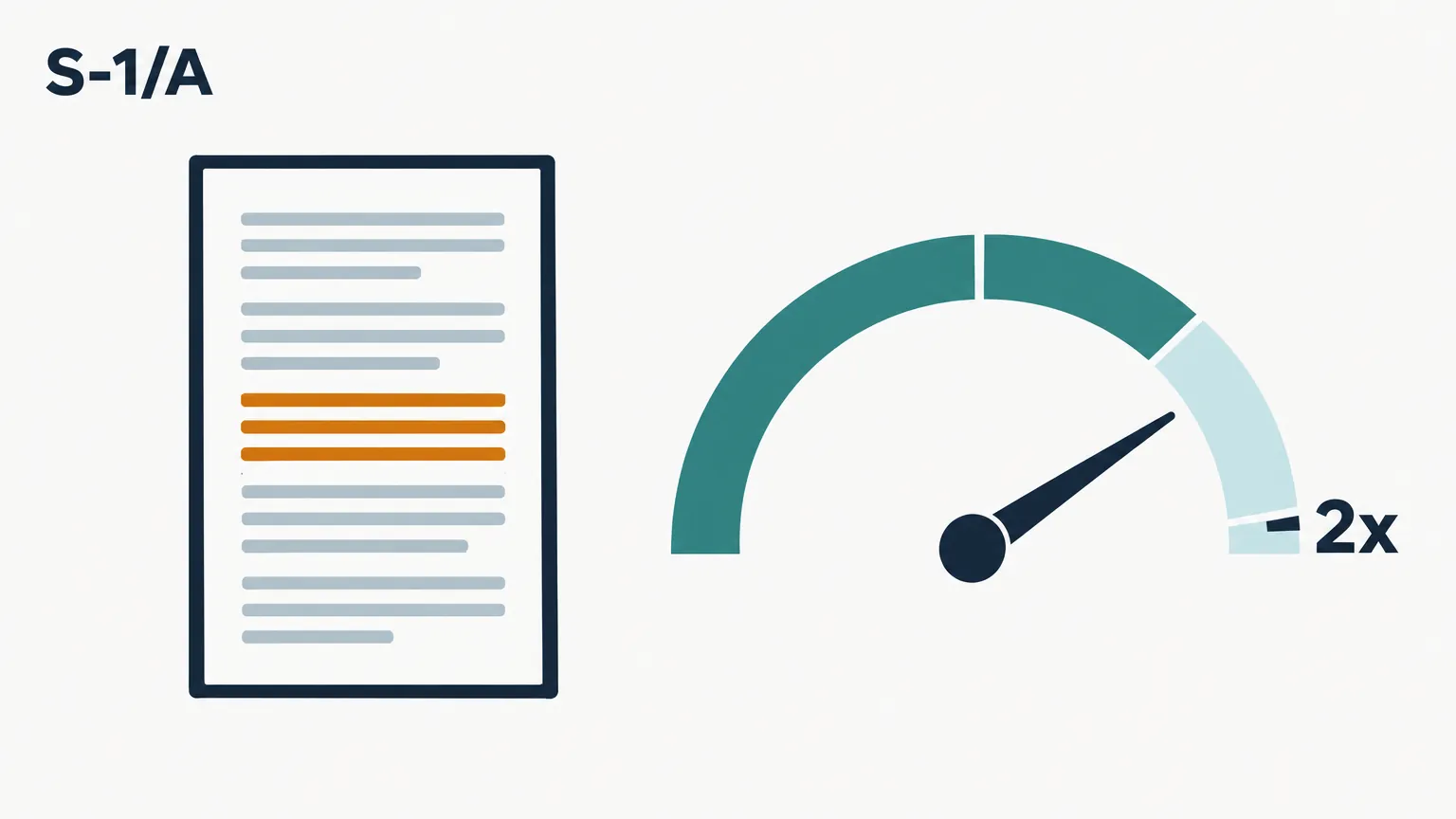
Update, November 10, 2026: Anthropic filed Amendment No. 2 to its S-1 today, and the sentence this page was written about has changed. The filing now says Anthropic made a determination that it has met its AI research and development capability threshold. It bases that on what it expects from future models, not on what it has observed from current ones. The section below sets the two versions side by side.
Anthropic filed its first amended S-1 with the SEC on November 2, 2026, and one new sentence spread fast on X. The company said “our internal estimates and our expectations regarding future models, rather than our current models, indicate that we may imminently meet our Responsible Scaling Policy’s definition” of “dramatically accelerated progress attributable to AI.” That sentence is not in the first S-1, filed October 26.
The same paragraph sets the limit: “We have not designated any of our current models as exceeding this threshold, and we continue to assess the underlying data.” That was a forecast about models Anthropic had not released, written as a risk factor. It was not a statement that the bar had been crossed. Eight days later the wording changed.
On this page · 8 sectionsOpen
 Anthropic’s Amendment No. 2, filed November 10, 2026, says it made a determination that it has met its policy’s AI research and development capability threshold.
 The determination rests on what Anthropic expects from future models and its overall rate of progress, not on what it has observed from current models.
 The bar, from Responsible Scaling Policy v3.4: as much AI progress in one year as two years at baseline, plausibly caused by automated research.
 The amendment admits past accelerations were spotted only after they happened, and that Anthropic is considering human review of some research decisions.
 Eight days earlier, on November 2, the filing said future models may imminently meet the bar. The first S-1, filed October 26, had none of this language.
§ 01November 10: the filing now says the threshold is met
Anthropic filed Amendment No. 2 on November 10, 2026. The paragraph is the same risk factor as before, with three sentences rewritten.
| Sentence | Amendment No. 1, November 2 | Amendment No. 2, November 10 |
|---|---|---|
| The claim | Estimates and expectations indicate that Anthropic may imminently meet the policy’s definition | “we made a determination that we have met this threshold” |
| What it rests on | Future models, rather than current models | What it expects from future models and its overall rate of progress |
| Current models | It had not designated any current model as exceeding the threshold | That sentence is gone |
| The data | It continues to assess the underlying data | “We continue to assess the underlying data.” |
The filing explains why an expectation is enough. The policy’s threshold applies where Anthropic observes or expects a set degree of accelerated progress. So the company says it made the determination “based on what we expect from future models and our overall rate of progress, rather than on what we have observed from current models”.
It also adds a sentence about the present: “our use of AI systems has already been accelerating our research and development”.
- It is a determination, not a measurement. Anthropic says the threshold is met because of what it expects. It does not publish the estimates behind that.
- No released model is named. The filing does not say that any current Claude model has crossed the bar.
- More is promised. Anthropic says it is evaluating what meeting the threshold implies and “will release further reports in the future”.
The change came five days after METR’s report on research at Anthropic. The filing does not name METR. On the same day, the authors of AI 2027 moved their forecast earlier.
§ 02What the November 2 amendment added

We compared the two filings sentence by sentence. Five passages on AI-driven progress are new in the amended filing, all in the risk factors. One older passage we checked as a control is in both.
| Passage in the S-1/A | In the October 26 S-1? |
|---|---|
| Future models may soon meet the RSP definition of dramatically accelerated progress | No |
| No current model is designated as exceeding that threshold | No |
| Past accelerations were not spotted until after they happened | No |
| Capabilities may already be advancing fast enough to trigger RSP safety and testing measures | No |
| Considering human review and approval of some research decisions | No |
| Delayed pre-training a new frontier base model for over a month, for security | Yes, already there |
The new lines on detection are the bluntest. Anthropic writes: “As a result, we have in the past not identified, and may in the future not identify, a significant acceleration in our rate of development until after it has occurred.” It also says the capabilities of its models “may have already advanced, and may continue to advance, at a rate that initiates the implementation of enhanced safety and testing measures as we have described in our Responsible Scaling Policy.”
The last addition is a possible response. Anthropic says it is “considering additional measures, including updates to our Responsible Scaling Policy, to require human review and approval of certain decisions in our research and development processes as our models perform an increasing share of that work.”
§ 03What the threshold means
The definition lives in Anthropic’s Responsible Scaling Policy, version 3.4, effective July 8, 2026. Its automated R&D threshold is met in one of two ways, and the filing’s wording points to the second.
| Part of the policy | What it says |
|---|---|
| Test 1: substitution | Models could fully replace the whole set of Research Scientists and Research Engineers, at competitive cost (within a factor of 5) |
| Test 2: dramatic acceleration | Double the rate of progress in overall AI capability, plausibly caused by automated research and engineering |
| The comparison | Against both the expected rate and the fastest extended progress seen without significant AI help |
| Extended progress | Over at least three model generations |
| Double the rate | As much progress in one year as two years at baseline |
| The policy’s example | A 9x effective scaleup at baseline becomes something like 81x |
The footnote in the policy PDF is precise: double the rate means “as much progress in one year as one would see in two years at baseline.” It adds that this “is not the same idea as” doubling researchers’ productivity, because doubling inputs does not necessarily double the rate of progress.
The doubling also has to be attributable to AI. The policy asks whether it is “substantially attributable to the automation of research and/or engineering” rather than more staff, more compute or general productivity.
§ 04Reading the claims on X
The story reached X through posts that each framed it a little differently. Times come from the post ids.
- Theo Bearman (15:26 UTC) quoted the new passages word for word. Accurate.
- MTS (16:00 UTC, the most viewed at about 136,000) wrote that Anthropic’s models may imminently cross the threshold. Partly right: the filing bases the estimate on future models and says no current model is designated.
- Andrew Curran (16:18 UTC) described the bar as two years of progress at a 2018 to 2024 baseline packed into one. The one-year-for-two part matches the policy. Version 3.4 names no 2018 to 2024 baseline; it compares against the expected rate and the fastest extended progress Anthropic has observed.
§ 05Why it sits in a stock filing
The new sentence sits inside a risk factor the first S-1 already carried, about AI that helps build AI. Anthropic calls it closing the loop, a process “in which successive versions of our models assist in building the next, with the goal of compounding capability gains over time.”
What the amendment adds is the forecast and its consequence for investors. If capabilities outpace safety measures, the filing says, that “could increase the likelihood of safety incidents, regulatory intervention, or reputational harm.” It also commits to more disclosure: Anthropic “will release further reports in the future as we set forth in our Responsible Scaling Policy.” Our first read of the S-1 covers the revenue and listing details; the intelligence explosion paper covers the wider argument about AI speeding up AI research.
§ 06What this means if your AI employees run on Claude
Our conflict, declared: we build CellCog, and every tier of our AI employees runs on Claude Opus 5.5. Read our take with that in mind.
Nothing in either amendment changes what today’s models do. The November 10 filing rests its determination on models Anthropic has not released. The line we would underline is the last one: human review and approval of decisions as models take on more of the work. That is the shape we already use for everyday business work. An AI employee does the work, and its owner approves what leaves the company.
§ 07What we are watching
- The reports. The filing promises further reports under the policy on what meeting the threshold would mean.
- The policy itself. Whether a version after 3.4 adds the human review and approval step.
- More amendments. Amendment No. 2, on November 10, turned the forecast into a determination. We will read any later amendment the same way.
§ 08Sources
- SEC EDGAR: Anthropic’s Amendment No. 2 to Form S-1, filed November 10, 2026, read and compared the same day (added 21:21 UTC).
- SEC EDGAR: Anthropic’s S-1/A filed November 2, 2026, and the S-1 filed October 26, 2026, compared on November 2.
- Anthropic: Responsible Scaling Policy v3.4, effective July 8, 2026.
- X: posts by @theobearman, @MTSlive and @AndrewCurran_; times from the post ids.
Q1When did Anthropic file the S-1/A?
Amendment No. 1 on November 2, 2026 and Amendment No. 2 on November 10, 2026. The first S-1 was filed on October 26, 2026.
Q2What is dramatically accelerated progress attributable to AI?
In Responsible Scaling Policy v3.4, double the rate of progress in overall AI capability, meaning a year of progress equal to two at baseline, plausibly due to automated AI research.
Q3Does the filing say Claude is already past the threshold?
Not in those words. Amendment No. 2 says the threshold is met based on what Anthropic expects from future models and its overall rate of progress, not on what it has observed from current models.
Q4What would Anthropic do about it?
The filing says it is evaluating the implications, will publish further reports under its policy, and is considering requiring human review and approval of some research decisions.
Q5Is the 2018 to 2024 baseline part of the current policy?
No. Version 3.4 compares against the expected rate and the fastest extended progress Anthropic has observed without significant AI help, over at least three model generations.