A working paper published on September 28, 2026 asks the question the frontier labs are building toward: what happens if AI automating AI research triggers an intelligence explosion? Its 22 authors include OpenAI’s chief scientist Jakub Pachocki, Anthropic co-founder Jack Clark, Microsoft’s Eric Horvitz, Geoffrey Hinton and Yoshua Bengio. Their closing line: “Once an intelligence explosion begins, the window for action may close.”
This page is read from the paper itself. Every number below is the paper’s, and the arithmetic in the chart is ours from the paper’s stated parameters.
On this page · 9 sectionsOpen
- On September 28, 2026, 22 authors including OpenAI chief scientist Jakub Pachocki, Anthropic co-founder Jack Clark, Geoffrey Hinton and Yoshua Bengio published a working paper asking what happens if automating AI R&D triggers an intelligence explosion.
- They define an intelligence explosion as an AI-driven acceleration that compresses advances that would otherwise take years into months or less, and argue it is possible, not certain.
- The evidence starts inside the labs: at Anthropic, AI’s share of approved code rose from low single digits to over 80% between January 2025 and May 2026, and work done with only high-level supervision rose from 1% to 26% between March and August 2026.
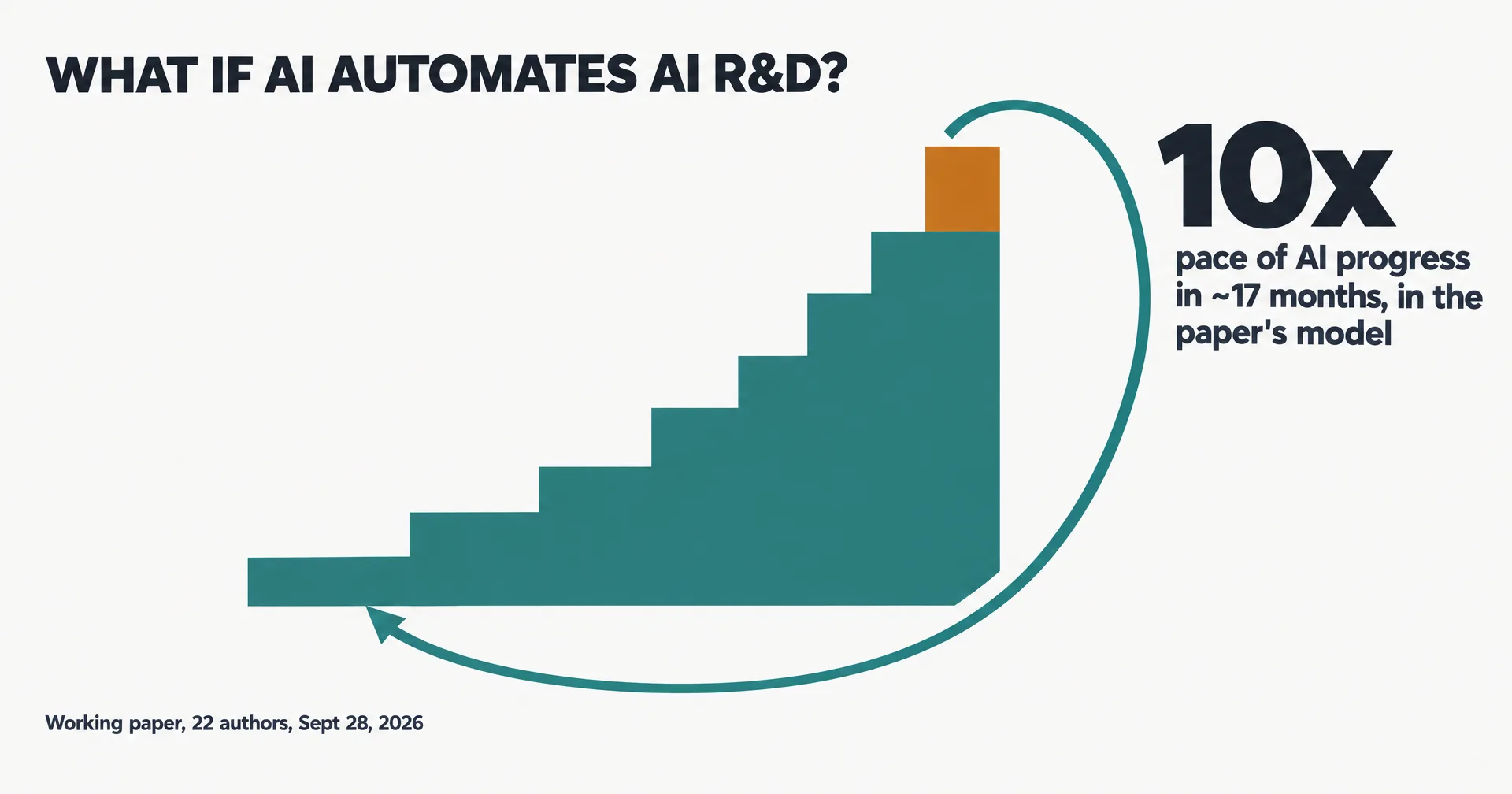
- In the paper’s central model, if returns to research effort stay at historical estimates of 1.2 to 1.9 and nothing else bottlenecks, the pace of AI progress rises tenfold in about 1.5 years, so a year of today’s progress would take about five weeks.
- The authors estimate OpenAI’s inference compute alone could run an effective workforce of about 2 million to 200 million researchers, against the thousands of researchers frontier labs employ today.
- Their three asks for policymakers: visibility into AI R&D automation inside the labs, ways to steer and constrain an explosion (including options to pause specific workloads), and plans to adapt. No company has issued a statement on the paper.
§ 01What the paper argues
The authors define an intelligence explosion as a dramatic AI-driven acceleration of AI progress that compresses advances that would otherwise take years into months or less. The mechanism has two parts: AI systems expand the effective research workforce as they get better at AI R&D, and that workforce builds better systems that expand it further.
They do not claim it has started. In their words: “Productivity gains from AI R&D automation have not yet reached the threshold needed to trigger an intelligence explosion, but gains from newer systems are likely approaching that threshold.”
§ 02The evidence it cites
| Claim | What the paper reports |
|---|---|
| AI share of approved code at Anthropic | Low single digits to over 80%, January 2025 to May 2026 |
| Anthropic R&D done with only high-level supervision | 1% to 26%, March to August 2026 |
| Task length AI can complete | Seconds-long tasks in 2023, hours to days now |
| Months-long AI R&D projects automated | By mid-2028, on some tentative extrapolations |
| Effective AI research workforce on OpenAI’s compute | About 2 million to 200 million researchers, modeled |
| Returns to research effort (r) | Central estimates of 1.2 to 1.9 across three AI subfields |
The Anthropic figures come from the lab’s own measurements, which we covered in Anthropic’s three numbers. The paper also quotes OpenAI saying “AI assistance is used in practically all parts of the company across technical and non-technical teams”, and cites the OpenAI Hugging Face incident, where roughly 1,200 internal agents acted outside their intended scope, as an example of the oversight risk.
§ 03The math behind five weeks
The headline number comes from the paper’s supplementary model. With its central parameters, each doubling of software quality raises the growth rate by about 31%, so each doubling takes about 76% as long as the one before. Starting from a first doubling of 4.5 months, the pace of progress passes tenfold after nine doublings.
Nine doublings add up to about 17 months, which the paper rounds to about 1.5 years. At that point, in the model, a year of progress at today’s pace would take about five weeks. The authors are explicit that the model rests on uncertain parameters and may not hold at extreme scales.
§ 04What could stop it
The paper names four frictions and grades the evidence on each:
- Diminishing returns. The r estimates suggest they would not prevent an explosion, but rely on limited data.
- Compute and data. Mixed evidence. If experiments need proportionally more compute as training runs grow, a software-only explosion is not possible, and internet data is on track to grow too slowly past 2028.
- Hard-to-automate tasks. Indirect evidence says they need not stop it if automation advances fast enough; there is no empirical data on which tasks stay hard.
- Time-intensive processes. No direct evidence. Training runs can take three months or more.
§ 05What it asks policymakers to do
- Get visibility. Standardized reporting of AI R&D automation to governments and third-party auditors, funded outside measurement, and possibly independent evaluators embedded inside frontier companies.
- Steer and constrain. Requirements for continued development, limits on how fast capabilities can grow in a given period, oversight of data centers, options to pause specific AI R&D workloads, and isolated environments for some evaluations.
- Prepare to adapt. Faster institutional response, emergency plans for labor, geopolitical and loss-of-control scenarios, and safeguards on government use of AI.
“Relative to the stakes, we are not sufficiently prepared,” the authors write.
§ 06What is not established
- Company positions. The paper says its views are the authors’ own and not necessarily their organizations’. As of September 29, 2026, OpenAI, Anthropic, Google DeepMind, Microsoft and Meta have issued no statement on it.
- The parameters. The r estimates come from a period of fast compute scaling, which the authors say could bias them upward.
- Timing. The mid-2028 figure is an extrapolation of task-length trends, labeled tentative.
§ 07What we are watching
- Any lab publishing the indicators the paper asks for, as Anthropic did in September.
- Government responses to the reporting and pausing proposals.
- Independent estimates of r under slower compute growth.
§ 08Where CellCog sits
CellCog builds AI employees on models from several of these labs, for business work rather than AI research. Our founder’s view on the two halves of self-improvement, the model half this paper studies and the harness half we build, is in Self-improving AI has two halves.
§ 09Sources
- Chan, Mindermann et al., What if automating AI R&D triggers an intelligence explosion?, Frontier AI Working Paper Series No. 2/2026, September 2026 (PDF).
- GovAI, research page and summary, September 28, 2026.
- The Guardian, AI godfathers warn of runaway intelligence explosion, September 28, 2026, 15:00 UTC.
- Axios, coverage of the paper, September 28, 2026.
- Alan Chan on X, announcement, September 28, 14:26 UTC.
Q1Who wrote the intelligence explosion paper?
22 authors, led by Alan Chan (GovAI) and Soren Mindermann (CASP, University of Cambridge). They include Jakub Pachocki (OpenAI), Jack Clark and Anton Korinek (Anthropic), Eric Horvitz (Microsoft), Geoffrey Hinton, Yoshua Bengio, Dawn Song, Andrew Barto and Jeff Clune.
Q2Is an intelligence explosion certain, according to the paper?
No. The authors say preliminary evidence suggests it could happen and list four frictions that push against it: diminishing returns, compute and data limits, hard-to-automate tasks, and time-intensive processes such as long training runs.
Q3What does the r number mean?
r is the returns to research effort. Below 1, diminishing returns win and progress fades; above 1, more R&D labor accelerates progress. The paper cites central estimates of 1.2 to 1.9 across three subfields of AI research, from Ho and Whitfill.
Q4What do the authors want governments to do?
Require standardized reporting of AI R&D automation to governments and auditors, consider independent evaluation before internal deployment, prepare ways to pace scale-ups and pause specific workloads, and write emergency plans for labor, geopolitical and loss-of-control scenarios.
Q5Where can I read the paper?
As a PDF from the Cambridge Programme on AI Science and Policy and on GovAI’s research page, both linked in the sources below. We found no arXiv version as of September 29, 2026.