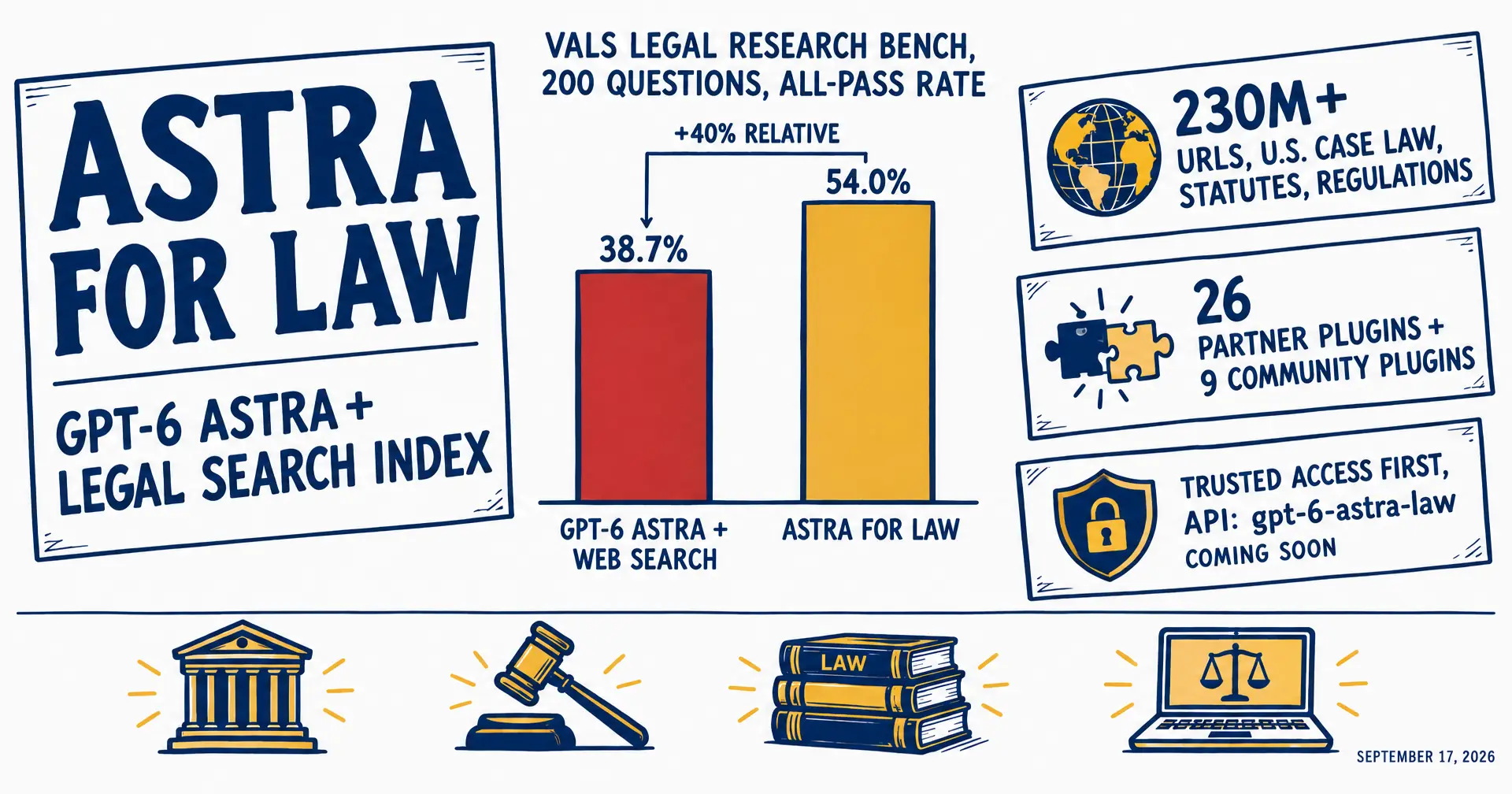
At 20:15 UTC on September 17, 2026, OpenAI posted “Astra for Law: Frontier intelligence built for your practice.” and published Introducing Astra for Law, subtitled “Our most powerful model, configured into a new AI foundation for law.” The one-line version is the subtitle. GPT-6 Astra, the model OpenAI launched two weeks ago, has been given a legal search index, instructions for legal analysis and writing, and a set of controls that law firms require, and the package is being handed first to selected firms and then to the companies that build legal software on OpenAI’s API.
A disclosure before the record: we build CellCog, an AI employee platform, and we are not a legal technology company. We read this announcement for what it says about how frontier models are being sold into professions, and for the numbers. Everything below is from OpenAI’s post and its announcement thread, read within five hours of publication; where OpenAI ran the evaluation, we say so.
On this page · 9 sectionsOpen
 OpenAI announced Astra for Law on September 17, 2026: GPT-6 Astra with a legal search index, instructions for legal analysis and writing, and settings tuned for thorough work. It is a configuration of the existing frontier model, not a new model; OpenAI’s own line is that Astra was configured into a new AI foundation for law.
 The benchmark OpenAI chose is Vals AI’s Legal Research Bench, 200 questions from its private validation set. At the highest reasoning effort, Astra for Law passed the overall correctness check on 54.0% of questions against 38.7% for GPT-6 Astra using web search alone, which OpenAI calls a 40% relative improvement. Independent runs: none yet.
 The index covers U.S. case law, statutes, regulations, court rules and administrative decisions across more than 230 million URLs, with Free Law Project’s CourtListener collection of published precedential case law inside it. OpenAI says it complements, rather than replaces, the licensed content firms buy from Thomson Reuters and others.
 Access is gated. Astra for Law goes first to selected law firms through a Trusted Access Program in ChatGPT and Codex, with Zero Data Retention on the API and ChatGPT Enterprise usage excluded from human review by default. It appears in the model picker as GPT-6 Astra Law and will reach the API as gpt-6-astra-law; OpenAI gives no date and no price.
 The ecosystem launched alongside it: 26 partner-built plugins (iManage, Intapp, DeepJudge, Thomson Reuters HighQ, Relativity, Clio among them), 9 community plugins carrying 47 custom skills, and ChatGPT for Word generally available the same day. Sullivan & Cromwell, Ropes & Gray and Cooley have already built firm-specific tools on ChatGPT Enterprise with OpenAI’s forward-deployed engineers.
 The shape is the news: a frontier lab now sells a role-shaped configuration of its best model, with the retrieval, instructions and controls that make it usable inside a profession, and promises to carry that configuration forward as the base model changes. That is the same move as hiring an AI employee for a role, applied to one vertical at a time.
§ 01What OpenAI shipped
| Piece | What it is |
|---|---|
| Base model | GPT-6 Astra, OpenAI’s current most capable model |
| Legal search index | U.S. case law, statutes, regulations, court rules and administrative decisions across more than 230 million URLs, with sources added daily; includes Free Law Project’s CourtListener collection |
| Instructions | Custom instructions for legal analysis and writing: applying research to the client’s facts, developing arguments or deal terms, identifying weaknesses and uncertainty |
| Settings | Tuned for thorough work; the evaluation was run at the highest reasoning effort |
| Where it appears | Model picker as GPT-6 Astra Law in ChatGPT and Codex; API id gpt-6-astra-law, coming soon |
| Controls | Trusted Access Program for eligible firms; Zero Data Retention on the API; ChatGPT Enterprise usage excluded from human review by default |
| Ecosystem | 26 partner-built plugins, 9 community plugins with 47 custom skills, ChatGPT for Word generally available |
| Price | Not published |
OpenAI calls it “a new foundation for law firms and legal technology companies to build AI products and workflows around their expertise”, built from “settings, tools, and context tailored for professional legal work”. The index is described as complementing, not replacing, the licensed content firms already pay for; Thomson Reuters is named as the example, and its CTO is quoted in the post.
§ 02The legal research numbers
The benchmark is Vals AI’s Legal Research Bench, and OpenAI used 200 questions from its private validation set. The post reports three results, all at the highest reasoning effort for both systems.
| Measure | GPT-6 Astra with web search | Astra for Law |
|---|---|---|
| All-pass correctness rate | 38.7% | 54.0% |
| Reference cases found on case-law questions | Baseline | 24% more |
| Relevant passages retrieved from the correct court opinions (audited set) | Baseline | Up to 54% more |
In OpenAI’s words, “Astra for Law passed the evaluation’s overall correctness check on 54.0% of questions, compared with 38.7% for GPT-6 Astra using web search alone”, and “Astra for Law found 24% more reference cases than GPT-6 Astra using web search alone at the highest reasoning effort”. On the audited passages it “retrieved up to 54% more relevant passages from the correct court opinions”. The post’s chart also plots cost per answer against score across reasoning efforts; the dollar figures behind it are not printed as numbers, so they are not in this record.
Three things to hold alongside the numbers. The comparison is against the same model with ordinary web search, so it measures what the index and the instructions add, not how Astra compares to another lab’s model. The validation set is private, so nobody outside OpenAI and Vals can re-run it as published. And 54.0% is an all-pass rate on a rubric: the model passed every criterion on just over half the questions, which is a strong number for legal research and a reminder that a lawyer still reads the authorities herself, a point the post makes in its own closing line on the topic.
OpenAI also shows two worked prompts, one litigation and one transactional, with side-by-side answers from Claude Fable 5.1 and Astra for Law. Its verdict on its own comparison: “in the litigation example, Claude Fable 5.1 returned a holding that had been reversed on appeal”, while Astra for Law returned two matching precedents. One prompt each, chosen by the vendor; useful as a picture of what the product is for, not as evidence about Fable.
§ 03Who gets it, and how
| Group | Access |
|---|---|
| Selected law firms | Trusted Access Program in ChatGPT and Codex, from September 17 |
| Eligible firms under Trusted Access | Zero Data Retention on the API; ChatGPT Enterprise usage excluded from human review by default |
| API builders (Harvey and Legora named) | gpt-6-astra-law, coming soon, no date |
| Everyone else | Contact OpenAI; no public sign-up |
| Price | Not published for any tier |
The availability sentence is the whole policy: Astra for Law “will be initially offered to selected law firms through Trusted Access in ChatGPT and Codex, and will be coming soon to the API”. The controls that go with it, “Zero Data Retention (ZDR) on our API, and usage of ChatGPT Enterprise is excluded from human review by default”, are the terms a law firm’s general counsel asks about before anything else, and OpenAI put them in the launch post rather than in a help-center article. Latham & Watkins is named as the design partner on information permissions, ethical walls and client instructions.
§ 04The plugins and the firms
The launch is as much an ecosystem announcement as a model one. “Today, we’re launching 26 partner-built plugins”, the post says, naming iManage (draft a brief, file it to the matter), Intapp (surface activities that need a time entry), DeepJudge (bring prior deals into a comparison), Thomson Reuters (HighQ matter context now, a CoCounsel Legal connector previewed), Relativity and Clio. Alongside them are “9 community plugins from lawyers and legal engineers at LegalQuants, LECG, and Skills.law, with 47 custom skills”, and ChatGPT for Word went generally available the same day.
Three firms have already built on ChatGPT Enterprise with OpenAI’s forward-deployed engineers: Sullivan & Cromwell an agreement analyzer that reads a new deal against the firm’s negotiating playbooks, Ropes & Gray a deal-diligence system for data rooms, and Cooley GO Public for IPO preparation, which OpenAI wrote up separately the same morning. Wachtell, Lipton, Rosen & Katz is named as a research partner on legal judgment. The post’s framing of all this is deliberate: “Building on OpenAI should mean getting more from the ecosystem, not replacing it.”
§ 05Why it matters beyond law
Two weeks ago OpenAI shipped a model. Today it shipped a role. Astra for Law is the same weights with three things added: retrieval over the corpus the profession actually cites, instructions that encode how the profession reasons and writes, and the permission and retention controls the profession’s clients demand. OpenAI says the configuration will outlive the model: “As our frontier models advance, we’ll bring these legal capabilities to our latest models.” The product is the configuration; the model underneath is a component that gets swapped.
That is a different thing to sell than tokens, and it is the direction every frontier lab has been drifting. Google’s Gemini 3.8 Flash launch table carried a Harvey legal benchmark and a Vals finance agent row; Anthropic’s Claude Code redesign put a coordinator and a memory around the model rather than a bigger model inside it. The lab’s advantage in this shape is that it owns the model roadmap. Its disadvantage is that it can only do it one profession at a time, with forward-deployed engineers, for the firms it selects.
§ 06The CellCog case
We build the general version of this move. On CellCog you hire an AI employee for a role, and what turns a frontier model into that employee is exactly what OpenAI listed: the context of your business, the instructions for how the role reasons and writes, the tools and data the role needs, and the approval controls that decide what it may do on its own. The difference is who does the configuring. OpenAI does it for law, for selected firms, with its own engineers. Our employees do it for any role, for anyone, and keep the configuration as memory that carries from one day’s work to the next, on whichever frontier model is best for the job that week.
The two are not rivals for the same buyer. A law firm that qualifies for Trusted Access gets a legal-grade index and controls we do not sell. A business that needs a role filled, whether that role is legal operations, research, sales or support, wants the configuration done for its own work rather than for a profession in general. Astra for Law is evidence that the frontier labs agree about where the value sits: in the layer around the model.
§ 07What we are watching for
- A price. For Trusted Access, for the API model, or for the plugins. The table above says not published; the day OpenAI publishes one, the FAQ answer changes.
- The API date. gpt-6-astra-law is coming soon. A model page or a pricing row on developers.openai.com is the trigger for a fold here and on the Astra tracker.
- An independent run. Vals AI publishing Astra for Law on its public leaderboard, or any third party reproducing the 54.0% figure, moves the number from vendor-reported to measured.
- A second profession. OpenAI’s phrasing about bringing legal capabilities to future models, and the existence of Astra for Law at all, suggests Astra for Finance or Astra for Health is a question of when. A second vertical would confirm the pattern this record describes.
§ 08Update log
- September 18, 2026, 01:30 UTC. Page opened, about five hours after the announcement. Every claim read from OpenAI’s post and its announcement thread on X; the evaluation figures are OpenAI’s own.
§ 09Sources
OpenAI, Introducing Astra for Law, September 17, 2026. OpenAI, announcement thread on X, 20:15 UTC. OpenAI, How Cooley is accelerating IPO work with ChatGPT, September 17, 2026. Vals AI, Legal Research Bench, the benchmark named in the post.
Q1Is Astra for Law a new model?
No. OpenAI describes it as GPT-6 Astra, its current most capable model, combined with a legal search index, custom instructions for legal analysis and writing, and settings for thorough work. The weights are Astra’s; the configuration is what is new. OpenAI says it will bring the legal configuration to its future frontier models as they ship.
Q2What does the 54.0% number mean?
It is the share of 200 U.S. legal research questions, from the private validation set of Vals AI’s Legal Research Bench, on which Astra for Law passed every part of the correctness check at the highest reasoning effort. The comparison, 38.7%, is GPT-6 Astra using ordinary web search on the same questions. OpenAI also reports 24% more reference cases found on case-law questions and up to 54% more relevant passages retrieved from the correct opinions.
Q3Who can use Astra for Law today?
Selected law firms admitted to OpenAI’s Trusted Access Program, in ChatGPT and Codex, where it appears as GPT-6 Astra Law. Eligible firms get Zero Data Retention on the API and their ChatGPT Enterprise usage excluded from human review by default. API access under the id gpt-6-astra-law is coming soon; OpenAI names Harvey and Legora as builders who will be able to use it.
Q4What does Astra for Law cost?
OpenAI published no price for Astra for Law, for Trusted Access, or for the gpt-6-astra-law API model. GPT-6 Astra itself is $10 per million input tokens and $50 per million output tokens on the API; whether the legal configuration is priced the same is not stated. This record adds the price when OpenAI publishes one.
Q5How is this different from Harvey or CoCounsel?
Astra for Law is a foundation sold to those companies as much as to firms: OpenAI says Harvey and Legora will build on it, and Thomson Reuters is bringing HighQ matter context into ChatGPT while previewing a CoCounsel Legal connector. OpenAI frames the offering as open and composable, its words: building on OpenAI should mean getting more from the ecosystem, not replacing it. Whether the specialist products stay differentiated once the base foundation is legal-tuned is the open question.