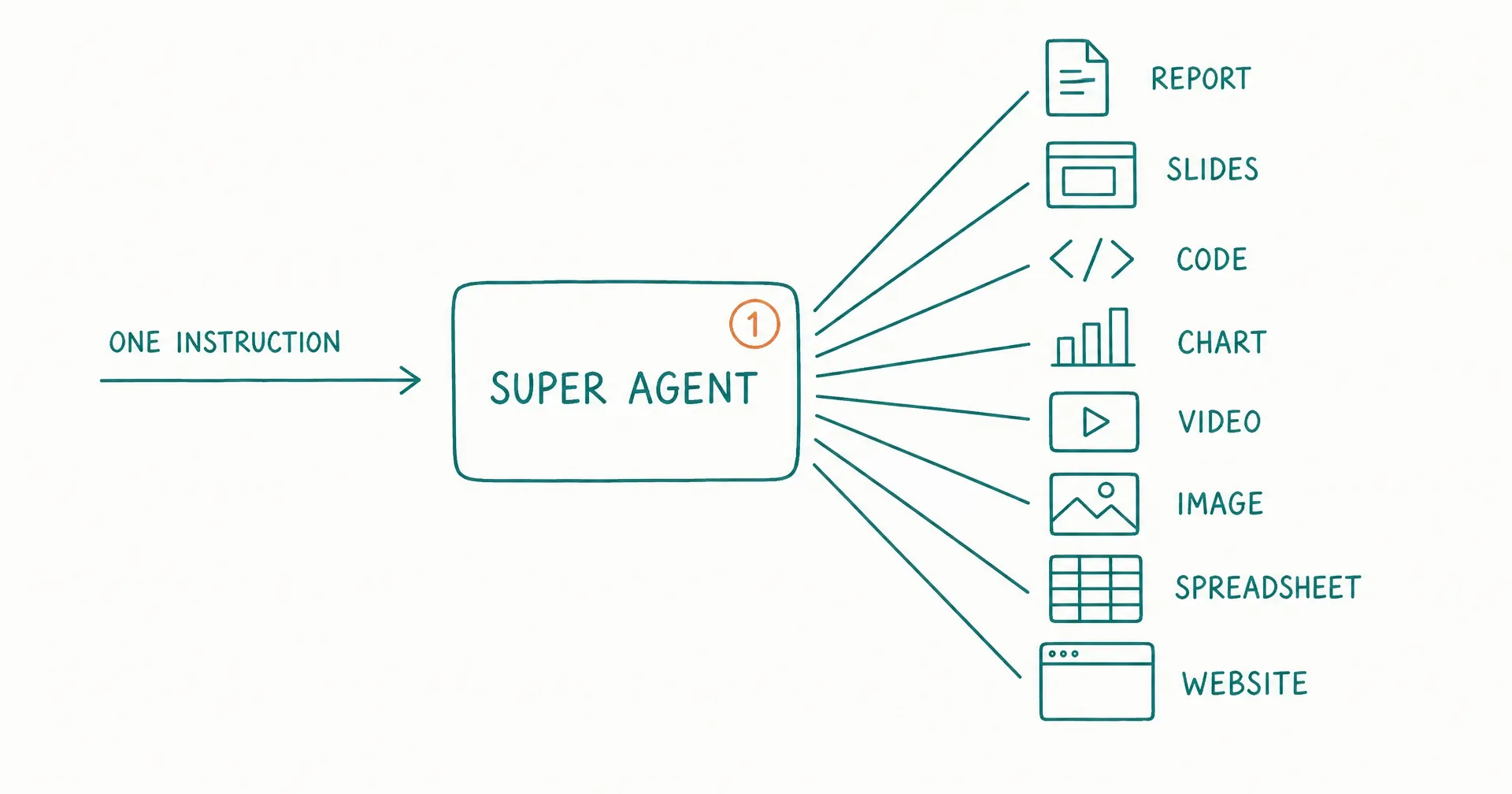
“Super agent” is the label the market settled on for one kind of product: you give it a goal, and it comes back with finished work. Not a chat answer, not a code diff, not a workflow you assembled. A report with sources, a deck, a working site, a spreadsheet, a video. Manus made the label famous in early 2026, Genspark put its own product name on it, and by September the biggest labs are shipping into the same space: Perplexity with Computer, OpenAI with ChatGPT Work, Anthropic with Cowork, Google with Gemini Spark.
This page is our October 2026 ranking of that category, re-ranked on the first of every month at this same URL. Every price below was read off the vendor’s own pricing page on October 1 in a real browser, or is dated to our last verified check where a page would not render one. And one thing said plainly before the table: we build one of these products, and we rank it first. A vendor at the top of its own list is worth exactly the evidence under it, so every claim about ourselves is dated and linked or attributed to a user report. Check them, then discount us as you see fit.
On this page · 8 sectionsOpen
- A super agent takes one goal and carries it through planning, tool use, artifact production and verification inside one loop; the test is finished work, not a feature list.
- Our October 2026 ranking: CellCog first on breadth and standing roles, Genspark for the widest set of polished deliverables, Manus for open-ended delegation on a cloud computer, Perplexity Computer for cited research. We publish this page and rank ourselves first, so check the receipts.
- Every price here was read off the vendor’s own pricing page on October 1, 2026, or is dated to our last check; credit-based plans (Manus, Genspark, Flowith) are not comparable per credit, only per outcome.
- The category moved in late September: Manus launched Manus 2.0 and Cue (September 28), OpenAI added a $500 Pro tier with faster ChatGPT Work and launched dots (September 29), and Meta opened Muse to small businesses (September 29).
- Coding-only agents (Claude Code, Codex, Cursor, Devin) are ranked on our harness page, not here; standing workers with inboxes and schedules are ranked on our AI employee page. This page is the layer between them.
- Pick by the deliverable you need most: slides and phone calls, cited research, open-ended delegation, or the whole range plus a worker that keeps the job.
§ 01What a super agent is, and what this page does not rank
A super agent carries one goal through planning, tool use (browser, terminal, files, APIs), media handling, artifact production, verification and recovery inside one execution loop. The test is whether the capabilities work together on a complete task, not how long the feature list is.
That definition draws two lines. Autonomous coding agents (Claude Code, Codex CLI, Cursor, Devin) produce one kind of output superbly and are ranked on our harness page. Standing workers that own a role between sessions, with their own inbox, task board and schedule, are the layer above and are ranked on our AI employee platforms page. This page is the middle layer: general agents you hand a task to.
§ 02The super agent rankings, October 2026
| Rank | Agent | Price today | Deliverables it produces natively | Best for |
|---|---|---|---|---|
| 1 | CellCog | Plans from $8/mo; usage-based; you pay for the work, not the hire | Research, code, dashboards, spreadsheets, PDFs, video, images, web apps | The full range of work, and roles that persist (our product; conflict declared below) |
| 2 | Genspark Super Agent | Free (100 daily credits); Plus from 10,000 credits/mo, Pro from 125,000, individual tiers priced at checkout; Team $30/seat/mo at our September 3 read | Research, slides, docs, sites, code, images, video, voice and phone calls | The widest set of polished office deliverables in one workspace |
| 3 | Manus | Free (300 daily credits); 4,000 / 8,000 / 40,000 credits per month tiers ($20 and $40 for the first two at our August 23 check) | Research, documents, slides, sites, code, data analysis, browser tasks | Handing off one open-ended task to a cloud computer |
| 4 | Perplexity Computer | Bundled into Perplexity Pro ($20/mo) and Max ($200/mo) at our September 3 read; Portable Computer needs a DGX Spark ($4,699) | Cited research, reports, browsing, spreadsheets, code, connector tasks | Research you have to be able to source, and private data on your own hardware |
| 5 | ChatGPT Work | Included in paid ChatGPT plans from $20/mo (not Free or Go) | Research reports, documents, spreadsheets, presentations, code, browser tasks | Office deliverables inside a subscription you already pay for |
| 6 | Claude Cowork | Claude Pro $20/mo, Max $100 and $200/mo; not on the Free plan | Documents, reports, file and folder work, code via Claude Code, computer tasks | Knowledge work on your own files, with Anthropic’s models |
| 7 | Gemini Spark | Google AI Pro $19.99/mo; AI Ultra $99.99 (5x limits) and $199.99/mo (20x) | Research, docs, spreadsheets, code, images, video via Veo, Google-app actions | A personal agent inside the Google ecosystem |
| 8 | Flowith | Free; Pro $19.90/mo, Ultimate $49.90, Infinite $499.90 | Canvas workflows, research, writing, images and media, presentations | Visual, multi-model workflows for creators |
We publish this ranking and we are in it, at the top. That is a conflict of interest, so the next section is written to be audited rather than believed, and the caveats at the foot of this page apply to us hardest.
The reasoning, briefly. CellCog takes the top slot on breadth: it is the only entry whose deliverable can be a research report, a dashboard, a spreadsheet, a PDF, a film or a working web app from the same agent, and the only one that extends upward into standing AI employees. Genspark is second because its deliverable set is the widest of the pure super agents, phone calls included, in one hosted workspace. Manus holds third on the thing it does best: you hand it an open-ended task and its cloud computer runs it to completion; it slips below Genspark on the credit-burn and reliability complaints our Manus alternatives page documents. Perplexity Computer is fourth as the best research-and-citations agent, and the only one you can now run entirely locally. ChatGPT Work and Claude Cowork are the big-lab entries: excellent office work inside subscriptions many readers already pay for, no native video, sessions rather than standing workers. Gemini Spark is the most promising personal agent for anyone living in Google’s apps. Flowith rounds out the table for creators who think in canvases.
Two products sit just outside the table on purpose. SpaceXAI’s Grok Bot is an always-on teammate, which makes it an AI employee competitor rather than a task agent; it is ranked on that page. OpenClaw is a free, self-hosted agent runtime rather than a hosted product; it appears on the harness page’s runtime layer and in the Manus alternatives. OpenAI’s dots and Meta’s Muse for small business, both launched September 29, are always-on personal agents rather than task agents, so they sit with Grok Bot on that side of the line for now.
§ 03Where CellCog stands, angle by angle
Here is the audit trail for the top row.
| Angle | Where we stand | The receipt |
|---|---|---|
| Deliverable range | Research, code, dashboards, spreadsheets, PDFs, video, images, web apps from one agent | The only entry here that produces video natively; users rate it above Gemini and ChatGPT for image and video work |
| Deep research | #1 on Deep Research Bench (July 2026); second on the GPT-5.5-judged tab as of October 1 | Public leaderboard, linked below |
| Models inside | Every tier on Claude Opus 5.5; Core and Max since its September 22 release day (Fable 5.1 from September 1) | Day-one posts linked below |
| Depth control | Agent, Agent Creative and Agent Team, each at Flash, Core or Max | Pick speed, everyday depth or maximum reasoning per task |
| Persistence | Extends into AI employees: inbox, task board, schedule, memory that carries from one day to the next | Our own company runs on them |
| Cost | Plans from $8 a month; usage-based | Pay for the work, not the hire: the cost depends purely on how much work you assign |
The research claim is the easiest to audit. cellcog-max ranked #1 on Deep Research Bench (July 2026), a public leaderboard. As of October 1, its GPT-5.5-judged tab lists cellcog-max second, at 55.78 to the leader’s 55.99, and we would rather you read that here than find it yourself. Our breakdown lives on the benchmarks page.
The deliverable-range claim is the one that decides most super agent choices, and it is not close: no other entry on this page generates video. CellCog ships it natively alongside images, PDFs, spreadsheets, dashboards and full web apps, from the same agent that writes the code and the research. Users coming from dedicated generators tell us the video output beats tools built for nothing else, and rate it above Gemini and ChatGPT for image and video work. Treat that the way you treat any vendor-relayed user report, then run your own task.
The models inside are the newest receipt: Core and Max tiers moved to Claude Opus 5.5 on September 22, the day Anthropic shipped it, after Fable 5.1 on September 1; every tier, Flash included, now runs on Opus 5.5, with no change to what users pay.
§ 04The other seven, briefly
Genspark Super Agent. The closest thing to a like-for-like general agent, and the one to read as your real number one if slides, sites and calls are your main output. Its membership page describes a Free plan with 100 daily credits, Plus tiers from 10,000 credits a month and Pro tiers from 125,000, with individual dollar prices chosen at checkout and annual billing about 20 percent cheaper; Team is $30 a seat. The caveat travels with the credit model: per-task burn is hard to predict.
Manus. The product that defined the category. On September 28 it launched Manus 2.0: a new harness Manus says cut run cost 32% in one tested setup, a desktop Studio with video and game editors, and Cue, personal agents in early access. Its pricing page still shows 300 daily refresh credits and an 8,000-credit tier on October 1; the dollar figures render as an animation we could not read, so the $20 and $40 from our August 23 check remain our last confirmed prices. The strength is real: hand it an open-ended task and it runs on its own machine until done. The weaknesses are documented in our Manus alternatives page: unpredictable credit consumption, reliability that fades on large projects, and the August 2026 data deletion for certain users during the separation from Meta.
Perplexity Computer. The best research agent for work you must be able to source, built on Perplexity’s answer engine and bundled into Pro and Max. On August 25 Perplexity shipped Portable Computer, the same agent running locally on an NVIDIA DGX Spark: private data stays on the device, local steps cost no credits. Our full read: Perplexity Portable Computer.
ChatGPT Work. Replaced Agent mode in July 2026 and turned ChatGPT’s paid plans into a credible office-deliverable agent: research reports, spreadsheets, presentations, documents. Included from Plus at $20 a month, not on Free or Go. At DevDay on September 29 OpenAI added Pro 500 at $500 a month, with Astra Ultrafast in Work and Codex. No native video; a session tool, not a standing worker.
Claude Cowork. Anthropic’s knowledge-work agent for your own files and folders, on Pro at $20 and Max at $100 or $200 a month, not on the Free plan (pricing). Anthropic’s release notes for September 1 opened computer access to Pro and Max subscribers. Coding runs through Claude Code, which we rank second on the harness page.
Gemini Spark. Google’s personal agent, positioned to act across your Google apps around the clock, on Google AI Pro at $19.99 and Ultra at $99.99 or $199.99. Video comes from Veo, research from Search. The bet is ecosystem depth rather than deliverable breadth.
Flowith. A visual canvas where agents run as nodes, at Free, Pro $19.90, Ultimate $49.90 and Infinite $499.90 a month. It turned on MiniMax H3 for video on September 3. Best for creators who want to see the workflow, not just the result.
§ 05What changed since September
| Date | Event | Why it matters |
|---|---|---|
| Sep 22 | CellCog moves Core and Max to Claude Opus 5.5 | Frontier model swapped in on release day; Flash tiers followed |
| Sep 28 | Manus 2.0 and Cue | New harness, desktop Studio, personal agents in early access |
| Sep 29 | ChatGPT Pro 500 at DevDay | $500 a month, Astra Ultrafast in ChatGPT Work |
| Sep 29 | OpenAI dots | OpenAI’s always-on personal agents |
| Sep 29 | Muse for small business (Meta) | Skills and connectors for running a small business |
The pattern: the independents are adding personal agents with their own identities (Manus Cue), and the labs are adding always-on agents beside their task agents (OpenAI dots, Meta Muse). Both point at the standing-worker layer above this page. The model-layer half of the story is on the harness rankings: Opus 5.5, GPT-6.1 Sol and Gemini 4 Argon all landed in the second half of September.
October 9 update on Cue. Manus’s Cue, launched with Manus 2.0 on September 28, gives each personal agent its own email, phone number, wallet and computer, the computer depending on availability per Manus’s Google Play listing. It needs an invite code and is free in early access; the phone-number subscription is sold separately at a price Manus has not published. Manus keeps its rank on its task agent; Cue is covered in our Cue explainer and, for teams of agents, in the multi-agent platform rankings.
§ 06How to choose
- You need slides, sites or documents most days: Genspark, or CellCog if you also need dashboards, video or a worker that keeps the job.
- You want to hand off one big task and walk away: Manus, with a budget for credits; or CellCog’s Agent Team at Max depth for the high-stakes version.
- You must be able to source every claim: Perplexity Computer; Portable Computer if the data cannot leave your building.
- You already pay for ChatGPT or Claude: try Work or Cowork before adding a subscription; neither will make you a video.
- The work recurs without you: you have left this page’s category. Hire at the employee layer; our 12-point evaluation framework is the long version.
§ 07The honest caveats
Credits are not comparable across products: a Manus credit, a Genspark credit and a Flowith credit buy different amounts of work, and per-task burn is the most common complaint in this category. Prices in this space move weekly; ours were read on October 1, except Manus’s dollar tiers (dated to an August 23 check because the live page animates its prices) and Perplexity’s Pro and Max and Genspark’s Team seat (dated to our September 3 read because their pages showed no plain price on October 1). Every capability claim about a competitor is the vendor’s own until independent tests accumulate. And we are a participant here, not a referee: treat our self-placement with the skepticism you would apply to any vendor, check the receipts we linked, including the one where we are currently second, and run your own task. We re-rank this page on the first of every month because the half-life of any ranking here is measured in weeks.
§ 08Update log
- October 9, 2026: Cue by Manus details added under What changed, with links to the Cue explainer and the multi-agent rankings. No rank changed.
- October 1, 2026: October edition. Prices re-read on vendor pages (Claude, ChatGPT, Gemini, Flowith, Genspark plans unchanged; three dated reads noted); Manus 2.0, ChatGPT Pro 500, OpenAI dots and Muse for small business added; CellCog model receipt updated (every tier on Opus 5.5). No rank changed.
- September 24, 2026: The title no longer carries the month; the ranking is still re-checked on the first of every month at this URL, and the date above says when.
- September 3, 2026: First edition.
Q1What counts as a super agent, and what does not?
It counts if one product takes a goal and returns finished work across several kinds of output: research, documents, slides, code, data, media, browser tasks. It does not count if the output is one kind only. Claude Code, Codex, Cursor and Devin are autonomous coding agents and belong on our harness ranking. Lovable, Bolt and Replit build apps. Lindy and 11x are workflow or sales specialists. Grok Bot and CellCog’s AI employees are standing workers, which is the layer above this page; CellCog appears here because the same agent also runs as a session tool.
Q2How does CellCog compare to Manus and Genspark?
CellCog is our product, so weigh the source. The checkable parts as of October 1, 2026: it produces the widest deliverable set on this page (research, code, dashboards, spreadsheets, PDFs, video, images and full web apps from one agent), its research engine ranked #1 on Deep Research Bench in July 2026 and sits second on that leaderboard’s GPT-5.5-judged tab today, and it is the only entry here that extends into standing AI employees with inboxes, task boards and memory that carries. Manus is the stronger pick for handing off one open-ended task to a cloud computer and walking away; Genspark is the stronger pick if slides, sites and phone calls are the deliverables you produce most. Both run on credit systems whose per-task burn is hard to predict; CellCog is usage-based, plans from $8 a month; you pay for the work, not the hire, and the cost depends purely on how much work you assign.
Q3Is Manus still a safe choice after the Meta separation?
It works, and Manus 2.0 (September 28) added a new harness, a desktop Studio and Cue personal agents; its pricing page still lists 300 daily refresh credits and credit tiers. The August 2026 data deletion for certain users during its separation from Meta, plus long-standing complaints about credit burn on long tasks, are why Manus alternatives is one of the most searched queries in this category. Our full read is on the Manus alternatives page.
Q4What is the difference between Perplexity Computer and Portable Computer?
Computer is Perplexity’s cloud agent, bundled into paid Perplexity plans. Portable Computer, launched August 25, 2026, runs the same agent locally on an NVIDIA DGX Spark ($4,699 at NVIDIA’s marketplace when we checked): private data stays on the device, local work consumes no credits, and cloud escalation needs your permission.
Q5Do ChatGPT and Claude count as super agents now?
Increasingly. ChatGPT Work replaced Agent mode in July 2026 and produces documents, spreadsheets, presentations and research reports inside paid ChatGPT plans from $20 a month. Claude Cowork works from your files and folders, and Anthropic’s September 1 release notes opened computer access to Pro and Max subscribers. Neither natively produces video, and both are session tools rather than standing workers.
Q6How were these rankings researched?
Prices were read off each vendor’s live pricing page on October 1, 2026, using a real browser, or are dated to our most recent verified check in the text. Product claims come from vendor documentation and release notes linked inline. The research pass was run with CellCog Max, the deep research engine ranked #1 on Deep Research Bench (July 2026). This page is re-ranked on the first of every month at the same URL.