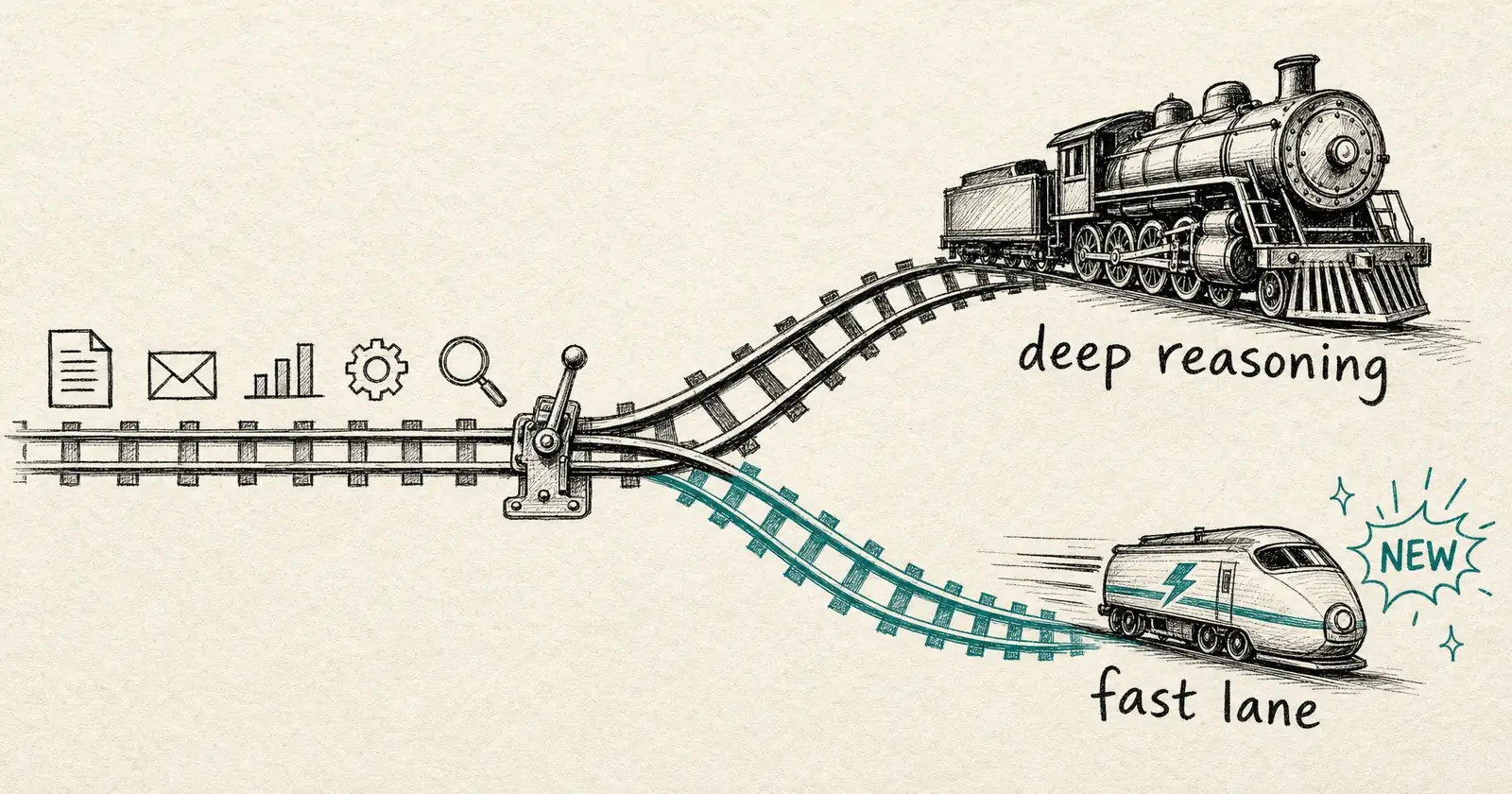
CellCog’s smart routing now includes Gemini 3.7 Flash - adopted the day Google shipped it. Not every job needs a frontier model. CellCog routes each piece of work to the right class of model: deep reasoning goes to frontier models, and fast, high-volume work goes to Flash-class models. On August 13, 2026, Google released Gemini 3.7 Flash, and CellCog’s fast lane upgraded to it the same day.
You don’t need to change anything. There is no model picker and no migration step. Jobs that belong on the fast lane simply run on a newer, more capable, and - for now - cheaper model.
- CellCog smart-routes every job to the right class of model: deep reasoning goes to frontier models, fast high-volume work goes to Flash-class models.
- On August 13, 2026 - the day Google released it - the fast lane upgraded from Gemini 3.6 Flash to Gemini 3.7 Flash.
- Google’s introductory pricing halves the fast lane’s cost through December 31, 2026; standard rates apply after that.
- Google positions 3.7 Flash as its most capable Flash model yet for coding and agentic workflows, and we raised its thinking effort to Google’s recommended setting.
- Nothing changes on your side: no model picker, no migration step, no settings. Jobs that belong on the fast lane simply run on a newer, cheaper model.
- Deep reasoning still runs on frontier models - the fast lane exists so that lighter work never pays frontier prices.
§ 01What Gemini 3.7 Flash Is
Gemini 3.7 Flash is Google’s newest Flash-class model, released August 13, 2026. Google describes it as its most capable workhorse model yet for coding and agentic workflows, with better instruction-following and stronger multi-step execution than its predecessor, on the same 1M-token context window.
Google is also launching it at an introductory price: half the previous Flash rate through December 31, 2026, with standard rates applying from January 1, 2027. That matters for the fast lane, because the fast lane’s entire reason to exist is doing lighter work at lighter prices.
§ 02Why CellCog Routes Between Models
A single model for everything forces a bad trade. Use a frontier model for every job and you pay frontier prices to summarize a document. Use a fast model for every job and your hardest work gets under-thought.
Smart routing removes the trade. CellCog’s primary reasoning runs on Anthropic’s Fable 5 - the model our AI employees are built around, as covered in that update. Around it, the router sends fast, high-volume work to a Flash-class lane where speed and cost matter more than maximum reasoning depth. Each job gets the right brain.
Today’s change upgrades the engine on that fast lane, not the architecture. Fable 5 remains the brain; the fast lane just got newer and cheaper.
§ 03What Changed Under the Hood
Three things, all invisible unless you look for them:
- The fast lane’s model moved from Gemini 3.6 Flash to Gemini 3.7 Flash, verified on our infrastructure before the switch.
- Thinking effort went up. Google’s guidance for 3.7 Flash recommends a higher reasoning setting for agentic work than the previous generation’s guidance did, and the fast lane now uses it. Slightly more deliberate, still fast.
- Costs went down. Fast-lane work now runs at Google’s introductory rate through the end of 2026.
§ 04The Honest Caveats
The introductory pricing is Google’s, not ours, and it ends December 31, 2026 - from January 1, 2027 the standard rate applies, which returns roughly to what the previous model cost. Google has published guidance and positioning for 3.7 Flash but not yet a full benchmark table; when it does, the numbers will be Google’s to stand behind. What we can stand behind is our own bar: the fast lane only upgrades when the new model is a drop-in successor we have verified ourselves, with the previous model one switch away as a fallback.
The fast lane got a new engine today. Your chats and your AI employees are already using it.
Q1What is Gemini 3.7 Flash?
Google’s newest Flash-class model, released August 13, 2026. Google describes it as its most capable workhorse model for coding and agentic workflows, with the same 1M-token context window as its predecessor.
Q2Does CellCog run on Gemini now?
No. CellCog’s primary reasoning runs on Anthropic’s Fable 5, as covered in our Fable 5 update. Gemini 3.7 Flash powers the fast lane: the class of work where speed and cost matter more than maximum reasoning depth. Smart routing decides which lane each job belongs in.
Q3Why route between models at all?
One model for everything means either overpaying for simple work or under-thinking hard work. Routing gives each job the right brain: frontier reasoning where it earns its cost, Flash speed where it doesn’t have to.
Q4Will this change my costs?
Fast-lane work now runs at Google’s introductory rate, which is half the previous price through December 31, 2026. From January 1, 2027 Google’s standard rates apply, which return roughly to what the previous model cost. Heavy reasoning work is priced as before.
Q5Why upgrade on day one?
The fast lane is exactly where day-one upgrades are safest: 3.7 Flash is a drop-in successor with the same context window and API surface as 3.6 Flash. We verified it on our infrastructure before switching, and the previous model remains available as an instant fallback.