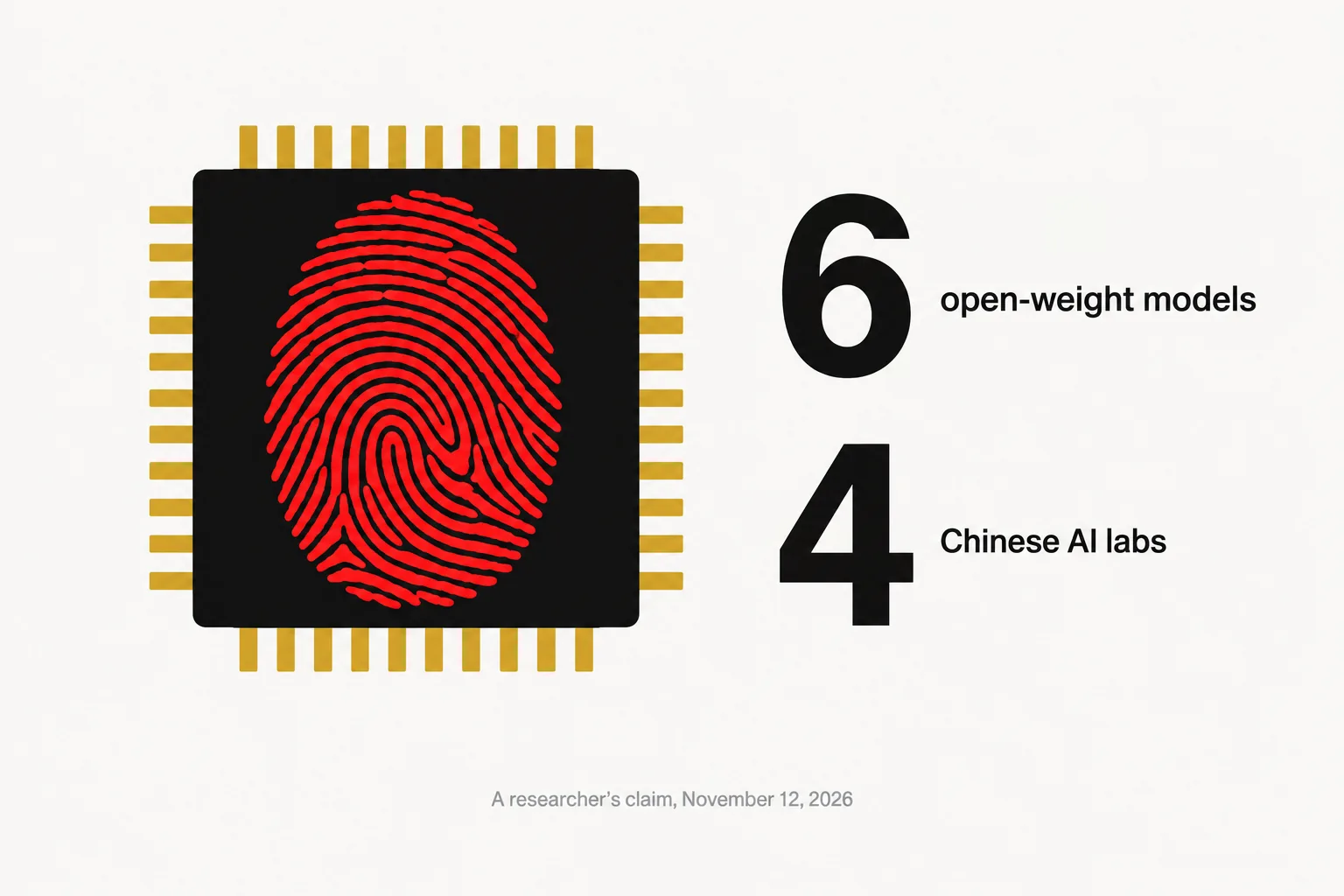
A report published on November 12, 2026 says six open-weight models from four Chinese AI labs were started on Nvidia Blackwell chips, which the report says need a US license for export to China. The author is Will DePue of Unemployment Labs, whose X profile says he previously worked at OpenAI. The labs are DeepSeek, Moonshot AI, MiniMax and Ant Group.
This post is read from DePue’s thread on X and his report, both fetched on November 12, 2026. We ran none of his tests and cannot confirm the result. No code has been published yet. Everything below is his account unless we say otherwise.
On this page · 9 sectionsOpen
 A report by Will DePue, published November 12, 2026, says six open-weight models from DeepSeek, Moonshot AI, MiniMax and Ant Group were started on Nvidia Blackwell chips.
 The method reads the starting values left in published weights. The same seed lays them out differently on chips with 132, 148 or 152 processor units.
 The report says a Blackwell B300 reproduced DeepSeek-V4-Flash’s untouched starting weights and a Hopper H100 did not. Its summary names a hardware check for two of the six.
 The report says the weights cannot show who owned the chips or where they were, and that it does not establish a breach of export controls.
 No code is public yet. DePue says a repository and a full paper will follow, and that researchers at OpenAI and Anthropic verified the result. The report names no verifier.
§ 01What the report claims
- The post. DePue posted the result on X at 21:29 UTC on November 12. The post had about 533,000 views when we read it at 22:49 UTC.
- The claim. The report says six models released since April 2026 “contain numerical patterns matching Blackwell hardware”, while earlier models from the same labs match Nvidia’s older Hopper generation.
- The evidence. It comes from the weights the labs published themselves. The report says it uses no leaks and no insider accounts.
- Other labs. The report says the newest models it could read from Alibaba, Zhipu, Tencent, Xiaomi and StepFun match Hopper.
| Lab | Model | Weights posted | Chip class matched | Strength the report gives |
|---|---|---|---|---|
| DeepSeek | DeepSeek-V4-Flash | April 2026 | Blackwell B200 or B300 | 1,385 sigma |
| DeepSeek | DeepSeek-V4-Pro | April 2026 | Blackwell GB200 or GB300 | 49 sigma |
| Moonshot AI | Kimi K3 | July 2026 | Blackwell GB200 or GB300 | 305 sigma |
| Moonshot AI | Kimi K3.1-Pro | November 2026 | Blackwell GB200 or GB300 | 305 sigma |
| MiniMax | MiniMax-M3 | June 2026 | Blackwell B200 or B300 | 323 sigma |
| Ant Group | Ling-3.1-flash | October 2026 | Blackwell GB200 or GB300 | 244 sigma |
Sigma is the report’s measure of how far a match stands above chance. It says the best chance match across its whole search would reach about 8 sigma.
Two notes on the table. The report says Kimi K3.1-Pro starts from the same seed as Kimi K3 and may be K3 with further training. And it dates each model by when its weights were posted: our own page on Kimi K3.1 records that Moonshot released that model on October 23 and its weights on November 4.
§ 02How the method works
- Starting values. Before training, a model’s weights are filled with numbers from a random number generator. The generator starts from one number, the seed. The same seed gives the same numbers every time.
- The layout. PyTorch splits that job across many parallel threads on the GPU, and the number of threads depends on how many processor units the chip has. DePue’s thread says: “Hopper has 132, Blackwell has 148 and Grace Blackwell has 152.”
- Why the chip shows. The same seed therefore puts the same numbers in different positions on each chip class.
- What survives. Training changes most weights. DePue’s thread says some are never touched and the rest still correlate with where they started.
- The search. Pick a seed and a chip layout, generate the starting values, and compare them with the published weights. The report says it searched roughly 6 trillion combinations.

§ 03What was checked on real hardware
- DeepSeek-V4-Flash. The report says a Blackwell B300 running unmodified PyTorch with the seed 953049583 reproduced 461 of 469 selected rows of the model’s weights, 445 of them bit for bit.
- The control. A Hopper H100 with the same seed reproduced DeepSeek-V3’s preserved values and none of V4-Flash’s rows. Changing the seed by one reproduced nothing on either machine.
- Kimi K3. A rented GB200 reproduced all 13 of the model’s preserved rows with the seed 20256586.
- Two of six. The report’s summary says the match was confirmed on physical Blackwell chips for DeepSeek-V4-Flash and Kimi K3. It names no other model there.
- Known answers. For 24 models whose developers have named their hardware, the report says its reading agrees each time. It calls this “a consistency check rather than a measured accuracy rate”.
§ 04What the report says it cannot show
- Where the chips are. The report says: “The weights also cannot reveal who owned the chips or where they were located.”
- Rented abroad. It adds: “Blackwell systems can be rented from data centers outside China.”
- No finding of a violation. Of its own evidence, the report says “it does not establish that chips were smuggled into China or that an export-control violation occurred”.
- The start, not the whole run. In its words: “The method identifies the hardware that generated the starting weights, not every chip that later helped train the model.”
- An AMD alternative. The report says an AMD MI300X limited to 152 or 148 of its processing units reproduces the same layouts. A second test excludes AMD for DeepSeek-V4-Flash. For the rest, its words are “consider it very unlikely for the other five models”, which is not the same as excluded.
- Models it cannot read. Closed models have no published weights. Some frameworks leave no pattern. The report found no fingerprint in DeepSeek-V4.1-Flash.
§ 05Where the thread goes further than the report
- Conclusive, in the thread. The thread opens: “I’ve found conclusive forensic evidence that the top 4 Chinese AI labs”.
- Conclusive, in the report. Its conclusion calls the evidence strong for the six models and says “for DeepSeek-V4-Flash the evidence is conclusive”.
- Started on, or trained on. The thread says the labs built their newest models on Blackwell. The report says the fingerprint “supports, without proving, the inference that Blackwell also performed the training”.
- Export rules. A reply in the thread says “it’s clear that the export bans are deeply failing”. The report makes no finding that a rule was broken.
- Who verified it. The thread says “it has been independently verified by senior researchers at OpenAI and Anthropic”. The report names no outside verifier. We did not look for a statement from either company.
- Code. Another reply says: “I’ll be sharing a GitHub repo and full paper soon with implementation details”. Until then, nobody outside can re-run the search from his code.
§ 06The scale estimate
The report estimates how many Blackwell GPUs each training run needed. It assumes each model was trained on the hardware that started it, which the report itself says is not proven.
| Model | Best estimate | Range |
|---|---|---|
| DeepSeek-V4-Flash | 1,000 to 1,500 | 250 to 4,500 |
| DeepSeek-V4-Pro | 2,000 to 2,500 | 750 to 6,000 |
| Kimi K3 | 2,000 to 3,000 | 1,000 to 8,000 |
| MiniMax-M3 | 500 to 600 | 200 to 2,000 |
| Ling-3.1-flash | 1,100 to 1,650 | 400 to 6,500 |
The ranges are wide. The report prices a Blackwell GPU at roughly $70,000, puts the largest clusters at $150 million to $200 million, and the five together at more than half a billion dollars. These are its estimates, not measurements.
§ 07What we did not check
- We ran none of the tests and downloaded no model weights.
- We read the report’s summary, findings, limits, verification and conclusion sections. We did not read all of its method section or its second appendix, look at its figures, or open the sources it cites, including the US export rule.
- One search of X at 22:41 UTC found no post since the thread from accounts of Nvidia, DeepSeek, Moonshot, MiniMax or Ant Group. We guessed the account names, and we did not check the companies’ own sites.
- We do not know whether any of the four labs holds a license, or where any of these chips are.
§ 08Where CellCog sits
CellCog is our product, an AI employee platform. Its agents run on Anthropic’s Claude models, and it runs none of the six models in the report. Two things a reader should know. Anthropic, whose researchers DePue says verified the result, is our model provider. And our Privacy Policy names MiniMax as the provider of our speech and voice cloning models, through fal.ai. The MiniMax model in the report’s Table 1 is MiniMax-M3, a language model. OpenAI, where DePue’s profile says he worked, makes the image model behind this page’s pictures.
§ 09Sources
- Will DePue: Top Chinese Frontier AI Models Carry the Fingerprint of Export-Controlled NVIDIA Blackwell GPUs, Unemployment Labs, November 12, 2026, read at 22:42 UTC that day.
- Will DePue: thread on X, November 12, 2026, 21:29 UTC.
- CellCog: Privacy Policy, for the MiniMax line.
Q1What did Will DePue's report find?
It says six open-weight models from four Chinese labs carry number patterns that match Nvidia Blackwell chips, while earlier models from the same labs match the older Hopper generation. The evidence is read from the published weights.
Q2Which models does the report name?
DeepSeek-V4-Flash and DeepSeek-V4-Pro, Moonshot AI’s Kimi K3 and Kimi K3.1-Pro, MiniMax-M3, and Ant Group’s Ling-3.1-flash.
Q3Does the report prove that export controls were broken?
No. The report says the weights cannot reveal who owned the chips or where they were located, that Blackwell systems can be rented outside China, and that its evidence does not establish a violation.
Q4How does the fingerprint method work?
A model’s starting weights come from a seeded random number generator. PyTorch lays those numbers out across a number of threads that depends on the chip, so the same seed gives a different layout on Hopper, Blackwell and Grace Blackwell.
Q5Has anyone else confirmed the result?
DePue says senior researchers at OpenAI and Anthropic verified it. The report names no outside verifier, and the code is not public yet. We have not confirmed it ourselves.
Q6Does CellCog use any of these models?
No. CellCog’s agents run on Anthropic’s Claude models. Our Privacy Policy names MiniMax as the provider of our speech and voice cloning models through fal.ai, which is separate from MiniMax-M3.