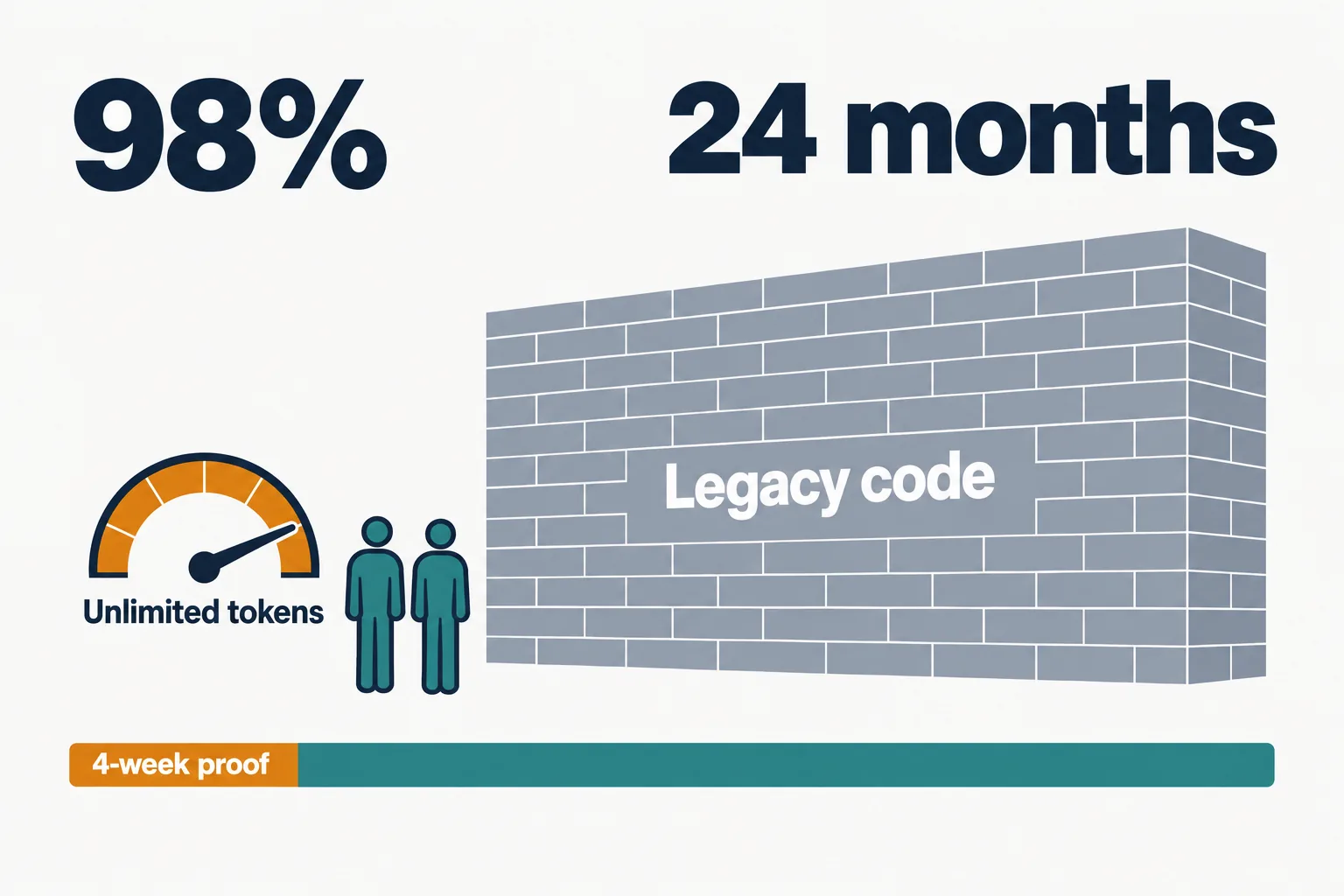
Cisco has handed one of its largest engineering jobs to a two-person team. Jeetu Patel, Cisco’s president and chief product officer, told Fortune he gave Padmanabhan Krishnamurthy, 27, unlimited AI tokens for the work: “I’ve given him unlimited tokens because he’s going to refactor code.” The goal Fortune reported is 98% of Cisco’s legacy code within 24 months, with a four-week window to prove the approach first.
Fortune’s story, by Orianna Rosa Royle, ran on October 30, 2026 at 3:00 a.m. ET. A post summarizing it passed 2.7 million views on X the same day, and Tom’s Hardware followed hours later. We found no post from Cisco or Patel about the project since.
 Cisco president Jeetu Patel gave engineer Padmanabhan Krishnamurthy, 27, unlimited AI tokens to refactor Cisco’s legacy code, Fortune reported on October 30, 2026.
 The goal is 98% of Cisco’s legacy code within 24 months, with a four-week window to prove the approach first.
 Krishnamurthy says a two-person team can do it; he joined Cisco when it bought his translation startup EzDubs in 2025.
 Fortune does not name the AI tools, the size of the codebase or how the new code will be checked.
 Anthropic’s Rust rewrite of its Messages API shows the missing detail: a pure port checked against live traffic before moving over.
§ 01What Cisco is betting on

| Item | What was reported |
|---|---|
| Who leads it | Padmanabhan Krishnamurthy, 27, a former startup founder |
| Team | Two people |
| AI budget | Unlimited tokens |
| Proof window | Four weeks |
| Goal | Refactor 98% of Cisco’s legacy code |
| Deadline | 24 months |
| Who set it up | Jeetu Patel, president and chief product officer |
Krishnamurthy joined Cisco in 2025, when it bought EzDubs, the real-time translation startup he cofounded. Cisco announced the deal on its Webex blog in November 2025 and said the EzDubs team would join Cisco Collaboration.
Patel told Fortune he found him five levels below him in the org chart, “buried away in the organization doing something unstrategic.” The two got talking during a visit to Cisco’s San Francisco office, where Krishnamurthy said he could rewrite Cisco’s legacy code with a two-person team. Fortune reports that even the most AI-forward people on Patel’s own team were not thinking that way. Patel’s answer, in his words: “So I’m like, you can go, you can go nuts.”
§ 02What the report leaves out

The story is about a bet, not a result. Fortune describes a goal and a proof window; it does not report any code rewritten yet. It also leaves out the facts an engineer would ask for first.
| Missing fact | Why it matters |
|---|---|
| Which AI tools or models | Agent harnesses differ in how they test and review code |
| How big the codebase is | 98% of an unknown number of lines |
| How results are checked | Tests, side-by-side runs or code review decide whether a port is safe |
| What passes the four-week proof | A target nobody outside can judge |
| Which systems go first | Customer-facing code carries different risk from internal tools |
None of these gaps means the plan is unsound. They mean the public record cannot yet say whether it is working.
§ 03How a documented AI rewrite looks
A useful comparison landed the same week. Anthropic’s engineers said on the Latent Space podcast that Claude wrote a Rust version of Claude’s Messages API, which is now fully rolled out. They described the method: a pure port with no new features, a full Rust fork, and copies of real traffic run through both systems so the outputs could be compared before any traffic moved. Humans designed the system and verified it; Claude wrote the code.
That is the shape of detail the Cisco story does not have yet: what the agent writes, what the humans own, and how anyone knows the new code does what the old code did.
§ 04Why Patel is doing it this way
Fortune frames the project as a hiring argument as much as an engineering one. Patel wants young hires who will “challenge the system and the status quo,” and he accepts the friction that brings. He told Fortune he wants that friction on purpose.
“Tension is good,” Patel said.
His reason: “I actually try to create tension in the teams because you want to have enough friction on the ideas.”
The bet pairs that view with a budget decision. Instead of staffing a large team for a multi-year modernization, Cisco is funding model usage without a cap and asking two people to show, within four weeks, that the approach holds.
§ 05What it means for teams with old code
For most companies the question is no longer whether an AI agent can write the code, but who checks it. A small team with a large model budget can move fast on a port, as long as three things are settled before the first commit: a definition of done for each system, a way to compare new output against old output, and a person who owns the rollback.
CellCog’s AI employees run on Claude Opus 5.5. An AI software engineer can write and port code with tests while your engineers keep the design and the review, which is the same split Anthropic described for its own rewrite.
Q1Who is rewriting Cisco's legacy code?
Padmanabhan Krishnamurthy, 27, a former founder who joined Cisco when it bought his startup EzDubs. Cisco president Jeetu Patel gave him the project, per Fortune.
Q2How long does Cisco's AI rewrite take?
The goal is 98% of Cisco’s legacy code within 24 months, with a four-week window first to prove the approach works.
Q3Which AI tools is Cisco using for the rewrite?
Fortune does not say. The report names unlimited AI tokens as the budget but no model, coding agent or vendor.
Q4How will Cisco check the rewritten code?
The report does not say. Fortune describes the goal, the team and the deadline, but no testing or verification method.
Q5Has anyone done a documented AI rewrite of production code?
Anthropic says Claude wrote a Rust port of its Messages API, checked against copies of real traffic before rollout, cutting CPU 40 to 50 percent by its engineers’ estimate.