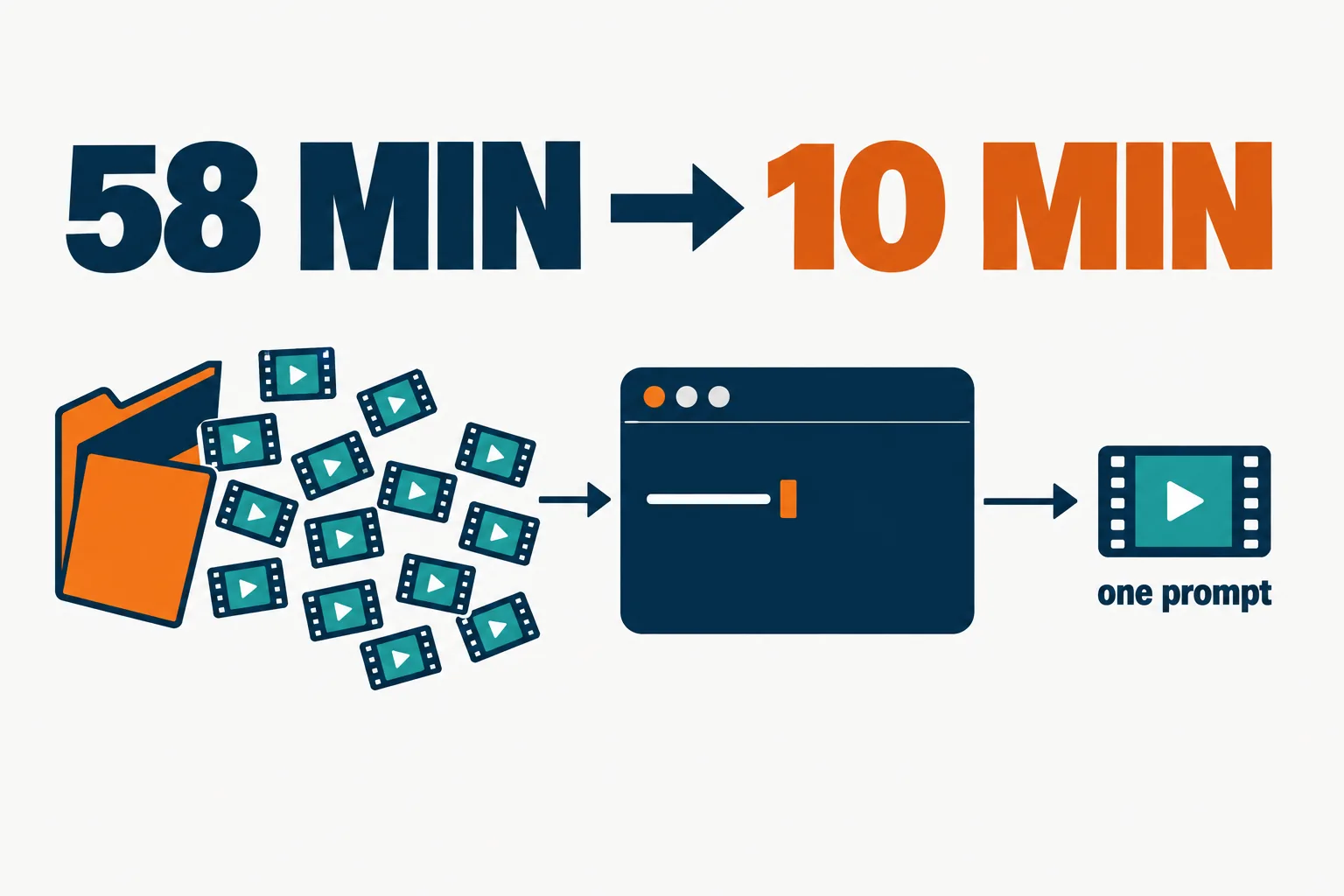
On November 1, 2026 Pieter Levels (@levelsio) posted that his vlog that day was “fully edited by Claude Code with Opus 5.5”. He copied the clips from his DJI camera into a folder, opened Claude Code there and asked for a 10 minute vlog. Claude Code picked its own tools: speech transcription, frame grids, voice matching, a cut list in JSON. In a reply he put numbers on it: 58 minutes of footage across 14 clips, cut to about 10.
The post passed 54,000 views within two and a half hours. It is one creator’s report, not an Anthropic feature, and every tool in it is open source and checkable.
On this page · 8 sectionsOpen
 On November 1, 2026 Pieter Levels said his vlog was fully edited by Claude Code with Opus 5.5, from one request: a 10 minute vlog for X and YouTube.
 Claude Code chose its own tools: mlx-whisper to transcribe, frame grids to see the footage, SpeechBrain ECAPA to find his voice.
 It looked at contact sheets of frames every few seconds instead of watching the whole hour.
 The edit itself is a JSON list of cuts (clip, start, end) that a script renders, so a person can read and change it.
 58 minutes of footage across 14 clips became about 10 minutes, on his MacBook, with a few adjustments from him.
§ 01What he asked for, and what came back

The whole request, in his words: “Claude can you edit these clips into a 10 minute vlog for X and YouTube”. Then the part that made the post travel: “I didn’t ask for any of this, and I didn’t know any of this until @thesamparr just asked me how I edited it”. Sam Parr had asked about his edit process 26 minutes earlier, and Levels answered with the list of what Claude Code had done on its own.
His own share of the work was small: “I made a few adjustments but not a lot”. And his reason for caring: without AI editing he would not be vlogging, because editing is slow for him and hiring an editor would be more hassle still.
§ 02The pipeline Claude Code built
| Step | Tool | What it did |
|---|---|---|
| Transcribe | mlx-whisper, Whisper large-v3-turbo on the MacBook’s GPU | Turned everything he said into text |
| See the footage | Frame grids (contact sheets) every few seconds | Let the model look at what is in each clip |
| Find his voice | SpeechBrain ECAPA voice matching | Told his voice apart from other people’s |
| Pick the cuts | Claude, reading transcripts and grids | Wrote a JSON list: clip, start time, end time |
| Thumbnails | OpenCV with the YuNet face detector | Found frames with a face for thumbnails |
| Captions | Pillow, Python’s image library | On-screen captions for X and YouTube’s first minute |
Every tool is public: mlx-whisper runs OpenAI’s Whisper on Apple silicon through Apple’s MLX, SpeechBrain’s ECAPA model turns a voice into a vector you can compare, and YuNet is a small face detector that ships with OpenCV. His post words the caption step as “I added”, so that one may have been his request; the P.S. covers the rest.
§ 03The numbers
| Footage | Minutes |
|---|---|
| Raw clips (14 files) | 58 |
| Finished vlog | 10 |
“Yep, it cut a lot, it was like 58 minutes of video across 14 clips, edited to ~10 minutes!” That is about 48 of 58 minutes cut, roughly 83% of the footage, chosen by a model reading transcripts and looking at grids of frames.
§ 04Why the JSON cut list is the clever part
The model never edits pixels. It writes an edit decision list: which clip, where to start, where to stop. A script then renders the video from that list. That split is what makes the result usable. The list is short enough to read, a person can change one line and render again, and the same footage gives the same cut every time the list is run.
The frame grids do the same job for vision. Claude does not watch an hour of video; it looks at a handful of contact-sheet images per clip and matches them against the transcript. The voice matcher answers a question a transcript cannot: who was talking. Each tool hands the model something small it can reason about.
§ 05What the post does not show
- One vlog, self-reported. The raw footage is not public, so nobody can compare the cut against the material.
- A Mac with Apple silicon. mlx-whisper runs on Apple’s MLX; other machines need a different Whisper build.
- Some human touch. He made “a few adjustments”, and the caption step may have been his ask.
- Guests are harder. A reply from @emot, who did the same with an interview, noted that “for remote recording with guests, Riverside still beats what I build with Opus 5.5.”
- Not a product. Claude Code wrote and ran scripts that call open-source tools. Anthropic has not shipped a video editor.
§ 06How to try the same thing
- Put the clips in one folder and open Claude Code in it.
- Ask for the outcome, length and destination, the way he did, and let it choose tools.
- Ask it to save the cut list as a file, so you can read and change it before the render.
- Check the first render at the cut points: a cut in the middle of a word is the usual miss.
- Keep the originals. The cut list points at them; nothing needs to be overwritten.
§ 07Where CellCog stands
CellCog runs every tier on Claude Opus 5.5, the model in his post. Our agents work in their own computer with the same kind of tools: speech transcription with word timestamps, video cutting and music under speech. The difference is the job around the model: an employee that keeps the brief, the style and the channel rules, instead of a fresh terminal each time.
§ 08Sources
- X: @levelsio, November 1, 2026, 18:23 UTC and his reply with the footage numbers; @thesamparr’s question. Read directly; times from the post ids.
- mlx-whisper on PyPI and the MLX Whisper example.
- SpeechBrain, ECAPA speaker recognition model.
- OpenCV Zoo, YuNet face detector.
Q1Can Claude Code edit video?
It can write and run scripts that do. In Pieter Levels’ case it transcribed the audio, built frame grids, matched voices and wrote a JSON list of cuts that a script rendered into a vlog.
Q2What did Claude Code use to transcribe the audio?
mlx-whisper, running Whisper large-v3-turbo on the MacBook Pro’s GPU through Apple’s MLX, according to his post.
Q3How much footage did it cut?
About 58 minutes across 14 clips, edited to roughly 10 minutes, per his reply on November 1, 2026.
Q4Do I need a Mac to do this?
For mlx-whisper, yes, it runs on Apple silicon. On other machines you would ask Claude Code to use a different Whisper build.
Q5Did he edit anything himself?
A little. He wrote that he made a few adjustments but not a lot, and his post words the caption step as something he added.