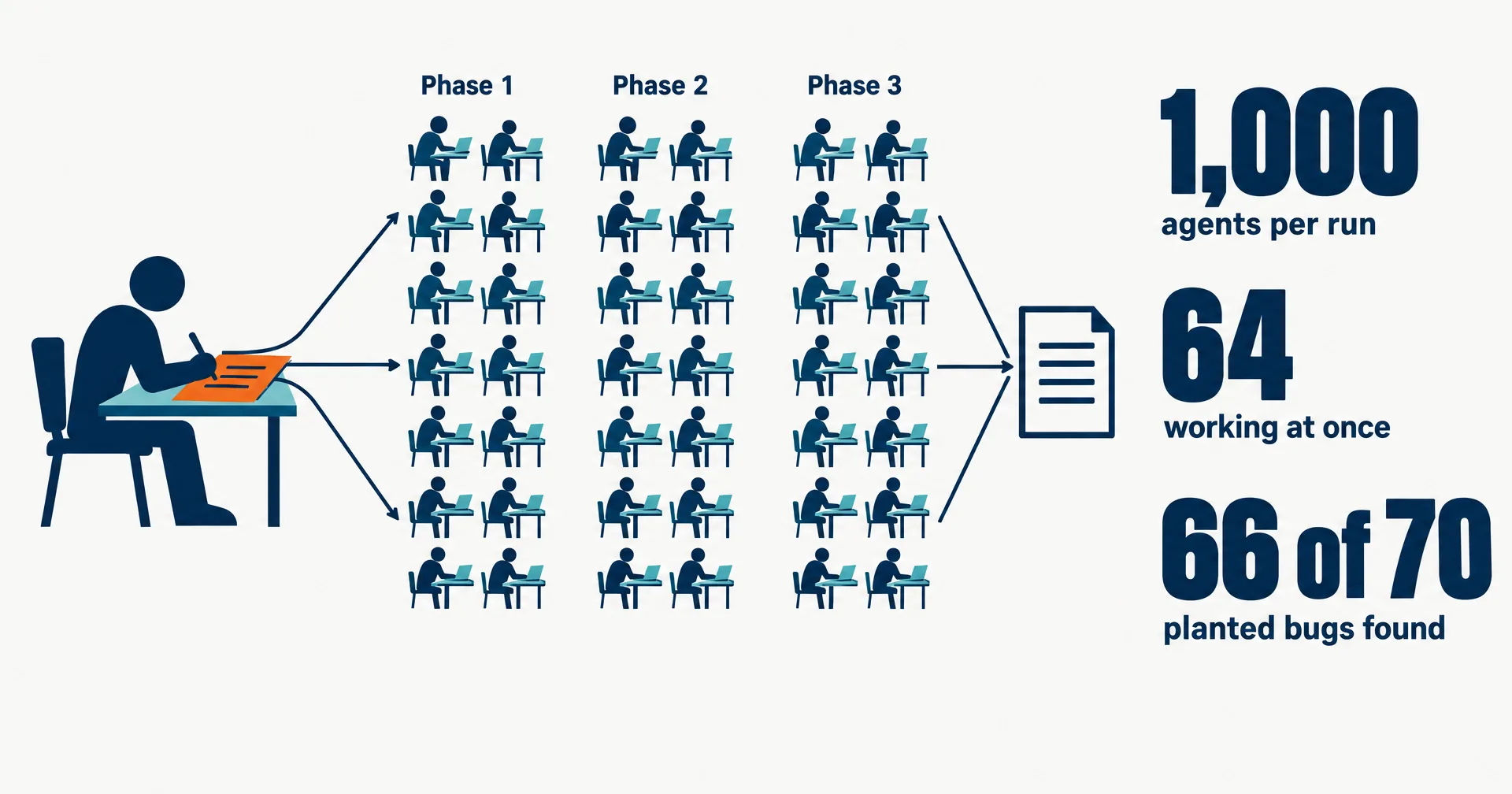
Anthropic made dynamic workflows for Claude Managed Agents available in public beta on October 9, 2026: an agent can now write a workflow, a program that runs up to 1,000 agents in phases and combines what they return, while Anthropic’s server runs it in the background. The release notes put it in one line: “A workflow is a program that runs many agents in phases and combines their results.” The launch thread from @ClaudeDevs went up at 16:12 UTC. This page reads the release notes, the workflow runs and multi-agent orchestration docs and the pricing page, all as of 16:34 UTC the same day.
On this page · 7 sectionsOpen
 Anthropic put dynamic workflows for Claude Managed Agents into public beta on October 9, 2026: an agent writes a program that runs many agents in phases and combines their results, and the server runs it in the background.
 A run can start up to 1,000 agents over its life, with up to 64 working at once, a 24-hour default lifetime and up to 10 runs open per session by default.
 Anthropic’s own test: with 70 bugs planted in a 116k-line codebase, a single agent found 14, 15 and 27 across three runs, and a workflow found 66 in each of its three runs.
 A run has no price of its own: its agents’ tokens bill at each model’s rates, plus Managed Agents session runtime at $0.08 per session-hour, and a session budget can cap the spend.
 The agent decides when to start a run from your message or system prompt, and once a run starts the agent cannot send follow-up messages to its threads.
§ 01What a workflow is
Managed Agents already let one agent hand tasks to subagents and read their reports. A workflow is the second mode. The orchestration guide draws the line: “With dynamic workflows, Claude writes a program to orchestrate agents without Claude’s direct involvement.” Results pass from one agent to the next inside the program, and the main thread stays free to talk to the user.
You do not start a run with an API call. You describe the work, and the agent decides whether and when to start one; Anthropic tells you to guide that choice in the system prompt. A run is divided into named phases, its agents can work at the same time, and you follow it through workflow_run.* events on the session stream. The trade is control: “The agent can’t send follow-up messages to a run’s threads, and the server archives each one by the end of its run.”
§ 02The limits
| Limit | Value |
|---|---|
| Agents a workflow starts over a run’s life | 1,000 |
| Agents working at once in one run | 64, not guaranteed |
| Run lifetime | 24 hours by default, or shorter if the agent sets it |
| Runs open at once in a session | 10 by default |
| Predefined agents a workflow can list | Up to 20 |
The 1,000 cap is on agents started, not threads: the server can rerun a failed agent on a new thread, so the doc notes that a run can end up with more than 1,000 threads. Going over the cap ends the run with a thread limit error.
§ 03Anthropic’s bug test
Anthropic’s evidence is one internal test, posted in the launch thread: “We planted 70 bugs in a 116k-line codebase. Across 3 runs, a single agent found 14, 15 and 27 bugs. A workflow consistently found 66 in each of its 3 runs.”
The spread matters as much as the top number: the single agent varied almost twofold across runs, while the workflow returned the same count three times. It is still Anthropic’s test on Anthropic’s codebase, with no cost figure attached; independent runs are the next thing to watch.
§ 04What it costs
“A run has no price of its own,” the doc says. Its agents’ tokens bill like the rest of the session, at each model’s rates, and Managed Agents adds session runtime at $0.08 per session-hour, counted only while the session is running. A session budget is the brake: when the session’s list cost reaches it, every open run pauses, and each working agent finishes the request it already started, so a run can pass the budget by one request per agent.
Anthropic’s own advice in the thread: “Dynamic workflows are powerful and can use a lot of tokens, so we suggest starting with a scoped task.”
§ 05What this means for teams of agents
Our conflict, declared: we build CellCog, where AI employees work in teams with managers and an org chart, and we rank the field on our multi-agent platform page. Dynamic workflows solve a different problem from ours, and solve it well: one large job, cut into hundreds of pieces, finished in hours, then archived. Nous Research’s 1,393-agent refactor and Vals AI’s ten Claude agents in Lean were the same shape, built by hand; Anthropic now ships it as a platform feature.
An AI employee is the other shape: a role that persists, with its own inbox, task board and memory, that wakes for the next piece of work tomorrow. The two fit together. A workflow is a strong way to finish a big task; someone still has to own the role that keeps creating tasks.
§ 06What we are watching
- Independent results. A second team’s numbers on cost and quality against a single agent.
- General availability. The feature ships under the
managed-agents-2026-04-01beta header; GA terms and any limit changes come next. - The 64-agent figure. Anthropic says it can change; a published guarantee would matter for anyone planning around it.
§ 07Sources
- Anthropic, Claude Platform release notes, October 9, 2026 entry.
- Anthropic, Workflow runs and Multi-agent orchestration, read 16:34 UTC October 9, 2026.
- Anthropic, Pricing: Claude Managed Agents and Budgets.
- @ClaudeDevs, launch thread, October 9, 2026, 16:12 UTC (time from the post ID).
Q1How do you turn on dynamic workflows?
Set the agent’s multiagent type to multiagent_20261001 with the managed-agents-2026-04-01 beta header. Workflows are on by default with that type; you then tell the agent, in its system prompt or your message, when to start a run.
Q2How is a workflow different from subagents?
With subagents, the agent delegates tasks and can send each one follow-up messages. With a workflow, the agent writes a program that runs agents in phases without its direct involvement, and it cannot message a run’s threads once the run starts.
Q3Can a workflow run out of control on cost?
Anthropic warns that workflows can use a lot of tokens and suggests starting with a scoped task. A session budget caps spend: at the budget every open run pauses, and raising or removing the budget resumes it.
Q4Which models can a workflow use?
Inline agents use the model of the agent that runs the session. To give some agents another model, create them as agents and list them in the workflow’s predefined agents, up to 20.
Q5Is this related to CellCog?
CellCog runs on Claude Opus 5.5 but does not use Managed Agents workflows. We build AI employees that work in teams, so we follow how labs ship multi-agent orchestration.